Shanxi Strengthens Medical Device Oversight; Vascular Intervention 'Little Giant' HuaMai Tech Advances IPO on Beijing Stock Exchange

Medtronic
Medical Device Manufacturer

Percutek Therapeutics
Developer of Minimally Invasive Cardiovascular Treatment Devices

Integrated Medical News
1. Shanxi Further Strengthens Provincial Supervision over the Operation and Use of Medical Devices
Recently, the Shanxi Provincial Drug Administration convened a meeting on risk assessment for medical devices, proposing to strengthen supervision over the distribution and use of medical devices across the province. The meeting reported on current risks in the distribution and use stages, analyzed regulatory shortcomings, and deployed tasks for the next phase: All localities are required to focus on key priorities, strictly uphold safety baselines, and concentrate on key areas such as volume-based procurement (VBP) selected products and myopia prevention and control among adolescents. They must establish risk ledgers to ensure closed-loop risk management; intensify supervisory inspections, severely crack down on illegal activities such as unlicensed operations, and create a deterrent effect by exposing typical cases; further consolidate territorial regulatory responsibilities and corporate primary responsibilities, build a collaborative regulatory framework, and strengthen professional training for grassroots regulatory personnel to enhance their ability to identify and handle risks, thereby providing a solid guarantee for promoting standardized and orderly development in the distribution and use of medical devices throughout the province. (Sina.com)
2. Price reductions for 41 types of medical consumables to be completed by the end of the month
Recently, the Inner Mongolia Pharmaceutical Procurement Center issued a notice requiring enterprises to voluntarily reduce the listed prices of certain medical consumables. This initiative covers 41 types of products, including embolic protection devices and implantable single-chamber cardioverter defibrillators, involving 74 domestic and international medical device manufacturers such as Medtronic, Abbott, and Boston Scientific. Enterprises are required to proactively review their product prices and submit price reduction applications via the [Online Service System] – [Price Adjustment] section of the Inner Mongolia Autonomous Region Pharmaceutical Procurement Center between June 24 and June 30. Required documents include the Business Acceptance Form and the Legal Representative’s Authorization Letter, among others. Failure to complete the price reduction declaration as required within the specified timeframe will result in the suspension of the product’s listing eligibility. This notice was issued in accordance with the work arrangements outlined in relevant correspondence from the Department of Medical Insurance Prices and Tendering and Procurement of the National Healthcare Security Administration. (Medical Device Distributors Alliance)
3. AI Agent Physicians Outperform Human Doctors in Disease Management
Recently, Google DeepMind and Google Research published a study in Nature introducing AMIE (Articulate Medical Intelligence Explorer), a medical AI system based on large language models. By integrating an empathetic conversational agent with a managerial reasoning agent, the system demonstrates performance comparable to or even superior to that of human physicians in managing diseases across multiple consultations. Leveraging the long-context capabilities of Google’s Gemini large language model, AMIE combines contextual retrieval with structured reasoning to ensure its outputs align with the latest clinical practice guidelines and drug formularies. In a randomized, blinded virtual Objective Structured Clinical Examination (OSCE) study, AMIE was compared with 21 primary care physicians. It performed non-inferiorly in overall management decisions and achieved higher scores in the precision of treatments and tests, as well as in consistency with and adherence to clinical guidelines. This study highlights AMIE’s significant potential in managing diseases over multiple visits. (Bio World)
4. Vascular Intervention “Little Giant” Shifts Focus to BSE IPO
Recently, Percutek Therapeutics’ IPO on the Beijing Stock Exchange (BSE) has entered the review process. As a national-level “Little Giant” enterprise specializing in specialized, refined, distinctive, and innovative technologies within the field of vascular disease treatment, its path to capitalization has been fraught with challenges. After terminating its STAR Market IPO application in 2022, the company has now shifted its focus to the BSE. Financially, Percutek Therapeutics turned profitable in 2024 and saw its profits double in 2025. The company plans to issue no more than 24 million shares (or no more than 27.6 million shares if the over-allotment option is fully exercised), with the proceeds earmarked for expanding a new production base for high-end medical devices, constructing an R&D center, and supplementing working capital. Its listing pace on the NEEQ was tight, taking only about one year from listing to the issuance of the sponsorship letter. The company chose to list under the BSE criterion requiring a market capitalization of no less than RMB 1.5 billion and cumulative R&D investment of no less than RMB 50 million over the past two years. Its combined R&D expenses for 2024 and 2025 exceeded RMB 100 million, far surpassing the threshold. (Xin Weilai)
5. The Drug Administration of the Tibet Autonomous Region Issued the "Administrative Measures for the Supervision of Production, Operation, and Use of Medical Oxygen in the Tibet Autonomous Region"
Recently, the Tibet Drug Administration issued the "Administrative Measures for the Supervision of Production, Operation, and Use of Medical Oxygen," which clarifies management requirements for all stages including production, sales, application, storage, and transportation of medical oxygen. It explicitly states that these measures apply to all activities related to the production, operation, and use of medical oxygen within the autonomous region. The document specifies that medical oxygen refers to oxygen listed in the "Pharmacopoeia of the People's Republic of China," with related products including medical oxygen cylinders. Medical oxygen and its associated products possess triple attributes as pharmaceuticals, hazardous chemicals, and special equipment, thus subjecting them to a tripartite collaborative regulatory framework. Procuring liquid medical oxygen for gasification, filling, and repackaging is considered pharmaceutical production behavior and requires obtaining a "Drug Production License" (Type A). Although processes such as liquid-to-liquid repackaging of medical oxygen do not constitute pharmaceutical production, they must still comply with relevant regulations and remain under supervision. (Tibet Autonomous Region Drug Administration)
6. Singapore Launches National Special Program
Recently, the National Research Foundation of Singapore launched a national-level special initiative on AI for Science, unveiling eight projects with a total investment of SGD 120 million. The projects span five strategic domains, including biomedical and health sciences. Key highlighted initiatives include: Nanyang Technological University collaborating with Kyoto University to develop the MOITAI platform for regulating energy carrier transport; the National University of Singapore leading the development of the MultiOmicsFM large model to integrate and interpret multi-omics data; establishing a Materials Data Foundry platform to build a comprehensive database of material synthesis, bridging the gap to industrial-scale preparation; the Agency for Science, Technology and Research (A*STAR) spearheading the development of a collaborative AI agent system to optimize mRNA vaccine R&D; and developing a foundational large model for surface science to accurately predict high-performance catalytic candidate materials, thereby reducing screening cycles and R&D costs. (Zhiyaoju)
7. R&D and Design Services Accelerate the Clinical Translation of Medical Research Achievements
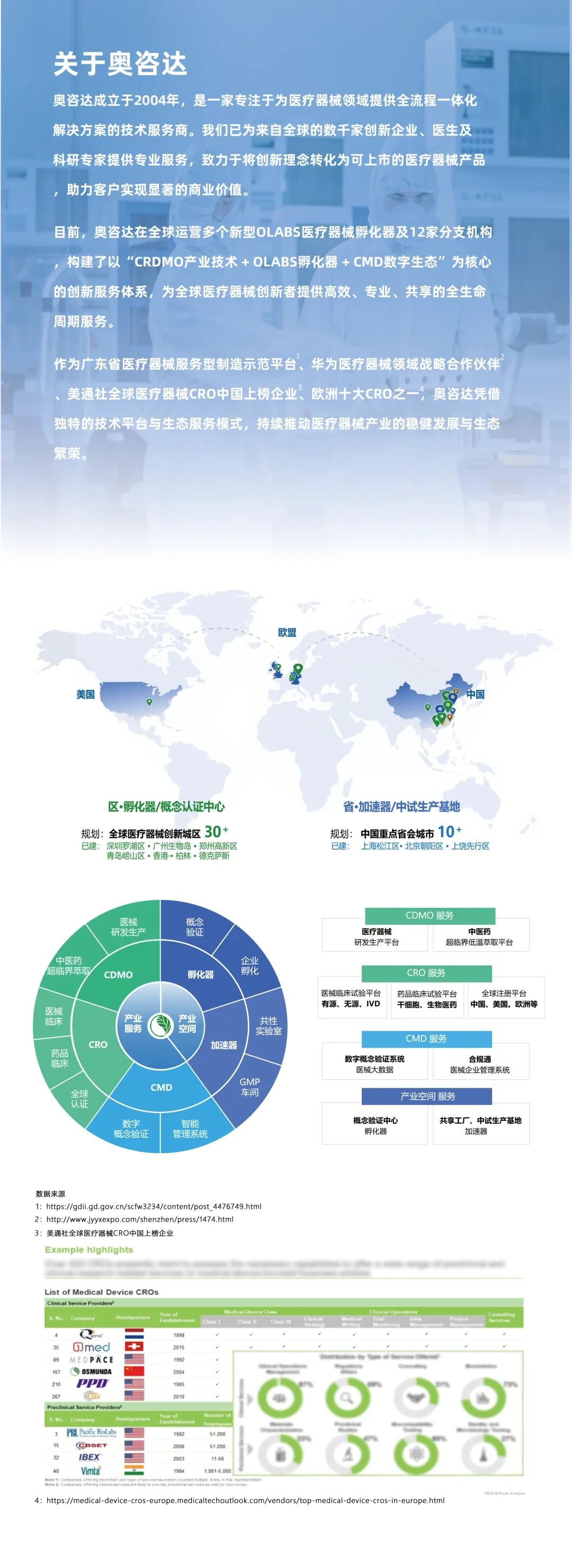
Medical device R&D is a complex and rigorous process involving multiple aspects, including technology, regulations, and clinical applications. Osida boasts a 20,000-square-meter science and innovation center and has established a Medical Device Research Institute dedicated to the clinical translation of medical research achievements. It possesses a high-level, international, multidisciplinary team proficient in the entire lifecycle of R&D, regulatory affairs, clinical trials, registration, and manufacturing, capable of developing and producing various complex and innovative products. With extensive project experience and industry resources, Osida has built a standardized, regulated, and digitalized full-process service system. It provides one-stop services ranging from preliminary market research, product concept generation, and product design and development to prototype production and testing. To date, more than 200 projects have entered the review stage at Osida, with over 100 projects under development, achieving a 100% translation success rate. (Compiled by Osida)
8. Xiaorou Group Completes Nearly RMB 100 Million in Series A Strategic Financing
Recently, Anhui Xiaorou Health Technology Group Co., Ltd. officially completed its Series A strategic financing round of nearly RMB 100 million, with joint strategic investment from Qiji Capital, a well-known innovative drug investment institution, and Yangzijiang Pharmaceutical Group. The funds raised in this round will be entirely used for the nationwide large-scale replication of its out-of-hospital market business model, iterative upgrades of its AI-driven growth system, and the development of a professional talent pipeline. These efforts aim to continuously strengthen the company’s core competitiveness and consolidate its leading position in the AI-powered out-of-hospital medical growth services sector. Xiaorou Group has already established operations in Jiangsu and Shaanxi provinces, while simultaneously advancing its presence in cities across China, including Heilongjiang, Anhui, and Beijing. The company has formed deep collaborations with top-tier (Grade III Class A) hospitals in various regions, steadily promoting localized smart healthcare operations and bridging the “last mile” in the delivery of medical services. (VentureBeat)