

Shanghai Biotech EpimAb, With Over $2.1 Billion in Licensing Deals, Refiles for HKEX Listing

EpimAb Biotherapeutics
Developer of Tumor Bispecific Antibodies
In 2026, China's innovative drug global expansion entered deeper waters. As license-out deals became the norm, companies with genuine platform value began to emerge.
EpimAb Biotherapeutics is precisely such a company. On June 24, 2026, the decade-old bispecific antibody developer once again filed its prospectus with the Hong Kong Stock Exchange, seeking a listing under Chapter 18A. CITIC Securities and CMB International served as joint sponsors. The company had previously filed on December 19, 2025.
Unlike most biotech companies rushing to list on the Hong Kong Stock Exchange, EpimAb Biotherapeutics has taken a more challenging path from the outset—building its own technology platform rather than simply in-licensing pipelines. All eight of its drug candidates, four of which have entered clinical trials, were discovered internally.
This endogenous capability is becoming the core variable in capital's repricing.
1TCE Is Not Just for Oncology: Autoimmune Diseases Are the Next Breakout Area
In 2014, Amgen's blinatumomab (Blincyto) was approved for the treatment of acute lymphoblastic leukemia, pioneering the T-cell engager (TCE) therapeutic class. For many years thereafter, TCE-based bispecific antibodies remained largely confined to hematologic malignancies, struggling to overcome the barriers associated with solid tumors.
It was not until around 2022 that the industry began to realize that the value of TCEs lies not only in oncology—they may hold even greater explosive potential in the field of autoimmune diseases.
The core logic lies in the fact that the root cause of diseases such as systemic lupus erythematosus, myasthenia gravis, and thyroid eye disease is B cells mistakenly attacking self-tissues. TCE can precisely eliminate B cells expressing specific antigens, effectively unlocking two markets with a single key.
EpimAb Biotherapeutics is an early mover in this trend.
Upon its establishment in 2015, EpimAb Biotherapeutics had a clear strategy: to build a pipeline covering oncology and autoimmune diseases centered around its bispecific antibody technology.
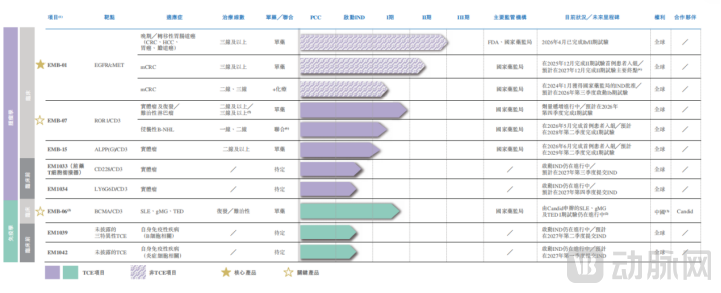
(Image source: Prospectus)
By 2024, EpimAb Biotherapeutics' EMB-06 had entered into a collaboration with Candid Therapeutics, whereby the latter assumed responsibility for the global development (excluding China) of EMB-06 for autoimmune indications, in a deal with a potential value of up to $635 million.
This timing is noteworthy.
2024 marked the year when global MNCs made significant strides in deploying autoimmune TCEs. Sanofi, AbbVie, and Johnson & Johnson sequentially placed their bets in this field. EpimAb Biotherapeutics completed a licensing deal at the bottom of the cycle, locking in certainty while retaining rights to the Chinese market.
2EMB-01: What Gives It the Confidence to Bet on Colorectal Cancer?
EpimAb Biotherapeutics' core product, EMB-01, targets both EGFR and cMET, and is one of the first EGFR/cMET bispecific antibodies globally to enter Phase II clinical trials for colorectal cancer.
Why Colorectal Cancer?
EGFR is a critical therapeutic target in colorectal cancer, but monotherapy with EGFR antibodies (such as cetuximab) faces the challenge of drug resistance. One mechanism of resistance is the activation of the cMET pathway, whereby tumor cells upregulate cMET to bypass EGFR blockade. Theoretically, simultaneous dual-target blockade of both pathways can address this issue.
More importantly, the choice of third-line treatment implies a market strategy. Patients with colorectal cancer at the third line and beyond have typically already undergone standard first- and second-line treatments, leaving limited therapeutic options and a significant unmet medical need. For innovative therapies like EMB-01, entering the market at the third-line setting allows for faster accumulation of clinical data, while laying the foundation for subsequent expansion into second- and first-line treatments.
The Phase II monotherapy trial of EMB-01 in the third-line setting completed enrollment of the first patient in December 2025, with the primary endpoint expected to be reached by December 2027. Meanwhile, the Phase Ib trial combining EMB-01 with chemotherapy in the second- and third-line settings is advancing, having received Investigational New Drug (IND) approval from the National Medical Products Administration (NMPA), and is anticipated to launch in the third quarter of 2026.
From a competitive landscape perspective, no EGFR/cMET bispecific antibodies have been approved globally for the treatment of colorectal cancer. Johnson & Johnson's amivantamab has been approved for non-small cell lung cancer, with its colorectal cancer indication currently in Phase III trials; Betta Pharmaceuticals' MCLA-129 is in Phase II trials in China; and Novatim Immune Therapeutics' KY-0301 is in Phase I/II trials in China. EpimAb Biotherapeutics holds a leading position in terms of development progress.
3Dual-Platform Engine: Plug-and-Play, Reducing Toxicity and Enhancing Efficacy
To understand EpimAb, one must understand its technology platform.
EpimAb possesses four proprietary technology platforms: FIT-Ig, MAT-Fab, T-FIT, and Pro-TCE. The first two are the core.
FIT-Ig (Tandem Fab Immunoglobulin) is EpimAb's flagship platform and currently the only bispecific antibody technology worldwide that requires no amino acid mutations and does not rely on linker peptides or non-antibody sequences. Traditional bispecific antibody development faces two major challenges: chain mispairing (incorrect pairing of heavy and light chains) and immunogenicity risk. FIT-Ig fundamentally avoids these issues through its unique structural design.
It is worth emphasizing that FIT-Ig is a "plug-and-play" platform. By simply inserting the variable region sequences of two monoclonal antibodies into the FIT-Ig framework, a new bispecific candidate molecule can be generated in an average of four to six weeks. This speed advantage means that EpimAb Biotherapeutics can validate more target combinations in a shorter period of time.
Both EMB-01 and EMB-06 were developed on the FIT-Ig platform, and both molecules have entered clinical development, fully validating the technical feasibility of the platform.
MAT-Fab complements FIT-Ig, focusing on the field of T-cell engagers. Unlike the tetravalent structure of FIT-Ig, MAT-Fab adopts a monovalent asymmetric design that includes an Fc region but binds to each target with monovalent affinity. This design addresses a core challenge in the TCE domain: cytokine release syndrome (CRS).
Traditional TCEs (such as Amgen's blinatumomab), due to their bivalent binding to CD3, are prone to causing excessive T-cell activation and triggering CRS. The monovalent design of MAT-Fab reduces this risk while retaining the extended half-life conferred by the Fc region. Whereas blinatumomab requires continuous intravenous infusion due to its short half-life, MAT-Fab molecules can be administered via subcutaneous injection or less frequent intravenous dosing.
Both EMB-07 and EMB-15 are developed based on the MAT-Fab platform. EMB-07, targeting ROR1/CD3, completed the enrollment of its first patient in May 2026 for a Phase I study evaluating its use in combination with R-CHOP as first-line therapy for aggressive B-cell non-Hodgkin lymphoma (B-NHL).
Synergy exists among the four platforms: FIT-Ig is suitable for scenarios requiring simultaneous blockade of two signaling pathways (e.g., EMB-01); MAT-Fab is suited for scenarios requiring precise control of T-cell activation (e.g., EMB-07); T-FIT extends the target scope to intracellular antigens (e.g., KRAS mutations); and Pro-TCE further reduces off-target toxicity through prodrug design.
The flexibility of platform combinations is the core differentiator that distinguishes EpimAb Biotherapeutics from single-target, in-license biotech companies.
4The Two "Lives" of EMB-06
The story of EMB‑06: a tale of strategic choices.
Prior to 2024, the primary indication for EMB-06 was multiple myeloma (MM). This choice is hardly surprising—BCMA has emerged as a star target in MM therapy. The successive approvals of Legend Biotech's Carvykti (a BCMA CAR-T therapy) and Johnson & Johnson's Tecvayli (a BCMA/CD3 bispecific antibody) have validated the commercial value of this target.
However, in 2024, EpimAb Biotherapeutics made a key decision: to license the rights for EMB-06's autoimmune indications to Candid.
This is not an easy decision.
The oncology market is larger but also more competitive. Although the patient base in the autoimmune disease market is smaller than that in oncology, treatment courses are longer, patient adherence is higher, and willingness to pay is stronger. The value of BCMA/CD3 bispecific antibodies in the field of autoimmune diseases has not yet been fully exploited; to date, no drugs of this class have been approved globally for the treatment of autoimmune diseases.
Candid is an immunology-focused biotech company acquired by Vignette Bio, with deeper strategic deployment and faster execution capabilities in the field of autoimmune diseases. EpimAb Biotherapeutics has entrusted the development and commercialization rights for global markets (excluding China) to a more specialized partner.
EMB-06 has completed the Phase I dose-escalation clinical trial in patients with relapsed/refractory multiple myeloma (R/R MM). Clear efficacy signals were observed at the 120 mg once-weekly (QW) dose, with no occurrence of cytokine release syndrome (CRS). This safety profile provides the foundational support for EMB-06's entry into the autoimmune disease field. As autoimmune conditions require long-term medication, significant CRS risk would substantially compromise patient tolerability.
Currently, Candid is advancing the Phase I clinical trials of EMB-06 for systemic lupus erythematosus, generalized myasthenia gravis, and thyroid eye disease. EpimAb Biotherapeutics anticipates that, after Candid initiates its pivotal clinical trials, it will either launch independent pivotal trials in China or join Candid's global pivotal trials.
This means that the value realization of EMB-06 will occur in two phases: The first phase comprises milestone revenues and potential royalties driven by Candid's global clinical development; the second phase consists of commercialization revenues following regulatory approval in the Chinese market. Between these two phases, EpimAb Biotherapeutics can leverage the global clinical data generated by Candid to support its regulatory submissions in China.
5EMB-07 Is Vying for the Frontline Market
EMB-07 is the product with the greatest international ambition in EpimAb's pipeline.
ROR1 is an intriguing target. It is highly expressed during embryonic development, gradually becomes silenced after birth, and is re-expressed only in certain hematologic malignancies and solid tumors. This "tumor-specific expression" profile makes ROR1 an ideal tumor-specific antigen.
The global competition for ROR1-targeted therapies is underway. MSD's zilovertamab vedotin (ADC) is in the lead, while CStone Pharmaceuticals' CS5001, licensed from LegoChem Biosciences, is in the clinical stage. EpimAb Biotherapeutics' EMB-07 is the clinical-stage leader in the ROR1/CD3 bispecific T-cell engager (TCE) track.
EMB-07's strategic focus is on diffuse large B-cell lymphoma (DLBCL). DLBCL is the most common type of aggressive non-Hodgkin lymphoma, accounting for approximately 30%–40% of NHL cases globally. The first-line standard treatment is R-CHOP (rituximab + cyclophosphamide + vincristine + doxorubicin + prednisone), but approximately 40% of patients experience relapse or refractory disease.
The design rationale for EMB-07 is "first-line combination with R-CHOP"—adding EMB-07 to standard therapy theoretically enhances tumor clearance and reduces recurrence. The underlying message of this strategy is that EMB-07 aims not only to enter later-line treatment but also to capture the first-line market.
EMB-07 is being evaluated in a platform trial encompassing five combination regimens: in addition to first-line combination with R-CHOP, it includes various second-line combinations such as R-GemOx, rituximab plus polatuzumab, rituximab plus lenalidomide plus zanubrutinib, and rituximab plus chidamide. This "one drug, multiple applications" clinical strategy enables the rapid validation of multiple indications and combination regimens within a single Phase I trial.
6Licensing Capabilities: The Invisible Competitive Edge
When evaluating a biotech company, its technology platform and pipeline progress are overt factors, while its licensing capability is the underlying driver.
EpimAb's licensing track record warrants close examination. The prospectus reveals that the company's revenue is derived almost entirely from licensing transaction milestones and technology transfer fees. Since 2023, EpimAb Biotherapeutics has secured multiple out-licensing partnerships, with a cumulative transaction value exceeding $2.1 billion, ranking second globally in the TCE field.
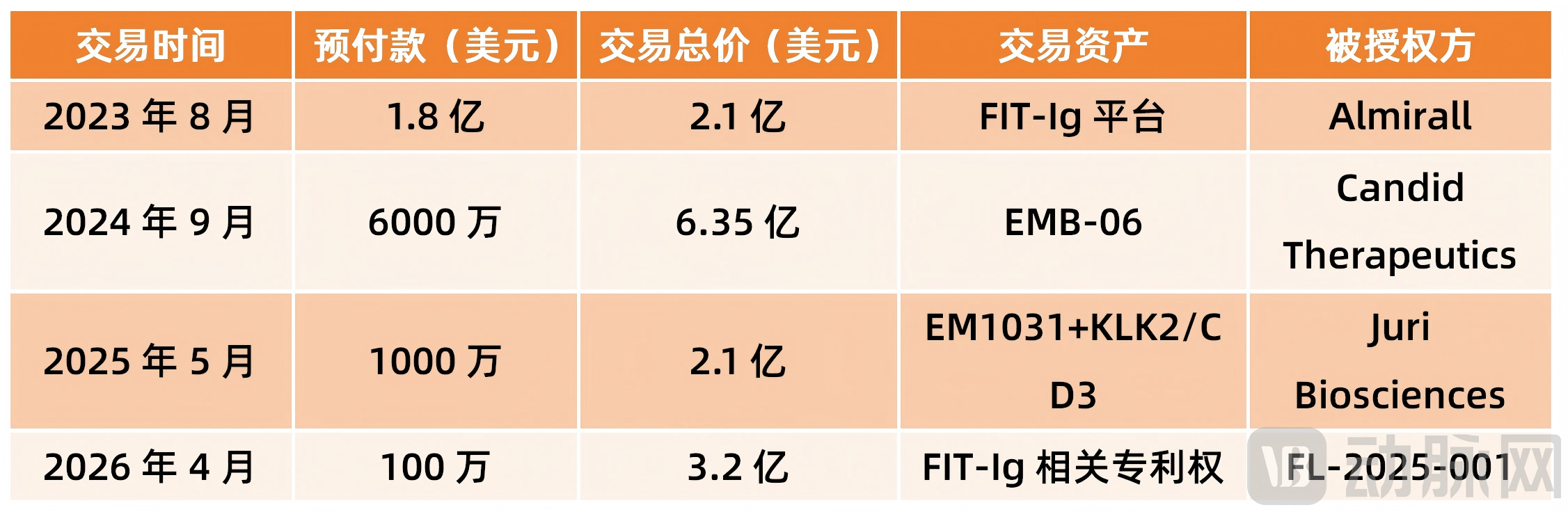
First tranche, Almirall (August 2023). In August 2023, it signed an exclusive licensing agreement with EpimAb Biotherapeutics for the FIT-Ig platform, obtaining the rights to use FIT-Ig technology to develop new products in the field of dermatology. The collaboration involves payments in three tranches. The first payment was received in May 2025, resulting in revenue recognition of approximately RMB 12.86 million reflected in the 2025 annual report. The significance of this deal extends beyond a mere check; it represents the first international market endorsement of FIT-Ig as a licensable platform technology.
The second transaction, Candid Therapeutics (August 2024). This is EpimAb's largest deal to date and the core reason for its strong financial performance in 2024. In August 2024, EpimAb entered into an exclusive global license agreement with Vignette Bio for EMB-06 (BCMA/CD3).
Vignette Bio was subsequently restructured in September 2024 and merged into Candid Therapeutics. In the same year, BMS acquired RayzeBio for approximately $4 billion, a backdrop that underscored the high market valuation of BCMA/CD3 assets during that period.
The third transaction involved Juri Biosciences (May 2025). EpimAb Biotherapeutics licensed the development rights for EM1031, a KLK2/CD3 bispecific antibody, to Juri, with Juri assuming primary responsibility for clinical development and commercialization. In 2025, this agreement generated RMB 71.53 million in revenue for EpimAb, accounting for 72.5% of its annual revenue and becoming the largest single source of income for the year.
In April 2026, EpimAb Biotherapeutics entered into a new licensing agreement with FL-2025-001, a portfolio company of Foresite Labs, transferring the development rights for a CD3-targeted FIT-Ig molecule, with an upfront payment of approximately RMB 100 million.
These collaborations share a common feature: EpimAb Biotherapeutics retains core rights in the Chinese market while licensing overseas rights to partners better equipped for local market development. This "asset-light" international expansion strategy not only reduces its own commercialization risks but also enables rapid entry into global markets by leveraging partners' networks.
Taking a holistic view, from 2024 to 2025, EpimAb Biotherapeutics' total upfront revenue from licensing partnerships amounted to approximately RMB 558 million, including approximately RMB 459 million in 2024 and approximately RMB 98.6 million in 2025.
One figure worth highlighting is the net profit of RMB 47.7 million recorded in 2024—a rare positive profit figure for a clinical-stage biotech company.
Bispecific antibodies are expanding from the forefront of oncology therapy into autoimmune diseases, representing a structural opportunity. EpimAb's dual platforms, FIT-Ig and MAT-Fab, provide technical support for this expansion. The collaboration between EMB-06 and Candid serves as a commercial exploration of new boundaries.