Global Innovation Converges in Hebei: 173 Cutting-Edge Health Tech Solutions Unveiled at 2026 Xiong'an International Medical and Healthcare Technology Application Finals

Hinacom
Developer, Manufacturer, and Service Provider of Medical Imaging Information Systems and Telemedicine Systems

How Digital Technology is Reshaping the Healthcare Service System? How Are Cutting-Edge Diagnostic and Treatment Technologies Reaching Grassroots Levels to Benefit Millions of People? On June 23, the Finals of the 2026 Xiong'an International Medical and Big Health Technology Application Competition Officially Kicked Off in the Xiong'an New Area, Fully Unveiling a Sci-Tech Innovation Event Focused on Digital and Intelligent Healthcare.
Embracing a Global Perspective: Accelerating the Aggregation of Cutting-Edge Innovations
Centered on the theme “Digital Intelligence and the Future of Healthcare,” this competition featured three tracks: Health Big Data Application Technologies, New Scenarios for Smart Hospitals, and Inheritance, Innovation, and Development of Traditional Chinese Medicine. It attracted participation from 514 organizations both domestically and internationally, with a total of 666 projects submitted. Projects from outside the province accounted for 44%, while 44 entries came from overseas and the Hong Kong, Macao, and Taiwan regions, covering 13 countries and regions. Following rigorous preliminary reviews and multi-stage semifinal selections, 173 high-quality projects—characterized by leading-edge technologies, mature business models, and significant potential for clinical translation—advanced to the finals.
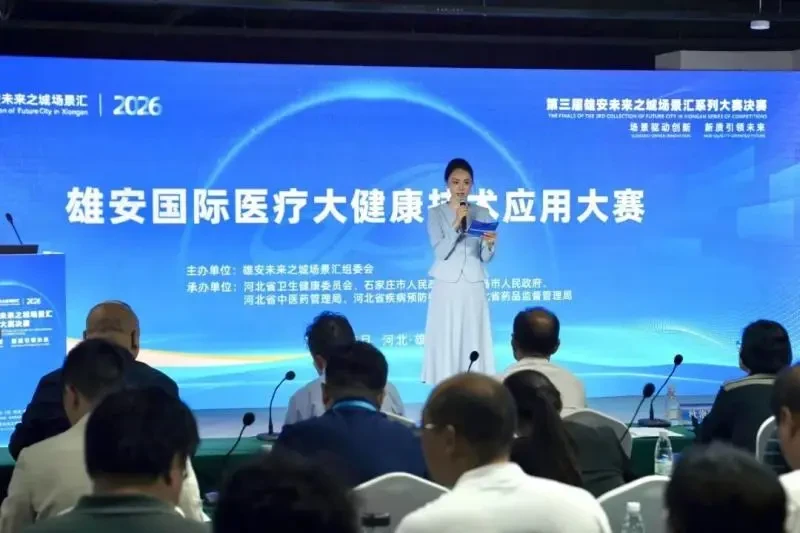
At the roadshow, innovative achievements were unveiled one after another, covering frontier fields such as brain science, AI-assisted diagnosis, high-end medical imaging, intelligent rehabilitation, and the modernization of traditional Chinese medicine. A large number of innovations with independent intellectual property rights and high potential for clinical translation were prominently featured. Ant Group’s “Afu” pioneered a dual-drive service model combining AI with family doctors, establishing a closed-loop health service system spanning “prevention–diagnosis and treatment–rehabilitation–management,” thereby filling the gap in intelligent healthcare services at the primary care level. Hinacom’s large model for medical image quality control increased the mutual recognition rate of medical images from 25% to 70%. The intelligent agent for early esophageal cancer diagnosis and treatment, developed by the Fourth Hospital of Hebei Medical University, achieved an initial screening accuracy rate of over 90% for early-stage cancer. The team led by Liu Aihua at Beijing Tiantan Hospital pioneered an evaluation system integrating high-resolution contrast-enhanced MRI with AI models, enabling personalized and precise assessment of aneurysm rupture risk. Boling Brain-Computer Interface utilized brain-computer interface technology to decode neural signals and drive exoskeleton devices, assisting stroke patients with hemiplegia in transitioning from hospital-based rehabilitation to home-based movement assistance. GE HealthCare introduced a handheld ultrasound diagnosis and treatment system, allowing patients to access high-quality diagnostic and therapeutic services at primary healthcare institutions.
Anchoring to People's Livelihood Needs: Precise Supply-Demand Matching Enriches Application Scenarios
The competition has consistently adhered to the core philosophy of “matching technologies to scenarios and scenarios to technologies.” To make cutting-edge medical technologies perceptible, experiential, and implementable, the competition concurrently launched a dedicated Smart Healthcare Exhibition Hall. This hall brought together more than 50 industry-leading enterprises to centrally showcase innovative products closely aligned with the public’s daily health needs. Liancheng Technology presented a comprehensive large-model support system covering the entire chain of clinical decision-making, medical record quality control, intelligent coding, and health insurance audit, significantly enhancing the efficiency of health insurance fund utilization and the quality of medical care. Harbin Institute of Technology Tianyu introduced its AI Health Kiosk, which enables non-invasive, full-body health screening in just 90 seconds. Jiuxing Funeng unveiled its intelligent service terminal for primary healthcare institutions (e-ZhenTong), bridging the “last mile” gap in primary medical services. This immersive and visualized exhibition platform not only provided enterprises with a window to showcase their technological achievements but also allowed healthcare institutions to intuitively understand the application value of digital and intelligent healthcare, laying a solid foundation for future collaborations.
Building on this foundation, the competition has cumulatively released 123 healthcare scenario requirements to the public, with a total investment scale reaching RMB 1.04 billion. These initiatives cover multiple areas of public welfare, including smart hospitals, AI-assisted diagnosis and treatment, early screening at the primary care level, and Traditional Chinese Medicine (TCM) health and wellness. As a result, a batch of advanced medical technologies has been rapidly implemented across hospitals at all levels, county-level medical consortia, and health and wellness institutions.
Deepening the Integration of Competitions and Industry: Paving a Fast Track for the Transformation of Scientific and Technological Achievements
The competition adheres to the working principle of “conducting competitions, facilitating matchmaking, and implementing projects simultaneously,” constructing a complete conversion loop of “competition–exhibition–negotiation–production” to break down barriers between innovative technologies and market applications. During the finals, delegations from the provincial health commission system and medical institutions at all levels were organized to visit exhibitions and engage in negotiations. A dedicated matchmaking zone was established to enable precise, face-to-face alignment of needs among enterprises, hospitals, industrial parks, and financial institutions. Meanwhile, multiple academic seminars on innovation in healthcare and the greater health industry were held concurrently, gathering industry experts to explore technological frontiers and discuss industrial development, thereby building a full-chain industrial ecosystem loop covering technology R&D, achievement exhibition, scenario implementation, and academic leadership.
To date, 34 high-quality medical enterprises have established operations in the Xiong'an New Area and 11 prefecture-level cities across Hebei Province, covering fields such as brain-computer interfaces, AI-enabled intelligent diagnosis and treatment, digital traditional Chinese medicine (TCM), high-end medical devices, pharmaceutical logistics, and health and elderly care services. Notably, Handan Central Hospital, leveraging Huawei Ascend computing power, was the first in China to deploy the Ruijin Pathology Large Model, supporting multiple application scenarios including regional intelligent smart inspection, AI-based medical record quality control, and early screening for esophageal cancer and stroke. Xingtai People's Hospital, relying on the early cancer screening solution developed by Alibaba DAMO Academy, utilizes existing non-contrast CT scans and AI technology to identify high-incidence cancers such as gastric cancer. This solution has been promoted and applied within certain county-level medical consortia, effectively filling the gap in early screening at the primary care level.
A representative from the Health Commission of Hebei Province stated that the competition will fully leverage Xiong’an New Area’s unique innovation ecosystem, promote precise alignment between technological supply and application demands, select high-quality projects for implementation and commercialization, better serve the public’s healthcare needs through digital and intelligent technologies, and inject strong innovative momentum into the development of Healthy Hebei and Xiong’an New Area.