

Lepu Medical Faces Four-Country Injunction in Europe Over Patent Infringement of MemoCarna Cardiac Occluders

Lepu Medical
Developer and Manufacturer of Cardiac Interventional Medical Devices and Pharmaceuticals

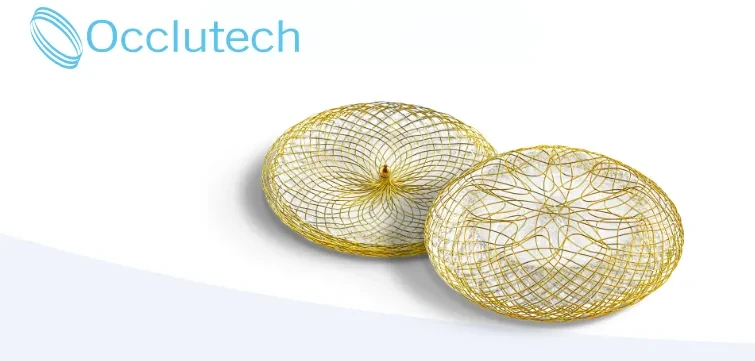
Occlutech
Manufacturer and Developer of Heart Occluders and Other Vascular Implants

Source: MedTech Home
On June 18, 2026, the Court of Appeal of the Unified Patent Court (UPC) issued a landmark final ruling in the patent infringement case of Occlutech v. Lepu Medical concerning occluder devices, overturning the previous non-infringement finding by the Düsseldorf Local Court.It was determined that Lepu Medical’s two MemoCarna series cardiac occluders, which have obtained CE certification but are not yet commercially available, fall within the scope of protection of a competitor’s core patents, resulting in preliminary injunctions prohibiting sales in Germany, France, Italy, and the Netherlands.
This patent battle has lasted nearly a year. Notably, the products involved in this case were not actually distributed for sale; instead, they obtained CE certification and participated in international exhibition promotions, which constituted “imminent infringement,” thoroughly breaking domestic medical device enterprises“Promotion with certification, no liability if unsold”inherent cognition.
01 Two Patent Sieges Starkly Different Judgments by Courts at Two Levels
The plaintiff, Occlutech GmbH, is a member of the Swiss Occlutech Group. It is the second-largest manufacturer in Europe and the third-largest globally of minimally invasive cardiac implant devices, specializing in various cardiac occluders and left atrial appendage (LAA) occlusion products, with research and development as well as manufacturing bases established in Germany and Turkey.
The defendant, Lepu Medical, is a leading domestic player in cardiovascular intervention. It possesses a three-generation product portfolio in the occluder segment, resulting in direct competition between the two parties in the atrial septal defect (ASD) and ventricular septal defect (VSD) occluder markets.
Occlutech holds two key European patents for braided occluders: EP2387951 and EP1998686. Leveraging these as strategic assets, it simultaneously filed applications for preliminary injunctions against UPC’s two regional divisions on two separate fronts, thereby encircling Lepu Medical with a patent blockade.
From March to May 2025, Lepu Medical’s MemoCarna ASD and MemoCarna VSD, two oxide-film single-rivet occluders, successively obtained EU CE certification. Subsequently, the company rapidly initiated global market预热 activities by participating in EuroPCR in Paris and DCIC in Dubai, sponsoring the CSI conference in Frankfurt, and showcasing the aforementioned occluders on-site.
Pricing has also become a focal point for competitors, with reports indicating that its end-user price is 20%–40% lower than that of Occlutech’s comparable products, creating a significant competitive advantage in pricing. Occlutech determined that the product’s market launch would severely erode its own market share in Europe and promptly initiated legal proceedings before the Unified Patent Court (UPC):
June 19, 2025: The Hamburg Regional Division filed an application for a preliminary injunction in patent EP2387951;
July 8, 2025: The Düsseldorf Local Division filed an application for a preliminary injunction regarding Patent EP1998686.
On October 21, 2025, the Hamburg branch court was the first to issue a ruling fully supporting Occlutech’s claims. The court clarified that CE marking is the sole statutory requirement for market access in the European Union; therefore, obtaining the certification and engaging in extensive public promotion, including physical product displays at offline exhibitions, constitutes completion of all pre-commercialization preparations. Such actions are deemed to “pave the way for infringement,” establishing an imminent risk of infringement without the need for actual sales or import activities. Lepu Medical’s defense at the time—that its products had not been actually sold in the five countries and thus no substantive infringing acts had occurred—was not accepted by the court.
The court issued a pan-territorial injunction across Germany, France, Italy, the Netherlands, and Ireland, prohibiting the import, market launch, and promotion of the products involved in the case, with a maximum fine of €250,000 per violation.
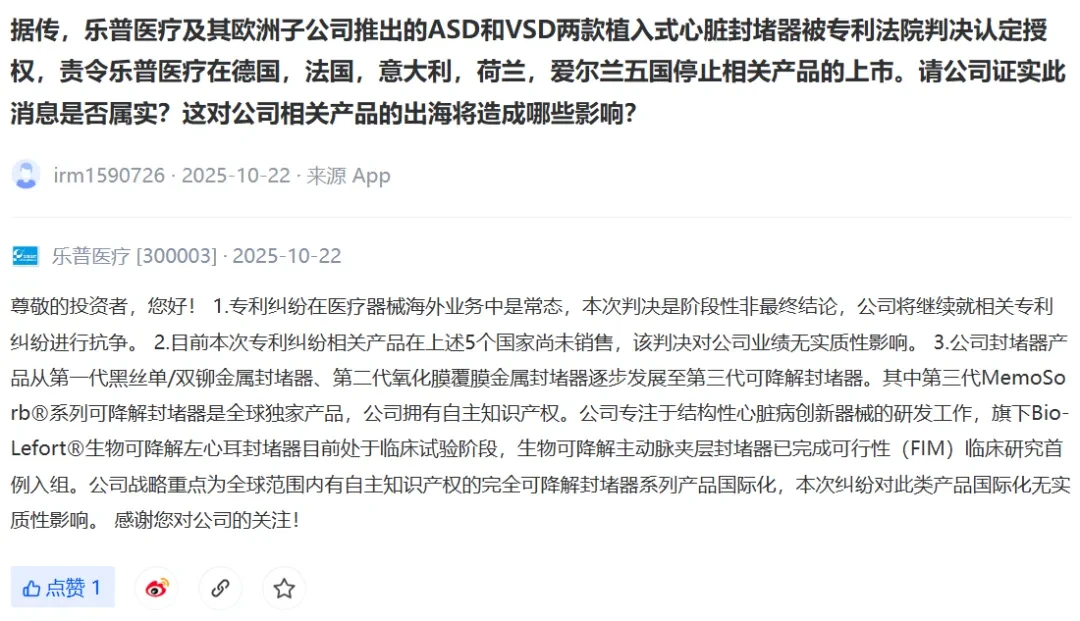
Following the issuance of the ban, Lepu Medical issued an official response on the investor platform on October 22, 2025:The dispute involves only an interim judgment, and the fact that the relevant products have not been launched for sale does not affect current performance. The company’s core overseas strategy focuses on its proprietary intellectual property in the biodegradable occluder series; the MemoCarna metal occluder involved in this litigation is not a focal point of its internationalization strategy. Meanwhile, the company stated it will continue to appeal and contest the ruling.
On the 31st of the same month, the Düsseldorf Division issued a contrary ruling regarding the second patent. The court acknowledged that all prerequisites for a preliminary injunction were met in this case (namely, imminent infringement, urgency, and balance of interests), but reached a negative conclusion solely on the technical comparison. The court of first instance adopted a literal interpretation, determining that Lepu Medical’s product was manufactured from a single wire strand and therefore did not satisfy the technical feature of “multi-wire braid,” thus falling outside the scope of patent protection. Occlutech subsequently appealed the first-instance decision to the UPC Court of Appeal.
On May 11, 2026, the UPC Court of Appeal held an oral hearing; Lepu Medical did not send representatives to attend the trial, and the court only considered its written defense submissions.On June 18, the final ruling was officially issued, completely overturning the first-instance technical determination by the Düsseldorf court.
The court clarified that the interpretation of the scope of patent protection should not mechanically focus on literal wording, but must be comprehensively determined in conjunction with the patent specification, drawings, and the original intent of the invention.Even if the initial raw material of the product is a single filament, the finished product consists of multiple fine filaments after cutting and segmentation during the manufacturing process, thereby satisfying the limitation of “multi-filament braid” and falling within the scope of protection of EP1998686.
With respect to the two core structural features, “completely closed proximal wall” and “continuous surface,” Lepu Medical’s product was determined to fully match the patented technical solution on an item-by-item basis;
Furthermore, the court directly refused to admit the new evidence submitted by Lepu Medical during the appeal stage. Lepu Medical submitted master's theses on R&D related to enterprises acquired in 2008 in court, attempting to use them as a basis for the prior art defense.The court ruled that the enterprise had full capacity to submit the evidence during the first-instance trial; submitting it supplementarily on appeal did not comply with procedural rules, and thus the evidentiary validity was directly excluded.
Final ruling to adjust the scope of the injunction.Excluding Ireland, while retaining Germany, France, Italy, and the Netherlands, the prohibited conduct and the €250,000 single-fine standard remain consistent with the judgment of the Hamburg Regional Court.
What warrants our attention in this case is that, since the Unified Patent Court (UPC) became operational in 2023, the timeline for adjudicating preliminary injunctions has been extremely short: the Hamburg Local Division took only four months from filing to issuing its order, and the entire appeal process was completed within seven months—far faster than previous separate national litigations. Moreover, a single injunction can cover multiple member states, allowing one lawsuit to block market access across several countries, thereby significantly reducing the cost of rights enforcement for overseas manufacturers. This mechanism naturally serves as a tool for European domestic companies to counter competing products from China. When balancing the interests of both parties, the court prioritizes the protection of local patent holders who have deeply cultivated the local market and invested heavily in clinical promotion. It determines that the market entry of low-priced Chinese-made medical devices would cause irreversible loss of market share, thus tending to grant injunctions.
Furthermore, all companies planning to enter the EU market must attach great importance to this,CE certification combined with promotional activities at overseas trade shows constitutes conclusive evidence of "imminent infringement."Regardless of whether the product has generated actual orders or completed sales, as long as the enterprise proactively publicizes its CE certificate or displays physical products at international exhibitions, the patentee may apply to the Unified Patent Court (UPC) for a preliminary injunction. There is no buffer zone for “no liability if not sold.”
Additionally,The first instance is the main battlefield of litigation; supplementary evidence submitted during the appeal stage is generally not admitted.The UPC strictly enforces time limits for the submission of evidence. Prior art, R&D documentation, comparative experimental data, and expert testimony held by companies must be fully submitted during the first-instance proceedings. Delays in evidence submission caused by internal document management issues or lagging communication with overseas law firms cannot be remedied at the appellate stage, resulting in the direct loss of defensive leverage.
Moving forward, we will continue to monitor the progress of this case and provide simultaneous analysis of more typical patent dispute cases involving domestic medical device companies.