CE Certification Is Just the Beginning: Chinese Cardiovascular Device Makers Face Patent Minefields Overseas

Lepu Medical
Developer and Manufacturer of Cardiac Interventional Medical Devices and Pharmaceuticals

Occlutech
Manufacturer and Developer of Heart Occluders and Other Vascular Implants
Heart Future
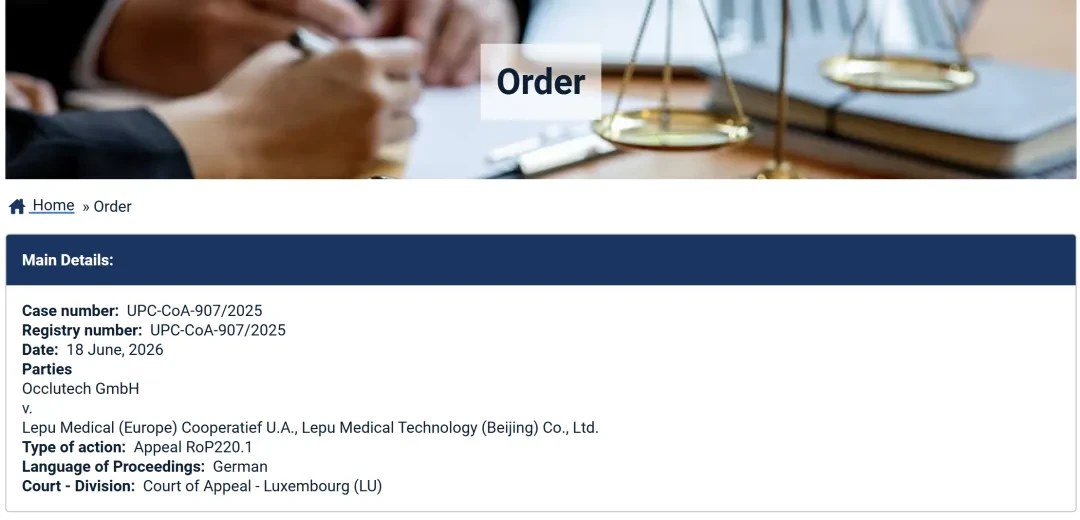
June 18, 2026,The Court of Appeal of the Unified Patent Court (UPC) issued a ruling imposing additional interim injunctions in four countries on two cardiac occluder devices from Lepu Medical, further restricting their promotion in core European markets.
Lepu Medical’s stock price briefly rebounded after the first ban in October last year, reaching a high of 20.26 yuan in January this year, but has since declined steadily, currently falling nearly 50% from its peak.
The sequence of events is straightforward: Lepu Medical’s two cardiac occluders, MemoCarna ASD and MemoCarna VSD, obtained EU CE certification in spring 2025 and subsequently appeared at international exhibitions such as EuroPCR in Paris and DCIC in Dubai. Seizing this opportunity, German competitor Occlutech applied for a preliminary injunction at the Hamburg Local Division of the Unified Patent Court (UPC) in June 2025. Over the following six months, Lepu suffered consecutive setbacks on two fronts: first, the Hamburg Local Division issued a five-country injunction (covering Germany, France, Italy, the Netherlands, and Ireland) based on one patent; then, on June 18, 2026, the Court of Appeal imposed an additional four-country injunction based on another patent. Occlutech has also filed formal infringement lawsuits separately based on these two patents. This legal battle is far from over.
# This Is More Than Just the Story of Lepu Medical
Lepu Medical is the industry leader, with revenue of approximately RMB 6.5 billion and net profit attributable to shareholders of nearly RMB 1 billion in 2025, underscoring its undisputed position in China’s cardiovascular interventional device market.
However, Lepu Medical’s recent setback in Europe has exposed a problem that is widespread yet rarely confronted head-on in the wave of Chinese cardiovascular device manufacturers expanding overseas:Our preparations for going global often stop at obtaining certification.
At present, the international expansion of many cardiovascular device companies is stalled at the same stage—applying for CE marking, having just obtained CE certification, preparing to attend international conferences, or planning to seek overseas distributors. Lepu Medical’s experience illustrates what may happen after this stage, and it is highly likely not an isolated case.
The global market for cardiovascular medical devices is valued at $56 billion, with Europe and the United States representing the largest profit pools. Centralized procurement has driven down the prices of high-value consumables in China by 70% or more, making international expansion an imperative for every cardiovascular device company with the capability to go global. However, this path is fraught with hidden patent pitfalls.

# What Details of the Lepu Medical Case Are Worth Close Examination
CE Certification is both the entry ticket and the target.
The logic of the judgment in the Lepu case is sobering: The Hamburg Branch of the Unified Patent Court (UPC) explicitly held that CE certification itself constitutes a legal signal of a company’s intent to enter the European market, thereby serving as one of the bases for “imminent infringement.” Occlutech’s timing in filing its application was no accident—it initiated legal action precisely after observing that Lepu had obtained CE certification and begun showcasing its products at European trade fairs. The interval between these events was less than two months.
For cardiovascular device companies, this means one thing:While you celebrate obtaining CE certification, your competitors may already be reviewing your patent risk list.
Claim interpretation is broader than you think.
The pivotal reversal in this appeal case hinged on the Unified Patent Court (UPC) Court of Appeal’s “holistic interpretation” of the patent claims. The Düsseldorf court of first instance had held that Lepu Medical’s product, being manufactured from a single wire, did not constitute the “multi-wire braid” recited in the patent, and thus did not infringe. However, the Court of Appeal ruled that one cannot rely solely on the literal wording; rather, the purpose of the invention, its technical effects, and the specification must be considered. Even if the raw material is a single wire, as long as it is cut into multiple segments during the manufacturing process, the final product falls within the scope of protection.
The first-instance finding of “non-infringement” was reversed to “infringement” by the appellate court—this is not an anomaly attributable to individual judges, but rather reflects the direction established by the Unified Patent Court (UPC) system in claim construction. For companies that believe they have implemented design-around strategies, this serves as a critical signal to reassess their position.
"Missing the hearing is the most costly mistake."
Lepu Medical did not send representatives to attend the oral hearing at the appellate court in May 2026. The appellate court consequently deemed, in accordance with procedural rules, that Lepu Medical relied solely on its written submissions. New evidence submitted by Lepu Medical during the appeal stage—a master’s thesis concerning the technical origin of the product—was rejected on the grounds that such evidence could have been fully presented during the first-instance trial.
This detail is harsh: patent litigation is not product competition; it follows strict procedural rules, and any absence or delay may cost you a battle you could have won.
The ban has broad coverage and is strictly enforced.
The UPC's preliminary injunction is not merely a restriction in one country.Pursuant to Article 34 of the UPC Agreement, the effect of a UPC decision extends to the Contracting Member States in which the relevant European patent has taken effect. In this case, the two interim injunctions covered core European markets including Germany, France, Italy, the Netherlands, and Ireland, respectively.Since January 2026, UPC litigation costs have increased by approximately 33%, and the penalty framework has been further strengthened—violations of injunctions are subject to cumulative fines of up to €250,000 per instance. This means that injunctions will indeed be enforced.
# Going Global Is More Than Just Registration; It’s About Building Comprehensive Operational Capabilities
The Lepu case prompts reflection, but what deserves greater attention is the gap in overseas expansion capabilities it reveals.
Expanding cardiovascular devices into overseas markets ultimately requires the simultaneous alignment of multidimensional capabilities; it is not enough to simply have superior technology, high-quality products, and regulatory certifications.
First, you need a team that truly understands European and U.S. patent rules—or reliable external partners.
Most domestic cardiovascular companies have in-house intellectual property teams, but they focus primarily on domestic filings and enforcement. Patent litigation in Europe and the United States, particularly under new unified frameworks such as the Unified Patent Court (UPC), involves fundamentally different rules, procedural paces, and defense logics. This is not an issue that can be resolved simply by hiring a patent engineer who can read English.
What is required are: European patent attorneys familiar with the UPC procedural rules; a local team capable of conducting freedom-to-operate (FTO) analyses; and a mechanism for completing patent risk assessments at critical milestones—such as prior to applying for CE marking or participating in international trade fairs. These capabilities can be developed in-house or obtained through partners, but they are indispensable.
MicroPort Medical is at the forefront in this regard. It has established a “Global Connect Platform” to integrate overseas resources across the group’s various business segments, including functions such as regulatory registration, medical services, and customer operations, thereby forming cross-product synergistic capabilities for global expansion. This achievement is not the result of overnight efforts, but rather the culmination of years of accumulation.
LifeTech’s approach is equally worthy of reference. As early as the product development stage, it maintained a high level of vigilance against patent conflicts. After developing China’s first-generation bare-metal coronary stent in 2001, the company proactively abandoned this direction due to concerns over potential patent disputes with international giants, shifting instead to develop iron-based bioresorbable stents with fully independent patent rights. This reflects a highly proactive patent strategy: preferring to navigate around obstacles rather than become collateral damage. LifeTech has secured over 1,000 patents globally and established comprehensive collaboration with Medtronic, achieving synergy in quality control, clinical trials, academic promotion, and distribution. The significance of this partnership lies not only in channel access but also in leveraging the mature compliance systems of an established partner to mitigate its own risks.
Second, you need substantial capital—the hidden costs of going global far exceed expectations.
This is a topic rarely discussed in earnest in conference rooms: How much does it really cost to go global?
Registration fees, clinical trial costs, and notified body fees are relatively easy to estimate. What truly catches companies off guard is the legal cost. In Europe, engaging a law firm familiar with the Unified Patent Court (UPC) to handle a patent dispute can incur legal fees alone in the range of millions of euros.In the United States, patent litigation is often accompanied by high legal fees, expert witness costs, and potential damages, with some cases also involving punitive damages.
Lepu Medical is currently confronting two patents, two fronts, and two parallel formal lawsuits, while simultaneously facing stock price pressure and hindered market access. For small and medium-sized enterprises that have just begun their overseas expansion and possess far less cash flow than Lepu Medical, patent wars of similar intensity could be fatal.
An industry veteran once made a remark that serves as a cautionary note:"A $10 million budget can complete the initial overseas expansion layout, but remember that reserves for patent litigation must also be included within this $10 million."
Third, you need to find the right partners—not just distributors, but allies.
Channel partners expanding overseas face a fundamentally different logic in European and American markets compared to the domestic market. The "distributor–hospital" model commonly practiced in China encounters a series of unfamiliar challenges in Europe and the United States, including direct procurement by Group Purchasing Organizations (GPOs), maintenance of physician networks, and alignment with compliance frameworks.
More important than channel partners, however, are local allies in the realm of legal and regulatory compliance. Over the years, Mindray Medical has acquired overseas companies such as Datascope in the United States, gaining not only distribution channels but also localized operational capabilities and accumulated compliance expertise. This “acquired global expansion capability” is, to some extent, faster than building it from scratch.
For enterprises that currently lack M&A resources, a more realistic strategy is to identify a local law firm or patent operation agency with years of deep cultivation in the target market and experience in handling patent litigation, and to maintain a long-term cooperative relationship in daily operations, rather than taking last-minute measures only after being sued.
# Direct Recommendations for Cardiovascular Companies Expanding Overseas
Complete the FTO analysis before obtaining CE marking.FTO (Freedom to Operate) analysis is not an optional step but a prerequisite for global market expansion. The CE certification application process serves as a public signal; therefore, it is essential to identify and navigate the patent minefields in the target market before this signal is issued.
Exhibiting at trade shows is not merely a marketing activity, but also a legal event.The products you exhibited at EuroPCR may serve as the basis for competitors to apply for a preliminary injunction from the UPC. Before departure, the patent attorney needs to have a synchronized discussion with the Marketing Director.
Establish an overseas patent monitoring mechanism.Competitors’ patent application trends should be continuously monitored, just as one tracks competitors’ product launches. Gaining early insight into their strategic positioning allows sufficient time to prepare countermeasures.
Take litigation proceedings seriously and never fail to appear.Once patent litigation commences, procedural initiative or default determines whether a party remains in the game. The cost of Lepu Medical’s absence from the hearing during the appeal stage was the loss of the right to submit new evidence.
Establish a "Patent Invalidation Reserve".Proactively assess the stability of competitors’ key patents and prepare invalidation materials in advance. In Europe, oppositions can be filed with the EPO; in the United States, Inter Partes Review (IPR) petitions can be submitted to the PTAB. These measures are not passive defenses but proactive offensives.
# Finally, a more significant matter
Lepu Medical’s European ordeal is aptly summarized in one sentence:"The pace of innovation outstrips patent portfolio deployment, leaving key technological nodes without sufficient defensive rights."
This is a challenge faced by Lepu Medical, as well as by many Chinese cardiovascular companies. In the domestic market, having strong technology and competitive pricing is often sufficient to achieve significant success. However, the European and American markets represent a different battlefield—competitors there possess decades of accumulated patents and extensive experience in leveraging legal instruments to block rivals.
Occlutech’s actions in this case were textbook: early patent positioning, close monitoring of competitors’ market moves, immediate action upon CE certification approval, simultaneous filing of two lawsuits in two courts, and an unyielding stance during the appeal phase. This was not an isolated act of suppression but a coordinated market defense strategy.
Chinese cardiovascular enterprises that can truly establish a firm foothold in Europe in the future will be those that internalize patent strategy as a core operational capability—rather than outsourcing it to legal departments and responding only when issues arise. Technological breakthroughs provide the confidence for global expansion, patent portfolios serve as armor, and compliant operations act as the passport for going global. The absence of any one of these three elements will inevitably lead to a scenario similar to what Lepu Medical has experienced.
The lawsuit has not yet concluded. We will continue to monitor the situation.
Comprehensive Solutions for Cardiovascular Devices Across All Disease Indications
Structural Heart Disease → ▌Medtronic
Vascular Diseases → ▌Huamai Tech