

Behind Johnson & Johnson's $22.5 Million Patent Lawsuit: Domestic Stapler Firms Battle for Market and IPO Amid Global IP Warfare
ESM
Developer of High-End Medical Devices for Minimally Invasive Oncology Surgery

Mindray
Medical Device R&D Manufacturer
Recently, Johnson & Johnson has once again initiated patent litigation in the field of surgical staplers.
In May 2026, Johnson & Johnson formally filed a lawsuit against Weierkaidi (a subsidiary of David Medical), a leading Chinese manufacturer of surgical staplers, at the Düsseldorf Local Division of the Unified Patent Court (UPC) in Europe. The patent in dispute pertains to electric surgical cutting and stapling devices equipped with a manual retractable firing system, directly targeting Weierkaidi’s European market expansion.
Domestic Front Escalates: Johnson & Johnson Files Three Patent Lawsuits Against Weierkaidi, Voluntarily Dismisses One During Trial, and Raises Damages Claim in Remaining Two Cases from RMB 10 Million to RMB 161 Million
In fact, since 2018, Johnson & Johnson has initiated large-scale patent litigation against Chinese manufacturers of surgical staplers. This protracted patent battle is no longer a simple dispute over technical infringement; rather, it is a commercial war waged with patents as weapons, unfolding against the backdrop of domestic substitution and the rising tide of Chinese brands expanding into global markets.
Patent Litigation: Essentially, a Continuation of Business Competition
Chu Ying, an analyst specializing in intellectual property for medical devices, explained: “Patent portfolio development requires significant upfront investment with no immediate revenue generation. For instance, the standard cost of filing a single invention patent application domestically is approximately RMB 10,000–20,000, whereas in the United States or the European Union, the typical filing cost amounts to around RMB 100,000. Quotations may vary among different patent agencies or law firms. Multinational giants continuously invest in R&D and deploy patents globally, bearing substantial costs for research and development, legal affairs, and maintenance. Patent litigation serves as a critical means for these companies to safeguard their rights, legally challenge competitors, protect innovative technologies from infringement, and seize global market share.”
Reviewing the Full-Cycle Industry Dynamics from 2010 to 2026: The Patent War in the Stapler Sector Clearly Unfolded in Three Major Phases—Foreign Companies Dominating Overseas Markets, Giants Shifting Focus to the Domestic Market, and Local Enterprises Actively Responding to Litigation with Proactive Risk Control.
These have been the eight most passive and powerless years for domestic stapler manufacturers.
At that time, the two multinational giants, Johnson & Johnson and Medtronic (Covidien), collectively monopolized approximately 80% of the global market share. With comprehensive local patent portfolios and mature legal systems, they leveraged patent barriers to sue Chinese manufacturers that were newly entering overseas markets.
During this period, Europe and the United States constituted the core global market for surgical staplers. Johnson & Johnson and Medtronic primarily targeted these markets to launch patent wars, aiming to safeguard their market share and enhance their brand image.
In 2010, Covidien, prior to its acquisition by Medtronic, initiated patent litigation in Germany, accusing four Chinese companies and one British company of copying its stapler product designs and infringing on its patents.
Wang Xiaobang, a lawyer who has represented numerous parties in medical device patent litigation, reflected: “The shortcomings of early domestic companies were glaringly obvious: zero overseas patent portfolios, no local legal teams, and a lack of understanding of U.S. and European patent adjudication rules, leaving no room for effective defense throughout the proceedings. Foreign giants, armed with comprehensive patent barriers, held absolute sway.”
The outcome of the litigation was a foregone conclusion: the German court issued a preliminary injunction against the products, and all stapler shipments from the five companies involved in the lawsuit were seized by customs. This result also underscores the legitimacy of Johnson & Johnson’s efforts to protect its rights and interests.
In 2016, Covidien, which had been acquired by Medtronic, took action again by filing a complaint with the U.S. International Trade Commission (ITC) against Chongqing-based local stapler manufacturers, requesting the initiation of a Section 337 investigation and seeking exclusion orders and cease-and-desist orders, with the intent to completely block these companies’ access to the U.S. market under the U.S. Tariff Act.
So-called Section 337 investigations are quasi-judicial proceedings initiated by the U.S. International Trade Commission (ITC) under the Tariff Act of 1930 against imported products that infringe intellectual property rights. The ITC can issue limited exclusion orders, general exclusion orders, and cease-and-desist orders, thereby directly banning competing products from the U.S. market.
Once again, the domestic company involved in the lawsuit was unable to substantiate defects in the foreign patent and ultimately had no choice but to privately sign a settlement agreement with Covidien.
Since 2018, Johnson & Johnson has also joined the patent war on surgical staplers, with its crackdown intensity and scope far exceeding that of Medtronic. Within just a few years, Johnson & Johnson initiated more than 15 targeted lawsuits in the Netherlands, Brazil, China, and the European Union, directly targeting a host of Chinese-made surgical stapler manufacturers, including Fenghe Medical, Ningbo Weierkaidi Medical Instrument Co., Ltd., Baoma Medical, and Nanshuo Medical.
Landmark Case Concluded in the Netherlands: Johnson & Johnson Sued Fenghe Medical for Patent Infringement in 2018. In its first-instance ruling, the Rotterdam Court of the Netherlands found that Fenghe Medical’s stapler products involved in the lawsuit constituted slavish imitation, while the stapler component products did not. The court ordered Fenghe Medical to recall and destroy the relevant products involved in the litigation and to adjust its product marketing materials. Subsequently, Fenghe Medical and Johnson & Johnson reached a settlement agreement, with Fenghe Medical paying approximately €145,400 in compensation to Johnson & Johnson.
During this period, domestic surgical stapler manufacturers primarily engaged in imitation and follow-on innovation, lacking independent patent portfolios and leaving them defenseless in patent litigation. In contrast, industry giants such as Johnson & Johnson and Medtronic leveraged patent litigation to safeguard their intellectual property rights, thereby protecting their core interests and market share in European and American markets.
Since 2019, multinational giants have shifted the focus of their patent battles over surgical staplers to China.
On one hand, the expansion of domestic medical consumption in China has driven the surgical stapler market size to rise year after year, making it an important emerging market. On the other hand, the pace of import substitution has accelerated. In 2019, the market share of domestically produced open surgical staplers stabilized at 50%, reaching parity with imported brands. The localization rate of high-end endoscopic surgical staplers exceeded 15%, continuously eroding the market share of foreign companies.
Meanwhile, after approximately a decade of development, Chinese manufacturers of surgical staplers have emerged and are accelerating their global expansion. For instance, Dongxing Medical is increasing its investment in emerging markets such as Brazil, Iran, and South Africa; Tianchen Medical leverages B. Braun’s global distribution network; David Medical has established a network of over 40 overseas distributors; Partel Medical’s overseas revenue accounts for up to 40% of its total; and Yisi Medical is targeting high-end markets in Europe and the United States.
Against this backdrop, Johnson & Johnson launched systematic patent litigation against Chinese manufacturers of surgical staplers to safeguard its own interests. Among these cases, the patent offensive and defensive battle between Johnson & Johnson and Fenghe Medical is the most representative.
In 2019, Johnson & Johnson filed four patent lawsuits against Fenghe Medical:
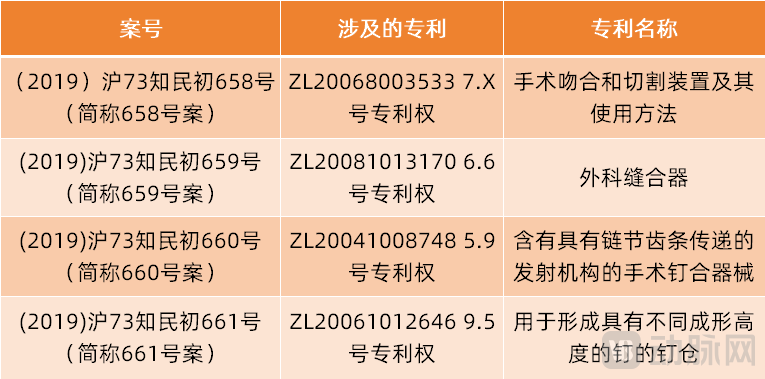
Wang Xiaobang analyzed, “At that time, Fenghe Medical was responding to the lawsuit while simultaneously challenging the validity of the relevant patents. This is a standard practice in handling patent litigation.”
In April 2022, Johnson & Johnson’s Ethicon patent ZL200410087485.9 (involved in Case No. 660) was declared entirely invalid. The petitioner for invalidation was Fenghe Medical.
Wang Xiaobang stated, “Once the patent is declared invalid, the basis for the related infringement lawsuit is lost. Therefore, Johnson & Johnson had no choice but to withdraw its appeal in Case No. 660.”
Not only the patent involved in Case No. 660, but Fenghe Medical also filed a request for invalidation with the China National Intellectual Property Administration (CNIPA) in June 2020 against the patent ZL200810131706.6 involved in Case No. 659.
In response to this invalidation challenge, Johnson & Johnson submitted replacement pages with amended claims three months later, deleting Claim 1 from the granted patent publication.
Wang Xiaobang analyzed, “This is also a victory for Fenghe Medical, as it has at least reduced the scope of protection for Johnson & Johnson’s corresponding patents.”
However, Johnson & Johnson did not lose entirely: in May 2021, the China National Intellectual Property Administration ruled that Johnson & Johnson’s patent remained valid after the claims were amended.
Meanwhile, Johnson & Johnson also secured a victory in the first-instance trial. In late 2021, the Shanghai Intellectual Property Court ruled in its first-instance judgment that Fenghe Medical must immediately cease infringing upon the plaintiff’s patent rights and compensate Johnson & Johnson for economic losses of RMB 4 million and reasonable expenses of RMB 600,000, totaling RMB 4.6 million.
Dissatisfied with the judgment, Fenghe Medical filed an appeal and subsequently submitted a request for invalidation in September 2022, providing compelling evidence: U.S. patent documents published in 1988, U.S. patent documents published in 1998, and PCT patent documents published in 2007.
Chu Ying explained, “There are clear criteria for determining the invalidation of a patent application. If prior art—such as existing patents, products, or academic papers—predates the filing date, the patent lacks novelty and may be declared invalid. Otherwise, the China National Intellectual Property Administration (CNIPA) will not rule it invalid.”
The evidence provided by Fenghe Medical was sufficient to prove that, at the time of filing for the patent involved in Case No. 659, corresponding technologies or patents already existed in the market, rendering the patent non-inventive. Consequently, on September 15, 2023, the China National Intellectual Property Administration declared the invention patent entirely invalid. Ten days later, the Supreme People's Court issued a second-instance ruling: revoking the first-instance judgment in favor of Johnson & Johnson and dismissing its lawsuit.
Although Fenghe Medical achieved significant victories in Cases No. 659 and No. 660, it lost both the first and second instances in Cases No. 658 and No. 661. In these two cases, Fenghe Medical was ordered to cease the production, sale, and offering for sale of the products involved in the litigation, and to pay compensation to Johnson & Johnson.
Despite being found liable for infringement, this had little impact on the revenue of Fenghe Medical’s stapler business.Following the lawsuit, Fenghe Medical initiated product iterations while responding to the claims and challenging patent validity, upgrading the passive articulation structure involved in the litigation to an active articulation structure. Additionally, by late 2022, Fenghe Medical implemented technical improvements—including optimization of manual blade retraction, control board solutions, and automatic blade retraction control schemes—to replace the products subject to the litigation.
Wu Shuai analyzed, “Judging from these patent lawsuits and their verdicts, although Johnson & Johnson prevailed in two patent cases, safeguarding its rights and interests, the financial returns were modest. This is because the scrutiny for awarding damages in medical device patent infringement cases is extremely stringent, and it is exceedingly difficult to substantiate the value of the infringement.”
For example, U.S. minimally invasive device company Rex Medical sued surgical robotics leader Intuitive Surgical; the court found that Intuitive Surgical’s stapler infringed on patents, but the damages award was reduced from the initial $10 million to a nominal $1.
The situation is similar in both the United States and China. In Case No. 658, where Johnson & Johnson prevailed, the claimed amount was RMB 35.21 million, with the court awarding approximately RMB 5.726 million in damages. In Case No. 661, also won by Johnson & Johnson, the claimed amount was approximately RMB 28.17 million, with the court awarding approximately RMB 2.37 million in damages.
Furthermore, even after prevailing in the lawsuit, Johnson & Johnson was unable to achieve a permanent market exit of the competitor’s products. Fenghe Medical mitigated the impact on its business by iterating its technology and replacing the litigated products with next-generation alternatives.
Overall, the actual effectiveness of Johnson & Johnson's patent enforcement is significantly constrained.
Of course, Johnson & Johnson is still defending its rights through patent litigation.In 2023, Johnson & Johnson filed three patent infringement lawsuits against Fenghe Medical, claiming a total of RMB 160 million in damages. Coincidentally, Fenghe Medical’s IPO application was accepted in June 2023. This timing led the market to interpret the lawsuits as an attempt to thwart the IPO.
The Shanghai Stock Exchange’s inquiries to Fenghe Medical primarily focused on patent litigation and other matters, with multiple pending lawsuits hindering the company’s IPO progress. In August 2024, Fenghe Medical voluntarily withdrew its listing application, bringing its IPO process to an abrupt halt.
This has further led the market to believe that Johnson & Johnson sabotaged the IPO of Fenghe Medical. Some industry insiders even commented, “In this battle, although the patent litigation has not yet reached a final verdict, Johnson & Johnson can be said to have already won. At the very least, they have achieved their stated objectives. A favorable final judgment would merely be an unexpected bonus.”
From Johnson & Johnson’s perspective, enforcing its rights through patent litigation is highly justified, as its upfront investments in R&D and patent applications were all aimed at safeguarding innovation. The company’s first-instance victories in the three patent lawsuits filed in 2023 further underscore the legitimacy of its actions. Legally, Johnson & Johnson may initiate litigation at any time against ongoing infringing activities. Moreover, inquiries into pending litigation involving companies seeking listing are standard practice by the Shanghai Stock Exchange.
The industry’s true inflection point began in 2024.
In 2024, Baoma Medical and Meidong Huicheng separately filed requests for invalidation against Johnson & Johnson’s patent ZL201180047031.7 (staple cartridge). On December 3, 2024, the China National Intellectual Property Administration (CNIPA) adjudicated the two invalidation requests separately, and in January 2025, declared the patent invalid, resulting in the complete invalidation of all claims of the staple cartridge patent.
Notably, Meidong Huicheng had not previously been sued by Johnson & Johnson; instead, it initiated patent invalidation challenges against the pharmaceutical giant. This move is viewed by the market as marking a new phase in which domestic companies proactively seek to invalidate patents held by industry leaders, thereby initiating proactive upfront risk control and patent challenges.
However, some industry insiders believe: “The company may have previously received a cease-and-desist letter for patent infringement that was not made public, leading to misunderstanding. At this stage, most domestic companies generally do not proactively challenge multinational giants unless they are formally sued for patent infringement.”
From the perspective of proactive, front-loaded risk control, Wu Shuai analyzed to VCBeat: “Meidong Huicheng is a CDMO enterprise in the field of minimally invasive surgery, currently expanding its business into IVD and the entire life sciences sector. In minimally invasive surgery, manual and powered endoscopic staplers constitute its core business. Therefore, any patent risks would significantly impact its revenue, damage its brand reputation, and ultimately affect its CDMO orders.”
“Perhaps in response to perceived risks, Meidong Huicheng took the lead in filing a patent invalidation challenge against Johnson & Johnson, which is a standard risk management practice in the global medical device industry. On the other hand, this lawsuit has garnered significant attention for Meidong Huicheng, enhancing its brand image and helping domestic enterprises recognize and appreciate its compliance efforts, ultimately driving more orders. The extensive media coverage of the patent invalidation case against Johnson & Johnson has already proven the effectiveness of this strategy.”
In addition to actively responding to lawsuits and proactively seeking invalidation, Chinese medical device companies such as Mindray Medical, Rich Surgical, and Yisi Medical have adopted another approach to address patent risks: implementing upfront risk control to avoid patent disputes at the source. According to Qichacha, VCBeat queried the case information of these companies, and as of now, none of them have faced patent infringement claims in the field of staplers.
Taking Yisi Medical as an example, the company has not been involved in any patent litigation during its international expansion. Its stapler product series has been sold to 90 countries and regions worldwide, gaining recognition and entry into many mainstream hospitals globally. In 2025, Yisi Medical won the bid for the largest stapler centralized procurement project in the United States, signed a supplier cooperation agreement with Vizient, Inc., the largest group purchasing organization in the U.S., and began entering the mainstream U.S. hospital market.
How Do These Companies Mitigate Patent Risks? Liu Le, an industry insider close to Yisi Medical, stated, “Yisi Medical conducts patent searches during R&D project initiation and prior to product sales to prevent overseas intellectual property disputes.”
Meanwhile, Yisi Medical’s R&D is directly overseen by a technical lead with expertise in intellectual property, integrating patent risk control into the initial project approval stage: at the outset of each project, competitors’ patents are searched and potential risks are systematically identified and analyzed.
Subsequently, the R&D team developed a risk-free technical solution based on patent risks and product design requirements. Prior to market launch, a secondary review of competitors’ newly filed patent portfolios was conducted, and the Freedom-to-Operate (FTO) infringement analysis was updated. The product was approved for commercial release only after verification confirmed no infringement risks.
Furthermore, Yisi Medical primarily addresses the pain points of traditional products and meets clinical needs through original innovation and independent R&D, thereby significantly mitigating patent risks. For instance, in response to clinical feedback, it pioneered the world’s first 60-degree large-angle design and innovatively introduced a detachable beak design as well as a “curved-surface staple cartridge + equal-height staples” solution. On this basis, Yisi Medical also proactively engages in patent layout to safeguard its technological innovations.
As countries strengthen their intellectual property protection, the frequency of patent litigation initiated by foreign giants has significantly increased.
Recently, in addition to surgical staplers, domestically produced innovative products such as shockwave balloons and continuous glucose monitoring (CGM) systems have also encountered patent litigation from multinational giants during their overseas expansion. In the long run, patents have become the entry ticket for the globalization of medical devices.
In this regard, companies such as Johnson & Johnson and Medtronic have long established global patent portfolios, which serves both to protect their own innovative achievements and as a standard operational practice in compliance with intellectual property regulations across various countries. The compliance barriers created by these patent strategies compel domestic and international enterprises alike to prioritize patent portfolio development and original innovation.
The patent game continues and will keep impacting the overseas expansion of Chinese-made medical device companies; we will maintain long-term observation.
Note: Wu Shuai, Chu Ying, Liu Le, and Wang Xiaobang are all pseudonyms.