

Abiomed's Impella Left Ventricular Assist Device Registration Terminated in China Amid Rising Domestic Competition

Johnson & Johnson
Medical Device R&D and Manufacturer

ForQaly
Minimally Invasive Heart Ventricular Assist Device Developer

Core Medical
Artificial Heart Series Product Developer

Source: Medical Device Business Review
China's pVAD Market Is Showing a Strong Signal of Turning Point.
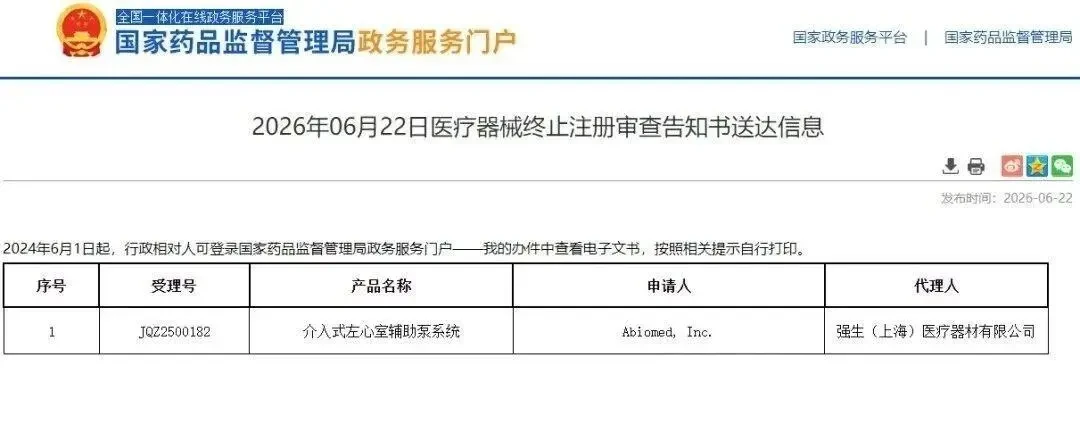
On June 22, the National Medical Products Administration released information on the delivery of notices regarding the termination of medical device registration reviews, for products filed by Abiomed, Inc. and distributed by Johnson & Johnson (Shanghai) Medical Devices Co., Ltd.“The Interventional Left Ventricular Assist Pump System” has been terminated from registration review, with the acceptance number JQZ2500182.
This means that,The official registration and launch timeline for Impella, the global benchmark product in pVADs, will be forced to shift later in China.
The current Impella product line dominates the global pVAD market and was acquired by Johnson & Johnson for $16.6 billion in 2022. Since then,Impella continues to contribute steady growth,Johnson & JohnsonThe official annual report disclosed that Abiomed’s sales growth was driven by the continued adoption of its Impella product series; 36Kr reported thatImpella's revenue in fiscal year 2025 was approximately $1.75 billion (about RMB 11.9 billion).
More subtly,During the same period, domestically produced pVADs are accelerating their market adoption.
On June 18, the National Medical Products Administration approvedForQaly Medical (Shanghai) Co., Ltd. Launches Its Interventional Left Ventricular Assist Device and Interventional Left Ventricular Assist Catheter Pump Kit;Prior to this, Core Medical’s CorVad transcatheter left ventricular assist system had also received approval.
While the registration of the imported benchmark product has been terminated, domestically produced products are continuously obtaining certifications. The Chinese pVAD sector is no longer just a market waiting for Impella’s entry.
First, clarify the concepts.
“Termination of Registration Review” does not mean that the product is permanently barred from the Chinese market. According to China’s medical device registration and evaluation process, termination of registration review typically arises from two categories of situations:The applicant voluntarily withdraws the application before the regulatory authority makes a final administrative licensing decision, or the applicant fails to submit the supplementary materials within the prescribed time limit, resulting in the termination of the review process.
Therefore, for Impella, it is more accurate to say that the current registration application was not carried through to completion.
It remains possible to re-file for approval in the future, but the commercialization timeline has changed.
For a product once regarded as the “global benchmark” in China for high-risk PCI and circulatory support in cardiogenic shock, the elongated time window itself constitutes a key variable.
The Global Prestige of Impella,Under Reevaluation Due to Safety Concerns
Impella asThe World's "Smallest Heart Pump"Its global standing requires no reaffirmation. It has long been the benchmark product in the fields of high-risk PCI and circulatory support for cardiogenic shock, and it is the core asset behind Johnson & Johnson’s acquisition of Abiomed.
However, global usage experience does not equate to automatic approval for high-risk life-support devices.
In the past few years,Impella has been subject to multiple Class I recalls and early warnings under the FDA regulatory framework.
In 2024, the FDA issued a Class I recall for the Impella Left Heart System due to risks such as left ventricular wall perforation caused by the pump catheter;FDA Page Discloses: The Event Involves 49 Death Reports and 129 Serious Injury Reports.
In May 2026, the FDA issued another Early Alert regarding the Automated Impella Controller: the controller may restart suddenly, causing the screen to go black and the pump to stop for approximately 35 seconds, during which time patients lose system support.As of April 27, Abiomed has reported one death and two serious injuries.
These events do not imply that Impella has lost its clinical value. In fact, several FDA actions pertain to updates in the labeling or instructions for use, rather than a comprehensive market withdrawal of the product. Nevertheless, they are sufficient to highlight one issue:pVADs are not ordinary interventional consumables; once risks materialize, they impact the patient’s most critical hemodynamic support.
Therefore, the termination of Impella’s current registration process in China should not be simply interpreted as a failure of imported products;
More precisely,It reflects that the Chinese market has raised higher requirements for safety data, risk control measures, post-market data, and local clinical evidence for such high-risk devices.
As the pace of Impella’s registration slows, domestically produced pVADs are making the critical leap from R&D to market launch.
In December 2025, Core Medical’s percutaneous left ventricular assist device and catheter pump kit received regulatory approval, marking a significant breakthrough for domestically produced pVADs. In June 2026, ForQaly’s SynFlow®3.0 system subsequently gained approval, further advancing the commercialization of domestically produced pVADs in China.
pVAD does not correspond to a niche market.
2In 2024, the volume of PCI procedures in China reached approximately 1.906 million, with high-risk PCI accounting for about 10%-15%;Patients with cardiogenic shock also represent a key indication. According to Frost & Sullivan’s forecast,By 2033, the market size of short- to medium-term artificial hearts in China will exceed RMB 11 billion.
But the true barrier to entry in this market is not merely obtaining regulatory approval.
pVAD targets ultra-high-risk scenarios such as high-risk PCI and acute myocardial infarction complicated by cardiogenic shock. The product must simultaneously address issues of safety, flow support, hemocompatibility, vascular access, physician learning curve, perioperative management, and cost per case.
The opportunities for domestic enterprises also lie here:If it can establish a foothold in terms of reliability and clinical benefit, while lowering the barrier to adoption through pricing, services, and training systems better suited to local hospitals, there is an opportunity to first create a domestic benchmark during the window period when Impella is absent or delayed.
In the past, perceptions of China’s pVAD market largely revolved around Impella. Johnson & Johnson’s global brand strength, clinical data, and product recognition constituted a formidable barrier that domestic players had to confront.
But now, the logic of competition has changed.
First, regulators no longer simply follow the overseas allure.Even global benchmark products must provide sufficiently clear evidence of safety, efficacy, and localization.
Second, domestically produced products have transitioned from “clinical validation” to “post-market validation.”Following regulatory approval for Core Medical and ForQaly, the industry’s focus has shifted from mere technical specifications to the ability to secure adoption in leading hospitals, establish standardized clinical pathways, and accumulate real-world data.
Third, the outcome of commercial competition will ultimately be determined at the hospital level.pVADs are not ordinary consumables; physicians will not readily alter their treatment habits based solely on whether the device is domestically produced or imported. Those who can assist hospitals in establishing protocols for circulatory support during high-risk PCI, and who can streamline single-case costs, training, and after-sales service systems, are more likely to capture market share.
The termination of Impella’s current registration cycle has indeed created a clearer window for domestically produced pVADs.
But this is not an automatic victory.
For domestic enterprises, the real test has only just begun.pVADs are life-support devices with an extremely low tolerance for error; hospitals are highly sensitive to product stability and complication control.
Market approval is merely the entry ticket; subsequent real-world data, physician trust, payment coverage, and commercialization capabilities are the key determinants of a product’s fate.
The true signal released by this event is that China’s pVAD market is transitioning from “waiting for imported benchmarks to educate the market” to a stage where “domestic products proactively define local pathways.”
Impella may still return, but the Chinese market is no longer what it used to be.
As domestically produced pVADs begin to obtain regulatory approval, enter hospitals, and establish benchmark cases, the barriers to entry for latecomers will continue to rise. For Core Medical, ForQaly, and other domestic players currently advancing their initiatives, the present moment represents a critical window to build clinical trust and secure first-mover advantage in commercialization.