

StarryArc Completes Tens-of-Millions Pre-A Financing to Accelerate Global Deployment of Wearable Incision Negative-Pressure Device

StarryArc
Developer of Closed-Incision Negative Pressure Therapy Devices
Royal Sunward
Equity Investment Management Firm
Changzhou StarryArc Medical Technology Co., Ltd. (hereinafter referred to as "StarryArc") recently announced the completion of a Pre-A financing round in the tens of millions of RMB, led by Royal Sunward, with Yanling Electronic participating as a follow-on investor.
The raised funds will be primarily used for the CE certification in the European Union and the FDA registration in the United States of its core product, the "Zhiyujie" disposable micro vacuum negative-pressure device (a smart dressing for rapid healing without replacement), as well as for the research and development of next-generation products.

In the field of wound management, negative-pressure wound therapy is not a new technology. Over the past two decades, vacuum sealing drainage has been widely used in the treatment of open wounds, infected wounds, and complex wounds, and has become an important means of surgical wound management.
However, with the development of the enhanced recovery after surgery concept, clinical focus is gradually shifting from "treating complications" to "preventing complications," and closed-incision negative-pressure therapy has been emerging.
Unlike traditional vacuum sealing drainage, which is primarily used for open wounds, closed-incision negative-pressure therapy is specifically designed for sutured surgical incisions and belongs to the category of advanced and refined incision management technology. Its core mechanism lies in the continuous negative-pressure drainage of blood, exudate, and lymphatic fluid, which reduces incision tension, improves local microcirculation, and creates a closed sterile environment, thereby reducing complications such as surgical site infections, seroma, hematoma, and wound dehiscence.
In Europe and the United States, closed-incision negative-pressure therapy has accumulated over a decade of clinical application experience and can be used for preventive management of high-risk surgical incisions in orthopedics, general surgery, cardiothoracic surgery, and other specialties. For high-risk populations such as elderly patients, obese patients, diabetic patients, and those undergoing implant surgery, the clinical value of closed-incision negative-pressure therapy as an adjunctive measure for incision management in reducing complications such as surgical site infections has been supported by multiple randomized controlled trials.
In China, however, this technology is still in its early stages. Currently, most postoperative incision management still relies on traditional dressings and routine wound dressing changes. Against the backdrop of a continuously increasing number of high-risk patients, including the elderly, obese individuals, and diabetics, the limitations of traditional dressing changes in exudate management, tension control, and infection prevention are becoming increasingly apparent, driving a growing demand for refined incision management.
At the same time, with the ongoing reform of diagnosis-related group and diagnosis-intervention packet payment systems, hospitals are facing more urgent needs to reduce postoperative infections, shorten hospital stays, improve bed turnover efficiency, and control medical costs.
Driven by both clinical demand and payment system reform, closed-incision negative-pressure therapy, which has already been validated in European and American markets, is now entering a window period for accelerated adoption in China. StarryArc has set its sights precisely on this opportunity.
Wound management manufacturers worldwide are actively developing closed-incision negative-pressure products, and how to effectively address the issues of portability and noise in negative-pressure devices remains a common challenge across the industry.
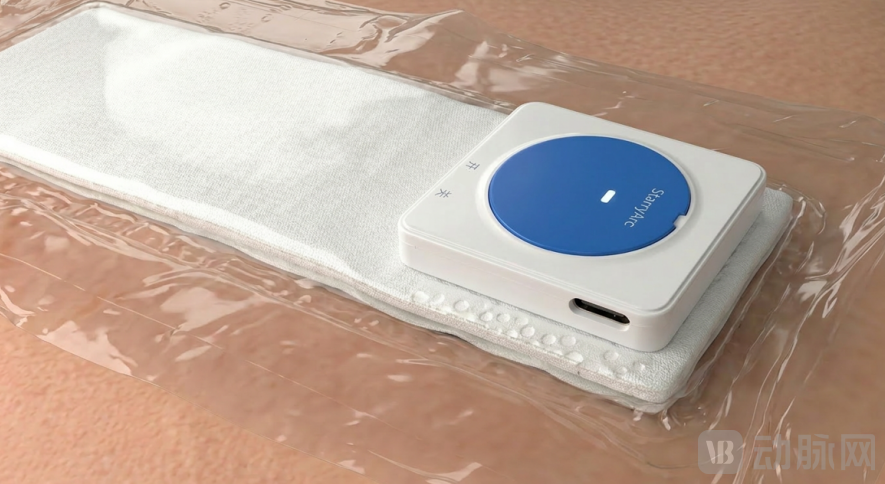
"Zhiyujie" Disposable Miniature Vacuum Negative Pressure Device
StarryArc's core product, the "Zhiyujie" disposable micro vacuum negative-pressure device (a smart dressing for rapid healing without replacement), offers a solution to the aforementioned challenges. For the first time, it has reduced a medical vacuum negative-pressure device to the size of a bottle cap, achieving a wearable, zero-noise design. Its highlights include:
Extreme miniaturization: The entire device weighs only 16 grams, with an ultra-thin design that can be directly applied to the incision surface, providing an almost imperceptible wearing experience;
Ultra-quiet operation: The device operates without any noise, meeting the need for a quiet environment during the patient's postoperative recovery period;
Tube-free design: It completely eliminates the tubing constraints of traditional negative-pressure systems, allowing patients to move freely and supporting seamless transitions from acute-phase in-hospital management to post-discharge continued care;
One-button activation: The device features an extremely simple operation, reducing the threshold for clinical use by healthcare professionals;
Extended battery life: Under proper sealing conditions, it can operate continuously for five to seven days, covering the critical postoperative healing window.
In September 2025, the product entered the innovation product registration procedure for Class II medical devices in Jiangsu Province. In October 2025, it was officially approved for market launch. The Jiangsu Provincial Medical Products Administration noted that the successful market launch of this product "fills the technological gap in the field of negative-pressure drainage therapy in China."
It should be emphasized that, for hospitals, the cost of postoperative infections far exceeds a single dressing change.
Surgical site infections are among the most common healthcare-associated infections, leading to prolonged hospital stays, increased antibiotic use, higher readmission rates, and even the need for secondary debridement and reoperation.
Under the diagnosis-related group and diagnosis-intervention packet payment models, the risk of cost overruns due to complications is gradually becoming a major challenge in the refined operational management of hospitals. A substantial body of international evidence-based research has demonstrated that closed-incision negative-pressure therapy can significantly reduce the incidence of postoperative incision complications, while also lowering readmission rates and shortening hospital stays.
For high-risk patients, the additional consumable costs associated with prophylactic use of closed-incision negative-pressure therapy are often far lower than the additional medical expenditures incurred by complications.
Therefore, the value of closed-incision negative-pressure therapy is reflected not only in patient benefits, but also in improved hospital operational efficiency and more efficient utilization of medical insurance funds.
From this perspective, incision management is gradually evolving from a mere nursing practice into a critical component that runs through both medical quality management and payment system reform.
With population aging, an increasing number of high-risk patients, and continued growth in surgical volume, the postoperative incision management market is also expected to enter a new growth cycle.
Following the completion of this financing round, StarryArc's short-term strategy is clear and well-defined:
First, to advance international regulatory certification. The funds will be primarily allocated to obtaining CE certification in the European Union and FDA registration in the United States, paving the way for the product's entry into overseas markets. In Europe and the United States, where closed-incision negative-pressure therapy is already a mature market, a product that truly addresses the pain points of portability and noise is expected to gain rapid clinical acceptance.
Second, to accelerate the research and development of new products and iterative upgrades. Building upon the existing "Zhiyujie" platform, the company will further expand the range of indications for its products, optimize intelligent monitoring functionalities, and explore potential integration with digital therapeutics and remote patient management.