

Shanghai Jiao Tong University's AR-Guided Cataract Surgery System Licensed for RMB 9.2 Million

MediWorks
Ophthalmic Product Manufacturer
In the field of ophthalmology,Cataract SurgeryIt is a routine surgery that helps countless patients regain their sight, but the narrow operative field and the demand for precise movements continually test every surgeon’s skill and concentration.
How to make surgical procedures more composed and precise has become a direction that the industry continues to explore.
Shanghai Jiao Tong University’s new patented technology offers a compelling answer:Integrating AI recognition and augmented reality into surgical microscopes to intuitively present professional operational guidance before surgeons’ eyes, wielding technology as a blade to assist physicians in safeguarding vision.
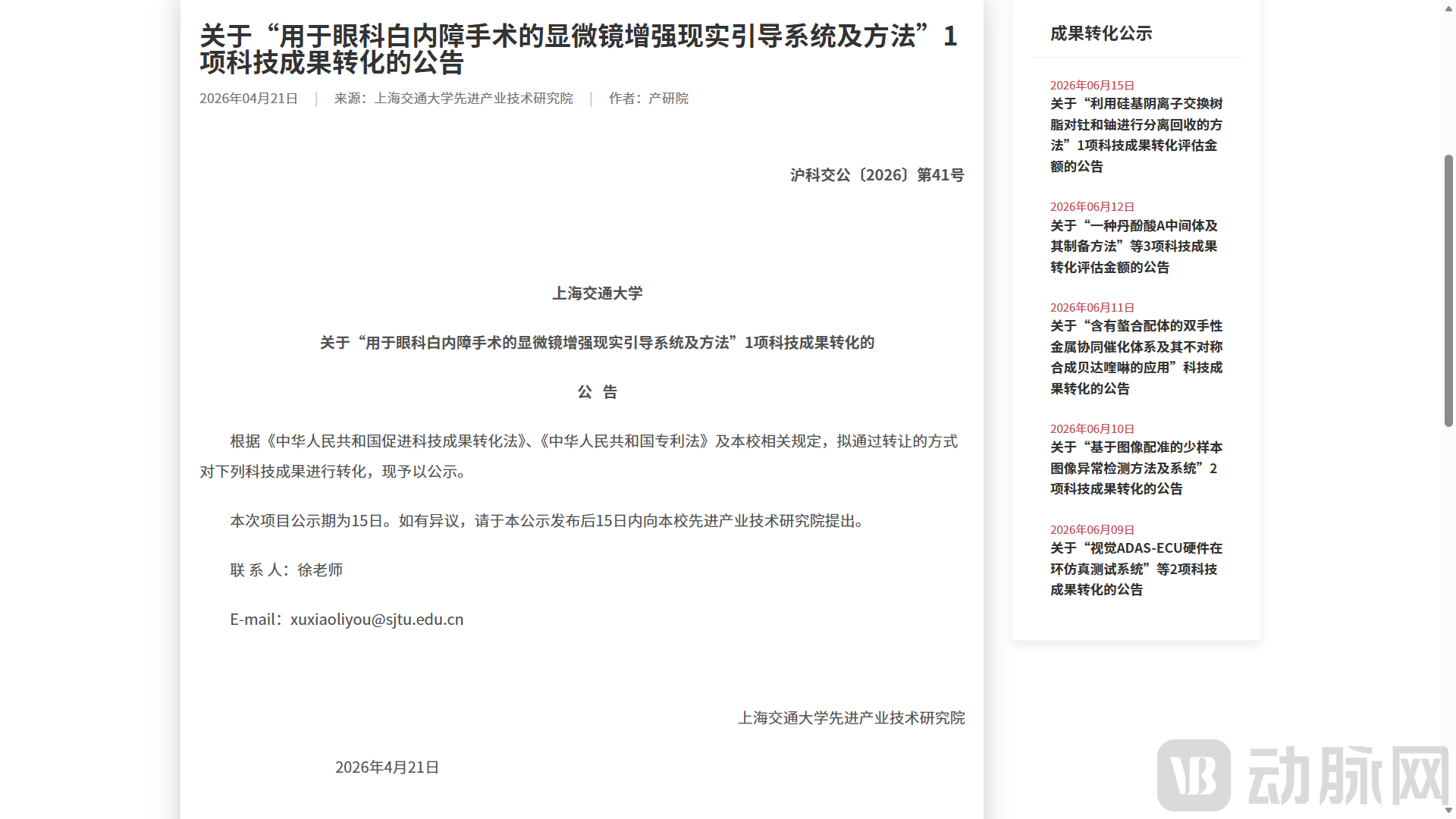
Image from the official website of the Advanced Industrial Technology Research Institute, Shanghai Jiao Tong University
Recently, Shanghai Jiao Tong University released a public notice on the transformation of scientific and technological achievements, proposing to transfer the "Microscope Augmented Reality Guidance System and Method for Ophthalmic Cataract Surgery" to Shanghai Mediworks Precision Instruments Co., Ltd. The proposed transaction amount is RMB 9.2 million, including a transfer fee of RMB 1.67 million and sales royalties of RMB 7.53 million. The inventors of this patent are Zheng Ce and his team.
The R&D team, jointly established by Xinhua Hospital Affiliated to Shanghai Jiao Tong University School of Medicine and Shanghai Jiao Tong University, comprises core members including Zhao Peiquan, Zheng Ce, Chen Xiaojun, Tu Puxun, and Huang Danqing. The team has long been dedicated to the interdisciplinary field of ophthalmic clinical practice and artificial intelligence algorithms, continuously exploring viable pathways for empowering ophthalmic surgeries with intelligent technologies over the years.
The team comprises clinical experts with decades of experience in the diagnosis and treatment of cataracts and pediatric fundus diseases, as well as algorithm specialists focused on computer vision and medical image analysis. Having previously launched multiple cutting-edge achievements, including the Ophthalmic Video Foundation Model (OVFM), the team has accumulated extensive experience and technical expertise in intelligent ophthalmic navigation and digital surgical analysis.
Mainstream in Clinical PracticePhacoemulsification Cataract Surgery, conducted entirely under a surgical microscope, with a narrow operating space that demands extremely high stability from the surgeon.Current intraoperative guidance systems generally face three major pain points in practical implementation:The analytical results of such systems are mostly displayed on external monitors outside the microscope, requiring doctors to repeatedly shift their gaze during operation. This easily disrupts the rhythm of hand-eye coordination and increases the risk of surgical complications.
Meanwhile, traditional image processing algorithms rely on iterative optimization. When faced with real-time video from surgical microscopes at 30 frames per second, their computational speed falls short, leading to prominent issues such as frame lag and guidance latency, which fail to meet the requirements for real-time intraoperative assistance. Furthermore, traditional solutions can only output basic information such as anatomical boundaries and surgical workflows, without translating them into core operational parameters that surgeons can directly reference, such as incision location and capsulorhexis range, thereby limiting their practical value.
To address these persistent real-world clinical challenges, the team leveraged frontline surgical experience and deep learning technology to develop this microscope-based augmented reality guidance system and its accompanying methodology. The system overlays AI-generated visual guidance cues directly into the microscope’s optical path, delivering precise surgical instructions while ensuring real-time computational efficiency, thereby deeply integrating intelligent assistance into the entire cataract surgery workflow.
Leveraging years of experience in cross-disciplinary R&D between medicine and engineering, the team has developed an augmented reality-guided solution for cataract surgery microscopes. The entire system consists ofSurgical microscope, image acquisition card, workstation, and semi-transparent displayComposed of four major modules, with software and hardware working in synergy to provide intelligent intraoperative assistance.
The image acquisition card captures surgical video in real time at 30 frames per second via an HDMI interface and transmits it to the workstation. Leveraging a deep learning convolutional neural network, the workstation accurately identifies the iris and surgical instrument regions, and, in conjunction with proprietary post-processing algorithms, rapidly extracts core parameters of ocular structures through contour extraction, curvature calculation, and ellipse fitting.
The system generates standardized guidance metrics based on anatomical parameters, precisely defines the angular ranges for primary and secondary incisions, and determines the reference radius for capsulorhexis. Simultaneously, it captures the instrument’s centerline in real time to calculate operational deviations. All guidance information is seamlessly overlaid onto the microscope’s optical path via a see-through display, allowing surgeons to intuitively receive operational prompts while observing the real-time surgical field.
This technology leverages deep learning to ensure real-time image processing, and combines it with proprietary post-processing algorithms to effectively reduce recognition errors, comprehensively enhancing the precision, stability, and practical value of surgical guidance.
Cataracts are a leading cause of blindness worldwide. Driven by population aging and policies promoting the decentralization of medical resources, market demand for intelligent surgical assistive devices in ophthalmology continues to rise, underscoring the sector’s clear and essential nature.
This technology directly addresses the pain points of traditional products. By integrating AR prompts into the microscope’s optical path and leveraging AI for real-time computation, it offers significant advantages in clinical adaptability, precision, and practicality. Backed by R&D teams from renowned hospitals and universities, the solution holds core patents and establishes robust technical barriers, making it difficult for competitors to replicate.
The system is compatible with existing mainstream devices, resulting in low implementation costs for hospitals and a low barrier to adoption. Its business model is clear: it can penetrate top-tier (Grade 3A) hospitals and specialized ophthalmic institutions, while also extending to grassroots levels for standardized physician training. Furthermore, the algorithm is scalable, with the potential to expand to various types of ophthalmic microsurgery, offering substantial growth opportunities.
Overall, the project boasts a broad market space, low implementation barriers, and a solid technological moat. It offers robust short-term profitability and significant long-term growth potential, making it a high-quality investment opportunity within the niche segment of smart healthcare.