

Nans Tech Secures Tens of Millions in Pre-B Financing with "Temporal Targeting" as First BCI-DTx Product Nears Launch

Nans Tech
Developer of Digital Therapeutics for Generalized Brain Dysfunction

Plum Ventures
Early-Stage Investment Firms

Jiangxi Financial Holding
State-Owned Wholly Financial Holding Group
Hangzhou Nans Tech, a company that has long been dedicated to the field of neurological rehabilitation digital therapeutics, is transitioning its corporate positioning from a provider of pediatric rehabilitation digital therapeutics to a full-life-cycle neurological rehabilitation technology platform. The company has also completed a Pre-B round of financing amounting to tens of millions of RMB.
This financing round was led by Plum Ventures, with Jiangxi Financial Holding participating as a follow-on investor. The raised funds will be primarily allocated to the research and development of the "temporal targeting" closed-loop brain-computer interface technology platform, the clinical validation, regulatory submission, and industrial-scale implementation of combined digital therapy and electrical modulation products, and the further enhancement of the industrial ecosystem and service network.
The so-called "temporal targeting" does not simply focus on "which brain region to stimulate," but further addresses the question of "at which millisecond-level time window of dynamic neural activity to stimulate, and with what temporal sequence of stimulation."
The former corresponds to the optimal timing of stimulation, while the latter corresponds to the optimal stimulation sequence that dynamically changes with neural activity. By introducing "temporal targeting" in addition to "spatial targeting," neuromodulation is expected to evolve from a "blind stimulation mode" to "precision guidance," thereby establishing a systematic neural coding strategy.
This is precisely the key factor that has attracted capital interest in Nans Tech.
The integration of digital therapeutics and brain-computer interfaces is an inevitable trend as neurological rehabilitation moves toward precision medicine.
Take neurodevelopmental disorders, language and cognitive impairments, and psychiatric conditions as examples. Patients in these categories have long-term and persistent needs, yet professional rehabilitation resources remain relatively scarce. Digital therapeutics can bridge screening, assessment, digital prescribing, rehabilitation training, outcome documentation, and follow-up management. To a certain extent, this alleviates the shortage of rehabilitation resources, enhances the level of professionalization in treatment, and improves patient adherence.
However, digital therapeutics also have their limitations. For instance, language and cognitive digital therapeutics primarily deliver controlled visual, auditory, and other stimuli through systematic training tasks to elicit corresponding neural activity. While they are effective at "eliciting" neural responses, they are not adept at directly "correcting" abnormal neural activity. Yet for the aforementioned conditions, the correction of neural activity and the remodeling of neural networks are precisely the key factors that determine whether rehabilitation outcomes can achieve a breakthrough.
Therefore, dynamic neuromodulation that can directly influence neural activity becomes particularly necessary. Conventional neuromodulation has long focused on the site of stimulation—namely, the "spatial target"—but has struggled to align with the optimal timing and stimulation sequence within dynamic neural activity. Nans Tech is now committed to bridging this gap: making precise modulation based on "spatial target, temporal target, and brain state" a reality.
Thus, the integration of digital therapeutics and brain-computer interfaces is not a mere conceptual patchwork, but rather the construction of a new closed-loop therapeutic pathway: using task-based stimulation from digital therapeutics to precisely elicit neural activity, employing electroencephalographic acquisition to sense brain states, applying electrical stimulation and other neuromodulation techniques to intervene at the right time with the right stimulation sequence, and continuously iterating modulation strategies through data feedback.
This holds the potential to propel neuropsychiatric rehabilitation from a black-box intervention model toward a new paradigm that is perceptible, quantifiable, and interpretable.
Of course, this path is by no means an easy one.
Data is the first critical barrier in this endeavor.
In this regard, Nans Tech has already built a substantial foundation. Its "Xiaonan Listening and Speaking" product series has been deployed in over 1,300 hospitals and rehabilitation centers across the country, serving more than 50,000 children with neurodevelopmental disorders and accumulating millions of hours of training and outcome data. These real-world data constitute an important foundation for the company's expansion toward closed-loop brain-computer interfaces.
Technological expertise is equally crucial. It is understood that the founding team of Nans Tech has years of experience in the industrialization of neuroelectrical stimulation products such as cochlear implants, as well as long-standing innovation and practical experience in core technologies such as dynamic neural coding strategies. This means that the company is not merely making a transition from a single digital therapeutics foothold, but rather possesses a solid grounding in both digital rehabilitation and neuroelectrical stimulation technological lineages.
On this basis, Nans Tech has established a technological pathway comprising "neural sensing, target identification, adaptive modulation, and data feedback."
Wang Ningyuan, founder of Nans Tech, emphasized in interviews that while neuromodulation has historically placed greater emphasis on the accuracy of stimulation location, the timing of stimulation is equally critical. Taking language rehabilitation as an example, the process from hearing a sound, recognizing speech, extracting semantics, to forming a response involves distinct neural processing stages at each step. Stimulation delivered at different time windows can produce different intervention effects, and may even shift from being facilitative to being disruptive.
More importantly, neural activity itself is a bioelectrical signal that changes over time. To truly achieve modulation coding, one cannot rely solely on fixed-frequency, fixed-intensity stimulation patterns; rather, stimulation sequences that dynamically match neural activity must be applied. By linking task-based stimulation, electroencephalographic feedback, modulation parameters, and training data, Nans Tech aims to make treatment protocols and outcomes more predictable and interpretable, while also providing more robust data support for clinical research and product iteration.
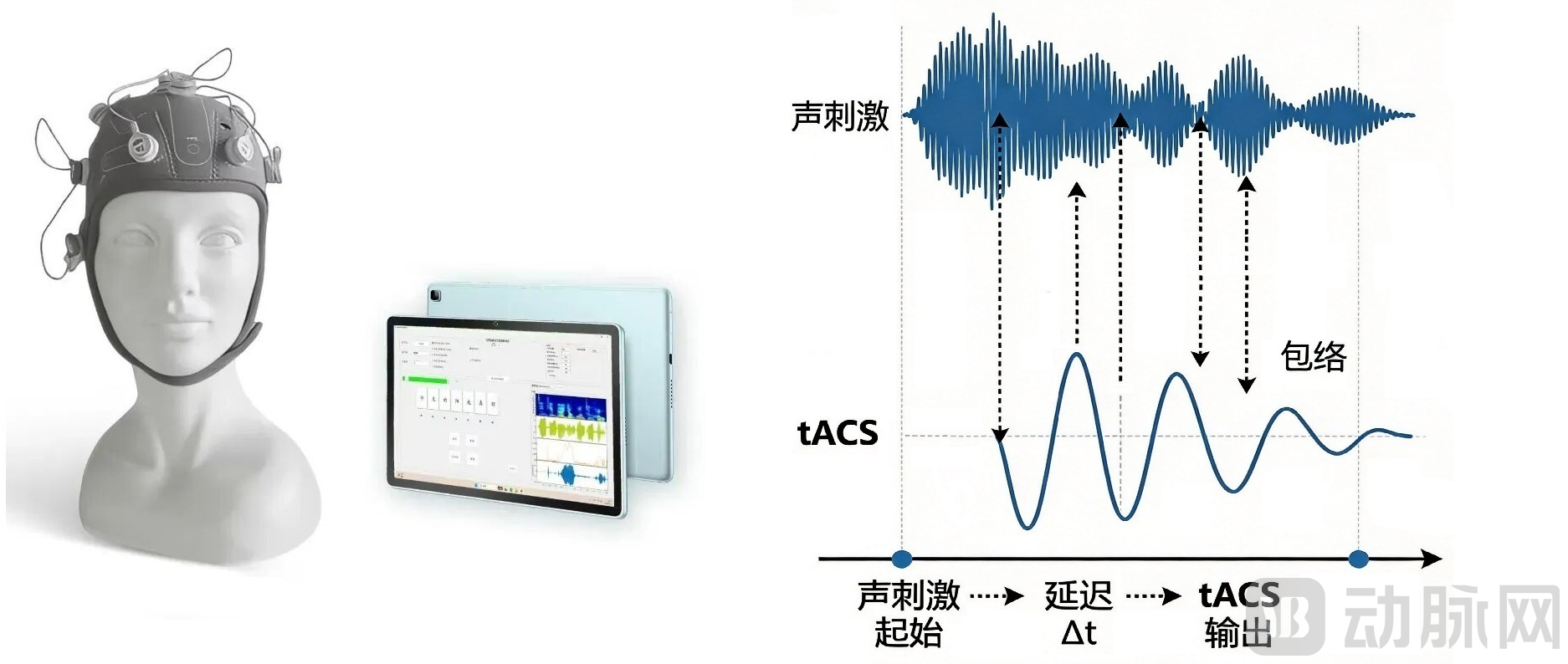
Schematic Diagram of the Digital-Electric Combined Therapy System and Linguistic Neural Coding Electrical Stimulation
According to Wang Ningyuan, based on this technology platform, Nans Tech's first combined digital therapy and electrical modulation product will prioritize the domain of language disorders, and has already yielded favorable pre-clinical data. This product is expected to officially initiate its regulatory submission process by the end of this year, and is anticipated to qualify for the fast-track pathway for innovative medical devices.
Looking ahead, Nans Tech will leverage its existing digital therapeutics platform and the technological evolution of "temporal targeting" brain-computer interfaces to continuously upgrade its rehabilitation systems for language disorders, autism spectrum disorder, attention deficit hyperactivity disorder, and learning disabilities. The company also plans to further expand into a broader range of neuropsychiatric rehabilitation scenarios, including stroke, Alzheimer's disease, depression, and sleep disorders, thereby building a product matrix of combined digital therapy and electrical modulation solutions.
While advancing its innovative products, Nans Tech is also building a more comprehensive neurological rehabilitation service network.
In terms of offline medical institution coverage, Nans Tech's digital therapeutics products have been adopted by more than 1,300 hospitals and rehabilitation centers across China, including over one hundred top-tier hospitals, and have served more than 50,000 patients cumulatively. At the same time, the company has established its own internet hospital, Brainheal, which serves as a critical hub connecting in-hospital services with home-based rehabilitation care.
Thus, from offline medical institutions to online internet hospitals, and from in-hospital assessment and institutional treatment to home-based training and remote management, Nans Tech is connecting previously fragmented rehabilitation components into a continuous service chain. Its service network not only covers a more diverse range of settings but also extends its products from institutional clients to family end-users.
Based on this framework, Nans Tech is able to provide patients, physicians, and rehabilitation therapists with more complete and continuous professional services on one hand. On the other hand, new combined digital therapy and electrical modulation products can be accelerated in their validation and implementation within the existing clinical network and real-world usage scenarios, enabling faster clinical translation through continuous iteration.
Regarding this round of financing, Plum Ventures stated that it values Nans Tech's technological originality in the direction of "combined digital therapy, electrical modulation, and brain-computer interfaces," as well as the determinacy of its clinical implementation pathway.