

World’s Only Approved Motor-Separated pVAD Unveils New Domestic Solution for Severe Circulatory Support

ForQaly
Minimally Invasive Heart Ventricular Assist Device Developer
SynFlow® 3.0, the proprietary percutaneous transvalvular ventricular assist system engineered by ForQaly Medical, received marketing clearance from China’s National Medical Products Administration(NMPA) on June 18. Comprising a pumping catheter, extracorporeal control unit, perfusion tubing and catheter sheath set, the system is indicated for high-risk percutaneous coronary intervention(PCI), delivering left ventricular hemodynamic support for adult patients with severe coronary artery disease, reduced left ventricular ejection fraction and hemodynamically stable status.
For decades, intracorporeal motor designs have monopolized the global market for percutaneous ventricular assist devices(pVADs). Though their clinical benefits are well-established, embedding precision motors within single-use disposable consumables drives per-procedure costs up to hundreds of thousands of renminbi, creating a critical roadblock to universal clinical access.
ForQaly Medical targeted this unmet clinical and economic pain point with SynFlow® 3.0’s game-changing separable reusable motor design. The motor, previously integrated into single-use high-value catheters, is relocated outside the patient’s body to form a reusable hardware unit. This proprietary engineering innovation delivers robust circulatory support while slashing per-treatment expenditures; it preserves long-term operational safety and dramatically expands clinical accessibility, fitting seamlessly within China’s existing medical payment ecosystem.
As the world’s only NMPA-approved motor-separated pVAD, SynFlow® 3.0 stands as a defining milestone for China’s domestic pVAD industry and a landmark for homegrown premium medical devices competing on the global stage through original, differentiated engineering pathways. In a segment long locked into a single technical paradigm, ForQaly’s separable reusable motor framework delivers a transformative product-level solution to resolve the cost-reimbursement impasse plaguing pVAD care, unlocking access to this life-sustaining technology for a far broader cohort of heart failure patients.
Population aging, compounded by rising prevalence of coronary artery disease and heart failure, has fueled steady growth in patients presenting with complex coronary lesions and diminished ejection fraction, cementing rigid clinical demand for high-risk PCI. According to Frost & Sullivan research, China recorded 193,000 high-risk PCI procedures in 2024, with annual volumes forecast to jump to 772,000 by 2033, driving sustained unmet demand for intraoperative circulatory support.
Patients undergoing high-risk PCI possess severely limited cardiac reserve and minimal native circulatory compensatory capacity. Complex interventional maneuvers including rotational atherectomy, prolonged balloon dilation and multivessel revascularization can trigger transient myocardial ischemia or hemodynamic instability, precipitating acute drops in cardiac output, hypoperfusion of vital organs and potentially catastrophic circulatory collapse. Stabilizing hemodynamics throughout the procedure to grant operators ample time for careful intervention has therefore become a decisive factor in procedural success and long-term patient outcomes.
Percutaneous ventricular assist devices(pVADs) have risen as a core therapeutic advancement for high-risk PCI, given their minimally invasive profile, ability to offload the left ventricle, boost cardiac output and sustain perfusion to critical organs. Beyond intraoperative hemodynamic stabilization, these systems enable clinicians to execute more complete, safer revascularization, extending life-saving care to patients with complex lesions previously deemed untreatable or high-risk for intervention.
Despite expanding clinical need, steep treatment costs remain the primary constraint limiting widespread pVAD deployment. All mainstream international pVAD platforms rely on intracorporeal motor technology, with intricate motors built into catheter tips and discarded alongside the single-use catheter following each procedure. This all-in-one disposable architecture keeps procedural costs prohibitively high.
Per-procedure costs for leading pVAD systems range from $20,000 to $25,000(approximately RMB 140,000 to RMB 180,000) across European and U.S. markets. For cases imported under China’s clinical urgent access pathway, additional markups from import tariffs, cross-border logistics and special approval licensing push out-of-pocket patient expenses even higher domestically.
“A technology’s impact is muted if it remains out of reach for most patients. No matter how sophisticated a medical device may be, it fails to fulfill its core mission of saving lives if only a tiny subset of the population can afford it,” Tang Zhirong, Founder of ForQaly Medical, told Arterial Network. The most direct path to fundamentally lower procedural costs, he explained, was decoupling the motor from the catheter to create a reusable extracorporeal component.
While relocating the motor from the catheter tip to outside the patient may appear a simple positional adjustment, it demanded an end-to-end systems engineering overhaul. The company had to build entirely new frameworks for power transmission, hermetic sealing and long-duration operational stability—technical hurdles with no established global precedents to draw upon.
After locking in the separable motor development roadmap, ForQaly’s engineering team first tackled a foundational challenge: reliably driving the high-speed impeller housed inside the patient’s ventricle via an extracorporeal motor.
Intracorporeal motor designs feature a direct drive shaft linking the motor to the impeller, creating a short, efficient power transmission pathway. Moving the motor outside the body, however, inserts an extended power transfer route stretching externally through tortuous vascular anatomy, requiring consistent torque delivery along a curved, elongated pathway—a feat posing extreme engineering complexity.
ForQaly Medical overcame this barrier with proprietary flexible drive shaft technology. The pliable torque-transmitting flexible shaft transfers rotational power stably from the extracorporeal motor to the catheter-tip impeller to maintain continuous blood pumping. The flexible drive architecture forms the technical backbone of the separable motor design, without which reusable motors and corresponding cost reductions would not be feasible.
Flexible drive shafts inherently feature low structural stiffness and extreme length-to-diameter ratios, prone to severe mechanical vibration under high rotational speeds that undermines system stability. ForQaly’s R&D team launched iterative technical research starting in 2015 to mitigate vibration through targeted engineering adjustments: fine-tuning shaft diameter, reducing component mass, adding constraint layers and calibrating rotational clearances, alongside iterative design optimization guided by rotor dynamics theory. After years of successive prototype iterations, bench testing and preclinical animal trials, the platform achieved continuous stable operation at nearly 50,000 revolutions per minute for 14 consecutive days, laying critical engineering groundwork for the separable motor platform.
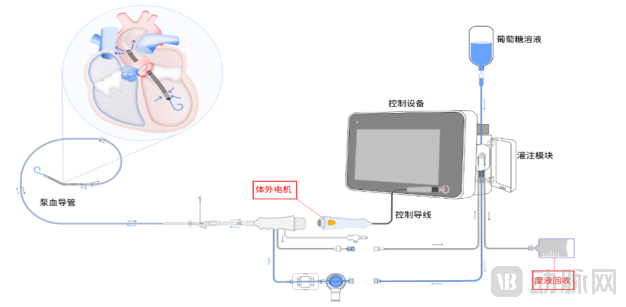
SynFlow® 3.0 System
A long-overlooked yet critical safety challenge for prolonged pVAD support is particulate debris generated during high-speed operation. All pVAD systems employ mechanical drive trains, and friction within high-velocity bearings and transmission hardware inevitably produces micro-wear particles. Should these particles enter systemic circulation, they risk distal embolization or chronic vascular wall deposition, with cumulative latent hazards compounding as support duration extends.
ForQaly Medical engineered its proprietary Clinfusion® Clean Perfusion Technology to block this risk pathway. Leveraging a multilumen catheter design, the system delivers sterile perfusate to the distal catheter tip, splitting fluid flow into two streams. One stream flows antegrade into the vasculature to prevent retrograde blood reflux, while the second stream travels retrograde along the drive train back to the extracorporeal circuit. This dual-flow design lubricates transmission components while continuously flushing wear particulates out of the patient’s circulation, eliminating exposure of the bloodstream to microdebris.
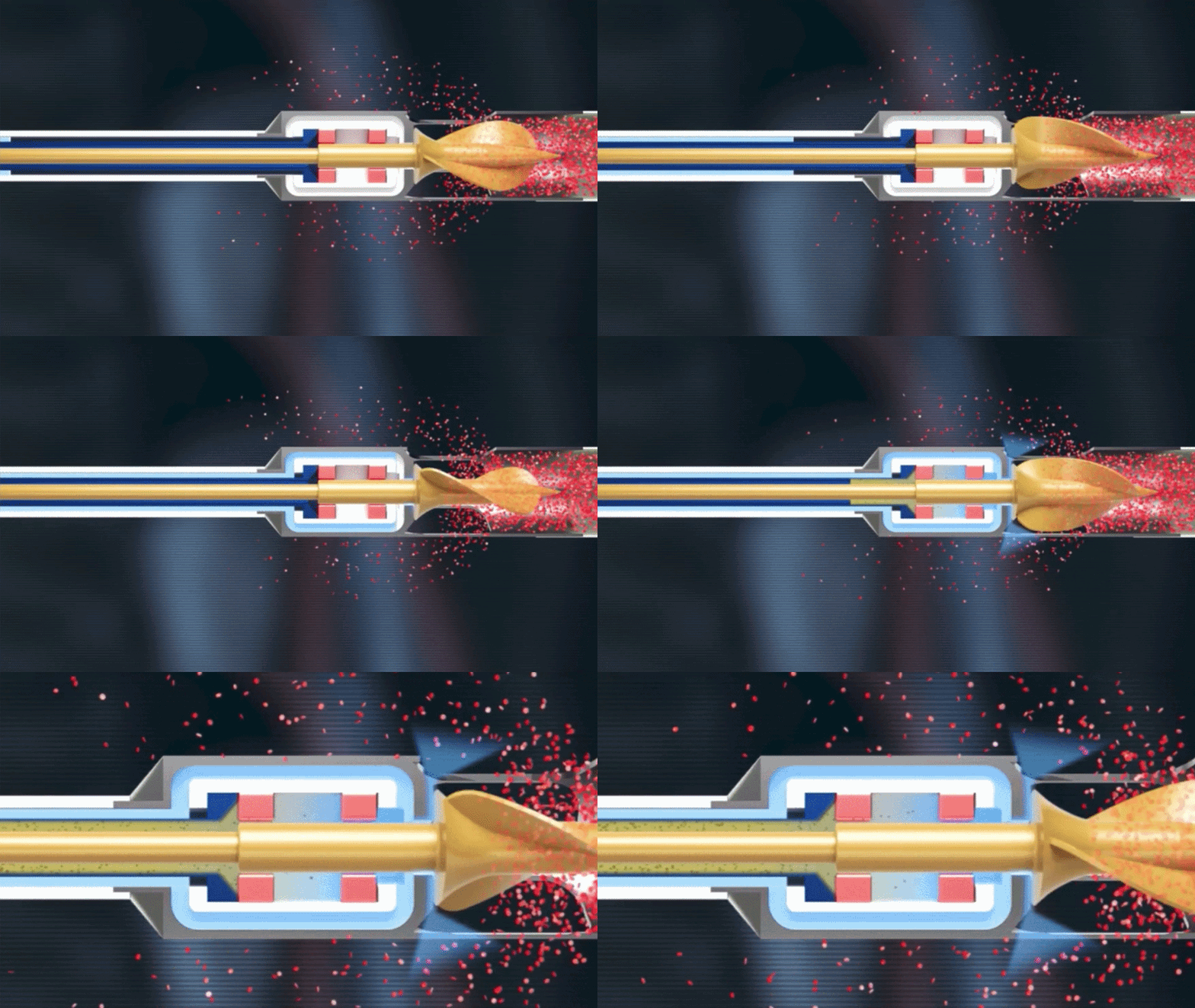
Clinfusion®Clean Irrigation Technology
Tang Zhirong, Founder of ForQaly Medical, elaborates on the proprietary Clinfusion® Clean Perfusion platform.
Two core proprietary breakthroughs underpin SynFlow® 3.0’s foundational “separable motor+clean perfusion” architecture: flexible power transmission resolves torque delivery across extended pathways, while Clinfusion® Clean Perfusion mitigates particulate hazards during long-duration support. Together, this reimagined platform redefines pVAD value propositions across safety, deliverability and cost efficiency across four key dimensions:
First, it mitigates thermal injury risks within the vasculature. Removing the motor from the intracorporeal space eliminates electromagnetic heat buildup from sustained high-speed rotation inside the body, lowering risks of blood thermal degradation, hemolysis and thrombosis.
Second, it minimizes electromagnetic interference(EMI). The extracorporeal motor sits separated from subcutaneously implanted cardiac implantable electronic devices(CIEDs) by the full width of the patient’s torso, and electromagnetic field strength decays exponentially with distance, substantially reducing the likelihood of device cross-interference.
Third, it improves vascular deliverability. Eliminating the intracorporeal motor shortens the catheter’s non-flexible rigid segment, boosting overall trackability. The softer catheter profile navigates complex vascular anatomies with greater ease and reduces mechanical trauma to native heart valves and myocardial tissue.
Fourth, it restructures the total cost of care model. Shifting the motor from a single-use disposable component to a reusable hardware unit delivers sharp reductions in per-procedure costs, making life-sustaining circulatory support accessible to far more patients.
Collectively, SynFlow® 3.0 represents more than a localized domestic alternative to imported pVAD devices; it delivers a transformative industry solution centered on two core unmet needs: equitable clinical access and sustained long-term operational safety. Its design prioritizes not just rapid, reliable establishment of circulatory support, but sustained safer, affordable and extended therapeutic benefits for patients once support is initiated.
Cutting-edge engineering innovation ultimately stands or falls on tangible clinical value, and SynFlow® 3.0’s performance has been validated through formal clinical trials and real-world practice.
At the 37th Transcatheter Cardiovascular Therapeutics(TCT) Annual Scientific Meeting held in San Francisco in October 2025, Academician Ge Junbo of the Chinese Academy of Sciences, representing the research team at Zhongshan Hospital, Fudan University, presented top-line results from the PERSIST Ⅲ clinical trial. Trial data confirmed SynFlow® 3.0 delivers robust hemodynamic support alongside a favorable safety profile: enrolled patients exhibited lower intraoperative transfusion rates, shorter hospital lengths of stay and minimal incidence of device-related adverse events.
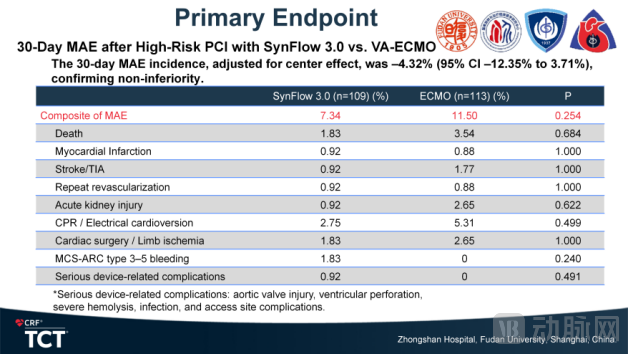
Primary Endpoint Data from the PERSIST Ⅲ Clinical Trial
The platform has also demonstrated capacity to scale from short-duration intraoperative support to prolonged intensive care interventions for critically ill patients in real-world complex clinical scenarios. The First Hospital of Lanzhou University deployed SynFlow® 3.0 for 7.5 consecutive days to successfully rescue a patient with fulminant severe myocarditis. Xiamen Cardiovascular Hospital combined the system with VA-ECMO for extended circulatory support to treat a patient with acute myocardial infarction complicated by cardiogenic shock(AMICS). Clinicians at Zhongshan Hospital, Fudan University completed four high-risk PCI procedures in a single day, verifying consistent stable performance for routine complex interventional cases.

Group Photo of the Recovered Patient Supported by SynFlow® 3.0 for 7.5 Days at the First Hospital of Lanzhou University
As real-world clinical experience and high-level clinical evidence continue to accumulate, SynFlow® 3.0’s therapeutic potential within critical circulatory support care will expand further.
ForQaly Medical set out a decade ago with a singular mission: to build a pVAD system affordable for Chinese patients. Today, the firm has delivered on that vision by securing regulatory approval for the world’s only motor-separated pVAD platform after ten years of concentrated R&D. The milestone underscores a core industry truth: the global pVAD landscape is not limited to a single technical pathway.
Shifting the motor from a disposable consumable to a reusable hardware unit pulls per-procedure treatment costs down from six-figure renminbi price points to financially manageable levels, bringing this life-critical circulatory support technology within reach of mainstream patient populations. SynFlow® 3.0’s NMPA clearance stands as both the culmination of a decade-long engineering quest and a new inflection point for universal clinical adoption of percutaneous ventricular assist devices.