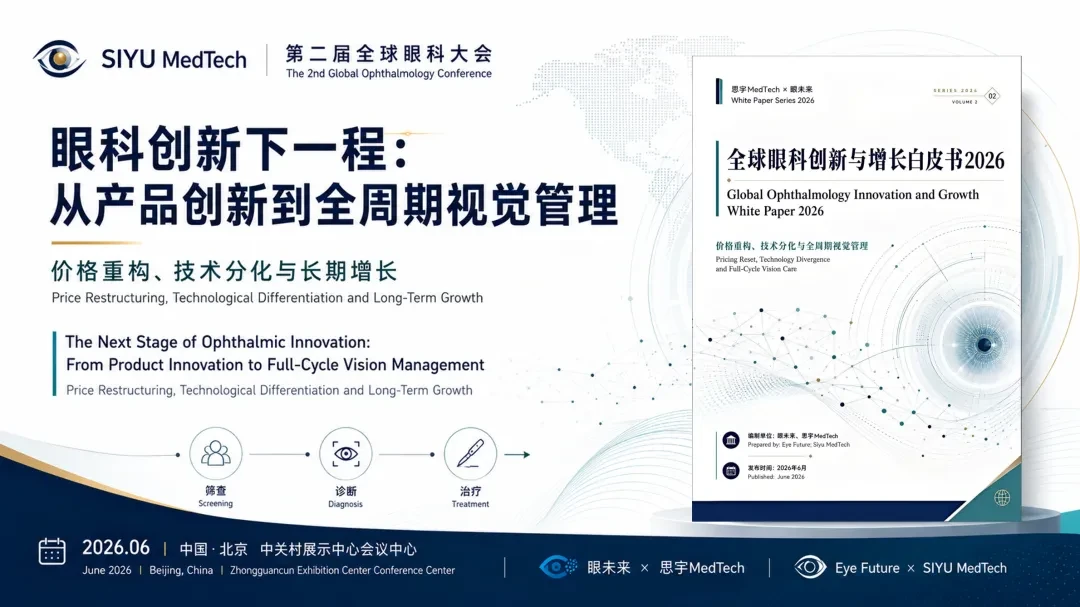
Global Ophthalmology Innovation and Growth White Paper 2026 Released at the 2nd Global Ophthalmology Conference

Big Vision
Developer of Artificial Intelligence Analysis and Diagnosis Products for Ophthalmic Imaging
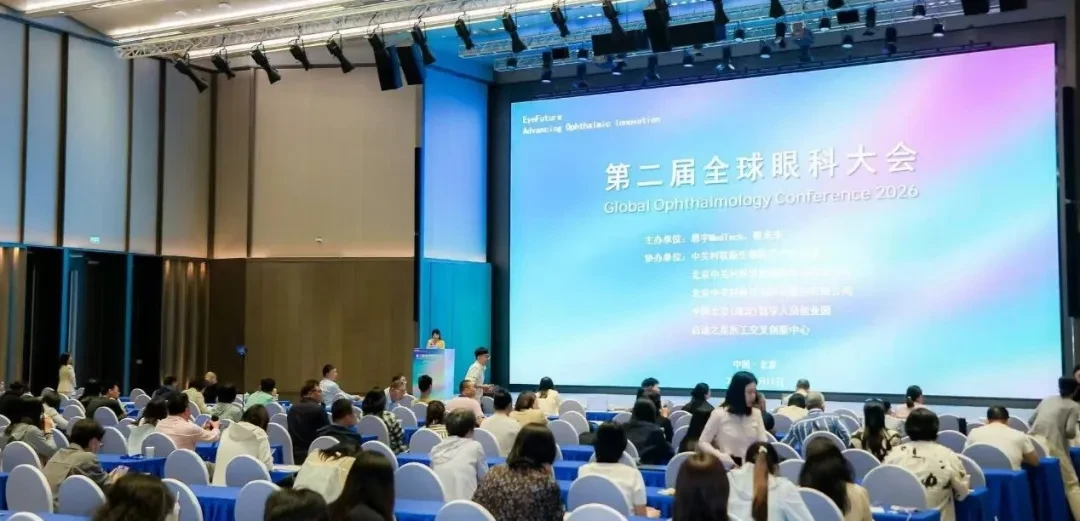
June 11, 2026The 2nd Global Ophthalmology Conference was held at the Conference Center of Zhongguancun Exhibition Center in Beijing.Zhao Qing, Editor-in-Chief of Siyu MedTech and Eye Future; Secretary-General of the Zhongguancun Lianxin Biomedical Industry AllianceDelivering a Thematic Presentation: “The Next Chapter in Ophthalmic Innovation: From Product Innovation to Full-Cycle Visual Management”, and release"Global Ophthalmology Innovation and Growth White Paper 2026"。

Zhao Qing, Editor-in-Chief of Siyu MedTech and Eye Future, Secretary-General of the Zhongguancun Lianxin Biomedical Industry Alliance
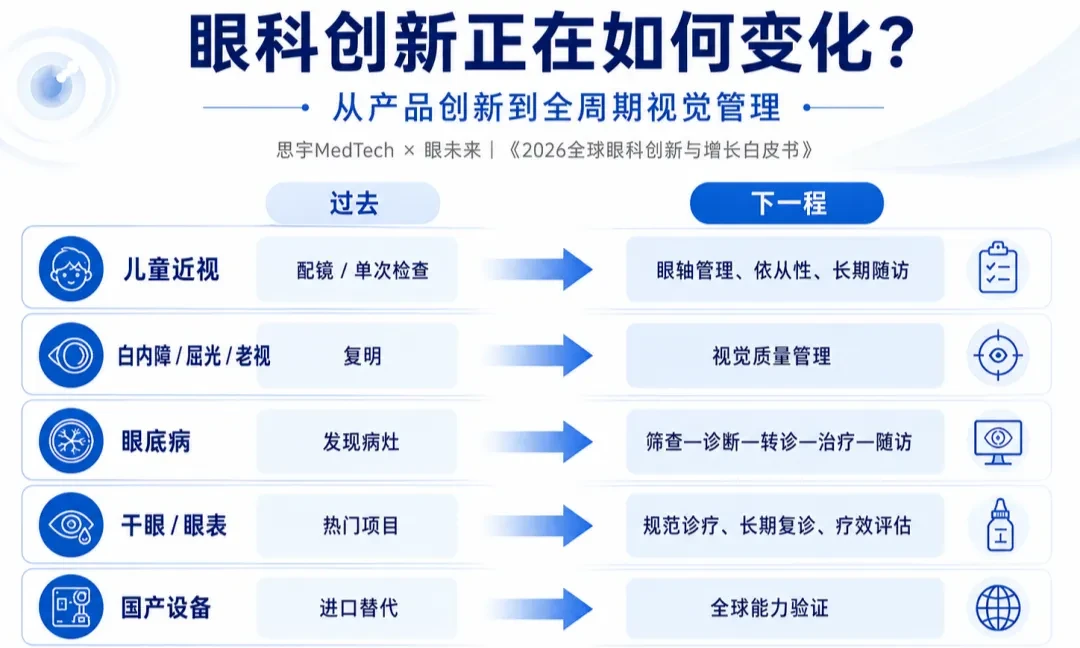
“Eye Future” tracks daily information flows across global ophthalmic instruments, ophthalmic equipment, optometry, fundus imaging, ophthalmic AI, dry eye and ocular surface, refractive and cataract surgery, and myopia prevention and control. Past growth was driven by demand release, channel expansion, equipment installation, and project popularity; in the future, growth is more likely to stem from enterprises’ capabilities in managing the full patient lifecycle, enhancing physician efficiency, adapting to payment changes, and delivering innovative services that integrate single products into real-world clinical workflows.
The white paper focuses on eight key issues:
First, why is the global demand for visual health still expanding;
Second, how price restructuring influences the direction of ophthalmic innovation;
Third, how cataract, refractive, and presbyopia treatments are shifting from "restoring sight" to "visual quality";
Fourth, Why Myopia Prevention and Control Is Evolving into Pediatric Visual Management;
Fifth, Why Fundus Imaging, OCT, AI, and Glaucoma Management Will Become Long-Term Entry Points;
Sixth, how the dry eye and ocular surface market can return from a popular trend to standardized diagnosis and treatment;
Seventh, how Chinese high-end ophthalmic equipment can move from import substitution to global competition;
Eighth, what growth strategies might Chinese ophthalmic companies adopt in the future.
We strive to present the facts and logic, leaving the judgment to the readers.
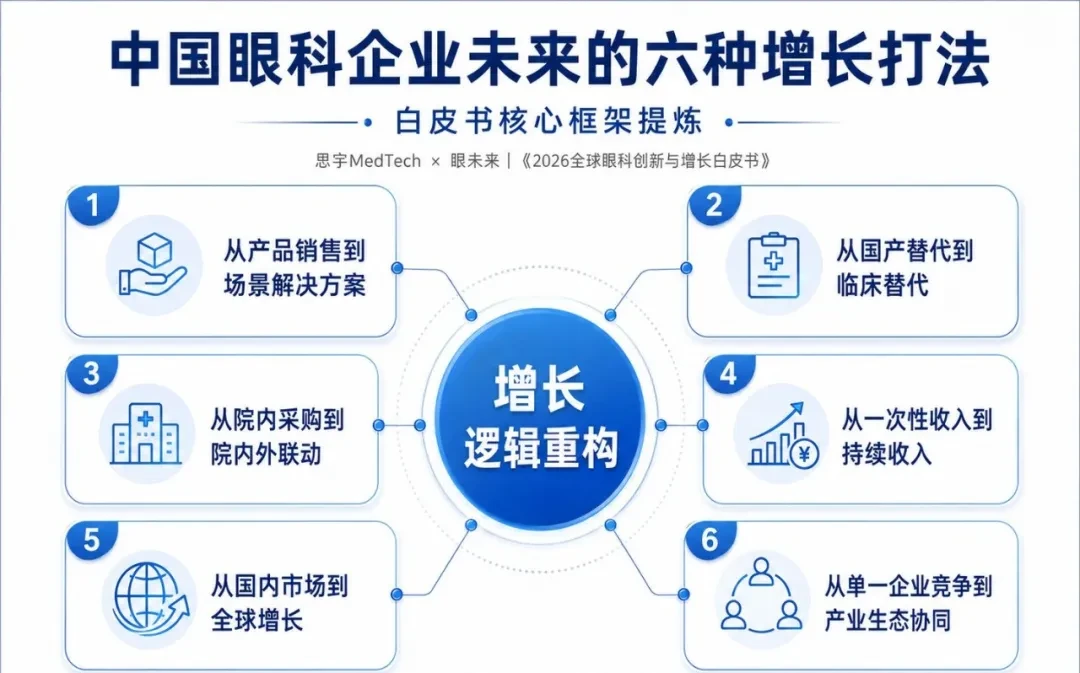
In the “2026 Global White Paper on Ophthalmic Innovation and Growth,” “Eye Future” not only focuses on price restructuring, technological differentiation, and growth logic in the global ophthalmic industry, but also selectsA Cohort of Representative Chinese Innovative Ophthalmic Enterprises.
Big Vision MedicalThis represents the trajectory of ophthalmic imaging AI evolving from “algorithmic capability” to a “clinical tool.” The company has built an integrated hardware-software product ecosystem centered on optical coherence tomography (OCT), ultra-widefield fundus imaging, and AI-assisted diagnosis. Its OCT image-assisted diagnostic software, MIAS-3000, has obtained a Class III medical device registration certificate, focusing on age-related macular degeneration (AMD) screening and lesion identification. More importantly, Big Vision’s value extends beyond the devices themselves, manifesting in applications such as fundus disease screening, primary screening at grassroots healthcare facilities, two-way referral systems, and comprehensive lifecycle management of chronic fundus diseases.
Intalight SaiweiRepresenting the trend of Chinese-made high-end ophthalmic diagnostic and therapeutic equipment leading the global frontier, it forms a diagnostic matrix with the Ruyi True Color Camera, Ruyi Full-Cornea Biometer, and Ruyi Whole-Eye OCT. It enhances multimodal imaging synergy and ultra-high-speed OCT capabilities through the Ruyi Center and Ruyi 600. Meanwhile, it is developing therapeutic equipment such as surgical microscopes and full femtosecond laser surgery systems. Committed to integrating the advantages of semiconductor optics, swept-source OCT, multimodal imaging, and AI algorithms, it aims to accelerate the construction of the Ruyi Smart Optical Diagnosis and Treatment Ecosystem, covering diagnosis and treatment, and oriented towards clinical practice, scientific research, and international markets.
Big Vision MedicalThis signifies the shift in optometry from “training services” to a model of “digital therapeutics + home-based management.” The company specializes in strabismus and amblyopia treatment, visual function training, and myopia prevention and control. Its brand Duobaoshi focuses on digital therapeutics for visual training, while Beibeile has developed a product line centered on PBM red-light therapy for myopia prevention and control. Its core value lies in extending eye health management from one-time clinical visits at hospitals to long-term adherence management in children, home-based usage, and the accumulation of real-world evidence.
AnshikangThis represents the opportunities for the widespread adoption of optometric equipment across diverse scenarios. The company has deployed comprehensive solutions for ophthalmic diagnosis and treatment, school-based vision screening, and optical retail stores, centering on products such as vision screening systems, optical biometers, dry eye diagnostic devices, and visual function assessment and training systems. Its core products, Swan and Draco, cover scenarios including myopia management and pre-operative cataract measurements, extending optical biometry capabilities from hospitals to schools, communities, optometry centers, and primary care settings, thereby making precise screening accessible to a broader population.
Topview MedicalAs a representative of domestic enterprises independently developing a full range of ophthalmic diagnostic and treatment equipment, it leads Chinese-made ophthalmic devices from single-product breakthroughs toward the development of a comprehensive, multi-category platform.. The company has built a product portfolio centered on OCT/OCTA, ophthalmic surgical microscopes, ultra-widefield fundus cameras, and optical biometers, while further expanding into integrated phacoemulsification and vitrectomy systems, femtosecond laser surgical systems, surgical robots, and AI-based diagnostic and therapeutic platforms. In particular, the intraoperative swept-source OCT navigation surgical microscope,Like providing surgeons with "X-ray vision" during operations, it plays a key role in intraoperative decision-making and surgical guidance, propelling ophthalmic surgery into an era of precision, intelligence, and digitalization.
Blue HugIt represents the care segment within the myopia control industry chain, which is often overlooked yet constitutes a critical necessity. As the user base for orthokeratology lenses, contact lenses, and various optometric products expands, standardized care, safety, and compliance have become genuine clinical concerns. The Lanbaobao Contact Lens Cleaner simulates manual rubbing to provide standardized cleaning and convenient home use.Reduce the safety risks caused by improper manual cleaning operations.
Nuanxinjia TechnologyIt represents the more advanced and cutting-edge exploration of artificial vision technologies in ophthalmic innovation. The company focuses on brain-computer interfaces (BCIs) and neuromodulation, with its high-resolution visual BCI products targeting patients with severe vision loss and impairment, exploring visual restoration through retinal and visual cortical pathways. This also indicates that the boundaries of ophthalmic innovation are extending into neuroengineering, implantable chips, and brain-computer interfaces.
Jiuchen MedicalThis represents an upgrade in ophthalmic diagnostics from central refraction to peripheral retinal refraction and comprehensive visual quality assessment. Its Wide-Field Retinal Refractive Topographer, VPR, can objectively measure the refractive status of multiple retinal points in a single session, driving clinical practice from traditional "single-point optometry" toward "full-field topography." The future goal of ophthalmic management is not merely "clear vision," but also "good vision, comfortable vision, and long-term stability."
These corporate cases collectively point to a judgment:Innovation in ophthalmology has already evolved into a new round of competition centered on clinical workflows, affordability, patient adherence, physician efficiency, data closed loops, and long-term management and service capabilities.
Those who can integrate technology into real-world scenarios and transform products into sustainable solutions are more likely to secure a position in the next phase of restructuring within the ophthalmic industry.
Beyond 2026, the ophthalmic industry will still present substantial opportunities.
Some opportunities lie in value reassessment following price restructuring, some in long-term visual management for children, some in fundus chronic disease screening and AI-driven workflow transformation, some in standardized diagnosis and treatment of dry eye disease, some in the globalization of high-end domestically produced equipment, and others in more frontier areas such as visual brain-computer interfaces, intraoperative navigation, and comprehensive refractive measurement.
If you are evaluating whether a product is worth investing in, whether a company possesses long-term value, or whether a niche market still has growth potential, we hope this white paper provides you with some insights.
The "2026 Global Ophthalmology Innovation and Growth White Paper" has been released.
Click “Read Full Text” at the end of the article to read, download, and print the full content.(Content exchange, contact Editor-in-Chief Zhao Qing: WeChat ID qingzhao2017)