Note: This article does not constitute any investment advice or recommendations; please refer to official/company announcements for authoritative information. This article is intended solely for the introduction of medications related to medical and health care, and does not recommend treatment plans (if involved), nor does it represent the platform's position.Authorization is required for any article reprint.
On June 18, Westlake Therapeutics (hereinafter referred to as "Westlake Bio"), based in Hangzhou, announcedCompleted a new round of financing exceeding RMB 100 millionThis round of financing was jointly led by Beijing Shijingshan District Modern Innovation Industry Development Fund Co., Ltd. (hereinafter referred to as "Shijingshan Modern Innovation Industry Fund") and Ruili Synthetic Biology Fund, with participation from well-known industrial investors in the follow-on investment. Existing shareholders including Yifeng Capital, Huafang Capital, and Sequoia China continued to increase their investments.

The proceeds from this round of financing will be primarily used to advance the development of the company’s pipeline of red blood cell-based therapeutics in oncology, autoimmune diseases, and other therapeutic areas; accelerate clinical validation and regulatory filings for core products; and further strengthen capabilities in research and development, manufacturing, and industrialization.
Westlake Therapeutics, established in 2019, is the first biotechnology innovation enterprise spun off from research achievements at Westlake University, specializing in the research, development, and industrialization of engineered red blood cell (RBC)-based therapeutics. The company focuses on the natural interaction between RBCs and the immune system, leveraging the biological properties of RBCs—specifically their homing to the spleen and participation in immune regulation—to develop a new generation of immune-modulating RBC-based drugs.Around this directionThe company has established the world’s first adult red blood cell–drug conjugation technology platform, REDx, which enables stable conjugation of diverse therapeutic payloads—including antibodies, nucleic acids, small molecules, and enzymes—to red blood cells. It has also built a portfolio of innovative pipelines in oncology, autoimmune diseases, metabolic disorders, and nucleic acid delivery.The company has simultaneously established a fully automated, closed, and standardized red blood cell therapeutic manufacturing system, capable of supporting stable supply during the clinical stage and laying the foundation for subsequent large-scale production and industrialization.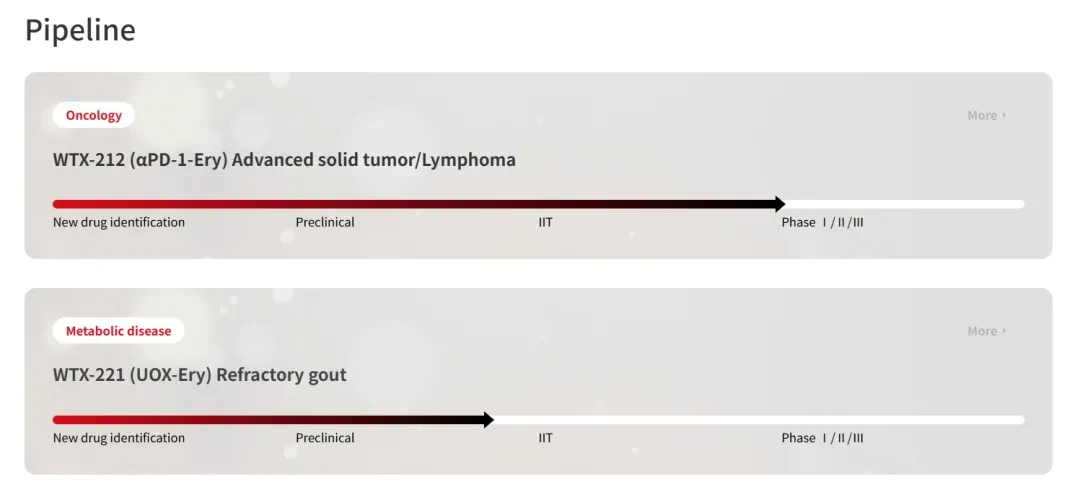
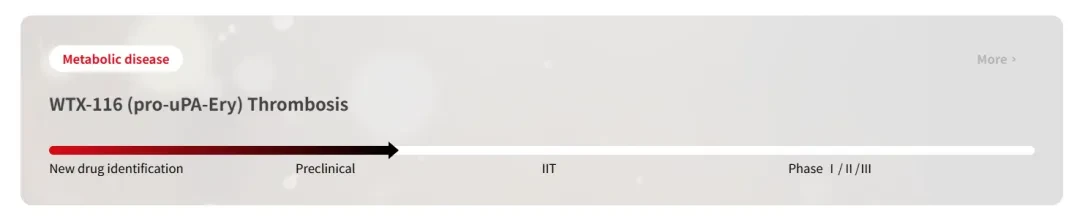 WTX-212: The World's First Red Blood Cell–Anti-PD-1 Antibody Conjugate:Leveraging the natural splenic homing property of red blood cells, WTX-212 remodels the immune microenvironment within the spleen, promotes the expansion of newly generated tumor-specific T cells, and enhances systemic anti-tumor immune responses, thereby overcoming immune resistance at the fundamental mechanistic level. This drug combines the advantages of low toxicity, standardized preparation, and scalable manufacturing, holding promise to provide a new therapeutic pathway for patients with immunotherapy-resistant solid tumors. In the first-in-human clinical study initiated by investigators,WTX-212 demonstrated favorable safety and significant antitumor activity in patients with PD-1/PD-L1 resistant solid tumors, achieving the world’s first complete response in a solid tumor patient treated with red blood cell therapy.and sustained survival benefits were observed. WTX-212 is scheduled to submit Investigational New Drug (IND) applications in both China and the United States in 2026, and clinical exploration of its allogeneic red blood cell version has already been initiated.WTX-101 Red Blood Cell–mRNA-LNP Conjugate Drug:WTX-101 is a red blood cell–mRNA-LNP conjugate drugBy leveraging the natural interaction mechanism between red blood cells and the splenic immune system, this approach reshapes the in vivo distribution and delivery pathways of mRNA therapeutics, enabling highly efficient targeted delivery to the spleen and myeloid immune cells while reducing liver exposure and the risk of systemic inflammatory responses associated with traditional lipid nanoparticle (LNP) systems. Based on this platform, the company has achieved in vivo generation of CAR-immune cells, providing a novel technological pathway for the treatment of cancer and autoimmune diseases.
References:
Company Website
Scan the QR code to join the groupMastering CAR-T therapy, stem cell therapy, and geneTherapy,Comprehensive Information on Oncolytic Viruses and Nucleic Acid Therapeutics