

MoleculeMind Led by Jinbo Xu Secures Over $100M Series A, Defining New Global Infrastructure for AI Protein Industry

MoleculeMind
AI Protein Design Platform Developer

PDVC
Headquartered in Zhangjiang Hi-Tech Park and backed by the Yangtze River Delta economic circle, the company supports the development of small and medium-sized technology enterprises while achieving its own capital appreciation, thereby creating a win-win situation.

Oriental Fortune Capital
Professional Venture Capital Management Firm

Infinity
Equity Investment Firm
The AI protein sector has landed another landmark financing deal.
MoleculeMind Inc., a global front-runner in AI-powered protein design platforms, has completed its Series A financing package, with cumulative funding surpassing $100 million.
New investors joining the round include Blue Bridge Capital, PDVC, COFCO Emerging Industries Fund, Oriental Fortune Capital, Fosun Capital, Guofang Venture Capital, Sepax Technologies(688758), Infinity, Caixin Capital and Zhengding. Long-standing shareholders Cathay Biotech(688065) and Neux Capital have also injected additional capital.
The broad mix of financial investors, industrial conglomerates and state-backed venture arms signals widespread market conviction in MoleculeMind’s technical roadmap and commercial trajectory.
At a time when capital markets prize tangible commercial certainty and AI for Science(AI4S) moves into deep industrial deployment, the fundraising delivers a clear message: global competition in AI protein development has shifted beyond lab-based model benchmarking to industrial-grade rivalry centered on solving real industry pain points and building closed-loop commercialization.
Amid this sector-wide realignment, MoleculeMind is cementing its rare position as the definer of global AI protein industrial infrastructure, backed by world-leading core technology, validated industrial deliverables and uncommon cross-sector investor alignment.
01
Generational Technology Edge: World-Renowned Scientist Leads the Second Paradigm Shift in AI Protein Research
For decades, both new drug discovery and industrial enzyme engineering have essentially relied on a blind, hit-or-miss screening process. Faced with candidate molecular libraries numbering in the hundreds of millions, pharmaceutical companies typically spend more than a decade and billions of dollars on screening and validation.
“The next phase of AI drug development must move past random trial and error,” said Professor Jinbo Xu, founder of MoleculeMind.
Professor Xu is the inventor of RaptorX-Contact, the world’s first effective AI algorithm for protein structure prediction, and is widely recognized as the founding pioneer of AI protein folding.
Following the first paradigm leap driven by protein structure prediction, he is now leading MoleculeMind to drive the next transformation: moving biological macromolecule R&D from random trial-and-error to a deterministic era of programmable bioengineering.
While most industry players remain focused on structure prediction, MoleculeMind has extended its capabilities into the industrial validation phase of de novo design, delivering tangible results for real clinical targets.
The company recently launched MMDesign, its AI-powered de novo biologic design platform with transformative industrial value. In tests across 12 real clinical targets, the platform achieved a hit rate of over 90%, cracking notoriously challenging targets such as GPCRs and TNFα.
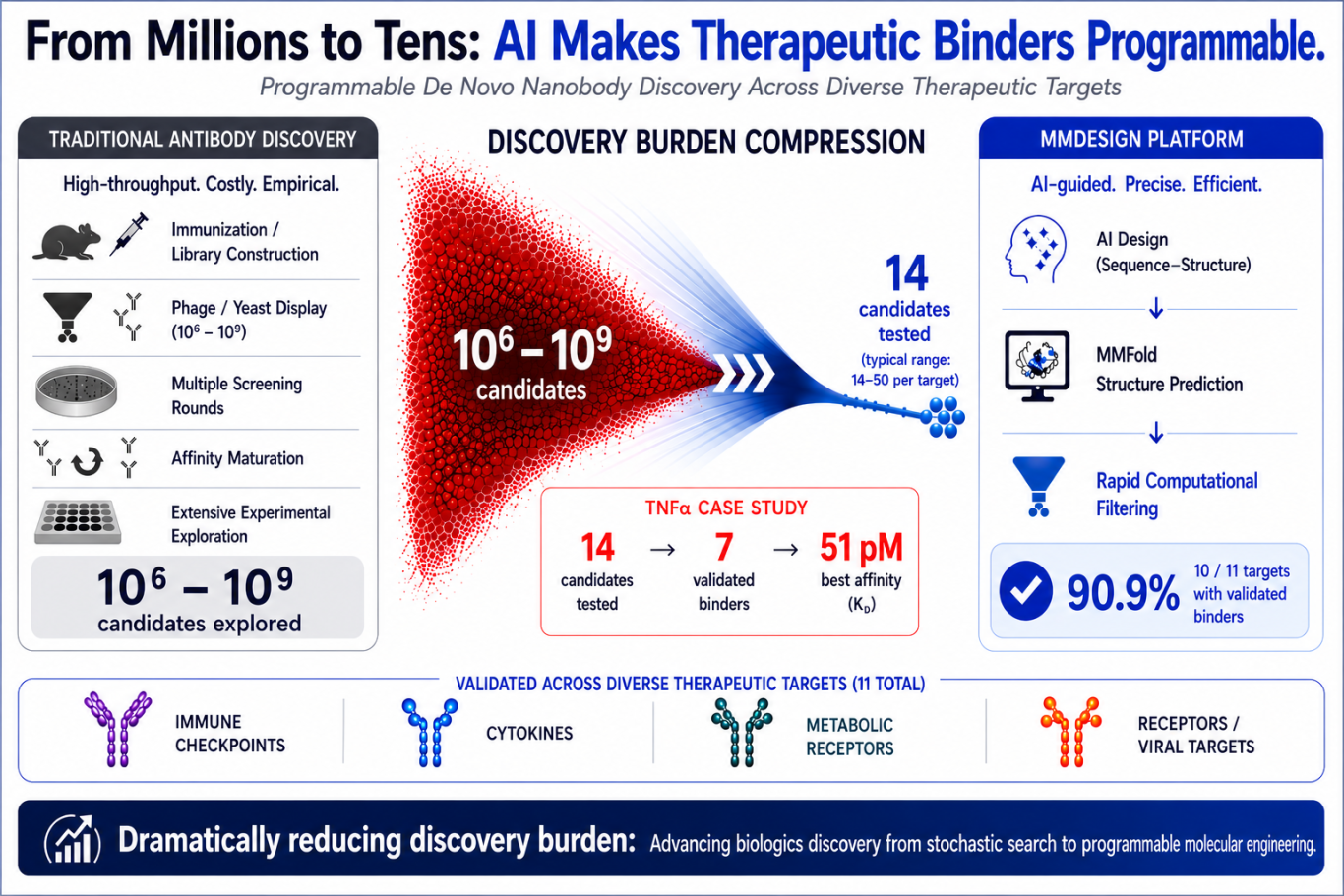
More critically, it delivers exponential improvements in R&D cost and efficiency. Traditional antibody discovery requires screening candidate libraries on the scale of hundreds of millions, while MMDesign only needs wet-lab validation of 14 to 50 AI-generated candidates to produce novel nanobodies with high affinity and high expression levels. Notably, antibodies designed for the highly difficult TNFα target reached picomolar binding affinity.
This industry-leading hit rate is underpinned by MMFold, MoleculeMind’s proprietary high-precision base model for structure prediction. In the authoritative global FoldBench benchmark, MMFold outperformed all open-source models on the highly complex antibody-antigen interface, and held a definitive, generational lead over mainstream models including Google’s AlphaFold 3 in high-accuracy structure prediction.
This marks the first time a Chinese team has made the critical leap from follower to global leader in the most industrially valuable core segment of AI protein technology.
02
Building a Defensible Moat: Proprietary AI Macromolecular “Operating System” Rebuilds Bio-Infrastructure Through Programmable Bioengineering
Isolated technical breakthroughs cannot support large-scale industrial application. MoleculeMind’s core competitive barrier lies in its positioning beyond a single algorithm tool: it has built MoleculeOS (MOS), an AI-native bioengineering infrastructure system.
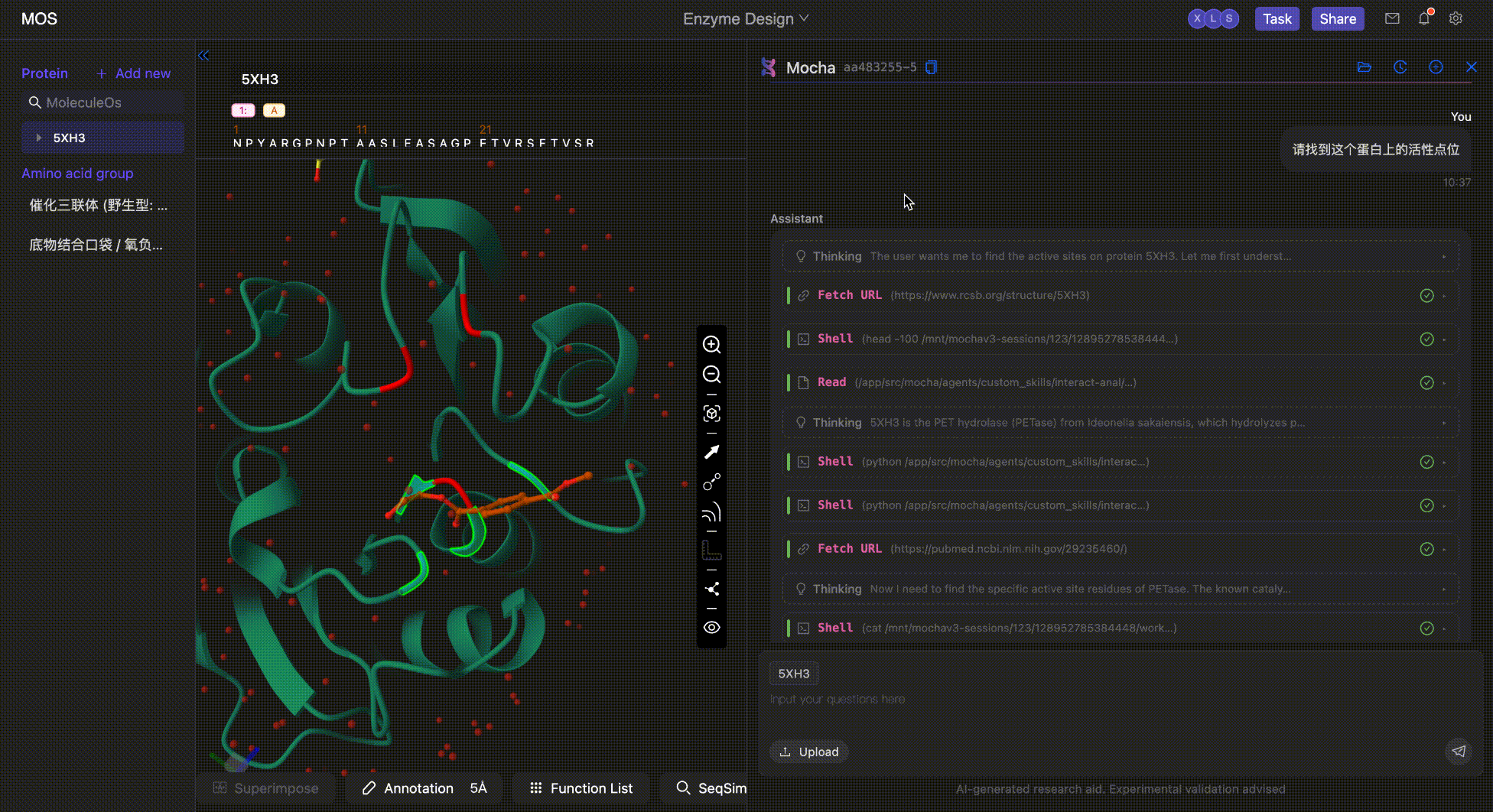
Built on its MOS platform, MoleculeMind has notched a series of wet-lab-validated breakthroughs across high-threshold industrial use cases that have stymied both traditional experimental methods and general-purpose AI tools.
In high-stakes innovative drug development, the team resolved a pH-sensitive antibody design challenge that had stumped conventional high-throughput screening in just two months, achieving a 60-fold affinity difference across varying pH environments. For a pipeline asset plagued by extremely low expression, the platform boosted yield by more than 400% with monomer purity exceeding 90%, effectively rescuing a high-value commercial asset.
In green biomanufacturing, the company partnered with industry players to engineer premium industrial enzymes via directed evolution, multiplying strain productivity and unlocking significant cost reduction potential for large-scale production.
These results are not just technical achievements, but full validation of commercial monetization capability.
To date, the MOS platform has been validated through real projects with top-tier strategic partners across innovative pharmaceuticals, food, chemical new materials and other sectors. Its partners include top global multinational pharma firms by market capitalization, leading U.S. biotech venture capital firms, China’s first-tier innovative drug developers, domestic synthetic biology leaders, listed food companies and world-leading chemical new material groups.
Notably, multiple partners initiated follow-up collaborations after their first project, with some clients building sustained multi-project partnerships that have expanded from single targets to multiple molecular formats and application scenarios.
This track record demonstrates that MoleculeMind’s AI protein design platform has strong customer stickiness, cross-sector applicability and sustained value creation capacity, laying a solid foundation to become a foundational R&D platform for the life sciences.
Meanwhile, these real industrial projects, rigorously validated through wet labs, continuously generate high-quality proprietary closed-loop data that feeds back and strengthens the MOS platform. This data flywheel, driven by real industrial deployment, builds a hard-to-replicate industry moat and gives MoleculeMind unique engineering advantages across the global AI protein landscape.
03
Investor Consensus: Cross-Sector Leaders Place Strategic Bets on AI4S Infrastructure Race
The global innovative drug industry is at a critical inflection point across market cycles, with capital and industrial resources rapidly concentrating on core hard-tech infrastructure. Industry demand for AI has outgrown research-grade structure prediction; stakeholders now require end-to-end engineering solutions covering design, validation and production. Only platforms combining core technology, engineering capacity and closed-loop commercialization can thrive in this environment.
Its cross-sector foundational platform positioning and proven customer retention have made MoleculeMind a rare, high-priority target for both financial and industrial investors.
Huang Bohao, founder of Blue Bridge Capital, commented: “MoleculeMind is one of the few teams in the world with genuine original capabilities in AI protein core technology. Professor Xu’s academic standing is irreplaceable, but even more valuable is that the team has translated technical strength into verifiable commercial milestones. This ability to close the loop from scientific breakthrough to industrial delivery is extremely scarce in AI drug development.”
Chen Huawei, partner at Oriental Fortune Capital, noted: “AI4S is one of the most definitive technological revolutions of the next decade. Beyond its world-leading foundational protein model, MoleculeMind has built monetizable, validated capabilities for high-frequency pharma use cases such as antigen-antibody complex prediction and conditionally activated protein design.”
Ye Lijuan, managing director of investment at Fosun Capital, said: “Fosun Capital continues to back top global AI4S teams. From protein decoding to de novo design and reconstruction, AI and life sciences are deeply integrating. MoleculeMind has built system-wide full-stack protein design capabilities, from underlying core algorithms to upper-layer industrial applications, to empower the industry.”
The entry of industrial capital further confirms that MoleculeMind’s application scope extends far beyond innovative drugs, serving as a foundational enabler for upgrading the trillion-dollar bioeconomy.
An investment lead from COFCO Emerging Industries Fund stated: “Biomanufacturing is a future industry prioritized in national strategy. MoleculeMind has made deep AI deployments in industrial enzyme design, biomaterial optimization and food industry innovation, with clear commercialization potential. COFCO’s industrial fund will continue to support MoleculeMind’s biomanufacturing rollout, leveraging our group’s scenario and data advantages in the biological sector to jointly advance China’s leadership in the AI-driven bioeconomy.”
Huang Xueying, chairman of Sepax Technologies, highlighted the synergies: “Chromatographic purification and protein engineering are tightly coupled key links in the biologic industry chain. MoleculeMind’s leading capabilities in AI protein design and engineering are highly complementary to Sepax Technologies’ expertise in separation and purification, large-scale production and industrial resources. We look forward to jointly improving the overall efficiency of biologic drug R&D and manufacturing.”
As a returning investor, Dr. Yang Chen, president of Cathay Biotech remarked: “MoleculeMind’s AI protein engineering capabilities have been fully validated through our joint industrial projects. From directed evolution of industrial enzymes to significant improvements in strain yield, MoleculeMind has proven the tremendous value of AI in biomanufacturing with tangible results. Our follow-on investment is rooted in the proven certainty of the ‘AI + biomanufacturing’ path and the team’s rare ability to translate technology into industrial efficiency.”
A PDVC representative added: “Pudong New Area is building an internationally influential biomedical innovation hub. As a benchmark enterprise in the AI4S field, MoleculeMind’s technological leadership and industrial deployment capabilities are highly aligned with the district’s development strategy. We will support the company in building a world-leading AI bioengineering R&D center through both capital and policy resources.”
04
Global Industrialization: From Market Leader to Standard-Setter, Powering Value Upgrade of the AI Bioeconomy
Behind the capital interest lies a clear commercialization path. MoleculeMind has built a multi-layered business model covering platform licensing, joint R&D and proprietary pipelines.
For platform licensing, MOS is open to leading pharmaceutical companies, embedding its “AI precision design+small-scale wet-lab validation” capabilities into partners’ R&D workflows. For joint R&D, the company delivers industrial-grade results for partners tackling high-difficulty targets and complex protein engineering projects. On the proprietary pipeline front, MoleculeMind has built up a portfolio of early-stage assets with First-in-Class potential.
Professor Jinbo Xu said: “The core technological revolution of AI proteins has completed theoretical validation. We are now moving from laboratories to large-scale industrial application, converting silicon-based computing power into tangible material output.”
Fueled by the over $100 million in new financing, MoleculeMind is accelerating the global industrial rollout of its full-stack technology system. As AI fundamentally reshapes the underlying logic of drug discovery and the trillion-dollar biomanufacturing sector, MoleculeMind is proving through a string of validated industrial milestones that Chinese teams can not only compete in the global AI protein technology race, but also define the standards for next-generation bioengineering infrastructure.
The race to build AI4S foundational infrastructure has only just begun. In this competition shifting from model performance to closed-loop industrial commercialization, MoleculeMind has secured a definitive competitive edge, taking center stage in the global industrialization of AI protein technology.