

Allurion Technologies: Pioneering Non-Invasive Weight Loss with Swallowable Gastric Balloon and AI-Powered Virtual Care

Allurion Technologies
Weight Loss Medical Device Developer
Obesity can be described as the root cause of numerous diseases and is associated with various chronic conditions, including cardiovascular disease, diabetes, dyslipidemia, stroke, and certain types of cancer. As early as 1948, the World Health Organization (WHO) included obesity in its classification of diseases. According to data from the *World Obesity Atlas 2023*, the number of overweight or obese individuals aged over 5 years worldwide is projected to increase from 2.6 billion in 2020 to 4 billion by 2035, accounting for more than 50% of the global population. There is a substantial market demand for the treatment of obesity.
Mainstream approaches to treating obesity include lifestyle modifications, pharmacotherapy, and bariatric surgery. Lifestyle modifications are prone to failure and weight regain among many individuals with obesity. Pharmacotherapy, as an adjunctive treatment, is not suitable for monotherapy; furthermore, many medications have side effects, with some even withdrawn from the market due to severe adverse events. Surgical options, primarily sleeve gastrectomy and gastric bypass, carry certain risks.
In addition to these treatment modalities, medical devices can also assist in the management of obesity. Currently, medical devices used internationally as adjunctive therapies for obesity primarily includeElectrical stimulation devices, gastric bands, gastric emptying systems, intragastric balloonsetc.
Allurion Technologies (hereinafter referred to as “Allurion”) is a company that manufactures intragastric balloons. VCBeat has learned that in early August 2023, Allurion announced the completion of its merger with Compute Health Acquisition Corp., successfully listing on the New York Stock Exchange (NYSE) on August 2 under the ticker symbol ALUR. The net proceeds from the merger amounted to approximately $100 million, significantly exceeding the minimum cash closing condition of $70 million required for the transaction. However, since its listing, the company’s stock price has continued to decline.As of September 7, 2023, Allurion’s market capitalization was $222 million.。
Intragastric Balloon, also known as a gastric water balloon, works by placing a fluid-filled balloon in the stomach to induce satiety and prolong gastric retention of food, thereby helping to control appetite.
As early as the 1980s, intragastric balloons were already being used by the international medical community to manage weight in individuals with obesity. The first intragastric balloon product was introduced in 1985; however, it was quickly withdrawn from the market due to complications such as gastric mucosal compression leading to ulceration and balloon rupture. With technological advancements in endoscopic bariatric surgery, intragastric balloon devices have been significantly improved and have re-emerged in clinical practice. In February 2018, the American Society for Metabolic and Bariatric Surgery (ASMBS) officially approved the intragastric balloon as the fifth standard surgical treatment for obesity, establishing it as a non-surgical device-based weight loss option.
Conventional intragastric balloons require endoscopic placement and subsequent removal after several months, must be used in conjunction with long-term dietary guidance and behavioral modification programs, and have certain limitations regarding patient tolerance and product durability.
●Allurion Balloon
Allurion’s intragastric balloon, the Allurion Balloon (formerly known as the “Elipse Balloon”), is the world’s first swallowable weight-loss intragastric balloon, requiring no surgery, anesthesia, or endoscopy for placement.The Allurion Balloon is primarily indicated for individuals with a body mass index (BMI) ≥27 who have been unable to achieve sustained weight loss.
The Allurion Balloon is made of polyurethane, a material that is thinner, lighter, and more elastic than the silicone used in endoscopy-dependent balloons. It automatically conforms to the shape of the stomach as it moves, enhancing patient comfort. Prior to insertion into the body, the balloon is compressed within a small capsule attached to a thin catheter. The patient swallows the capsule into the stomach, and the physician confirms its gastric placement via X-ray.After the patient swallows the capsule, it ruptures under the action of gastric fluid. The physician then injects 550 mL of sterile filling solution into the balloon via a catheter, thereby inducing satiety and suppressing hunger in the patient.After balloon inflation, the physician will use fluoroscopy again to confirm that the water-filled balloon is positioned within the stomach.
The entire procedure takes only 15 minutes and can be performed in an outpatient setting, thereby avoiding the physical burden and additional costs associated with surgery or endoscopy. After 16 weeks, the balloon automatically opens its valve to drain the internal fluid and is subsequently excreted with feces.
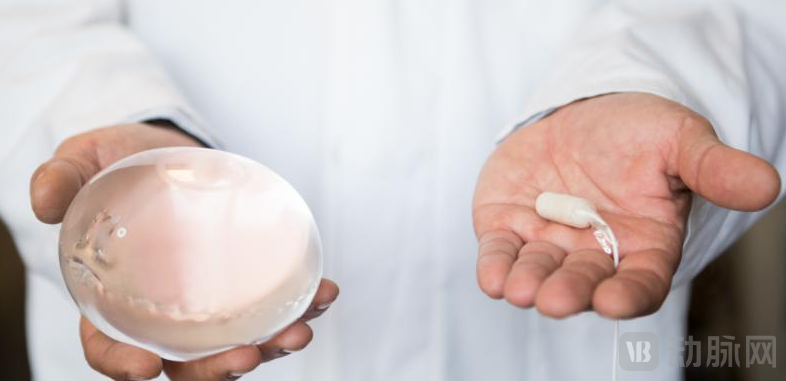
Allurion Balloon Image source: Allurion official website
Allurion's research data indicates that,The Allurion Balloon can help patients lose an average of 10%-15% of their body weight., the incidence of adverse events such as abdominal pain, vomiting, diarrhea, and small bowel obstruction is 10 times lower than that of other intragastric balloons.Allurion Balloon received CE certification in 2015 and has since entered the markets of Canada, Mexico, India, Australia, and Brazil.Covering more than 60 countries, the treatment has been administered to over 100,000 patients, resulting in a total weight loss of 1.3 million kg.On June 27, 2023, the Allurion Balloon was used for the first time in China at Ruijin Hospital Hainan Hospital (Hainan Boao Research Hospital), affiliated with Shanghai Jiao Tong University School of Medicine.
●Allurion VCS
The company’s other product is the Allurion Virtual Care Suite (VCS), which includes a connected scale, a health watch, and an app, with remote monitoring powered by the Iris AI platform.
Connected scales, similar to body fat scales, can measure patients’ weight, BMI, and body composition; smart health watches can continuously monitor patients’ step counts and sleep patterns. By connecting both devices to a mobile app, patients can view their physical status and weight-loss progress, and seek lifestyle and dietary advice from physicians. Through VCS, Allurion can remotely monitor patient performance, integrate data from the app, connected scales, and smart health watches, leverage an AI platform to analyze patient conditions, and adjust weight-loss plans in real time based on patients’ current status.
VCS can be marketed as a standalone product or used in combination with the Allurion Balloon.
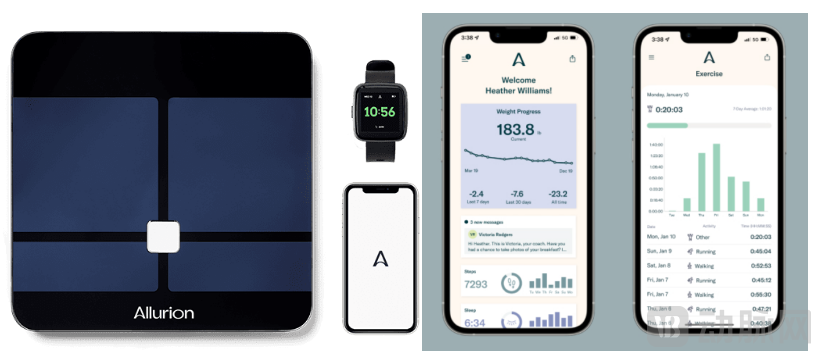 Allurion VCS Source: Allurion Official Website
On June 22, 2023, Allurion announced a pilot collaboration agreement with Medtronic, under which Medtronic will serve as the sales distributor for Allurion’s intragastric balloon products and VCS products in the Central and Eastern Europe, Middle East, and Africa (CEMA) region over the next year.
For Medtronic, the distribution of Allurion’s products serves as a key assessment of its increased commitment to the weight-loss sector; if market response is favorable, Medtronic will prioritize strategic expansion in the weight-management field.
Allurion’s ties with Medtronic predate this latest collaboration. In February 2023, Allurion announced its intention to go public on the New York Stock Exchange via a SPAC merger with Compute Health several months later. Compute Health is a blank-check company established by Omar Ishrak, former CEO of Medtronic, which is also an investor in the SPAC. Allurion successfully completed its listing in August, signaling that the two parties will maintain a long-term collaborative relationship.
Why Did Medtronic Take an Interest in Allurion?
Revenue is the most intuitive metric. According to data released by Allurion,In 2020, 2021, and 2022, the company’s annual revenues were US$20 million, US$38 million, and US$64 million, respectively, with year-over-year growth rates of 90% in 2021 and 68.4% in 2022.. In other words, while the global economy suffered severe shocks during the three-year COVID-19 pandemic, a weight-loss company unrelated to the pandemic managed to double its revenue.
Such achievements can be attributed to the significant advantages of its products, as well as the success of the company’s strategic planning. In light of this, it is not surprising that Allurion was selected by Medtronic from among numerous weight-loss companies.
According to MarketsandMarkets, the global market for bariatric surgical devices is projected to grow from $1.9 billion in 2022 to $2.4 billion in 2027, representing a compound annual growth rate (CAGR) of 5.4% during the forecast period. Although the bariatric surgical device market is smaller than the anti-obesity medication market, it remains highly attractive. Notably, Boston Scientific, another overseas giant, moved ahead of Medtronic in making strategic investments in this sector.
On November 29, 2022, Boston Scientific announced it would acquire Apollo Endosurgery for $615 million (approximately RMB 4.2 billion). The transaction was completed on April 4 of this year. Apollo Endosurgery specializes in developing minimally invasive devices designed to treat gastrointestinal defects, gastrointestinal complications, obesity, and other conditions. Through this acquisition, Boston Scientific has incorporated Apollo’s product portfolio, including the Orbera intragastric balloon system. Orbera is implanted into the stomach via a minimally invasive endoscopic procedure through the mouth and received FDA clearance in 2015.
In addition to Orbera, other intragastric balloons currently approved by the FDA include ReShape from ReShape Medical and Obalon from Obalon Therapeutics.
Intragastric balloons have reached maturity in overseas markets, yet their application in China remains a blank slate, with no intragastric balloon products currently approved domestically. Zhishan Medical is the pioneer in this field in China; its independently developed Spheria Intragastric Balloon features “swallowable insertion, timed degradation, and natural expulsion,” and has entered the product registration phase, poised for imminent approval and market launch.