

Radiaction Medical Secures $12.6M in Series C2 Funding to Advance Its Automated Radiation Shield System That Blocks Over 90% of Scattered Radiation

Radiaction
Radiation Protection Product Provider

InnovaHealth Partners
Private Equity Investment Firms
Recently, VCBeat learned that medical device company Radiaction Medical, Ltd. (hereinafter referred to as “Radiaction”) announced it had raised $12.6 million in its Series C2 financing round. The round was led by the U.S. private equity firm InnovaHealth Partners, with participation from other co-investors. The proceeds will be used to expand Radiaction’s business operations in the United States and accelerate functional development and technological upgrades of its products.
Radiaction, founded in 2014 and currently headquartered in Tel Aviv, Israel, is an innovative company dedicated to providing radiation protection for interventional physicians at risk of radiation exposure. Its founder is Amir Belson, M.D., who was previously a co-founder of Vascular Pathways and Neoguide Systems.
“Revolutionizing radiation protection methods to safeguard medical personnel from C-arm scatter radiation at the source” has been Radiaction’s pursuit and mission since its inception. Its independently developed Radiation Shield System (hereinafter referred to as RSS), an automated radiation protection system, is the first innovative solution to block radiation at the source. RSS provides full-body protection for medical staff without requiring them to wear protective gear, fundamentally transforming radiation protection practices for interventional department personnel.
The C-arm is a “double-edged sword” in interventional surgical procedures. It plays a unique role in positioning, diagnosis, and the implementation and management of minimally invasive surgeries in orthopedics, further enhancing surgical accuracy and efficiency. However, the X-rays it emits generate ionizing radiation that can harm the human body.
For medical personnel in the operating room, the cumulative effects of ionizing radiation are more pronounced. Studies have shown that prolonged exposure to ionizing radiation increases the risk of brain tumors, breast cancer, cataracts, cognitive decline, thyroid disorders, fetal exposure, and orthopedic injuries.
The U.S. Occupational Safety and Health Administration (OSHA) stipulates that the permissible radiation exposure limits over a three-month period under current standards are 1¼ rem for the whole body, 18¾ rem for the hands, forearms, feet, and ankles, and 7½ rem for the skin of the whole body. However, with the increasing number of interventional procedures, surgeons and operating room staff are exposed to scattered radiation more frequently, making it difficult to keep radiation exposure within dose limits. A report published by Mastrangelo G, MD, et al. indicated that orthopedic surgeons have higher average cumulative radiation doses (35.2 mSv) and cancer incidence rates (29%) compared to other medical specialties.
The fundamental principle for reducing radiation exposure is to "minimize one's own radiation dose as much as possible," known as ALARA (As Low As Reasonably Achievable). The three basic measures for individual radiation protection are "time," "distance," and "shielding." For medical personnel in the operating room, current radiation protection methods primarily include wearing personal protective equipment such as lead aprons, lead glasses, lead garments, lead collars, and lead caps, as well as using lead screens, lead curtains, and suspended lead windows to isolate individuals from radiation.
However, existing radiation protection equipment mainly has two problems.
First, the excessive weight and poor mobility. In clinical practice, lead aprons with lead equivalents of 0.35 mmPb and 0.5 mmPb are widely used; these can weigh between 4.5 and 6 kilograms. Prolonged wear exerts pressure on the back and spine, potentially causing orthopedic injuries, and may also reduce the operational dexterity of medical personnel during surgical procedures.
Second, there are protective loopholes, making comprehensive protection difficult to achieve. During surgery, a significant portion of the radiation from the C-arm still scatters throughout the operating room through interactions with the patient’s body and the X-ray table. Even when wearing full protective gear and using lead shields for blocking, parts of the body such as the thyroid, eyes, and hands remain exposed to radiation.
A survey conducted by Lloyd W. Klein, MD, and colleagues among 310 members of the Society for Cardiovascular Angiography and Interventions (SCAI) revealed that 49.4% of respondents had sustained at least one orthopedic injury, 34.4% reported lumbar spine issues, 24.7% reported cervical spine issues, and 19.6% reported hip, knee, or ankle problems. Furthermore, 6.9% of respondents had to limit their workload due to radiation exposure, and 9.3% had taken time off work for health-related reasons. Issues arising from radiation exposure compromise the well-being of healthcare professionals, which can ultimately adversely affect patient care.
Unlike the traditional approach of encasing medical staff in heavy lead aprons, RSS is a novel radiation protection system mounted on C-arm fluoroscopy units. Integrating sensor technology with highly automated robotic mechanics, it can be installed as an independent accessory on various existing C-arm systems available on the market and is compatible with any specialized procedure. Currently, it has been proven compatible with Siemens Artis series fluoroscopic C-arm machines.
![]`LHY@2BVIRKM`EGP35C{SQ.png](http://cdn.vcbeat.top/upload/image/09/09/06/00/1693990803946685.png/dmw) Radiation Shield System Mounted on C-arm
Radiation Shield System Mounted on C-arm
Image source: Radiaction official website
RSS received FDA 510(k) clearance and CE marking in March 2022, making it the only fully automated, integrated total protection system. Building on the prior clearance of the Toshiba Infinix-I system, the FDA approval and CE marking enable RSS to be used in more interventional cardiology and electrophysiology laboratories across North America and the European Union.
Compared with existing radiation protection equipment, the innovation of RSS lies in its ability to encapsulate the imaging beam at the source of the C-arm, thereby blocking scattered X-ray radiation within the operating room. Without increasing radiation exposure to patients or compromising image quality, it prevents medical staff from being exposed to scattered radiation, providing them with comprehensive head-to-toe protection and achieving a paradigm shift in occupational radiation safety for healthcare professionals.
The RSS is installed around the detector and X-ray source of the C-arm. It comprises four main components: upper and lower automated telescopic shields composed of discrete, overlapping lead-free radiation-blocking segments; anti-collision safety sensors and controllers mounted on the shields to enable flexible extension and retraction; a desktop control panel; LED indicators displaying system status; and a patient face mask.
When the physician presses the button on the control panel, the RSS begins deployment, and the LED indicator turns orange. At this stage, the upper and lower shields automatically detect the patient’s position and body contour. Based on the detected positional and morphological data, the shields automatically extend and conform to the patient’s body, filling the gaps between the C-arm and the operating table, as well as between the image detector and the patient’s body. This creates a barrier around the X-ray imaging beam, blocking scattered radiation before it can reflect. Upon completion of deployment, the LED indicator turns blue. Throughout the entire surgical procedure, the RSS encapsulates scattered radiation from the imaging beam, preventing the source radiation from spreading and diffusing within the operating room.
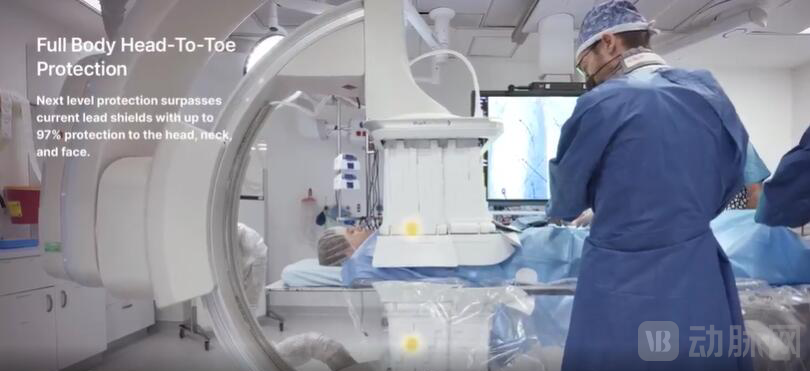
During surgery, the Radiation Shield System provides radiation protection for doctors and patients.
Image source: Radiaction official website
During surgery, two compatible disposable sterile high-barrier protective covers are placed over the C-arm to prevent leakage of scattered radiation, thereby providing full-body radiation protection from head to toe for medical staff in the operating room. A study conducted by Avishag Laish-Farkash, MD, Emanuel Harari, and colleagues evaluated the efficacy of RSS in a clinical laboratory setting. The results demonstrated that during image-guided interventional procedures using RSS, more than 90% of scattered radiation in the room was blocked, with radiation exposure to the head, neck, and face of medical staff reduced by 97%.
Each component of the RSS can be independently programmed to ensure smooth operation and deployment, allowing physicians to customize compilation protocols as needed to accommodate varying preferences and procedural requirements, while remaining adaptable to any patient anatomy, access needs, and C-arm angulation.
During surgical procedures, if the C-arm needs to rotate, the RSS rapidly retracts the upper and lower shields in advance, without compromising the C-arm’s operational performance, maneuverability, power, or imaging quality. Once the C-arm rotates to the target direction, the shields rapidly deploy again. During table translation, the RSS can complete deployment in hover mode without obstructing table movement. Furthermore, it does not disrupt clinical workflows; with a single button press, the RSS completes dynamic barrier deployment within 30 seconds, while the upper and lower radiation-blocking segments extend and retract in just 2–3 seconds, enabling rapid and seamless integration into the workflow of all catheterization laboratory procedures.
Currently, wearable products remain the dominant form of medical radiation protection equipment in China. According to the "Market Prospects and Investment Strategic Planning Analysis Report on China's Medical Radiation Protection Products Industry (2023–2028)" released by Qianzhan Industry Research Institute, as of July 2022, more than 200 enterprises in China had registered or filed records for medical radiation protection products, with wearable radiation protection devices—such as gowns, skirts, caps, glasses, and face shields—constituting their primary product offerings.
According to a report by Mordor Intelligence, the global medical radiation protection market is projected to grow at a compound annual growth rate (CAGR) of 4.6% from 2023 to 2028, with the Asia-Pacific region emerging as the fastest-growing market. Meanwhile, the White Paper on Interventional Medicine in China (2021 Edition), released by the Branch of Interventional Medicine Centers of the Chinese Hospital Association, indicates that approximately 60% of hospitals in China have independent interventional medicine departments. There are 8,716 interventional physicians, 3,511 interventional technologists, and 10,895 interventional nurses nationwide. Between August 2020 and July 2021, 1,345 hospitals performed approximately 2.26 million interventional procedures. As the number of interventional procedures continues to rise in the future, the standards for radiation protection among interventional department healthcare professionals are also being increasingly elevated.
Currently, China has companies such as Huake Medical, Kangningda Medical, and Zhongke Lansheng that provide medical radiation protection products, but there are still no products available that can achieve comprehensive radiation protection. How to innovate protection technology and provide more comprehensive and effective protection for medical staff in interventional departments is a key issue facing the future development of China's medical radiation protection industry.
References:
[1]. Mastrangelo G, Fedeli U, Fadda E, Giovanazzi A, Scoizzato L, Saia B. Increased cancer risk among surgeons in an orthopaedic hospital. Occup Med (Lond) 2005;55:498–500. doi: 10.1093/occmed/kqi048.
[2]. Occupational health hazards of interventional cardiologists in the current decade: Results of the 2014 SCAI membership survey.
[3]. Laish-Farkash A, et al. EuroIntervention 2022;18:262-266.