

Kairuisi Medical Completes 548-Patient Clinical Validation, Pioneering Early Detection of Endometrial and Ovarian Cancers
Cervical cancer, endometrial cancer, and ovarian cancer are the three most common gynecologic malignancies. In recent years, significant progress has been made in the early screening, diagnosis, treatment, and prevention of cervical cancer, whereas effective methods for the early screening and diagnosis of endometrial and ovarian cancers remain lacking.
The underlying reason is that the endometrium is located within the uterine cavity, enveloped by a thick myometrial layer and further covered by an outer serosal layer. Its deeper anatomical position, compared to the cervix, precludes direct exposure for smear sampling simply by inserting a speculum to open the vagina, as is done for cervical sampling.
Ovaries, chestnut-shaped and suspended deep within the pelvic cavity, allow tumors to grow and spread unrestrictedly throughout the abdominal cavity. Due to the absence of sensory nerve innervation, ovarian cancer lacks early warning symptoms. It is often only detected when the tumor has reached 10–20 centimeters in size, or when acute abdominal pain prompts medical evaluation following tumor rupture or torsion. By the time of diagnosis, the vast majority of cases have already progressed to an advanced stage, earning ovarian cancer the moniker “the king of gynecologic cancers.”
Diagnosis of endometrial cancer requires obtaining suspicious endometrial tissue for pathological examination. The common methods for obtaining endometrial tissue are fractional curettage and hysteroscopy.
Transvaginal Ultrasound: It can detect endometrial abnormalities, including endometrial thickening and imaging features suggestive of pathology (such as cystic endometrium, intrauterine fluid collection, and suspected polyps). Patients generally report a high level of safety and good tolerability. However, its limitation lies in the relatively low specificity of transvaginal ultrasound for diagnosis, with only one true positive case out of 50. Subsequent invasive procedures and biopsies are still required. The diagnostic accuracy may be influenced by the operator’s experience, and the detection efficacy varies significantly among patients with different types of endometrial cancer, showing limited diagnostic value for Type II endometrial cancer.
Dilation and Curettage (D&C):Diagnostic curettage is an invasive intrauterine procedure in which physicians insert a slender curette into the uterine cavity to scrape the endometrium. As a blind scraping technique, it carries a risk of incomplete sampling, particularly in the bilateral uterine cornua, resulting in a missed diagnosis rate of approximately 10%. Furthermore, due to the pain and trauma associated with the procedure, patient acceptance is low, limiting its value for large-scale early diagnosis and screening of endometrial cancer.
Hysteroscopy:With the advancement of endoscopic technology, hysteroscopy has become increasingly prevalent. Its minimally invasive nature allows for visual localization of suspicious lesions for biopsy or resection, thereby effectively reducing the false-negative rate. However, its limitations include cervical stenosis and pain, which can hinder hysteroscopic manipulation and lead to procedural failure. Additionally, the infusion of fluid into the uterine cavity during hysteroscopy may facilitate the spread of cancer cells from the fallopian tubes into the peritoneal cavity.
The target population for early detection of endometrial cancer primarily consists of high-risk individuals and those presenting with clinical manifestations suggestive of endometrial cancer. To date, there remains a lack of sufficiently accurate and reliable early detection methods to triage these women.
Shenzhen Caronos Medical Technology Co., Ltd. (hereinafter referred to as “Caronos Medical”) specializes in the early diagnosis and screening of gynecological tumors, striving to become a pioneer in the field of precision medicine for women’s cancers globally. Guided by clinical needs, the company has launched Sugongkang®(Early Diagnosis and Screening Kit for Endometrial Cancer and Ovarian Cancer)Aims to provide a method for the early diagnosis and screening of endometrial cancer and ovarian cancer, featuring high sensitivity, high specificity, and low invasiveness.
The founding of Caronos in 2022 was no coincidence; it was closely tied to the personal experiences of its founder, Dr. Yao Xiaoming.
Dr. Yao Xiaoming, founder of Caronos, holds an MD/PhD from Xiangya School of Medicine. He has eight years of clinical experience in neurosurgery, completed a four-year postdoctoral fellowship in molecular biology and genetics at Stanford University, and served as a Professor of Medical Translational Research at UCSF for over ten years. With more than two decades of dedication to molecular biology, genetic testing, and clinical translational research, he has published 39 SCI-indexed papers.
During his more than 20 years of study and work in the United States, he participated in founding the Silicon Valley companies GMR Epigenetics, GenoMed, and Epiking Inc. He later served as Vice President of the Asia-Pacific Region and Chief Scientist at mProbe/Yunjian Medicine, accumulating extensive experience in the research and development as well as marketing of products for early screening and diagnosis of major chronic diseases and cancer.

Dr. Yao Xiaoming, Founder of Caronos
Dr. Yao Xiaoming told VCBeat that the early screening and diagnosis rate for major chronic diseases or cancers in Europe and the United States reaches 70%, whereas in China it is likely below 30%. In particular, regarding female cancers, the Chinese government has introduced numerous policies in recent years, including screening for the “two cancers” (breast cancer and cervical cancer). However, common gynecological malignancies include cervical cancer, endometrial cancer, and ovarian cancer. Among these, the incidence and mortality rates of cervical cancer have been brought under control thanks to the widespread adoption of ThinPrep Cytologic Test (TCT) screening, HPV testing, and HPV vaccination. In contrast, there is a lack of highly effective and precise methods for the early screening and diagnosis of endometrial cancer and ovarian cancer in clinical practice.
Thus, he set his sights on “precision medicine for women’s cancers” and founded Caronos, focusing on filling the gap in early diagnosis and screening products for endometrial cancer and ovarian cancer as a breakthrough.
After years of dedicated development, the Caronos team has launched Sugongkang, a product capable of simultaneous early detection of endometrial cancer and ovarian cancer.®Test Kit and Its Compatible Sample Collection Brush, Yao Brush®。
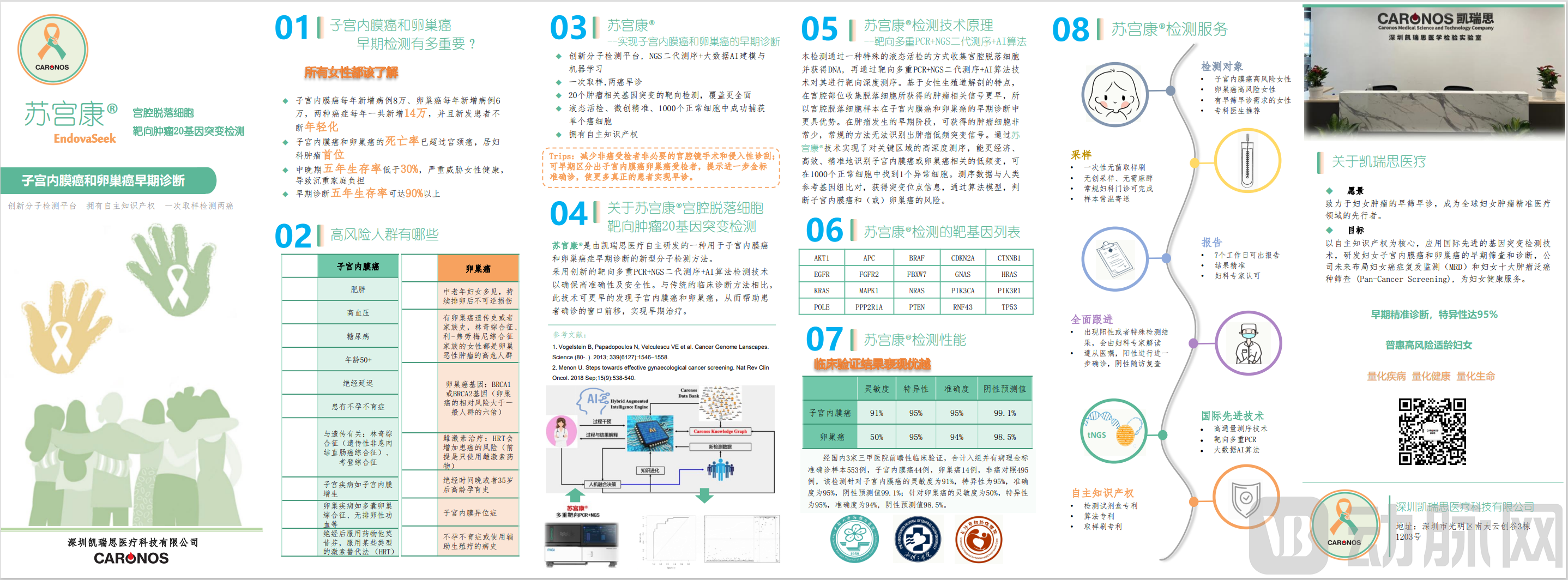
Its method of use is that the doctor uses the Yao brush®Exfoliated cells (uterine cavity secretions) were collected from the patient’s uterine cavity, and the samples were sent to the laboratory for analysis using Sugongkang.®Detection Kit: Test results are generated and reports are issued through multiplex targeted amplification, next-generation sequencing, and AI algorithm-based software analysis. The entire process, from sample collection to final report issuance, takes approximately 7 working days.
Its technological highlight is the pioneering development of molecular detection technology for endometrial and ovarian cancers. By employing multiplex targeted PCR, next-generation sequencing (NGS), and AI algorithms to detect mutation sites across 154 fragments of 20 genes, it can successfully capture single cancer cells among 1,000 cells, enabling detection prior to the onset of clinical symptoms.
Su Gongkang®Its advantages include being non-invasive, painless, and requiring no anesthesia. The test is efficient, convenient, accurate, and safe, with good patient compliance and hygienic single-use design. It can be used for early diagnosis in high-risk women of appropriate age, shifting the diagnostic and treatment window earlier, providing precise detection with high sensitivity and specificity (specificity up to 95%).
Yao Shua®In addition to cooperating with Sugongkang®It can also be applied to the diagnosis of endometritis and pelvic inflammatory disease, and marketed independently in the reproductive health sector.
According to Dr. Yao Xiaoming, Caronos Medical has now established collaborations with the Department of Gynecology at Xiangya Second Hospital, the Department of Gynecology at Xiangya Third Hospital, Changsha Maternal and Child Health Care Hospital, and the West China team, and has recently completed 548 cases of Sugongkang.®clinical validation, achieving the anticipated clinical statistical endpoints. This not only marks the successful validation of Caronos Medical’s innovative molecular testing platform, but also lays a solid foundation for subsequent nationwide, multi-center, large-cohort clinical trials and the application for Class III medical device registration in China. Next, Su Gongkang®It will be commercialized, and an application for innovative medical device registration will be submitted concurrently.
Su Gongkang®He Yao Shua®This is merely the first step in Caronos’ strategic layout for precision medicine in women’s oncology. In the future, the company will further deepen its presence in this field by developing products for monitoring gynecologic cancer recurrence and pan-cancer screening for women, thereby expanding its reach within the realm of precision medicine for women’s cancers.
References:
Medical Forum Online: “6 Tests Can Detect Endometrial Cancer Early! A Comprehensive Review”
Wu Zhixi, Associate Chief Physician of the Department of Gynecology at Dongguan People's Hospital: "How to Early Identify Endometrial Cancer"
Shanghai Jiahua Hospital: “Early-Stage Ovarian Cancer, Which Is Difficult to Screen For, Does Not Originate in the Ovary!”