

Arimedi Medical Breaks Through Domestic Bottleneck in Surgical Navigation with Core Tracking and Positioning Components via Deep Industry-Academia Integration
Ariemedi
Developer, Manufacturer, and Distributor of Intelligent Medical Devices
Huawei’s Powerful Launch of the Mate 60 Pro Marks a Breakthrough in Domestic Chips, Overcoming Critical Bottlenecks and Inspiring Confidence. A Similar Breakthrough Occurred at the Inaugural Global Surgical Robotics Conference Held on September 8, 2023.
At the conference, the “2023 Surgical Robotics Industry Awards” were announced. Arimedy Medical Technology (Beijing) Co., Ltd. (hereinafter referred to as “Arimedy”), a leading domestic provider of one-stop smart surgical solutions, was honored with the “2023 Surgical Robotics Technological Innovation Award” for its breakthroughs in core medical sensors and digital diagnostic and therapeutic equipment.
Dr. Fan Jingfan, Co-founder of Arimedy, was invited to attend the conference and participate in the concurrent forums, where he delivered a keynote speech titled “Breaking the Shackles of Core Technologies to Help China’s Intelligent Medical Devices Achieve Leapfrog Development.” During the event, Arimedy officially launched its self-developed product, the Ruitong Optical Positioning Sensor, providing core positioning solutions for fields such as minimally invasive surgical navigation.
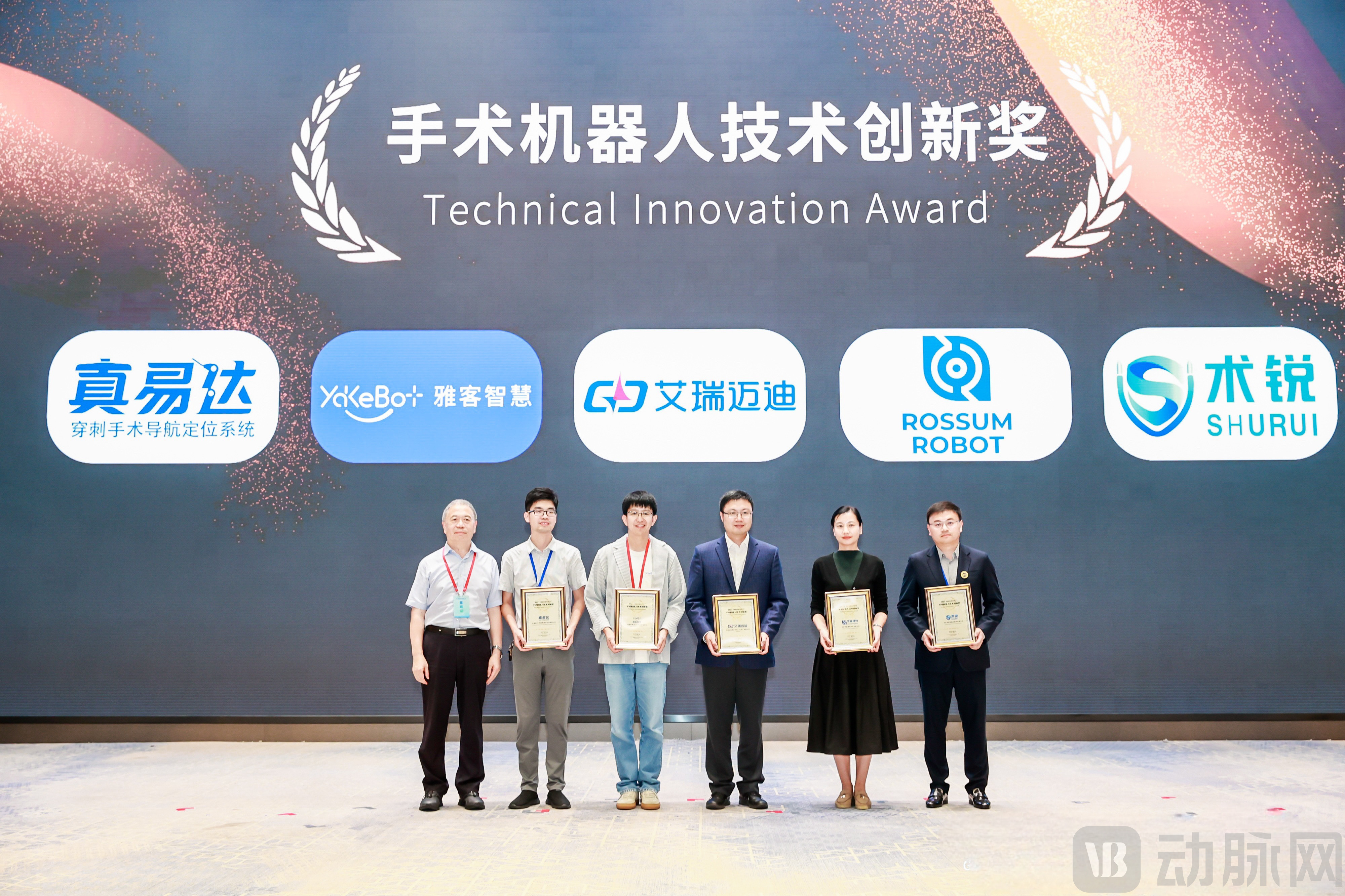
Arimedy Wins “2023 Surgical Robot Technology Innovation Award”
Arimedy, established in 2016 and headquartered at the Robotics Industry Innovation Center in Zhongguancun, Beijing, is dedicated to providing core technologies, key components, and complete solutions for intelligent medical devices to support navigation-robot-assisted minimally invasive surgical diagnosis and treatment. As a national high-tech enterprise specializing in the research, development, production, and sales of augmented reality-based precise navigation intelligent products, Arimedy has also been recognized as a Beijing “Specialized, Refined, Differential, and Innovative” SME. In October 2022, the company completed its nearly RMB 100 million Series A+ financing round, jointly invested by Hairui Investment and Haier Capital.
Although Arimedy was established in 2016, its core founding team had already been deeply engaged in the field of precision surgical navigation since 2003. The team successfully undertook and completed multiple national-level projects in related areas, earning recognition from physicians during pre-clinical applications.
Arimedy has assembled a team of professionals specializing in optics, electronics, mechanics, and artificial intelligence, boasting a high-caliber workforce proficient in product research and development, quality control, testing and certification, and market expansion. Arimedy maintains close collaborations with prestigious universities such as Beijing Institute of Technology and Tsinghua University, establishing an integrated collaborative innovation model that combines industry, academia, and research.
Through more than 20 years of technological breakthroughs and accumulation, the company has now achieved comprehensive breakthroughs in core technologies such as positioning sensing, optoelectronic imaging, virtual simulation, intelligent analysis of medical images, and human-computer interaction, becoming the first enterprise in China to master the core technologies of optical and electromagnetic clinical-grade navigation systems.
“Initially, we aimed to provide physicians with precise guidance in areas such as positioning, visualization, and fine-target detection. As our R&D efforts deepened and our understanding of the industry grew, we identified a critical bottleneck in the core components of domestically produced navigation and positioning systems. Currently, optical tracking and electromagnetic tracking technologies, which are widely used in navigation equipment both in China and abroad, rely heavily on Canada’s NDI company.”
Dr. Fan Jingfan told VCBeat that leading international companies have a significant first-mover advantage, establishing closed-loop barriers across all segments of the industrial chain. They dominate China’s navigation sector through advanced manufacturing capabilities, leading innovative processes, comprehensive product portfolios, and strong brand equity. Achieving domestic production of core components for navigation and positioning is therefore an urgent priority.
As a “national team” player in the R&D and manufacturing of optical positioning sensors, Arimedy has shouldered the mantle and, after years of overcoming significant technical challenges, successfully developed its own core tracking and positioning components. This achievement has enabled domestic substitution for related products from NDI, the Canadian company that holds a global monopoly, while surpassing them in key performance indicators such as accuracy stability within the tracking volume, tracking frame rate, and dynamic response.
Arimedy has progressively built three product and service pipelines centered on core components, terminal devices, and platforms.
Self-developed core components for optical and electromagnetic tracking and positioning, providing hardware solutions for the industry.“Ruitong,” unveiled at this conference, is an optical navigation device that performs tracking and positioning based on binocular vision. It enables real-time localization sensing with sub-millimeter high precision, a wide field of view, and multi-target capability, offering advantages such as high stability, high accuracy, and ease of secondary development. The product’s overall performance benchmarks against imported counterparts, while surpassing them in core metrics including positional stability within the tracking volume, tracking frame rate, and dynamic response.
The product series currently comprises two models: “SE” and “MAX.” The SE model, with a width of approximately 30 cm, enables precise tracking and positioning within a range of 1–1.5 meters, achieving a positioning accuracy of 0.2 mm, making it suitable for minimally invasive surgeries of the head and neck. The MAX model, with a width of approximately 50 cm, supports tracking and positioning within a range of 2–2.5 meters, delivering ultra-high precision of 0.12 mm, and is designed for major surgical procedures such as orthopedic surgery.
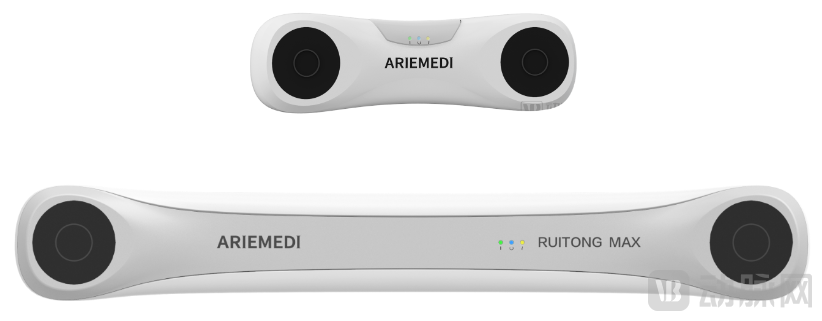
Ruitong SE and Ruitong MAX
According to Dr. Fan Jingfan, in civilian applications such as vehicle-mounted systems, the accuracy of tracking and positioning components is typically at the centimeter or millimeter level. However, in medical scenarios, particularly during surgery, where the diameter of normal human arterial vessels is only 2–3 mm and the vessel wall thickness is 1–2 mm, binocular optical positioning devices must control errors to the sub-millimeter level. Achieving such precision poses extremely stringent challenges for product algorithms, structural design, optical system design, and optical manufacturing processes. Through dedicated research and development, Arimedy has successfully overcome a series of core technologies, including medical-grade electromagnetic compatibility, temperature-drift-free vibration resistance, and jitter suppression.
Modular technology for surgical navigation robots and imaging devices provides the industry with integrated hardware-software solutions.Based on its core components and technology platforms, Arimedy has independently developed a skull base surgical navigation system and a percutaneous puncture surgical robot. The former, leveraging Arimedy’s image registration and augmented reality visualization technologies, offers functionalities such as real-time navigation, safety alerts, 3D modeling for surgical planning, and endoscopic fusion display. It has already received market approval, empowering physicians to perform precise surgical procedures. The latter has pioneered the integration of “multimodal fusion + respiratory motion compensation” and is expected to obtain regulatory certification within this year.
Dr. Fan Jingfan specifically highlighted that intraoperative deformation and shift are widely recognized challenges in the industry, particularly with soft-tissue deformation and respiratory motion in organs such as the liver and kidneys, which have become significant obstacles for every surgical navigation company. To address this issue, Arimedy incorporates intraoperative imaging to provide real-time information on anatomical changes, performs respiratory motion correction based on this data, provides compensation for deformations occurring during intraoperative procedures, and thereby enhances accuracy through such compensation.
Taking Arimedy’s self-developed percutaneous puncture surgical robot as an example, its integration of ultrasound-guided late-stage motion compensation reduces puncture errors from 5–8 mm to within 3 mm, significantly enhancing therapeutic efficacy and safety.
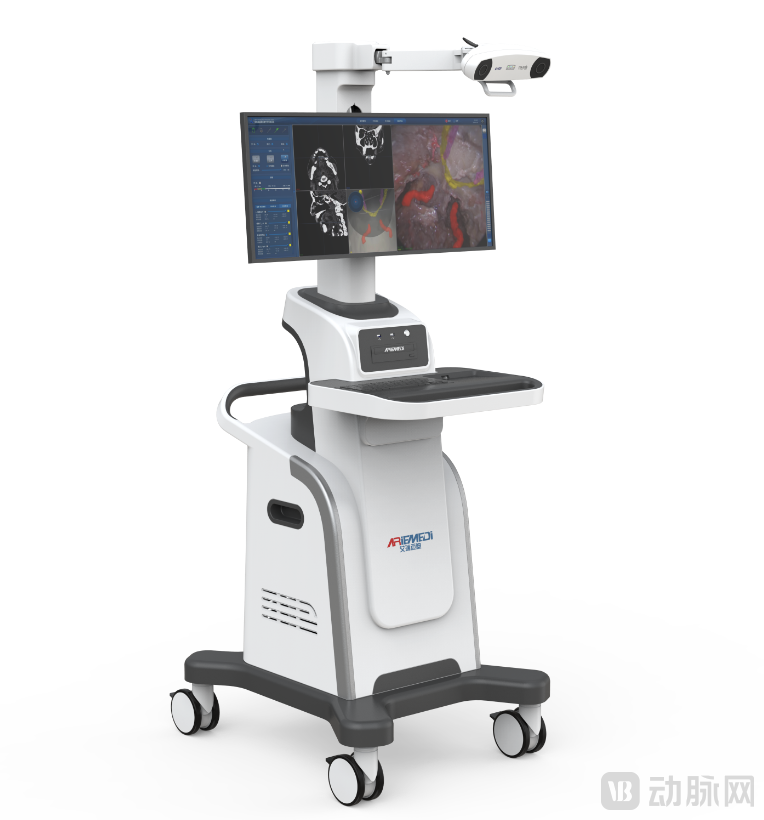
Arimedy Develops Proprietary Surgical Navigation System for Skull Base Surgery
Standardize registration testing and clinical trial capabilities to provide the industry with an integrated solution from R&D to regulatory approval.A single tree does not make a forest, nor does a single flower bring spring. Leveraging its comprehensive capabilities spanning R&D, testing, clinical trials, and regulatory approval, Arimedy opens up its expertise and technology to the industry, providing end-to-end services from development to certification for enterprises in the field. This accelerates clients’ development of surgical robots, drives advancements in both technological innovation and supply within the sector, and supports outstanding companies in the R&D, registration, and certification of surgical navigation robots, image enhancement for imaging equipment, simulation systems, and more, thereby accelerating the rapid growth of the surgical robotics industry.
Dr. Fan Jingfan added, “Our greatest distinction from other surgical robotics companies lies in our positioning as an upstream provider of technologies, solutions, and products. Therefore, we are able to open up our years of accumulated expertise in surgical navigation robotic systems, regulatory registration, and manufacturing to industry peers. This enables companies across the surgical robotics sector to leverage their respective strengths, enhancing their capabilities for better, faster, and more cost-effective R&D and product launches in areas such as surgical navigation, imaging equipment, and surgical simulation, thereby accelerating the widespread adoption of surgical navigation robots on the supply side.”
The aforementioned three product models represent Arimedy's three revenue models—Facing All Competitors in the Surgical Navigation Robotics Industry, offering sales of core components;Facing Hospitals or Healthcare Institutions, providing sales of end-user products (navigation systems and surgical robots);For enterprises in the industry seeking to rapidly enter or expand into related business sectors, providing comprehensive services from technology to products.
With its superior performance, Arimedy hasWe have established partnerships with more than 50 domestic manufacturers in fields such as surgical robots, orthopedic instruments, surgical consumables, endoscopes, imaging equipment, and intelligent diagnostics, achieving revenue in the tens of millions of yuan.
To strengthen its underlying technologies and ensure they remain aligned with actual clinical applications, the company also collaborates withBeijing Institute of Technology, Peking University, Beihang University, Tsinghua University, Beijing Tongren Hospital, Peking Union Medical College Hospital, Chinese People's Liberation Army General Hospital, Xuanwu Hospital of Capital Medical Universityreached cooperation with universities and hospitals. As of now,Arimedy has served nearly 100 hospitals and supported over 1,000 surgical procedures.
“Reducing production costs is an imperative for domestically produced surgical robots; the inability to localize core components leads to higher manufacturing costs. Only by achieving domestic substitution of core components and functionalities can the localization of surgical robots reach new heights,” stated Fan Jingfan. Arimedy looks forward to collaborating with more peers in the field of surgical navigation robots and medical device manufacturers, pooling efforts to pursue shared development and help China’s intelligent medical device industry achieve leapfrog growth.