

Sientis Pharma Secures China's First Aβ-PET Imaging Agent Approval, Addressing Critical Early Diagnosis Challenges for Millions of Alzheimer’s Patients
Early diagnosis and timely intervention are currently the most effective approaches to delay Alzheimer'sa critical approach to monitoring the progression of Alzheimer’s disease (AD). However, AD has an insidious onset; patients in the early stages do not exhibit obvious clinical manifestations such as cognitive or memory impairment, making clinical diagnosis challenging. Indeed, the precise early diagnosis of AD represents one of the greatest challenges facing modern medicine.
On September 15, Xiantong Medicine’s Aβ-PET Imaging Agent Ouweining®Fluorine[18F] Betaphen Injection Approved for Marketing by the NMPA, BecomingThe first Aβ-PET imaging agent approved in China for the diagnosis of AD.Fluorine[18F] After injection into the body, Betafen Injection specifically binds to Aβ (amyloid-beta) plaques in the cerebral cortex of patients with Alzheimer's disease.18F-labeled isotopes emit positron signals, enabling brain scans via PET-CT or PET-MRI systems to visually reveal the presence and spatial distribution of Aβ plaques in the brain.Highly aligned with the trend of “early, precise, and non-invasive” AD diagnosis, offering a glimmer of hope for the dilemma of early diagnosis of Alzheimer's disease (AD) in China.
The burden of Alzheimer’s disease (AD) in China is increasingly mounting. With continuous positive developments in the research and development of anti-amyloid-beta (Aβ) monoclonal antibody therapies, the approval of Xiantong Pharma’s Aβ-PET imaging agent marks a new starting point, significantly boosting market confidence in both the AD and radiopharmaceutical sectors. Moving forward, the entire industry will have greater confidence in both the diagnosis and treatment of AD and the development of China’s radiopharmaceutical industry.
Current Diagnostic Methods Are Highly Limited, Driving Strong Demand for Aβ-PET Imaging
The “World Alzheimer Report 2021,” released by Alzheimer’s Disease International, indicates that Alzheimer’s disease (AD) is currently the seventh leading cause of death globally, with more than 55 million people worldwide diagnosed with AD in 2020. The “China Alzheimer’s Disease Report 2021” shows that in 2019, the number of individuals in China affected by AD and other dementias exceeded 13 million, including approximately 10 million AD patients, with prevalence and mortality rates higher than the global average. Consequently, China faces greater pressure in the prevention, control, diagnosis, and treatment of AD.
With the continuous increase in the aging population, the number of Alzheimer’s disease (AD) cases in China will grow rapidly., leading to a continuous increase in disease burden and triggering a cascade of social issues, early diagnosis of Alzheimer's disease (AD) has become an imperative need that cannot be overlooked.
The core pathological biomarkers of Alzheimer’s disease (AD) widely recognized in the field include biomarkers reflecting amyloid-beta (Aβ) accumulation and tau protein biomarkers. The primary detection methods encompass cerebrospinal fluid (CSF)/plasma assays or measurements via PET-CT/MRI.
CSF testing requires lumbar puncture, a relatively complex procedure with traumatic risks, resulting in low patient acceptance. Although plasma biomarker methods, which have emerged in recent years, can be used for stratified screening, the “gold standard” for definitive diagnosis remains CSF analysis and PET imaging. Compared with CSF testing, PET scanning after injection of Aβ imaging agents can visually reflect the deposition levels of Aβ or tau protein in the brain, offering high sensitivity and specificity, as well as the advantages of early, non-invasive, and precise diagnosis.
Comparison of Various Diagnostic Methods for Alzheimer's Disease
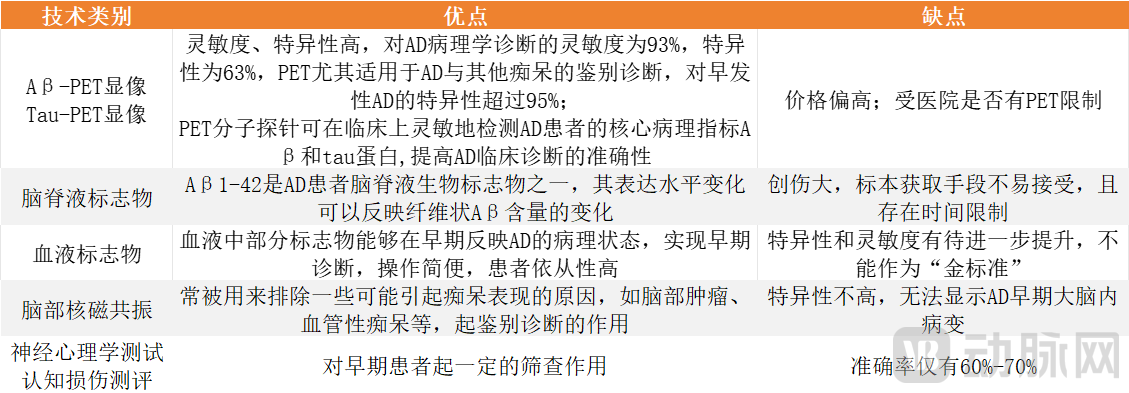
Overall, current technologies for AD diagnosis in China are relatively limited, lacking objective methods that are early, accurate, and non-invasive.Overall, PET imaging is a more suitable and appropriate method for the early diagnosis of AD.
Unfortunately, the development of PET imaging agents in China remains a long and arduous journey, with no formally approved PET imaging agents currently available for the early diagnosis and assessment of Alzheimer’s disease.Meanwhile, Aβ-PET and Tau-PET imaging agents have long been marketed and used overseas, with relatively mature applications. For example, Neuraceq (chemical name: florbetaben [18F]), an Aβ-PET imaging agent developed by Germany’s Life Molecular Imaging,18F] Flutemetamol Injection) was launched in Europe and the United States in 2014 and is widely used for the diagnosis of Alzheimer's disease (AD). Clinical data show that, with autopsy as the reference standard, the qualitative image interpretation of Neuraceq has a sensitivity of 97.9% and a specificity of 88.9%, while quantitative analysis yields a sensitivity of 89.4% and a specificity of 92.3%.
On the other hand, the recent boom in anti-Aβ monoclonal antibodies has also driven substantial demand for Aβ-PET imaging.Anti-Aβ targeted therapies are the most rapidly advancing and promising drugs for Alzheimer’s disease (AD). Multiple anti-Aβ agents, such as Lecanemab and Donanemab, are currently undergoing clinical trials in China and are poised for imminent approval. These trials all employ Aβ-PET imaging for participant screening and as study endpoints. As anti-Aβ monoclonal antibodies enter a golden period of development and successive products gain market approval, demand for Aβ-PET imaging agents is expected to surge.
In summary,Fluorine[18F] Florbetaben Injection holds significant clinical value in the precise diagnosis of early-stage Alzheimer's disease (AD) and in guiding treatment decisions for anti-amyloid-beta (Aβ) monoclonal antibody therapy.
According to statistics from VCBeat, among the disclosed nuclear medicine pipelines in China, nearly 10 products are focused on the early diagnosis of Alzheimer’s disease (AD). Notably, Beijing Xiantong International Technology Co., Ltd. obtained the license for the development and commercialization of Neuraceq in China in 2017, and on September 15, 2023, its fluorine-18F] Florbetaben Injection was the first to receive NMPA approval, becoming the first Aβ-PET imaging agent for AD diagnosis marketed in China, thereby filling a domestic gap.
Intensifying Competition: Production and Commercialization Capabilities to Become Key Focus in Radiopharmaceuticals
Amid the relatively sluggish market environment in recent years, nuclear medicine has emerged as a bright spot within the biopharmaceutical sector. On one hand, the introduction of landmark policies, such as the Medium- and Long-Term Development Plan for Medical Isotopes (2021–2035) and the Technical Guidelines for Clinical Evaluation of Radiopharmaceuticals for Internal Use, has sent strong positive signals. On the other hand, the robust market performance of foreign-approved oncology radiopharmaceuticals, including Lutathera and Pluvicto, has expanded the growth potential and imagination for China’s nuclear medicine market.
Driven by multiple favorable factors, nuclear medicine emerged in 2022 as the niche sector within innovative drugs with the highest proportion of financing rounds exceeding RMB 100 million, securing nearly RMB 900 million in total funding for the year. Industry enthusiasm further intensified in 2023, with Beijing Xiantong International Technology Co., Ltd. completing a financing round of RMB 1.37 billion.
To date, Xiantong Medicine has secured cumulative financing exceeding RMB 2 billion, making it the most heavily funded enterprise in China’s radiopharmaceutical sector. In terms of pipeline development, the company has more than 15 projects under investigation, with strategic layouts in the highly sought-after neurological, cardiovascular, and oncological fields within radiopharmaceuticals. As of September this year, Xiantong Medicine already has an Aβ-PET imaging agent, fluorine- [18F] Two products, betahistine injection and adenosine injection for myocardial perfusion stress testing, have been approved for market launch; the R&D progress of multiple products is far ahead, lutetium [177[Lu] Lutetium-177 oxodotreotide injection is the first peptide receptor radionuclide therapy (PRRT) drug in China to enter clinical development, currently in Phase III clinical trials; another blockbuster product for Alzheimer’s disease diagnosis, the tau-PET imaging agent, has also entered clinical trials...In terms of financing scale, pipeline layout, and product progress, Xiantong Medicine has joined the ranks of leading domestic nuclear medicine enterprises.
Notably,This fluorine[18F] The approval of Betafen Injection for market launch indicates that Xiantong Pharma has entered a stage of comprehensive commercialization explosion.It is understood that Xiantong Pharma has made ample preparations for production and commercialization, and operates three radiopharmaceutical manufacturing bases in Zhongshan (Guangdong), Wuxi (Jiangsu), and Mianyang (Sichuan).
Among these, the Zhongshan (Guangdong) and Wuxi (Jiangsu) bases focus on the commercial production and distribution of diagnostic radiopharmaceuticals, covering the economically developed key markets of the Yangtze River Delta and the Pearl River Delta, respectively. The Mianyang (Sichuan) base specializes in the production and distribution of therapeutic radiopharmaceuticals, with nationwide coverage across China; for regions where independent production and distribution have not yet been achieved, layout will be primarily established through collaborations with external companies. The company’s commercialization team has been fully established, having forged partnerships with over 300 hospitals nationwide, thereby building comprehensive capabilities in radiopharmaceutical production, distribution, and market promotion. The commercial achievements of Xiantong Pharma are highly anticipated.
China’s radiopharmaceutical market has become a highly competitive landscape, with industry momentum expected to accelerate significantly over the next three to five years. Multiple radiopharmaceuticals targeting popular markers such as PSMA and SSTR, as well as those labeled with fluorine-18, lutetium-177, and gallium-68, are poised to enter the Chinese market. Given the stringent regulatory environment and the short half-life characteristics of radiopharmaceuticals, a key focus for the industry will shift toward companies’ production, distribution, and commercialization capabilities. Enterprises that can successfully integrate the entire value chain—from R&D and manufacturing to distribution and marketing—will gain a strategic advantage.