

Genetron Health's PDGFRA D842V Companion Diagnostic Kit Becomes China's First Domestically Developed CDx Approved by NMPA
After three years of uninterrupted research and development and clinical validation, the "Human PDGFRA Gene D842V Mutation Detection Kit" (hereinafter referred to as the "Kit") developed by Genetron Holdings Limited has recently received formal approval from the National Medical Products Administration (NMPA), becoming the first domestically developed companion diagnostic kit approved by the NMPA. The Kit serves as a companion diagnostic for CStone Pharmaceuticals’ avapritinib tablets, which are indicated for the treatment of adult patients with unresectable or metastatic gastrointestinal stromal tumors (GIST) harboring PDGFRA exon 18 mutations, including the PDGFRA D842V mutation.
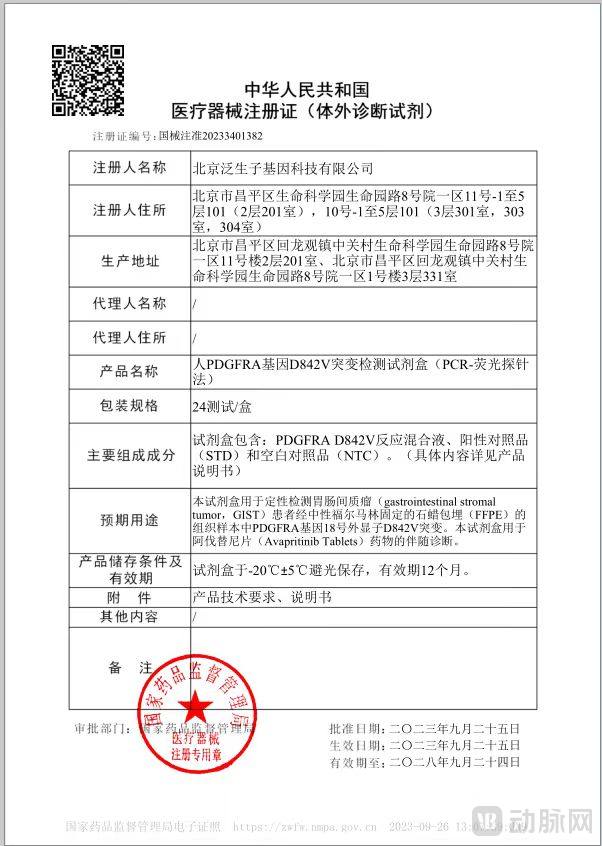
The launch of this kit has achieved several “firsts”: it is the first domestically produced companion diagnostic kit approved for market entry by integrating pharmacodynamic data from both within and outside China; the first companion diagnostic kit to reach the market via a complete bridging pathway following the issuance of the Guidelines for Clinical Trial Registration and Review of Non-Innovator Companion Diagnostics for Antineoplastic Drugs and the Guidelines for Clinical Trial Registration and Review of Innovator Companion Diagnostics Developed Concurrently with Antineoplastic Drugs; and the first companion diagnostic kit in which both the drug and the device received priority review.
Priority Review Granted: First Original Companion Diagnostic Kit Approved Under New Regulations
China has consistently encouraged and supported the innovation of medical device technologies and the development of new products to advance medical technology. This test kit was granted priority review by the National Medical Products Administration (NMPA) on the grounds that it addresses an urgent clinical need and that no similar medical devices had been approved in China. Following the announcement of collaboration between Genetron Holdings Limited and CStone Pharmaceuticals in late 2019, the test kit completed its journey from research and development to regulatory approval in just three years, despite multiple challenges posed by the COVID-19 pandemic. This clearly demonstrates the NMPA’s authoritative assessment of the kit’s clinical value and its efforts to facilitate early market entry so that patients can benefit as soon as possible. Meanwhile, the rapid approval also reflects Genetron’s capabilities in R&D and regulatory registration, as well as its ability to collaborate effectively with pharmaceutical companies.
Previously, the Center for Medical Device Evaluation of the National Medical Products Administration (NMPA) issued two review guidelines related to companion diagnostic reagents in December 2021 and June 2022, respectively: the “Guiding Principles for Clinical Trial Registration Review of Non-Originator Companion Diagnostic Reagents for Antineoplastic Drugs” and the “Guiding Principles for Clinical Trial Registration Review of Originator Companion Diagnostic Reagents Developed Concurrently with Antineoplastic Drugs.” Undoubtedly, the introduction of these new regulations helps optimize and streamline the review of registration applications for companion diagnostic reagents, accelerating their market launch. Furthermore, they provide important guidance and impetus for the research, application, and commercialization of antineoplastic drugs and their associated companion diagnostic reagents, thereby enhancing China’s innovation capacity and competitiveness in the field of oncology therapeutics.
It is widely recognized within the industry that the implementation of this series of policies has not only standardized the registration requirements for companion diagnostic kits but also raised the registration threshold for companion diagnostic companies. For the industry, this marks the first kit approved via a bridging study since the new regulations took effect, offering valuable experience in successfully navigating the regulatory pathway and providing a reference model for future applicants.
In both China and the United States, it is common for the development of companion diagnostic reagents to lag behind that of drug clinical trials. Consequently, bridging studies have become the primary pathway for the regulatory approval and market launch of most companion diagnostic reagents. By leveraging existing data from drug clinical trials, this approach evaluates the accuracy and reliability of the diagnostics by analyzing the correlation between the therapeutic efficacy of known drugs and the predictive results of the companion diagnostic reagents. This strategy can significantly reduce the time and resource costs associated with conducting standalone clinical trials, accelerate the market entry of companion diagnostic kits, and promote the advancement of precision medicine and personalized healthcare.
In a similar development, in August this year, the FDA approved a real-time fluorescent PCR companion diagnostic product from Qiagen, which bridges the NAVIGATOR clinical study BLU-285-1101. This product also detects the D842V somatic mutation in the PDGFRA gene to determine which patients may be suitable for avapritinib treatment. These two companion diagnostics with consistent intended uses were approved almost simultaneously. Furthermore, since the approval of avapritinib tablets in China was based on two key clinical studies, BLU-285-1101 and BLU-285-1105, Genetron Holdings Limited also conducted two bridging trials combining domestic and international efficacy data. This is expected to support both FDA and CE approvals simultaneously, making it the first domestically developed companion diagnostic reagent to pursue market authorization in China, the United States, and Europe concurrently.
Notably, Genetron Holdings Limited, leveraging its proprietary liquid biopsy technology for early hepatocellular carcinoma screening, became the first molecular diagnostics company in China to receive the U.S. FDA’s “Breakthrough Device” designation. This achievement underscores its internationally leading technical capabilities validated by the FDA, thereby paving the way for subsequent global multicenter clinical trials.
Companion Diagnostics Are Key to Achieving Precision Medicine
An indisputable industry consensus holds that the faster a companion diagnostic test is matched with a newly launched drug, the more effectively clinicians can identify patients with specific target alterations, thereby enhancing the efficacy and safety of targeted therapies while reducing healthcare costs. This is key to achieving precision oncology.
Taking gastrointestinal stromal tumors (GIST) as an example, the symptoms caused by GIST lack clinical specificity, making early detection difficult. Many patients are diagnosed at intermediate or advanced stages, when surgical resection is no longer curative. Avapritinib tablets are the first highly active therapeutic agent approved in China for the treatment of GIST with PDGFRA exon 18 mutations. The NAVIGATOR study demonstrated that avapritinib achieved an objective response rate (ORR) of 89%, with 59% of patients maintaining a median duration of response (DOR) of ≥6 months. With the approval of avapritinib in China, it will bring tangible hope to Chinese GIST patients, enabling efficient benefits from precision therapy and robust benefits from later-line treatments.
Meanwhile, clinical trial results for Genetron’s companion diagnostic kit demonstrated that the objective response rate (ORR) to targeted therapy, guided by the companion diagnostic, reached 92.5%. The positive percent agreement (PPA) and negative percent agreement (NPA) compared to Sanger sequencing, the clinical gold standard, were 100% and 99.43%, respectively, with an overall percent agreement (OPA) of 99.46%. These figures indicate that 92.5% of patients identified by the kit responded effectively to afatinib, providing robust evidence of the kit’s efficacy. Much like a rifle scope, companion diagnostics enable precise targeting, thereby unleashing the full therapeutic potential of targeted drugs, akin to a sniper rifle.
Conquering the Blue Ocean of Companion Diagnostics: R&D Capability, Assay Design Capability, and Regulatory Approval Capability Are Key
The importance of companion diagnostics is self-evident. Building on this foundation, accurate test results and rapid regulatory approval have become shared priorities for both clinical practitioners and pharmaceutical companies. Although the prospects are promising, successfully bringing companion diagnostic products to market requires precision diagnostics companies to possess comprehensive capabilities integrating R&D, assay design, and regulatory submission. Key considerations include:
Robust assay design capability is the foundation for ensuring the success of companion diagnostic products, requiring developers to possess substantial knowledge backgrounds, research capabilities, and comprehensive judgment skills. The development of a companion diagnostic, from project initiation to final regulatory approval, typically takes 3–4 years and involves complex trial designs. A comprehensive, rigorous, and scientifically sound design protocol can ensure high sensitivity and specificity, avoid design flaws, fundamentally guarantee the smoothness and efficiency of the entire trial process, and expedite the approval timeline. This was highlighted as one of the key reasons for the successful launch of the kit by CStone Pharmaceuticals at this year’s CMAC Annual Conference: the high-quality primer design in Genetron Holdings’ companion diagnostic reagent ensured the validity of its clinical trials.
Robust regulatory submission capabilities are key to the approval of companion diagnostic products. Recent regulations introduced over the past two years indicate that China is also encouraging the co-development of drugs and companion diagnostics. The companion diagnostic kit recently approved for Genetron Holdings Limited had no successful precedents to reference and required the acquisition of compliant overseas samples to bridge efficacy data between international and domestic markets, highlighting the considerable challenges involved. During this process, Genetron’s ability to interpret policies, communicate effectively with regulatory authorities, and provide rigorous and accurate data undoubtedly played a critical role. These three competencies are clear manifestations of strong regulatory submission capabilities and were instrumental in securing successful approval.
It is worth noting that cross-border companion diagnostic capabilities are a significant competitive advantage for diagnostic companies. Whether it involves Chinese pharmaceutical companies, represented by CStone Pharmaceuticals, introducing overseas drugs, or the intensive efforts of Chinese innovative drug companies in recent years to expand globally, the ability to use a single test kit to simultaneously analyze domestic and international samples and align clinical trial data can greatly enhance the efficiency of global multi-center clinical trials. Genetron Holdings Limited’s test kit has successfully bridged domestic and international data, demonstrating that its product accuracy is on par with international standards.
Nevertheless, propelled by favorable policies, we anticipate more companion diagnostic collaborations akin to those between Genetron Holdings and CStone Pharmaceuticals in the future, empowering more physicians and patients to wield the tools of precision medicine to precisely target cancer, this stubborn adversary.