

Zhiyu Medical AI Secures Nearly RMB 10 Million in Pre-A Funding to Accelerate Commercialization of Liver Imaging Products
In 2023, the field of medical imaging AI was indeed somewhat calm.
But just yesterday, an AI imaging company announced that it had completed a financing round, marking the first externally disclosed funding since its inception. While this development has bolstered market confidence, VCBeat is also curious about the company: Why has it managed to secure capital favor at this particular moment?
The company, named Shanghai Zhiyu Software Information Co., Ltd. (hereinafter referred to as “Zhiyu”), has just secured pre-A financing from Shanghai Yongli Private Equity Fund, a professional equity investment institution specializing in technological innovation, high-end manufacturing, and new materials.
Photo of the Signing Ceremony
The fund’s founders, Zhou Yiwen and Qiu Ying, along with their management team, possess extensive experience in industrial investment and the securities industry. They have previously invested in companies such as Montage Technology, Jinbo Shares, Feiwo Technology, Sunward Intelligent, and Dunyuan Juxin, which operate in the fields of new materials, integrated circuits, and high-end manufacturing. In July 2014, Shanghai Yongli Private Equity Fund (FORISING PRIVATE FUND) obtained the qualification of private equity fund manager from the Asset Management Association of China.
Regarding the investment in Zhiyu, Zhou Yiwen stated that there are three main reasons behind this decision. First, although the medical imaging AI industry is currently facing some development challenges, he remains highly optimistic about its future prospects, as “imaging AI holds significant positive value for the overall development of the healthcare industry, and the current difficulties are only temporary.”
Second, the Zhiyu team boasts a diverse and multidisciplinary background. Its founder, Wu Huazhao, has over 20 years of experience in medical device marketing and operations, while the team comprises professionals from multiple fields, including medical devices, artificial intelligence (AI), and medical imaging. Compared to startups in the healthcare sector that are purely AI-driven, the Zhiyu team possesses a deeper understanding of the medical industry and a more profound insight into the needs of radiologists and other imaging-related physicians.
Third, during the background check, FORISING PRIVATE FUND found that Zhiyu’s related products were indeed well-received.
Frankly speaking, the medical imaging AI sector is fiercely competitive. This has prompted many companies to seek differentiated development paths.
Zhiyu has been found, and indeed, he has accomplished something "notable."
The choice of niche segments reveals a distinct “differentiation” strategy. Rather than entering the crowded and highly competitive imaging AI markets for pulmonary nodules or fundus diseases, the company opted for liver and brain applications—sectors characterized by high barriers to entry but lower competitive intensity.
Avoiding fierce market competition is merely one of the factors considered by Zhiyu in selecting its strategic niche. More importantly, Zhiyu seeks to identify and operate within a niche that, while possessing both high social value and high industry value, has been somewhat overlooked. This is because niches with such dual high value will inevitably gain recognition over time. When that happens, innovative enterprises or investment institutions looking to enter the space will find that Zhiyu has already established its presence.
The therapeutic areas chosen by Zhiyu are liver and brain diseases. Taking liver disease as an example, China has long been a country with a high burden of liver disease, with Chinese patients accounting for approximately half of the global hepatocellular carcinoma (HCC) patient population—a staggering number. Moreover, the five-year survival rate for HCC patients in China is only 14.1%. However, if patients receive surgical resection and other local therapies at an early stage, the five-year survival rate can reach 80%–90%.
Unfortunately, due to the insidious onset of liver cancer and the absence of obvious symptoms in its early stages, approximately 70%-80% of patients are already at an intermediate or advanced stage at the time of initial diagnosis, thereby missing the window for early intervention. Furthermore, the treatment rate for liver diseases in China remains low. The primary reasons include the complex anatomical structure of the liver, which makes it difficult to identify small lesions using CT and MRI imaging; the high technical difficulty and prolonged duration of surgical procedures, accompanied by significant risks of hemorrhage and incomplete resection of lesions; and the scarcity of medical resources in China, where the treatment of liver diseases is highly dependent on physicians’ experience and expertise.
Therefore, for the prevention and control of liver diseases in China at the current stage, in addition to pharmacological treatment, large-scale screening and professional surgical planning are crucial. The former aims to identify individuals at risk of liver disease to facilitate early intervention, while the latter provides surgeons with surgical planning tools, thereby enhancing clinical efficiency and alleviating the shortage of medical resources.
Accordingly, in addition to pharmaceutical therapy, Zhiyu has established a comprehensive product and service ecosystem spanning from screening and surgical planning to postoperative rehabilitation.
Specifically, Zhiyu’s AI product line for liver disease imaging comprises the Integrated Liver Disease Screening and Diagnosis-Treatment System (solution), the AI System for Precise Quantitative Assessment of Abdominal Fat, the 3D Reconstruction Surgical Planning System, and the Imaging Data Management and Intelligent Analysis Platform.
Among them, the Zhiyu Liver Disease Screening, Diagnosis, and Treatment Integrated System (Solution) offers an AI-powered comprehensive solution spanning screening, risk assessment, assisted diagnosis, assisted treatment, efficacy evaluation, and prognosis prediction.
VCBeat has learned that the system not only enables precise measurement, assessment, and prediction across the entire abdominal cavity and for all disease types, but also, with the support of an imaging data management and intelligent analysis platform, facilitates secondary diagnoses and multidisciplinary team (MDT) consultations at primary care hospitals, while providing training support for scientific research, academic activities, and personnel development.
According to the company, Zhiyu is the first enterprise in China to engage in the precise quantitative assessment of abdominal fat. Furthermore, Zhiyu’s Precise Quantitative Assessment System for Abdominal Fat not only integrates the advantages of various algorithms accumulated by Zhiyu over many years but also adopts the method with optimal sensitivity for fat measurement—MRI-PDFF (Magnetic Resonance Imaging Proton Density Fat Fraction). As stated in the “EASL Clinical Practice Guidelines: Magnetic resonance proton density fat fraction is the most accurate non-invasive method for detecting and quantifying steatosis,” this approach enables precise, accurate, and reproducible measurements.
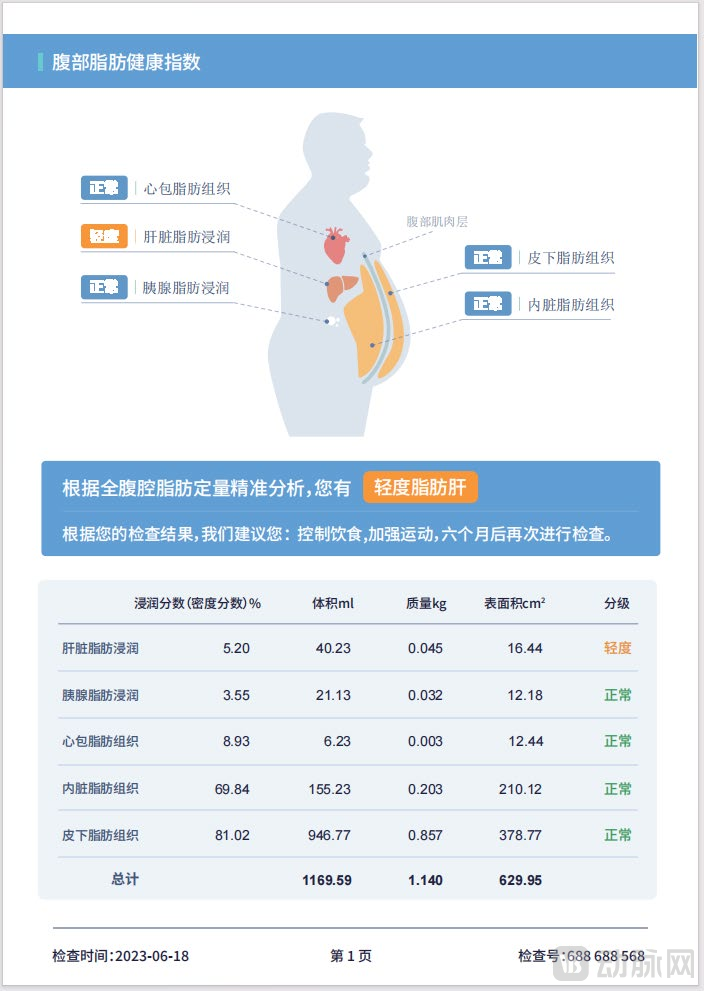
Specifically, after the scan is completed, the system automatically performs organ segmentation and segments the liver according to the Couinaud classification to calculate relevant parameters and determine fat grading. Depending on the version, the analysis report is available as a basic version providing liver-related parameters, or an upgraded version that includes quantitative analysis of total abdominal fat and pericardial fat.
Currently, Zhiyu’s precise quantitative assessment system for abdominal fat has been deployed at well-known health checkup institutions such as Pan-Imaging and Meinian Onehealth, receiving positive market feedback.
Moreover, the 3D reconstruction surgical planning system is the cornerstone of Zhiyu’s liver disease product portfolio.
Reportedly, by leveraging technologies such as quantitative imaging, digital modeling, and artificial intelligence, this system can complete image scanning within 2 minutes and reconstruction within 5 minutes. It not only accurately visualizes the liver and its complex internal vascular structures, determines tumor size and extent of invasion, and localizes lesions along with their spatial relationship to blood vessels, but also automatically annotates organs and lesions and generates personalized surgical planning schemes based on the patient’s specific condition. Furthermore, the system can simulate surgical procedures and their outcomes, quantitatively assessing postoperative liver function through the ratio of resected liver volume to remnant liver volume.
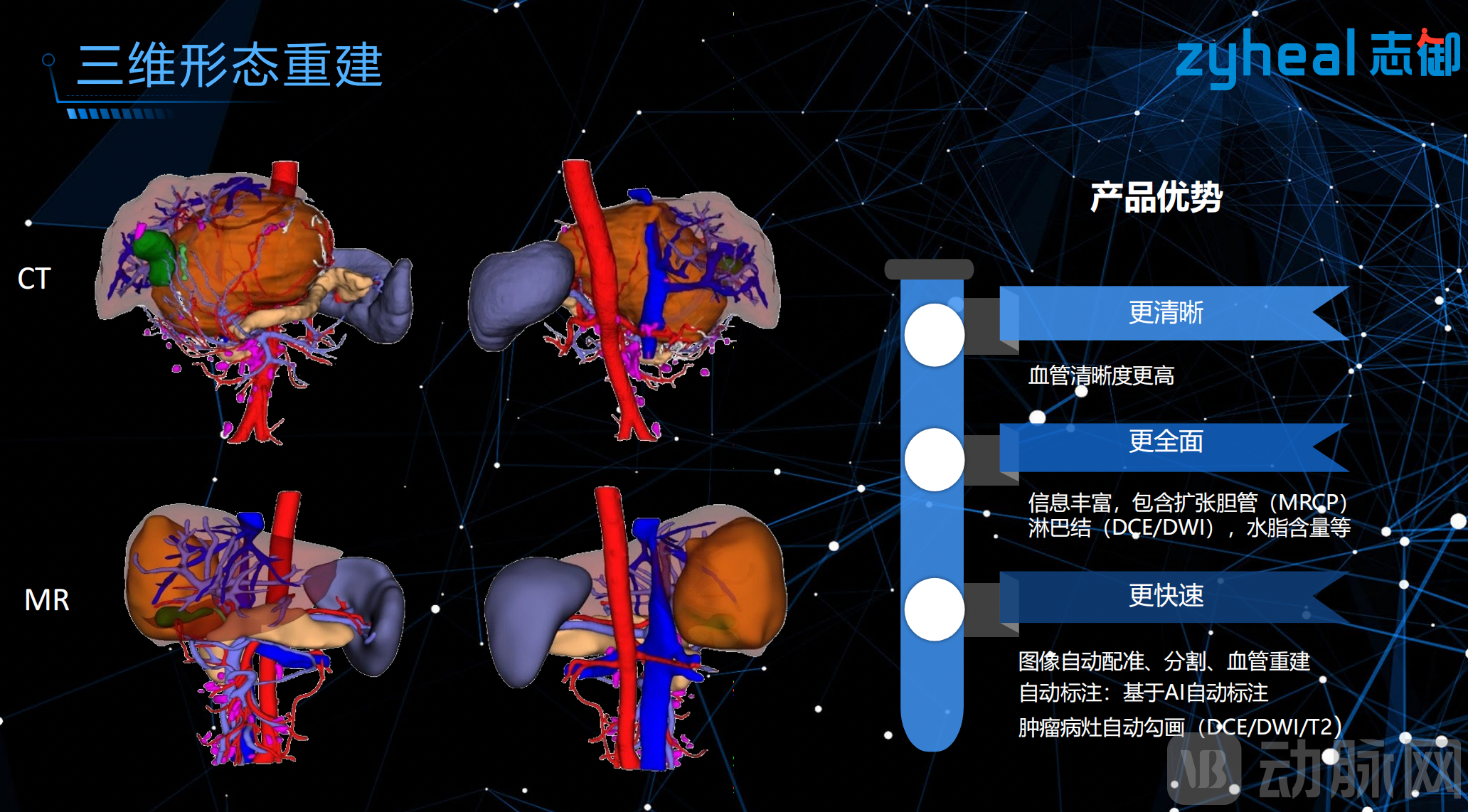
Overall, with the assistance of Zhiyu’s AI-powered imaging products for liver disease, clinicians can obtain more comprehensive information on vascular structures and lesions, thereby reducing surgical risks and shortening operative time.
Currently, Zhiyu’s 3D liver visualization and surgical planning products have been implemented at Zhongshan Hospital, Shanghai Eastern Hepatobiliary Surgery Hospital, Union Hospital Affiliated to Tongji Medical College of Huazhong University of Science and Technology, West China Hospital of Sichuan University, and the Affiliated Hospital of Southwest Medical University, receiving unanimous acclaim from clinical experts.
Wan Chidan, Director of the Department of Hepatobiliary Surgery at Wuhan Union Hospital, once commented on the Zhiyu 3D Liver Visualization and Surgical Planning AI System: “Based on quantitative analyses of tumors, liver volume, and blood flow territories, this system enables clearer identification of lesions and vasculature, facilitating precise and comprehensive preoperative planning for hepatic surgery as well as postoperative prognosis assessment.”
While its product strength has been widely recognized, Zhiyu also boasts strong commercialization capabilities. After all, since its inception, the “technology + commercialization” dual-drive strategy has been at the core of Zhiyu’s business model.
Both product development and commercialization capabilities are tied to the multidisciplinary backgrounds of the team, which investors value.
It is reported that over 70% of Zhiyu’s R&D team hold doctoral degrees. Its Chief Scientist previously completed a postdoctoral fellowship in Biomedical Engineering in the United States and served as a Senior Researcher at the research institute of a renowned international medical device manufacturer, with extensive experience in medical imaging and AI-based analysis.
Meanwhile, founder Wu Huazhao brings extensive experience serving over 1,000 tertiary hospitals across China. He not only possesses a deep understanding of hospital needs and pain points but also personally leads Zhiyu’s marketing team. To date, Zhiyu’s channel resource network has covered more than 1,000 tertiary hospitals and health management institutions, as well as over 5,000 county- and city-level medical facilities. In the international market, Zhiyu Technology maintains close collaborations with many renowned institutions, including HCA Healthcare in the United States, Massachusetts General Hospital, MD Anderson Cancer Center, Mayo Clinic, and NewYork-Presbyterian Hospital.
The challenges of integrating technology into clinical practice and the ambiguity of commercialization pathways are the primary factors constraining the development of the medical imaging AI industry. Regarding the former, as time passes and mutual understanding between enterprises and clinical practitioners deepens, successful integration is inevitable. As for the latter, with the clarification of relevant policies and the strengthening of companies’ commercial capabilities, a clear path will eventually emerge. As Zhou Yiwen stated in an interview, “The industry is indeed at a stage of overcoming numerous hurdles, but we believe that once these challenges are surmounted, the entire sector will usher in broader development.” This holds true for the industry as a whole, and likewise for Zhiyu.