

Veteran Internet Healthcare Company Xikang Cloud Hospital Finally Lists on HKEX After Four Filings in Two Years
Establishing China’s first cloud hospital and pioneering the prototype of internet hospitals, Neusoft Xikang, a “veteran” explorer in the internet healthcare sector founded in 2011, listed on the Hong Kong Stock Exchange today. Mirroring the industry’s turbulent development path, Neusoft Xikang finally reached this milestone after submitting its listing application four times between its initial filing in 2021 and 2023.
Since its launch in 2014, the Ningbo Cloud Hospital, Neusoft Xikang’s core strategic model—the Cloud Hospital Platform—has been replicated across 29 cities nationwide, forming four major solution portfolios: Cloud Hospital Platform Services, Internet Medical Services, Health Management Services, and Smart Healthcare Products.
Centered on the construction and operation of its Cloud Hospital platform, the four major solutions provide services to local governments, medical institutions, insurance companies, enterprises, and individuals, creating a diversified payer base. As the number of covered cities increased, Neusoft Xikang’s overall performance maintained steady growth, with annual revenues reaching RMB 503 million, RMB 614 million, and RMB 687 million in 2020, 2021, and 2022, respectively.
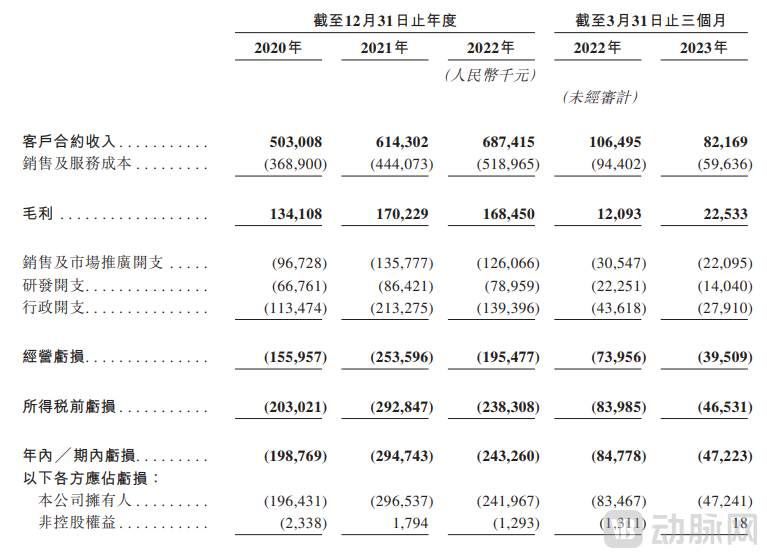
Neusoft Xikang’s Key Performance Data, Source: Prospectus
Due to the continuous incurrence of substantial sales and marketing expenses, R&D expenses, and administrative expenses during its business expansion, Neusoft Xikang remains in a loss-making position, with adjusted net losses of RMB 149 million, RMB 126 million, and RMB 147 million in 2020, 2021, and 2022, respectively.
However, unlike the current industry norm where pharmaceutical sales dominate as the primary revenue model, Neusoft Xikang has developed a unique business model through more than a decade of exploration.
2014, the inaugural year of internet healthcare, witnessed not only enthusiastic investment from the capital market but also several landmark events: the issuance of the “Opinions on Promoting Remote Medical Services in Medical Institutions,” which encouraged the integration of remote medical service systems into regional health planning and the development plans of medical institutions; in the same year, Guangdong Provincial Online Hospital went live, and Ningbo Cloud Hospital commenced construction, both serving as early prototypes of internet hospitals.
Ningbo Cloud Hospital Has Become a Regional Benchmark
Ningbo Cloud Hospital was jointly established by the former Ningbo Municipal Health and Family Planning Commission (now the Ningbo Municipal Health Commission) and Neusoft Xikang. Following preliminary development, it commenced operations in March 2015, with its offline physical medical institution opening in July of the same year. At launch, 226 specialist physicians and family doctors were onboarded onto the platform under signed contracts. Four “Cloud Clinics” were introduced, focusing on hypertension, diabetes, psychological counseling, and general practice. The platform provides appointment services for outpatient visits, hospitalization, diagnostic examinations, and health check-ups, while also enabling diagnosis and treatment activities tailored to specific populations and disease conditions.
As a new urban infrastructure platform, Ningbo Cloud Hospital connects local medical institutions, integrates healthcare resources, and establishes interconnectivity with third-party entities such as local chain pharmacies. Online prescriptions issued by “Cloud Doctors” can be seamlessly transmitted to these chain pharmacies, allowing residents to pick up medications at nearby locations or opt for delivery services based on their individual needs.
Over the past nine years, Ningbo Cloud Hospital has undergone upgrades and iterations across different stages.
From 2014 to 2016, Ningbo Cloud Hospital focused on integrating online and offline medical resources to achieve the sharing of electronic health information.
From 2016 to 2019, the internet-based medical services provided by the Ningbo Cloud Hospital Platform were continuously improved.The launch of the smart family doctor service enables patients and other healthcare consumers to contract with family doctors and access medical and health services in real time. Since 2016, the platform has provided internet-based home nursing services tailored to local needs in Ningbo. The Ningbo Cloud Hospital platform also assists hospitals in establishing telemedicine service centers, delivering remote medical services to primary healthcare institutions through the platform.
During this period, Ningbo Cloud Hospital also integrated health insurance payment for internet medical services. In 2018, pilot programs were launched at two hospitals in Ningbo, enabling mobile health insurance payments for 23 types of chronic diseases and 153 medications; by 2019, online health insurance payments had been gradually implemented for internet-based consultations and prescription medication purchases.
Since 2020, the Ningbo Cloud Hospital Platform has further empowered major local healthcare institutions., build its own cloud hospital system and tailor internet medical services to its needs, a move that can encourage more medical institutions to join the platform.
According to data from the Ningbo Municipal Health Commission, by December 2020, all public medical institutions in Ningbo had been integrated into the Ningbo Cloud Hospital Platform.As of the end of March 2023, the number of medical institutions connected to the Ningbo Cloud Hospital Platform increased from 647 at the end of 2020 to 756.
Furthermore, as of the end of March 2023, the Ningbo Cloud Hospital platform had approximately 13,000 doctors and 9,700 nurses, serving 8.5 million residents across 11 districts and counties in Ningbo. It offers 37 types of medical and health services, covering 53 medical specialties.
With the continuous upgrading and iteration of its business and services, key operational data for the Ningbo Cloud Hospital has grown in tandem. For instance, the platform provided 5,900, 11,000, and 23,000 instances of internet-based home nursing care in 2020, 2021, and 2022, respectively. In the first quarter of 2023 alone, approximately 9,000 such services were delivered. Notably, in 2021, the volume of internet-based home nursing care provided by the platform accounted for 60% of the total service volume across Zhejiang Province for that year. Due to its outstanding performance in this field, the Ningbo Cloud Hospital platform was selected by the provincial government as a model for promoting internet-based home nursing care services throughout Zhejiang Province.
To this day, Ningbo Cloud Hospital remains a vital public welfare service in the local community, frequently featured in official communications at key junctures.
Why Can the Cloud Hospital Model Be Replicated Across China?
As the Ningbo Cloud Hospital platform grew and expanded, Neusoft Xikang replicated this model in other cities across China. By the end of March 2023, its city-based cloud hospital platform services had covered 29 cities nationwide, including Anshan, Baoshan, Chongqing, Dalian, and Dandong.
The cloud hospital platform model is replicable primarily because Neusoft Xikang has identified several key logical underpinnings.
First, in the process of digital transformation of the healthcare service system, various regions have vigorously promoted the integration of regional medical resources, established health records, facilitated the interoperability of health data, and explored the value of data. Overall, in recent years, there has been considerable enthusiasm across regions for building regional health service platforms.
Secondly, the municipal level is a key tier for coordinated management, whether for healthcare institutions or medical insurance funds. Building cloud hospital platforms with cities as the entry point enables more efficient and extensive outreach to local healthcare institutions and facilitates integration with medical insurance payment systems.
Finally, given the multitude of interfaces involved in medical information systems, once a city-based cloud hospital platform becomes operational, it is unlikely to be completely replaced by another company’s technical infrastructure, thereby establishing high competitive barriers.
In the future, Neusoft Xikang also plans to expand its Cloud Hospital platform to other regions, including the Yangtze River Delta, the Pearl River Delta, and the Beijing-Tianjin-Hebei metropolitan area.
For a long time, a key factor hindering the progress of the internet healthcare industry has been scalability. While single-service encounters and service packages are highly scalable, the low frequency of individual user demand makes it difficult to generate substantial revenue or achieve profitability. Currently, some companies have built their business models based on specific regions and are gradually expanding; however, regional disparities make this path challenging. Neusoft Xikang’s progression from establishing benchmark projects to gradual expansion demonstrates that it has found certain breakthroughs in regional replication.
As the cloud hospital platform model continues to be replicated, Neusoft Xikang has established four major solutions: cloud hospital platform services, internet medical services, health management services, and smart healthcare products.
Among these, the Cloud Hospital platform services are directed at local governments, medical institutions, and insurance companies, providing platform construction and integration services. This includes building or upgrading Cloud Hospital platforms for local governments, or developing or enhancing independent Cloud Hospital systems for large medical institutions; it also involves integrating medical institutions into Neusoft Xikang’s Cloud Hospital platform, enabling them to deliver internet-based medical services.
Internet-based medical services are designed for residents. Supported by the Cloud Hospital platform, Neusoft Xikang’s self-operated medical institutions and third-party medical institutions onboarded on the platform provide integrated online-to-offline medical services, including Internet hospital services, telemedicine services, smart family doctor services, and internet-based home nursing care.
Health management services are primarily targeted at institutional clients, including government agencies, enterprises, banks, and insurance companies. Neusoft Xikang provides health management services to the employees of these institutions.
Smart healthcare products primarily provide local governments and primary healthcare institutions with smart cloud consultation rooms, smart cloud pharmacies, and all-in-one health kiosks, while also offering other smart medical devices to enterprises and individuals to meet healthcare needs across diverse scenarios.
According to the prospectus,Among the four major solutions, health management services and smart healthcare products accounted for the largest share of revenue. From 2020 to 2022, revenue from health management services represented approximately 30%-40%, smart healthcare products around 30%, and cloud hospital platform services about 20%.
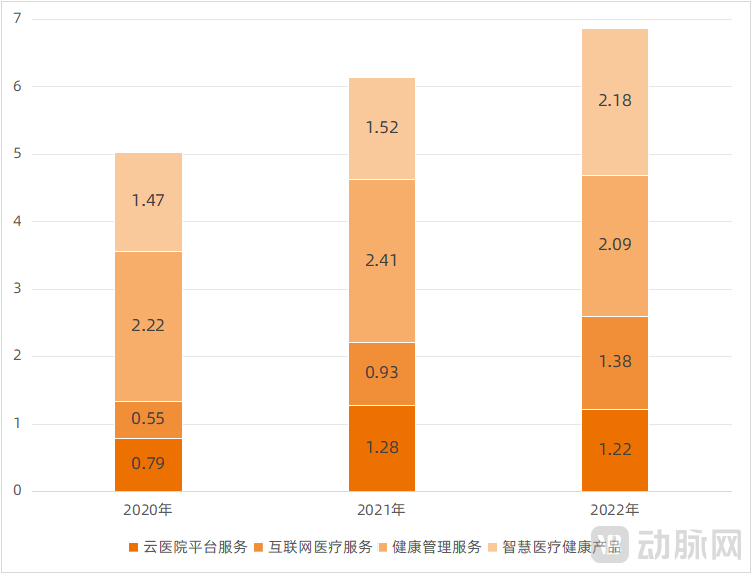
Revenue from Neusoft Xikang’s Four Major Solutions (RMB 100 million), Source: Prospectus
Nevertheless,Among the service offerings of the four major solutions, the Cloud Hospital Platform service stands out as the most core component.
From the perspective of service capabilities, cloud hospital platform services form the foundation for other service capabilities.
Neusoft XIKANG’s Cloud Hospital Platform typically comprises six functional modules: Internet Hospital, Telemedicine, Family Doctor Services, Internet-based Nursing, Health Management, and Chronic Disease Management. Clients may select one or multiple modules. Supported by the Cloud Hospital Platform, participating medical institutions can establish integrated online-to-offline service capabilities encompassing the aforementioned components.
As of the end of March 2023, Neusoft Xikang’s cloud hospital platform, covering 29 cities, had connected 35,600 medical institutions, the majority of which are public. In other words, these institutions rely on the cloud hospital platform to deliver various healthcare services to the public.
From the perspective of customer channels, the cloud hospital platform service establishes a traffic source for the synergy of other services.
Generally, Neusoft Xikang secures cloud hospital platform contracts through public bidding. Once a cloud hospital platform is established for a city, it can efficiently connect with local medical institutions, converting their patients into users of internet-based medical services and health management services.
Furthermore, cloud hospital platform services can generate high gross profit margins.
According to the prospectus, since 2020, the gross profit margin of cloud hospital platform services has consistently ranked first among the four major solutions and has continued to grow: increasing from 37.1% in 2020 to 46.2% in 2022, and reaching 48.1% in the first quarter of 2023.
This is primarily because the cloud hospital platform model is replicable and scalable, with costs shared across different platforms. In other words, the more cities in which the cloud hospital platform is deployed, the more the costs of standardized modules are distributed, thereby driving down overall costs.
With cloud hospital platform services as the entry point, the four major solutions have also formed a close synergistic relationship.
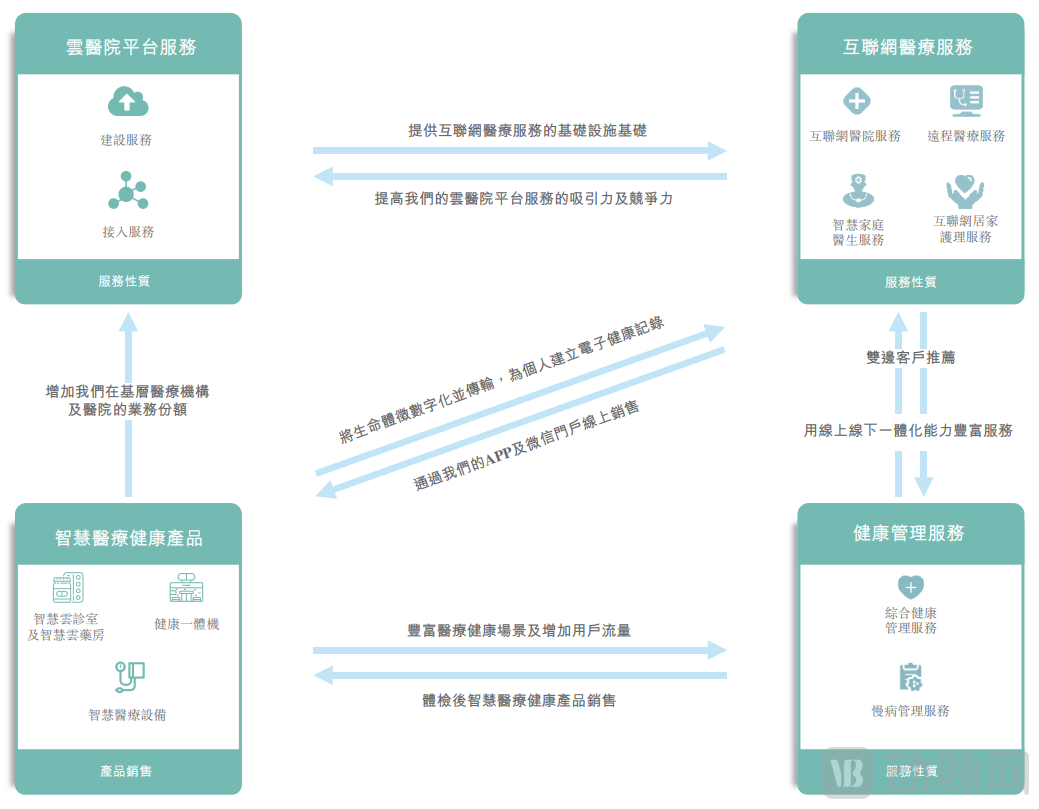
Synergy Among Neusoft Xikang’s Four Major Solutions. Image source: Prospectus
For instance, cloud hospital platform services connect healthcare participants to cloud infrastructure, enabling various stakeholders to access or utilize corresponding SaaS tools and medical service modules. Internet-based medical services empower participating healthcare institutions by delivering integrated services that bridge in-hospital and out-of-hospital care, as well as online and offline channels. Health management services leverage this online-offline integration capability to serve individual or institutional clients through self-operated medical facilities. Smart healthcare products enrich healthcare service scenarios by collecting health data via diverse hardware devices, thereby further expanding the scope of services.
These solutions work in synergy, laying the foundation for attracting more participants and expanding the reach of the cloud hospital platform.
Public records indicate that 2023 marked Neusoft Xikang’s fourth submission of its listing application. Previously, Neusoft Xikang had filed its prospectus three times—in May 2021, February 2022, and November 2022.
2020–2021 marked the heyday of internet healthcare.Since 2014, the industry has once again attracted significant attention from the capital market. In the primary market, multiple companies, including WeDoctor, DXY, Yuanxin Technology, Weimai, and Haoxinqing, have secured substantial financing rounds amounting to hundreds of millions of yuan or U.S. dollars. After years of exploration, many leading companies have established business models with comprehensive layouts spanning healthcare, pharmaceuticals, and insurance.From the perspectives of business development stage, market environment, and other factors, many industry insiders believed that it was an opportune time to make a push for a secondary market listing.
In December 2020, following JD Health’s IPO on the Hong Kong Stock Exchange, WeDoctor, Neusoft Xikang, Dingdang Kuaiyao, Zhiyun Health, and Yuanxin Technology sequentially filed listing applications with the Hong Kong Stock Exchange in 2021.
Among the batch of internet healthcare companies that raced to apply for IPOs at that time, most submitted their prospectuses more than once, regardless of whether they have successfully gone public by now. Although their innovative value was fully recognized by the market at the time, the path to an IPO for internet healthcare enterprises was not easy.Despite the halo of the “Neusoft Group” and the support of its technological capabilities and resources, Neusoft Xikang’s path to going public, like that of other companies, has not been smooth sailing.
For Neusoft Xikang, its value proposition is to empower all participants in the healthcare system without disrupting the system itself. Specifically, Neusoft Xikang works closely with local governments to establish and operate cloud hospital platforms that leverage cloud infrastructure and use cities as entry points. These platforms integrate regional medical resources, enabling healthcare institutions and regulatory authorities to share data and understand patient needs, thereby improving the efficiency of medical services. They also ensure that patients receive sustainable, comprehensive, and high-quality medical care. Meanwhile, the cloud hospital platform provides management tools to insurance companies to help them control risks.
From the progress in expanding the coverage of its cloud hospital platform, growing service volume, and increasing revenue scale, Neusoft Xikang’s original intention to empower participants has begun to show results. However, Neusoft Xikang remains in a loss-making position.The prospectus indicates that the Company is still in the “early stages of monetization” and continues to incur substantial sales and marketing expenses, research and development expenses, and administrative expenses.
In the future, Neusoft Xikang will continue to expand the coverage of its Cloud Hospital Platform. Given the significant variations across cities in terms of medical resources, healthcare informatization infrastructure, and residents’ acceptance of internet-based healthcare, Neusoft Xikang must deploy localized development teams and customize solutions to ensure service quality when tailoring development and designing personalized services for local conditions. At the same time, it must manage the associated costs. How to fully leverage the value of digital technologies while balancing personalization, efficiency, quality, and cost control remains a considerable challenge.
Since 2023, the internet healthcare industry has been plagued by predominantly negative sentiment. The recent listing of a company stands out as one of the few positive developments. As an early player in the sector, this newly listed entity not only helps bolster industry confidence but also conveys a clear message: even in a downturn, business models established in the early stages can endure over the long term, and their commercial value will ultimately gain recognition.
Like other publicly listed companies, Neusoft Xikang has also incorporated strategic M&A into its future plans. VCBeat has previously published articles analyzing potential M&A trends within the industry. Whether as an acquirer or a target, business models that have been refined through extensive trial and error and hold significant value for stakeholders in the healthcare service system are invaluable. It is worthwhile for such models to be sustained through mergers and acquisitions.
References:
Official Website of Ningbo Municipal Health Commission: China’s First Cloud Hospital, “Ningbo Cloud Hospital,” Launches Operations
Official Website of Ningbo Municipal Health Commission: “Ningbo Cloud Hospital” Offline Hospital Officially Opens