

CardiacSense Seeks Chinese Clinical, Commercial, and Manufacturing Partners to Launch Holter-Replacing Medical Watch in China

CardiacSense
Developer of Wearable Medical Devices
Among the approximately 330 million patients with cardiovascular disease in China (source: Report on Cardiovascular Health and Diseases in China 2022), about 13 million are stroke patients, and the number of patients with coronary heart disease has also reached approximately 11.39 million. According to statistics from the National Center for Cardiovascular Diseases, the number of hypertensive patients in China exceeded 245 million in 2022; however, the awareness rate of hypertension among adults aged 18 and above was only about 51.6%, the treatment rate was less than 50%, and the control rate was even lower at 16.8%.
In recent years, the popularity of smartwatches and fitness trackers, such as the Apple Watch and Huawei Watch, has risen rapidly in the consumer market. People are gradually adopting the habit of monitoring vital signs such as heart rate, respiratory rate, and blood oxygen saturation. However, unlike medical monitoring devices that perform similar functions, smart bands and sports watches do not seek certification from regulatory bodies such as the FDA, CE, or NMPA for vital sign monitoring. Therefore, the data collected by these devices cannot be used to support clinical diagnoses.
If medical-grade vital sign monitoring can be achieved through wearable devices such as smartwatches and fitness bands, and early disease detection or rehabilitation interventions can be realized through statistical analysis, this would constitute an effective approach to accelerating the implementation of health management initiatives.
VCBeat recently interviewed CardiacSense, an innovative Israeli developer of medical smartwatches. The CardiacSense medical watch, invented by the company, enables monitoring of 27 types of arrhythmia events through continuous, beat-to-beat cardiac monitoring. Additionally, the watch features functions such as blood oxygen saturation monitoring, beat-to-beat pulse rate monitoring, continuous respiratory rate monitoring, and atrial fibrillation event detection. Some of these features have already received FDA or CE certification, making it the most comprehensive and outstanding medical device in its category globally.
“CardiacSense was initially a health company,”Mr. Eldad Shemesh, Founder and CEO of CardiacSense“In an interview, he stated: ‘Eight years ago, when we realized that the precision of our products had advanced to a level suitable for professional medical devices, we decided to completely transform our company into a healthcare company.’ Mr. Shemesh is an electrical engineer who served in the Air Force for 20 years. He graduated from Tel Aviv University in Israel and formerly headed the Satellite and Space Systems Division of the Israeli Air Force.”
In 2009, Mr. Shemesh founded CardiacSense., and invitedProfessor Sami Viskin, one of Israel’s most authoritative cardiologists, serves as the company’s Chief Medical Officer for arrhythmia.Professor Viskin is the Director of the Cardiac Inpatient Department at Tel Aviv Medical Center. After witnessing that the company had spent six months on algorithm development and conducted two clinical trials, truly achieving the detection of atrial fibrillation and cardiac arrest through its product, he decided to join CardiacSense full-time.
Next, Professor Viskin introduced to the companyProfessor Giris Jacob, Director of the Department of Internal Medicine at Tel Aviv Medical Center, Israel, andProfessor Chaim Lotan, Director of the Heart Institute at Hadassah Hebrew University Medical Center in Jerusalem and Former President of the Israeli Society of Cardiology, currently serving as the Chief Medical Officer and Senior Advisor for the company's blood pressure division.
and inMichael Berman, Former President of Boston Scientific's Cardiology Business, andDaniel Naor, Former Partner at McKinsey & Company (Europe and North America) and Senior Executive at PepsiCo North AmericaUnder the leadership of two directors, CardiacSense has undergone rapid upgrades since 2015 and has now entered the global commercialization phase.
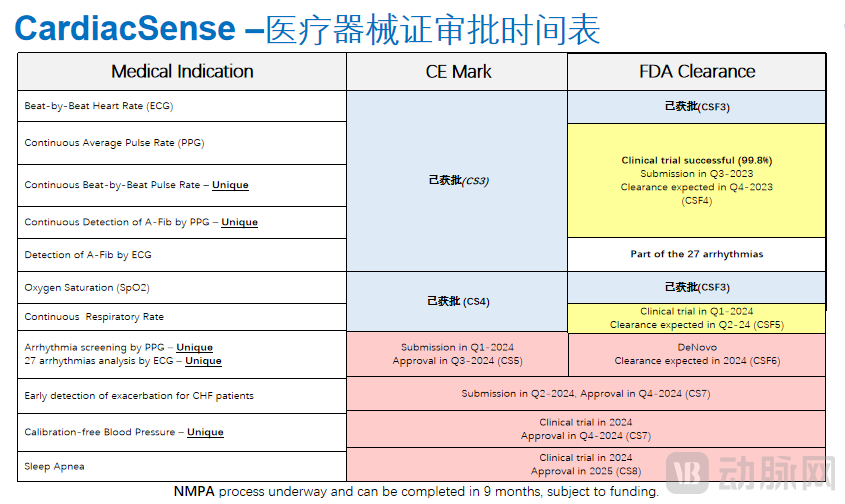
CardiacSense, as a professional personal medical companion and comprehensive medical device, has achieved detection capabilities for beat-to-beat heart rate, beat-to-beat pulse rate, PPG-based atrial fibrillation detection, ECG-based atrial fibrillation detection, continuous respiratory rate monitoring, analysis of 27 types of arrhythmias, and blood oxygen saturation. Furthermore, its non-inflatable blood pressure monitoring and early detection of worsening heart failure features are rapidly under development, with an expected launch in 2024.
CardiacSense Feature Overview (Image Source: CardiacSense)
Among the numerous features of CardiacSense, most have currently received professional clearance from the CE and FDA. According to reports,The device’s beat-to-beat heart rate monitoring function has received both CE and FDA approval. It is the only CE-approved product worldwide for continuous beat-to-beat pulse rate monitoring, and also the only CE-approved product globally that utilizes PPG technology for atrial fibrillation detection.
Unlike the single non-beat-to-beat detection used by other smartwatches on the market,This product enables simultaneous atrial fibrillation monitoring based on PPG and ECG, allowing for timely detection of atrial fibrillation within 5 minutes.The technology has already obtained CE certification, and based on its successful clinical performance, the company expects to receive FDA approval in the fourth quarter of this year.By integrating PPG-based screening with ECG analysis for all 27 types of arrhythmias, and connecting to its proprietary external ECG patch, the device can perform electrocardiogram measurements as an alternative to Holter monitoring.。
When the watch detects an arrhythmia, it alerts the wearer to perform an ECG measurement. The ECG waveform is transmitted to CardiacSense’s AI-powered cloud platform, which generates a comprehensive report covering 27 types of arrhythmias and sends it back to the user and relevant healthcare professionals. Based on this, automated detection and arrhythmia notifications can help streamline subsequent medical evaluations, accelerate treatment pathways, prevent patient deterioration, thereby avoiding hospitalization and improving patients’ quality of life.
In addition to cardiac sign data, continuous respiratory rate monitoring is another key feature of CardiacSense. The company’s proprietary technology enables continuous respiratory rate monitoring under dynamic conditions by combining optical sensors with photoplethysmography (PPG). This allows for long-term, continuous, and dynamic monitoring of patients with chronic obstructive pulmonary disease (COPD) and heart failure (HF). Furthermore, long-term respiratory monitoring supports health management for patients with chronic diseases, and the generated respiratory stability reports can provide timely recommendations for hospital admission.
In terms of product performance, taking atrial fibrillation (AF) monitoring as an example, CardiacSense can monitor each heartbeat, thereby enabling rapid detection of atrial fibrillation within 5 minutes. Clinical data indicate that its beat-to-beat detectionSensitivity can reach 99% (FDA requirement ≥96%), with a false positive rate of 0.6% (FDA requirement ≤2%). Overall, for atrial fibrillation detectionSpecificity and sensitivity both reached 99%., exceeding the FDA’s requirement of ≥95%, making it a product with absolute competitiveness among similar competitors.
With its comprehensive functionality and professional performance,CardiacSense has secured approvals from medical regulatory authorities and distributor agreements in 16 countries across Europe, Asia, and Latin America.。
Currently, the company has alreadyAchieved commercial sales in countries including the United Kingdom, India, Italy, Israel, and Spain., and has received consistently positive evaluations from doctors, patients, and distributors. The company has also received numerous user feedback reports from around the world, including Argentina, India, and Israel, all indicating that the watch provided timely atrial fibrillation warnings before obvious symptoms appeared, thereby securing critical time for emergency rescue and treatment and preventing condition deterioration.
In the third quarter of 2023, the Company will continue to advance the signing of distribution agreements in countries such as France and Germany. By the end of this year, CardiacSense’s commercialized markets are expected to span 12 countries worldwide.
After accumulating sufficient experience in business collaborations,In 2024, CardiacSense Will Enter Two Major Markets: The United States and China. Following the Company’s expected entry into the U.S. market and commencement of commercial sales in 2024, global sales volume is projected to reach USD 13 million. MeanwhileIn China, the Company will actively seek clinical, commercial, and manufacturing partners to expedite NMPA approval, achieve localized production, proactively embrace financing opportunities, and strive to ensure its product launch in China by the end of 2024.
In an interview, Mr. Shemesh revealed that the company is currently reducing production costs through product upgrades, which will lower the sales price from hundreds of dollars to tens of dollars, thereby enabling rapid market penetration and adaptation to the Chinese market.