

Jingchuang Gaoweidu Technology (Chengdu) Co., Ltd. Files IPO Prospectus: Pioneering Intelligent Digital TCM Diagnosis and Treatment Systems
In the men's team table tennis quarterfinals of the Hangzhou Asian Games in late September, the Iranian team defeated Japan 3-0, causing a major upset and revealing the “mysterious Eastern power” behind the Iranian players—cupping therapy.
As a great creation of the Chinese nation and an outstanding representative of traditional medicine worldwide, Traditional Chinese Medicine (TCM) is reaching a broader global audience alongside the hosting of international events. In this process of “going global,” the inheritance and development of TCM are undergoing new changes amid the influx of worldwide innovation trends.
Especially since the dawn of the 21st century, global technological innovation has exhibited new development trends and characteristics, with a new round of scientific and technological revolution and industrial transformation reshaping the global innovation landscape. Traditional Chinese Medicine (TCM) is also increasingly integrating with modern technologies such as digital information technology, artificial intelligence, and cloud computing.
Jingchuang High Dimension Technology (Chengdu) Co., Ltd. (hereinafter referred to as “Jingchuang High Dimension”) is an innovative enterprise that leverages digital healthcare to drive the development of the traditional Chinese medicine industry.
Founded in January 2023, Jingchuang High Dimension is remarkably young, even among startups. Yet, in the more than six months since its establishment, the company has garnered multiple recognitions in both corporate and product dimensions.
Jingchuang High Dimension is a newly established specialized enterprise under Huaxi Health Group, integrating R&D design, manufacturing, and sales services. It boasts a team of experts that is top-tier in China and world-class internationally. Supported by policies from the Chengdu Municipal Government and Huaxi Health Group, the company is currently the only entity in western China selected for the Ministry of Industry and Information Technology’s “Open Competition” program for AI medical devices in the field of Traditional Chinese Medicine (TCM) intelligence.
In terms of products, Jingchuang High Dimension has secured 5 patents and 12 software copyrights in the field of intelligent TCM diagnosis and treatment. The intelligent tongue image acquisition device and tongue image analysis software within its Intelligent TCM Digital Diagnosis and Treatment System have been submitted for type testing; the Clinical Classic Formula Big Data Platform has completed data annotation for over 10,000 cases... Furthermore, the intelligent tongue image-assisted diagnostic device has received pre-sale orders worth millions of RMB in its first batch, with delivery expected to be completed by the end of December this year.
The endorsement from society, the market, and the industry is inseparable from the support of the founding team and the lead organization.
Zhang Jin, Chairman of Jingchuang High DimensionProfessor Zhang Jin holds a bachelor’s degree from the Department of Automation at Tsinghua University and a Ph.D. from the Department of Electrical and Computer Engineering at the National University of Singapore. He currently serves as the Director of the Department of Medical Information Engineering at the School of Biomedical Engineering, Sichuan University. Since 2003, he has been engaged in fundamental and applied research in medical signal and image processing, artificial intelligence, virtual reality, and related fields. He has published more than 60 papers in international journals and conferences, with over 40 articles indexed by SCI and EI. He holds two international patents and more than ten Chinese patents.
CEO Zeng DiHolding a master’s degree from Thompson Rivers University in Canada, Zeng Di founded a SaaS software service platform rooted in the pharmaceutical retail chain industry. Leveraging his strengths and years of academic and professional experience, he has integrated technology with Traditional Chinese Medicine (TCM) and the broader health sector to foster the revitalization of the TCM industry. Currently, Zeng Di serves as Vice President of the Sichuan Branch of the China Medical Pharmaceutical Material Association, Vice President of the China Non-Prescription Drug Association, and Member of the Sichuan Provincial Federation of Industry and Commerce, among other roles.
Clinical Technical Director: Peng ShunlinHe is a Professor in the Department of Otolaryngology at Chengdu University of Traditional Chinese Medicine, a doctoral supervisor, an Academic and Technical Leader of Sichuan Province, and a recipient of the State Council Special Allowance. As the principal investigator, Professor Peng Shunlin has completed more than 10 ministerial- and provincial-level research projects and 4 bureau- and department-level projects. He has received one Third Prize for Scientific and Technological Achievement from the China Association of Chinese Medicine, one Third Prize for Scientific and Technological Progress from Sichuan Province, and two Third Prizes for Scientific and Technological Progress from Chengdu City.
Li Kang, Technical Consultant at Jingchuang High DimensionHolds a Bachelor’s degree in Mechanical Design and Manufacturing from Tsinghua University and a Ph.D. from the University of Illinois. Primarily engaged in research in the fields of biomechanics, human-computer interaction, medical robotics, artificial intelligence, medical image analysis, and medical device innovation.
Professor Li Kang currently serves as a Researcher and Doctoral Supervisor at West China Hospital of Sichuan University, Vice Dean for Scientific Research at the Pittsburgh Institute of Sichuan University, Academic and Technical Leader of the Health Commission of Sichuan Province, Director of the SenseTime Joint Laboratory at West China Hospital, and Chairman of both the West China Medical Robotics Institute and West China Jingchuang Medical Technology (Chengdu) Co., Ltd.
Backed by robust medical resources and strong scientific research capabilities, how does Jingchuang High Dimension leverage government, academic, and social resources to empower the traditional Chinese medicine (TCM) industry with modern technologies such as artificial intelligence, big data, and cloud computing? What are the specific advantages of its intelligently designed TCM digital diagnosis and treatment system?
Traditional Chinese Medicine (TCM) is a study of the real world, embodying thousands of years of practical experience accumulated by the Chinese nation. However, traditional clinical evaluation methods in TCM emphasize empirical experience, making bias difficult to control and resulting in poor reproducibility. This hinders the objective quantification and broader application of valuable clinical experience, thereby becoming a bottleneck constraining the internationalization of Traditional Chinese Medicine.
“Evidence-based medicine or traceability medicine serves as a yardstick, helping traditional Chinese medicine (TCM) undergo standardized verification and analysis through rigorous methods, thereby establishing an objective evaluation system,” CEO Zeng Di explained to VCBeat.
Jingchuang High Dimension’s integrated intelligent digital TCM diagnosis and treatment system currently comprises four products: the Intelligent Tongue Diagnosis System, the Expert Consultation System, the Clinical Classic Formula Big Data System, and the Acupuncture Robot.
1. Intelligent Tongue Image Acquisition Device: Objective Quantification and Authentic Reconstruction of Tongue Image Data
“Patients with lung heat disease first experience chills and cold limbs, with erection of body hair, aversion to wind and cold, and a yellow coating on the tongue.” The basic theories of tongue diagnosis and the relationship between the tongue and internal organs were already recorded in the *Huangdi Neijing* (The Yellow Emperor’s Inner Canon).
In Traditional Chinese Medicine (TCM), tongue diagnosis requires a comprehensive observation of both the tongue body and tongue coating, with integrated analysis to arrive at an accurate diagnosis. However, diagnostic outcomes are often constrained by the practitioner’s knowledge base, cognitive abilities, and diagnostic skills, as well as influenced by external factors such as lighting conditions. Consequently, it is difficult to replicate the actual clinical scenario during diagnosis, and there is a lack of objective evaluation criteria.
Jingchuang High Dimension’s intelligent tongue image acquisition device employs macro cameras and carefully calibrated simulated natural light sources to accurately identify and capture tongue features. By integrating color correction algorithms, image processing algorithms, and deep learning algorithms, the device performs multi-region color restoration and intelligent image segmentation of tongue images, ensuring that the collected tongue features accurately and objectively reflect the body’s functional status.
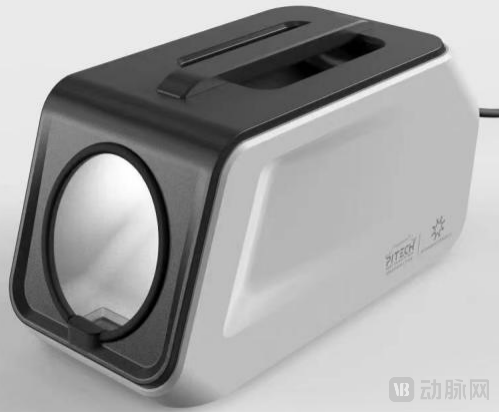
Intelligent Tongue Image Acquisition Device
Photo provided by the interviewee
2. Tongue Image Analysis Software: Test results can now assist physicians in clinical diagnosis
After resolving the data standardization issues at the acquisition port, analysis is the key next step toward achieving intelligent tongue diagnosis.
Leveraging the company’s leading artificial intelligence algorithms, Jingchuang High Dimension Technology achieves automated detection of tongue body, tongue coating, and tongue shape by integrating features such as tongue morphology, posture, and texture patterns. Meanwhile, it enables high-efficiency, high-accuracy classification of tongue image data metrics. The system has currently reached a standard capable of assisting clinicians in diagnosis.
Jingchuang High Dimension’s team comprises four leading medical image processing experts in China, and the accuracy and standardization rate of its tongue image analysis software have reached an internationally advanced level. The company’s team was previously invited by Harvard Medical School to optimize a pathological image dataset. “The accuracy of Harvard Medical School’s algorithm was 84%; after our team’s technical optimization, we increased the accuracy to 95%,” Zeng Di told VCBeat.
3. Big Data Platform for Classic Clinical Formulas: Over 10,000 Annotated Patient Records
Based on the “Catalogue of Ancient Classic Prescriptions” released by the National Medical Products Administration and big data analytics software from the Chinese Academy of Sciences, Jingchuang High Dimension has currently established a database comprising 200,000 commonly used prescriptions and over 1,000 classic prescriptions. These data provide valuable reference for primary care physicians in formulating treatment plans for similar cases.
Furthermore, the company has annotated over 10,000 cases of data for patients with chronic pharyngitis, allergic rhinitis, atrophic gastritis, and other conditions, standardizing and continuously expanding its database.
4. Acupuncture Robot Platform: Collaborating with the West China Medical Robotics Research Institute to achieve precise localization of hundreds of acupoints
Similar to tongue diagnosis, the *Huangdi Neijing* also documents the origins of acupuncture and moxibustion. Due to variations in techniques among different practitioners, manual acupoint localization is subject to subjectivity and uncertainty.
In collaboration with the West China Medical Robot Research Institute, Jingchuang High Dimension Technology has developed an acupuncture robot platform based on in-depth mining of traditional Chinese medicine knowledge and real-world data. Leveraging the OptiTrack motion capture system for high-precision 3D reconstruction and an acupoint localization algorithm model, the platform accurately identifies hundreds of acupoints and simulates traditional acupuncture techniques through a motion control system to perform automated, high-speed needle manipulation.
The integrated intelligent digital TCM diagnosis and treatment system, built upon the aforementioned four products, can assist clinical TCM practitioners in formulating personalized treatment plans for patients based on intelligent diagnostic results combined with clinicians’ confirmed diagnoses. These plans include corresponding herbal prescriptions, acupuncture protocols, and long-term daily dietary and health management guidance for patients.
“The tongue is the external manifestation of the spleen, and the tongue coating is formed by the steaming of stomach qi.” Traditional Chinese Medicine holds that the tongue appearance is most closely related to the spleen and stomach, and its changes can objectively reflect the health status of the stomach.
Clinical efficacy is the foundation for the inheritance and development of Traditional Chinese Medicine (TCM). In this regard, Jingchuang High Dimension Technology is currently expanding its multi-center clinical sample size with a focus on digestive system diseases. By processing and analyzing tongue images and pathological images, the company aims to gradually extend its indications and diagnostic scope from gastric ulcers and atrophic gastritis to the detection and diagnosis of esophageal and gastric cancers, thereby establishing tongue image diagnosis as a non-invasive screening tool for gastric cancer.
To fully leverage modern clinical medical indicator data and address diverse needs such as health assessment, disease diagnosis, and treatment, Jingchuang High Dimension has established pathological image diagnostic models to comprehensively achieve the digitalization, intelligence, and standardization of tongue diagnosis. Jingchuang High Dimension has built long-term and stable collaborative partnerships with numerous domestic universities, research institutes, and Grade A tertiary hospitals, including Sichuan University and the University of Electronic Science and Technology of China; research institutes such as the Sichuan Provincial Institute of Traditional Chinese Medicine and the Sichuan Academy of Traditional Chinese Medicine Sciences; and hospitals such as West China Hospital of Sichuan University and Sichuan Provincial People's Hospital.
To date, Jingchuang High Dimension has established 15 clinical sub-centers across Sichuan Province and conducted clinical studies at more than 30 hospitals nationwide for nearly seven months, with over 10,000 cases diagnosed and annotated by traditional Chinese medicine (TCM) physicians at the associate chief physician level or above.
Looking to the future, Zeng Di stated, “The company is currently in the midst of a new round of financing. In addition to continuously advancing clinical research within Sichuan Province and implementing large-scale production plans, we are also establishing cross-regional clinical centers to account for variations in climate and dietary habits across different regions.”
In early 2023, ten ministries and commissions jointly issued the "14th Five-Year Plan" Action Plan for the Project to Enhance Traditional Chinese Medicine (TCM) Service Capacity at the Primary Level, aiming to achieve 100% coverage of TCM clinics at primary healthcare institutions by 2025 and continuously improve the capacity of TCM services at the grassroots level.
This also aligns perfectly with the original entrepreneurial mission of Jingchuang High Dimension, namely, “to provide traditional Chinese medicine (TCM) services covering the entire population and full life cycle through diversified and intelligent tools, promote leapfrog development in TCM diagnosis and treatment technologies, and enable grassroots patients to access TCM diagnostic services at the level of Grade A tertiary hospitals right at their doorstep.”
References:
1. Exclusive Interview with Professor Li Kang of West China Hospital: Innovation Is a “Relay Baton,” and Different Tasks Should Be Undertaken by Different People, VCBeat Orange Fruit Bureau
2. Reform and Innovation: Comprehensively Promoting the Revitalization and Development of Traditional Chinese Medicine—An Interpretation of the “14th Five-Year Plan” for the Development of Traditional Chinese Medicine, People’s Daily
3. The “14th Five-Year Plan” Action Plan for the Enhancement of Traditional Chinese Medicine Service Capacity at the Primary Care Level, National Healthcare Security Administration
4. All Slots Filled in Just One Hour! After Shopping Spree at Sijiqing, Foreigners Fall in Love with This – CCTV.com