

FDA Rejects sNDA for Onpattro (patisiran) in ATTR Cardiomyopathy Despite Advisory Committee Support
Alnylam Pharmaceuticals
RNA Interference (RNAi) Innovative Drug Developer
On October 9, the FDA rejected Alnylam Pharmaceuticals’ supplemental new drug application (sNDA) for its siRNA drug Onpattro (patisiran) for the treatment of transthyretin-mediated (ATTR) amyloidotic cardiomyopathy.
Alnylam announced that this refusal does not affect the commercial viability of patisiran for the treatment of hereditary ATTR amyloidosis with polyneuropathy in adults (the existing indication), butAlnylam will no longer pursue the expansion of patisiran’s indications in the United States.
This result runs counter to the voting outcome of the FDA’s external advisory committee.In September, the external advisory committee voted 9:3 in favor of patisiran, concluding that the benefits of this siRNA therapy outweighed its risks.
In its Complete Response Letter (CRL), the regulatory agency stated that AlnylamInsufficient evidence providedDemonstrate the clinical significance of patisiran in the treatment of ATTR amyloidosis with cardiomyopathy. Meanwhile, the FDA has not identified any issues regarding the clinical safety, drug quality, manufacturing process, or research conduct of patisiran.
Nevertheless, Alnylam expressed a positive stance in its announcement, stating that it would remain committed to the field of ATTR amyloidosis and advance research on another siRNA therapeutic, vutrisiran (Amvuttra), for the treatment of transthyretin amyloid cardiomyopathy (ATTR-CM).
Transthyretin Amyloidosis (ATTR amyloidosis) is a rare disease that primarily causes polyneuropathy (ATTR-PN) and cardiomyopathy (ATTR-CM). ATTR is caused by the accumulation of abnormal amyloid deposits, which interfere with normal organ function. These protein deposits most commonly occur in the heart and peripheral nervous system, and gradually affect the respiratory system, kidneys, eyes, gastrointestinal tract, and central nervous system, leading to heart failure, loss of consciousness, pain, movement disorders, and death.
Patisiran is a double-stranded siRNA therapeutic that binds to and targets for degradation the mRNA molecules encoding transthyretin. This mechanism of action results in reduced overall protein levels, thereby preventing the pathological accumulation of misfolded transthyretin in various organs throughout the body.
In August 2018, the FDA approved Patisiran for the first time to treat hereditary ATTR amyloidosis with polyneuropathy in adults, making it the world’s first approved RNAi therapeutic and addressing a global patient population of approximately 50,000.If the expansion of indications is approved, Patisiran will also cover wild-type ATTR (wtATTR) amyloidosis, a condition affecting approximately 200,000 to 300,000 people worldwide.
In the field of ATTR-CM, Alnylam’s only current competitor is Pfizer’s blockbuster small-molecule drug tafamidis (Vyndaqel/Vyndamax). In May 2019, the FDA approved Vyndaqel and Vyndamax for the treatment of adult patients with ATTR-CM. This was the first and only drug approved worldwide for the treatment of ATTR-CM (approved for marketing in China in 2020).
In Pfizer’s second-quarter 2023 financial report, global sales of the Vyndaqel family (Vyndaqel, Vyndamax, Vynmac) increased by 43% year over year, reaching $782 million. During the same period, Onpattro generated global net product revenues of $91 million.
One point of comparison between the two lies in the efficacy evidence submitted to the FDA.
The FDA’s approval of tafamidis was based on clinical trial data—Pfizer conducted a trial involving 441 patients randomized to receive either Vyndaqel or placebo. After a mean follow-up of 30 months, the Vyndaqel group demonstrated higher survival rates than the placebo group, proving that the drug can help extend life and reduce cardiovascular-related hospitalizations in patients with ATTR-CM.
Alnylam demonstrated, through the six-minute walk test and the Kansas City Cardiomyopathy Questionnaire-Overall Summary (KCCQ-OS), that Onpattro helps improve physical function and quality of life in patients with ATTR-CM amyloid cardiomyopathy compared to placebo.
Alnylam CEO Yvonne Greenstreet stated during Monday’s conference call that the Phase 3 APOLLO-B trial, designed to support the use of Onpattro, was developed in consultation with the FDA. The trial met its primary endpoint, demonstrating a statistically significant improvement in the six-minute walk test among patients treated with Onpattro, with clinical benefits maintained over 24 months of follow-up. In the KCCQ-OS patient-reported outcome survey, the drug also showed clear superiority over placebo and exhibited a trend toward improved cardiovascular outcomes.
However, the FDA considers that the therapeutic effect of Onpattro has no clinical significance at all.In its assessment report, the FDA stated that the six-minute walk test also lacked evidence to substantiate this finding, and only certain components of the KCCQ-OS could directly assess patients’ physical function. The view that Onpattro’s efficacy was minimal was also raised during the September advisory committee meeting, with one expert describing it as a “slight breeze.” Meanwhile, some experts argued that Alnylam’s drug should not be considered an equivalent alternative to tafamidis.
The announcement stated that Alnylam intends to continue providing Onpattro to patients in the open-label extension (OLE) phase of the Phase III APOLLO-B study and to patients with ATTR-CM under the Expanded Access Program (EAP) in the United States.
Meanwhile, the Phase III HELIOS-B study of the RNAi candidate drug vutrisiran will continue, evaluating its efficacy on the composite endpoint of all-cause mortality and recurrent cardiovascular (CV) events in patients with ATTR-CM at 30 months. The candidate pipeline ALN-TTRsc04 is also targeting ATTR-CM as an indication; leveraging IKARIA technology, its once-yearly dosing regimen may reduce TTR (transthyretin) levels by more than 90%.
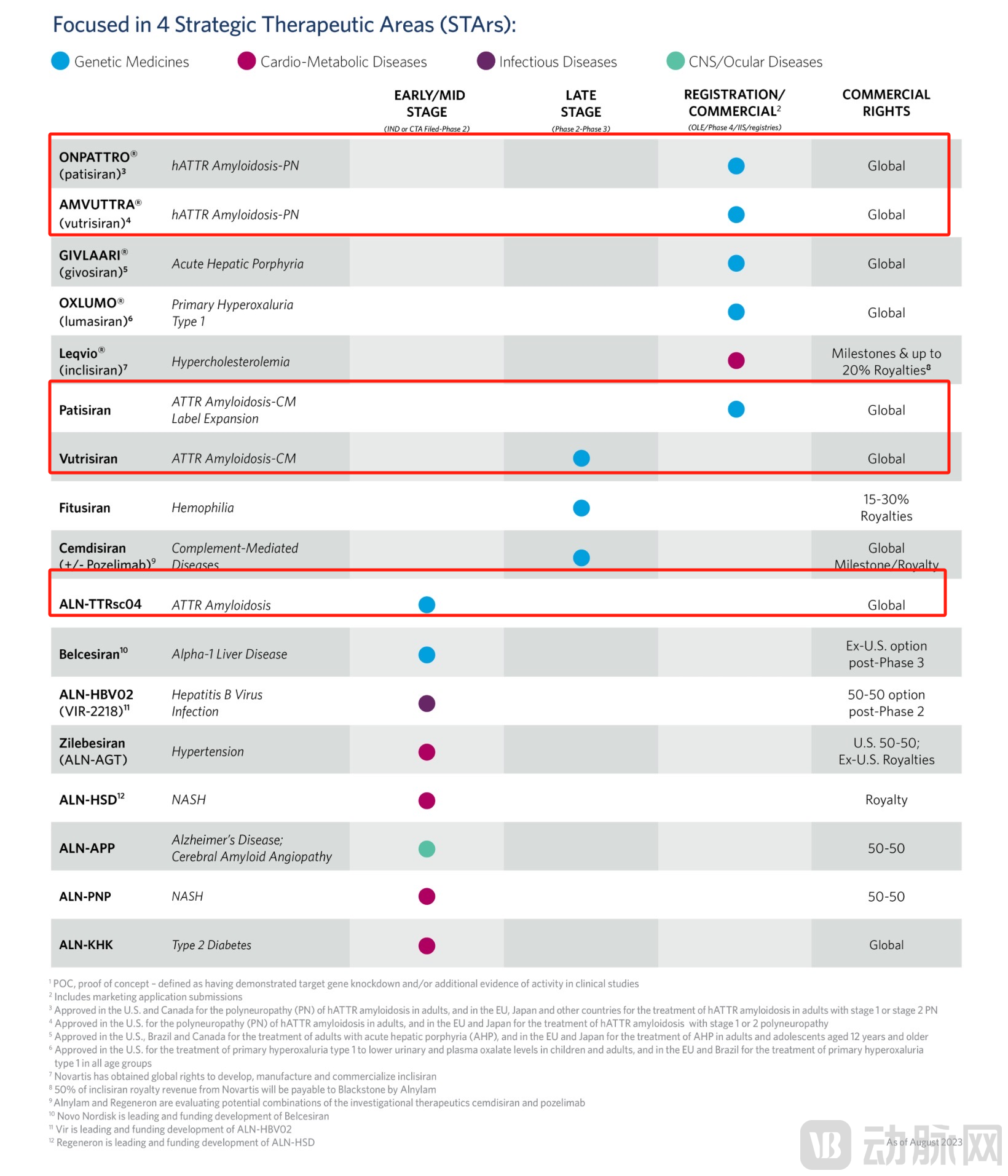
Alnylam’s Pipeline Portfolio (Red Box Indicates the ATTR Therapeutic Area)
To understand Alnylam’s strategic adjustment of “sacrificing a pawn to save the chariot,” one must first revisit the “star company” aura surrounding Alnylam. On December 23, 2022, Alnylam’s stock price peaked at its highest point of $237.90.
As a global leader in RNAi therapeutics, Alnylam’s 21-year trajectory has mirrored the evolution of RNAi technology itself—hailed with high expectations in the first decade of this century, it encountered significant setbacks before making a remarkable comeback, ultimately entering a phase of steady commercialization.

Alnylam Stock (Image source: Google Finance)
Alnylam’s “breakout success” lies in leading the trend of third-generation GalNAc (N-acetylgalactosamine) delivery technology.In the development of RNAi technology, delivery systems have long been a critical and challenging hurdle. For an extended period, second-generation vectors—specifically lipid nanoparticles (LNPs)—served as the core method for siRNA delivery, with Alnylam Pharmaceuticals continuously optimizing its LNP delivery platform during its first decade of operations.
Patisiran, the first RNAi drug globally and the focus of this indication expansion, was part of Alnylam’s early drug pipeline and a product launched on its second-generation LNP delivery platform.
Prior to the approval of Onpattro, Alnylam had already made in-depth investments in new delivery technologies centered around GalNAc. The third-generation delivery platform based on GalNAc has resolved some of the limitations associated with earlier second-generation LNP delivery systems, thanks to its low immunogenicity, low cytotoxicity, and high targeting specificity, thereby enabling siRNA therapeutics to reach their full potential.
The GalNAc trend pioneered by Alnylam has granted it a significant first-mover advantage. This explains why many marketed siRNA products are associated with Alnylam. For instance, Givlaari for the treatment of acute hepatic porphyria (AHP), Oxlumo for primary hyperoxaluria type 1, and Leqvio, a lipid-lowering agent co-developed with Novartis, all utilize the novel GalNAc delivery technology.
Having rapidly emerged as the leader in siRNA therapeutics through the development and successful commercialization of drugs for rare diseases, Alnylam continues to expand its RNAi pipeline, with a strategic focus on genetic medicines, cardiometabolic diseases, infectious diseases, central nervous system disorders, and ocular diseases.. Leveraging the technological expertise and insights gained from rare disease drug development, Alnylam is tackling common diseases such as hepatitis B and non-alcoholic steatohepatitis—“Our goal is to file 2–4 new Investigational New Drug (IND) applications annually.”
Returning to Alnylam’s foundational rare disease ATTR portfolio, its first drug, patisiran (Onpattro), and second drug, vutrisiran (Amvuttra), have been launched sequentially and are now commercially available worldwide.In the second quarter of 2023, Onpattro and Amvuttra reported global net product revenues of $91 million and $132 million, respectively, representing a year-over-year growth rate of 46%. Notably, the total growth rate in the U.S. market exceeded 70% for four consecutive quarters.
The distinction between the two lies not only in the updated delivery systems but also in the differing routes of administration. Onpattro is administered via intravenous injection once every three weeks, whereas Amvuttra is delivered via subcutaneous injection once every three months, with the potential for dosing once every six months. Meanwhile, the ALN-TTRsc04 pipeline mentioned in this announcement holds the promise of achieving a once-yearly dosing frequency.
At this point, Alnylam’s dual-pronged ATTR strategy has become clear: leveraging Onpattro to establish a foothold and using Amvuttra to capture a larger market share, thereby dominating the substantial ATTR market.Next, Alnylam will expand the indications of its two marketed drugs to further increase market size, while continuing drug iteration to consolidate its market leadership in ATTR.
Alnylam refers to it as a “bridging strategy.”