

Domain Therapeutics Files for IPO: GPCR-Focused Biotech Backed by Pfizer and Merck

Domain Therapeutics
Small Molecule Drug Developer
G protein-coupled receptors (GPCRs), first discovered in the 1970s, have now become a prominent target in drug development, spanning multiple therapeutic areas. According to a report by Alexander S. Hauser et al., as of 2017, there were 475 drugs on the market targeting 108 GPCR targets, accounting for approximately 34% of all FDA-approved drugs, with total sales representing about 27% of the global pharmaceutical market.
Despite the large number of GPCR-targeting drugs, approximately 80% of GPCRs remain untargeted. A study by Krishna Sriram et al. on GPCRs revealed that currently, only about 17% of GPCRs and GPCR-associated proteins have targeted drugs under investigation.
Meanwhile, with the expansion of immune checkpoint inhibitor therapy and a deepening understanding of tumor immune evasion, GPCRs have become a key research focus for addressing the mechanisms of tumor immunosuppression and drug resistance.
This all means that untapped GPCR targets represent an area of immense research value.
Meanwhile, French pharmaceutical company Domain Therapeutics (Domain) is poised to become one of the breakthrough players in this field, securing a foothold in the GPCR-targeted drug market.
Domain, established in 2001, is an innovative drug research and development enterprise dedicated to the discovery of novel small-molecule therapeutics targeting G protein-coupled receptors (GPCRs) in immuno-oncology. The company aims to address GPCR-mediated immunosuppression, thereby pioneering new approaches to cancer treatment.
On May 10, 2022, Domain secured $42 million in Series A financing. This round was co-led by Panacea Venture, CTI Life Sciences, and 3B Future Health Fund, with participation from adMare BioInnovations, Schroders Capital, Omnes, Turenne Capital, Theodorus, Viva BioInnovator, and existing investor Seventure Partners.
More than a month after closing its Series A financing, Domain announced that it had received a multimillion-dollar milestone payment from Merck. In 2017, Domain entered into an agreement with Merck stipulating approximately €240 million in milestone payments for Domain’s next-generation adenosine receptor inhibitors.
In addition to Merck, Domain has established partnerships with nine other renowned pharmaceutical companies, including Pfizer, Ono Pharmaceutical, Boehringer Ingelheim, and Lundbeck.
Among these, the collaboration with Pfizer began in 2017. At that time, Domain Therapeutics had gained prominence in the field of GPCR targets due to its proprietary bioSensAll™ technology, while Pfizer sought to address the challenges associated with developing drugs targeting GPCRs; consequently, the two parties entered into a partnership. Under this agreement, Domain Therapeutics utilized its bioSensAll™ technology to analyze signal transduction of mutant GPCRs, providing Pfizer with information on novel GPCR drug targets. In 2020, the two companies renewed their collaboration, with Domain Therapeutics supplying data on the impact of GPCR mutations on downstream signaling pathways to accelerate Pfizer’s development of GPCR-targeted therapeutics.
GPCRs are one of the most important families of integral membrane proteins, capable of sensing extracellular signals such as protons, metabolites (e.g., adenosine), and large proteins. Upon stimulation, they engage in specific signaling pathways, thereby activating a variety of cellular responses.
Immune cells express specific G protein-coupled receptors (GPCRs) on their cell surfaces, which are involved in the regulation of immune responses. Consequently, many tumor cells generate metabolites that promote immune escape through immunosuppressive mechanisms (such as adenosine, PGE2, and protons, all of which act as inhibitory checkpoints within the GPCR family). These metabolites serve as agonists coupled to GPCRs, activating the Gs signaling pathway. This activation leads to the accumulation of intracellular cAMP (an anti-inflammatory messenger) in immune cells such as lymphocytes, neutrophils, and eosinophils, thereby inducing immunosuppressive mechanisms that facilitate tumor immune evasion.
Due to their widespread distribution in organs and tissues such as the central nervous system, immune system, cardiovascular system, and retina, and their involvement in organismal development and the regulation of various physiological functions, GPCRs hold significant potential for novel oncology drug development. Furthermore, their therapeutic indications have now expanded to include Alzheimer’s disease, obesity, multiple sclerosis, and hypocalcemia.
However, despite the vast market potential for GPCR-targeted drugs, numerous challenges remain to be overcome. On one hand, not all GPCR targets are suitable for drug development. Among the approximately 800 human genes encoding GPCRs, around 400 encode olfactory receptors and 150 encode orphan receptors. On the other hand, difficulties in obtaining GPCRs—due to factors such as structural instability and low expression levels—mean that the structures of most GPCRs have yet to be resolved. This hinders structure-based drug design and the precise modulation of GPCR function. Furthermore, GPCR drug development faces additional challenges, including unclear structure–function relationships, poorly understood pathological mechanisms of GPCR-related diseases, and technical difficulties in GPCR activity assays.
Leveraging the role of GPCRs in immuno-oncology, Domain aims to address GPCR-mediated immunosuppression by developing first-in-class and best-in-class novel therapeutics. Over the past decade, Domain has utilized its bioSens-All® platform to overcome challenges such as the difficulty in accessing GPCRs, thereby establishing a portfolio of GPCR-focused pipeline projects in neurology and rare diseases.
bioSens-All™ is a technology based on bioluminescence resonance energy transfer (BRET), specifically designed for studying and analyzing the signaling profiles of GPCR ligands and downstream pathway drugs. It was developed and validated by Professor Michel Bouvier and his colleagues at the University of Montreal.
In 2016, Domain Therapeutics obtained an exclusive global license for the relevant technology from the University of Montreal. This enabled the company to build and iteratively develop bioSens-All®, a GPCR-based identification and cross-validation platform, to identify GPCR targets involved in immune surveillance mechanisms and to develop next-generation candidate drugs for cancer immunotherapy.
bioSens-All® consists of 63 assays based on enhanced homogeneous live-cell bioluminescence resonance energy transfer (ebBRET) biosensors, including 12 distinct biosensors. These biosensors measure receptor-proximal events involved in receptor activation at the plasma membrane (PM) and early endosomal compartments (EE), monitoring SH2 domain-containing protein-mediated downstream signaling of receptor tyrosine kinases (RTKs), thereby tracking the activation of MAPK, Akt, and PKC pathways.
This means that each sensor can track a specific signaling event upon GPCR activation without interfering with the structure of the receptor and its effectors. Based on this, Domain Therapeutics can facilitate the analysis of GPCR and ligand signaling, thereby accelerating the drug discovery process.
Data published on the official website of Domain Therapeutics shows that, to date, the company has analyzed more than 100 wild-type GPCRs and over 2,000 mutant GPCRs using the bioSens-All® platform.
Supported by the bioSens-All® platform, Domain has successfully developed a monoclonal antibody (mAb) library comprising dozens of antibodies. In this context, Domain has formulated and launched a small molecule/monoclonal antibody R&D program, dedicated to providing first-in-class and best-in-class candidate drugs for clinical use. Currently, Domain has four major pipeline candidates under development in the field of immuno-oncology.
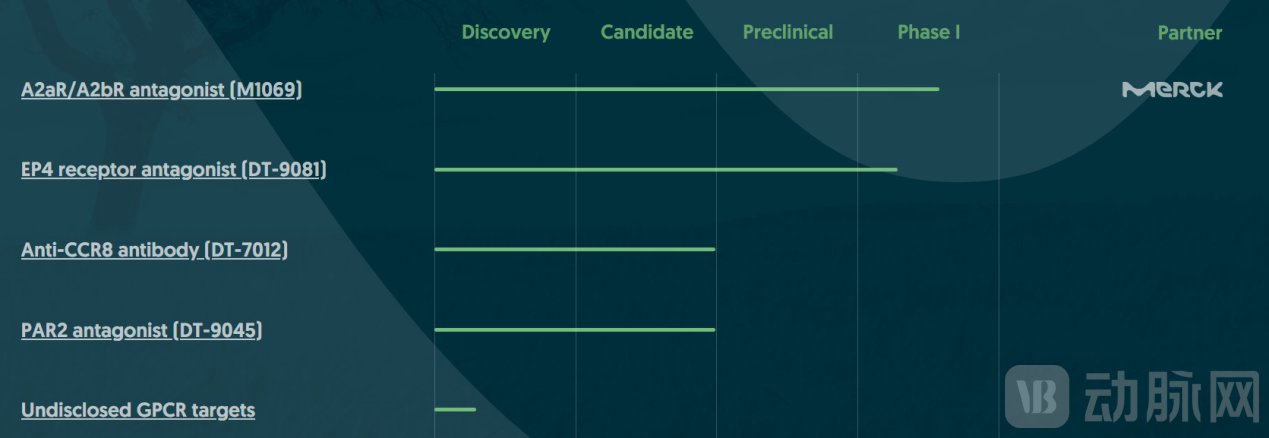
Domain Therapeutics' Pipeline in Development
M1069: A2aR/A2bR Antagonist
M1069 is an A2A/A2B receptor antagonist candidate co-developed by Domain Therapeutics and Merck. It is an oral adenosine receptor antagonist designed to inhibit the release of adenosine in the tumor microenvironment.
Adenosine (ADO) receptors expressed on the surface of immune cells mediate the immunosuppressive effects of ADO. Furthermore, ADO is involved in cellular energy transfer and plays a role in various signal transduction pathways; in certain contexts, ADO contributes to resistance against certain antitumor interventions, such as chemotherapy and radiotherapy.
Domain conducted a preclinical study to evaluate the efficacy of M1069 in combination with anti-PD-1 monoclonal antibody therapy in mouse models of spontaneous melanoma and breast cancer. The results demonstrated that, compared with monotherapy, the combination therapy reduced the risk of cancer metastasis and extended survival in mice.
Currently, M1069 is in Phase I clinical trials to evaluate its safety, tolerability, pharmacokinetics, pharmacodynamics, and clinical efficacy in patients with unresectable metastatic or locally advanced solid tumors.
DT-9081: EP4 Receptor Antagonist
Prostaglandin E2 (PGE2) is a product released into the tumor microenvironment by various solid tumors, including breast cancer, colorectal cancer, and lung cancer. As a ligand for the EP4 receptor (EP4R), PGE2 participates in processes such as the exhaustion of anti-tumor T cells, cancer cell invasion, and angiogenesis. PGE2 is synthesized by specific enzymes, including cyclooxygenase-2 (COX-2). In COX-2-positive tumors, the produced PGE2 activates EP4R on immune cells, thereby leading to an immunosuppressive state.
DT-9081 is an oral EP4 receptor antagonist. It reverses PGE2-mediated immunosuppression in certain tumors by blocking the activation pathway of EP4 receptors on immune cells. In July this year, DT-9081 was granted a patent by the European Patent Office.
Domain Therapeutics conducted a preclinical study on the efficacy of DT-9081 using multiple syngeneic mouse models, including the CT26 colorectal tumor model and the MCA205 sarcoma model. The results demonstrated that combination therapy with DT-9081 and immune checkpoint inhibitors (such as anti-PD-1/anti-CTLA-4) significantly activated the anti-tumor activity of immune cells across these mouse models. Furthermore, in human blood studies, DT-9081 normalized the release activity of both pro-inflammatory and anti-inflammatory cytokines.
Currently, DT-9081 has entered its first-in-human Phase I trial, named “EPRAD.” The EPRAD trial aims to evaluate the safety, tolerability, pharmacokinetics, pharmacodynamics, and preliminary efficacy of DT-9081 in adult patients with advanced, recurrent, or metastatic solid tumors, and to determine the maximum tolerated dose and recommended clinical dose of DT-9081.
Currently, the first patient has received DT-9081 dosing. The EPRAD is expected to be completed in July 2025.
DT-7012: Anti-CCR8 Antibody
CCR8 is a GPCR target specifically expressed by Tregs. In the tumor microenvironment, Tregs promote self-tolerance by suppressing effector immune functions (T cells and NK cells) through inhibitory cytokines, thereby limiting the infiltration of antigen-specific immune responses into the tumor. In this process, Tregs act as a “brake” on anti-tumor immune cells, restricting their anti-tumor activity.
DT-7012 is an anti-CCR8 monoclonal antibody. Preclinical data from Domain Therapeutics demonstrate that DT-7012 retains CCR8 modulatory activity and recognizes various forms of CCR8, even in the presence of high concentrations of CCR8 within the tumor microenvironment. Furthermore, as a monotherapy, DT-7012 depletes tumor-infiltrating regulatory T cells (Tregs) and induces potent, durable tumor-specific memory responses.
Currently, DT-7012 remains in the preclinical research stage, with its Phase I study expected to commence in 2025.
DT-9045: PAR2 Antagonist
In the tumor microenvironment, various inflammatory cytokines produced by cancer cells, host immune cells, and stromal cells can activate fibroblasts, known as cancer-associated fibroblasts (CAFs). CAFs are responsible for fibrosis-mediated immune resistance; they promote cancer cell growth and suppress anti-tumor immune responses by secreting soluble factors, ultimately contributing to drug resistance in tumor cells and accelerating tumor progression and metastasis.
Protease-activated receptor 2 (PAR2) is a GPCR target expressed by cancer cells and cancer-associated fibroblasts (CAFs). PAR2 is involved in multiple processes, including tumor proliferation, resistance to immunotherapy, and fibrosis. In June this year, Domain Therapeutics launched its candidate drug DT-9045, a negative allosteric modulator (NAM) of PAR2.
Preclinical study data show that, compared with currently marketed/clinical PAR2 antagonists, DT-9045 does not affect the β-arrestin pathway or ligand-induced receptor internalization, and maintains activity under typical acidic pH conditions such as those found in inflammatory and tumor microenvironments. Furthermore, when used in combination with immune checkpoint inhibitors, DT-9045 can enhance the antitumor efficacy of anti-PD-1 therapy.
Currently, Domain Therapeutics is conducting pre-IND studies for DT-9045 and expects to initiate a Phase I dose-escalation study targeting recurrent or metastatic solid tumors starting in 2025.
In addition to the four pipelines mentioned above, Domain’s R&D pipeline includes undisclosed GPCR-targeted projects. Furthermore, Domain has collaborated with pharmaceutical companies such as Ono Pharmaceutical, Pfizer, and Kurma Partners to develop three pipelines: a GPCR-targeted therapy for metabolic diseases, a targeted therapy for rare diseases, and a CXCR4 biased agonist.
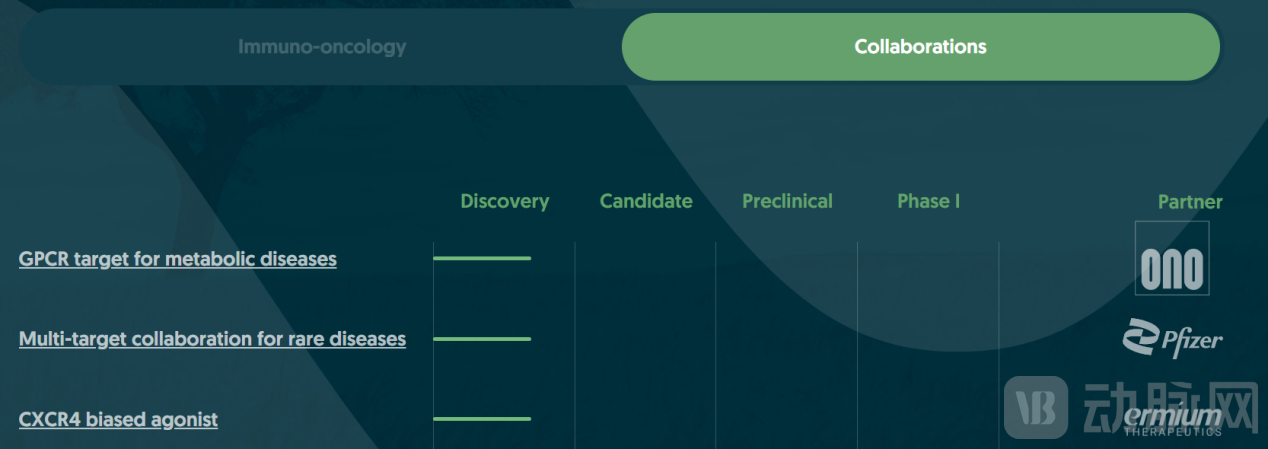
Domain’s Pipeline in Collaboration with Other Pharmaceutical Companies