

Celltrion's Zymfentra: First Subcutaneous Infliximab Approved by FDA for IBD, Tapping into a Multi-Billion-Dollar Market

Celltrion
Biopharmaceutical Manufacturer
On October 23, the U.S. Food and Drug Administration (FDA) approved Zymfentra (infliximab-dyyb), a subcutaneous formulation of infliximab from biopharmaceutical company Celltrion, for the treatment of inflammatory bowel disease (IBD). This marks the first subcutaneous formulation of infliximab. Zymfentra is expected to launch in the first quarter of 2024, with product pricing to be announced prior to its market release.
This FDA approval is based on positive data from two Phase III trials by Celltrion, which evaluated the efficacy and safety of infliximab as maintenance therapy in patients with moderate ulcerative colitis (LIBERTY-UC) and Crohn’s disease (LIBERTY-CD).
Based on the results of the LIBERTY UC and LIBERTY CD studies, Zymfentra demonstrated clinical superiority over placebo in the primary endpoints at Week 54 of induction therapy with intravenous infliximab, including clinical remission (UC and CD) (43.2% vs. 20.8%, and 62.3% vs. 32.1%, respectively) and endoscopic response (CD) (51.1% vs. 17.9%). Meanwhile, the overall safety profile of the Zymfentra group was similar to that of the placebo group during treatment, with no new safety events reported.
Inflammatory bowel disease (IBD) is a chronic, nonspecific inflammatory disorder of the intestine with an unknown etiology, encompassing three main types: Crohn’s disease (CD), ulcerative colitis (UC), and IBD unclassified (IBD-U). While IBD has a high incidence in adults, its prevalence among children has been rising in recent years. As a chronic, progressive, and relapsing intestinal disease, IBD significantly impairs patients’ quality of life and daily functioning, thereby increasing the healthcare burden. According to data released in the 2022 series of forward-looking reports on innovative drugs by CICC (China International Capital Corporation), IBD affects approximately 6 to 8 million patients worldwide.
Infliximab (brand name of the originator product: Remsima) is a monoclonal antibody against tumor necrosis factor-alpha (TNF-α), used to treat patients with Crohn’s disease (CD), ulcerative colitis (UC), rheumatoid arthritis, and ankylosing spondylitis. It is the first antibody biosimilar developed by Celltrion and has been approved for moderate-to-severe inflammatory bowel disease (IBD) that is refractory to conventional therapy, making it one of the four mainstream biologics for IBD treatment.
In April 2016, after infliximab received sales approval from the U.S. FDA, its sales revenue grew rapidly. The single-quarter sales revenue in Q3 2018 reached $92 million, and the full-year sales revenue in 2018 amounted to $642 million. (Data source: Bloomberg, Everbright Securities Research Institute)
To enhance medication convenience for patients, Celltrion has developed an infliximab subcutaneous injection (formerly marketed as Remsima SC) that overcomes the limitations of Remsima IV (intravenous administration), leveraging years of accumulated clinical results and patient data from Remsima. Clinical trial data indicate that Remsima SC demonstrates slightly superior efficacy compared to Remsima IV, with comparable effectiveness and safety profiles.
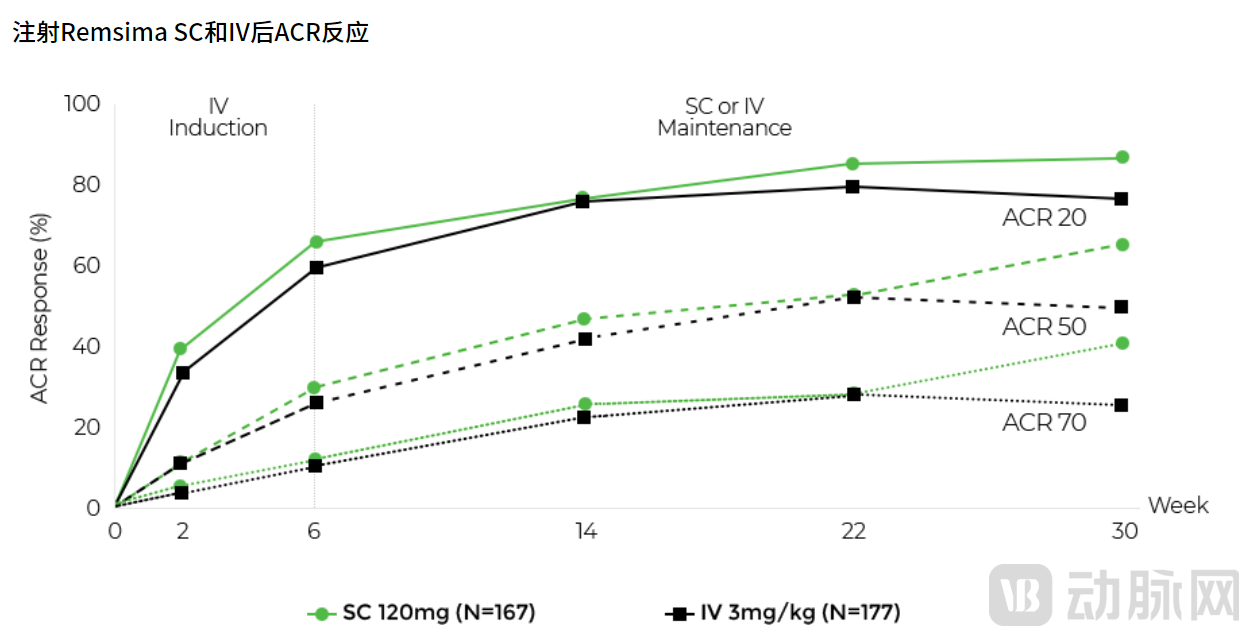
Remsima SC addresses the limitations of the original Remsima formulation by enabling self-administration via subcutaneous injection, thereby reducing hospital visits and enhancing medication convenience for patients. Meanwhile, this new dosage form provides physicians with an alternative administration option, overcoming the limitations associated with TNF-α inhibitors.
According to the 2022 series of research reports on frontier innovative drugs by CICC, the global market for inflammatory bowel disease (IBD) is currently valued at approximately $18 billion and is projected to grow to around $49 billion by 2030. In addition to infliximab, adalimumab, ustekinumab, and vedolizumab are currently the mainstream products in the IBD drug market, with these four agents accounting for 75% of global IBD market revenue.
Since biologic therapies, represented by adalimumab, have emerged as a new treatment option for patients with inflammatory bowel disease (IBD), their quality of life has been significantly improved; however, current therapeutic approaches still face challenges. According to an immunology review on IBD published by the U.S. National Institutes of Health, approximately one-third of patients do not respond to biologic therapy, and about half of those who initially respond experience “secondary loss of response,” a phenomenon analogous to antibiotic resistance.
In the face of enormous market potential and unmet clinical needs, industry giants such as Merck & Co. and Pfizer have actively entered the inflammatory bowel disease (IBD) therapeutic arena, with three major transactions already occurring in 2023 alone. Among these, antibodies targeting TL1A (TNF-like ligand 1A) have garnered significant interest.
TL1A antibodies target TL1A, a key pathogenic factor in IBD, thereby simultaneously inhibiting intestinal inflammatory and fibrotic pathways. Clinical evidence has demonstrated their favorable safety and tolerability profile, making them suitable for both ulcerative colitis (UC) and Crohn’s disease (CD), as well as potential extra-intestinal manifestations such as arthritis and skin lesions.
On April 16, Merck & Co. acquired biotechnology company Prometheus Biosciences for $10.8 billion, gaining its investigational IBD therapy, the TL1A monoclonal antibody PRA-023. Results from the Phase II ARTEMIS-UC trial and the Phase IIa APOLLO-CD trial demonstrated that PRA-023 has potential safety and efficacy in treating ulcerative colitis (UC) and Crohn’s disease (CD).
On October 4, Sanofi and Teva Pharmaceuticals entered into a collaboration to jointly develop TEV'574, a novel anti-TL1A therapy. The deal includes a $500 million upfront payment and up to $1 billion in development and milestone payments. TEV'574 is currently in Phase II clinical trials.
On October 23, Roche announced the acquisition of Telavant, a subsidiary of Roivant Sciences, and its IBD candidate drug pipeline RVT-3101 for $7.1 billion. RVT-3101 is a fully human monoclonal antibody targeting TL1A. By inhibiting TL1A-mediated inflammatory and fibrotic pathways, it represents a potential first-in-class therapeutic agent. Currently, RVT-3101 has been evaluated in patients with moderate-to-severe ulcerative colitis (UC) in the Phase 2b TUSCANY study, demonstrating favorable efficacy and safety profiles.
Currently, the development of IBD drugs is far from over. TL1A has emerged as a rising star in the IBD market, while other companies are also pursuing innovations in alternative therapies and targets.
Biopharmaceutical company Adiso Therapeutics is developing ADS051, a small-molecule neutrophil modulator, for the treatment of moderate-to-severe ulcerative colitis (UC). On July 13, Adiso released preclinical study data on ADS051 and plans to initiate a Phase 2a dose-ranging clinical trial in UC patients in the fourth quarter of 2023.
Furthermore, on October 12, Eli Lilly also announced the Phase III clinical trial results of its IBD drug mirikizumab (an anti-IL-23 monoclonal antibody). Based on the clinical data, Eli Lilly will submit a marketing application to the FDA in 2024 for mirikizumab for the treatment of Crohn’s disease (CD).