

Sichuan University Huang Chongxiang/Nie Yu Team: High-Strength, Highly Bioactive Pure Titanium and Its Industrialization Technology
Currently, global economic competition is centered on technological competition. As the “last mile” of the entire process of technological innovation, the translation of scientific and technological achievements into practical applications is a core driver supporting economic development and promoting social progress. The success or failure of technological innovation largely hinges on the smoothness of this translation process.
Scientists and technologists are the most critical drivers of scientific and technological achievement transformation, consistently delving into frontier research and overcoming key core technologies. Meanwhile, enterprises, being market-oriented, possess an in-depth understanding of the demands for industrial and product technology innovation. How can each party leverage its respective strengths? And how can frontier technologies be successfully commercialized to generate tangible value?
The Chinese Society for Biomaterials, in collaboration with VCBeat, launches the series “Transformation and Commercialization of Scientific and Technological Achievements,” sharing cases of deep integration among industry, academia, and research in the fields of biomaterials and medical devices. This initiative aims to explore new pathways for the deep integration of the innovation chain, industrial chain, capital chain, and talent chain in the translation of scientific and technological achievements, together with peers across the industry. Stay tuned.
April 2023, at Sichuan UniversityAcademician Zhang Xingdongunder the guidance of Sichuan UniversityProfessors Huang Chongxiang and Nie YuThe team has developed a biomimetic regulation approach based on pure titanium microstructures, resulting in aHigh-Strength, High-Toughness Pure Titanium Material, not only exhibits excellent mechanical properties but also demonstrates good osteoinductive performance, leading to rapid bone healing. The research was published in a top-tier international specialized journal under the title “High Strength Titanium with Fibrous Grain for Advanced Bone Regeneration”.Advanced ScienceOn.
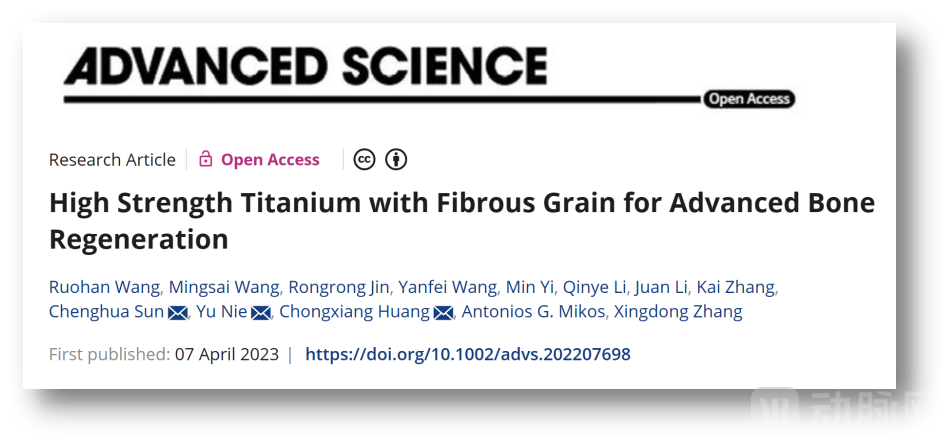
This is a significant original achievement in the field of biomaterials.
However, driving its industrialization is not something that can be rushed. “Ten years to sharpen a sword” is the norm in scientific research.Without adequate technical preparation and sufficient time for accumulation, it is difficult to translate basic research achievements into actual productive forces.” said Huang Chongxiang.
Therefore, they opted for a steady and prudent approach.
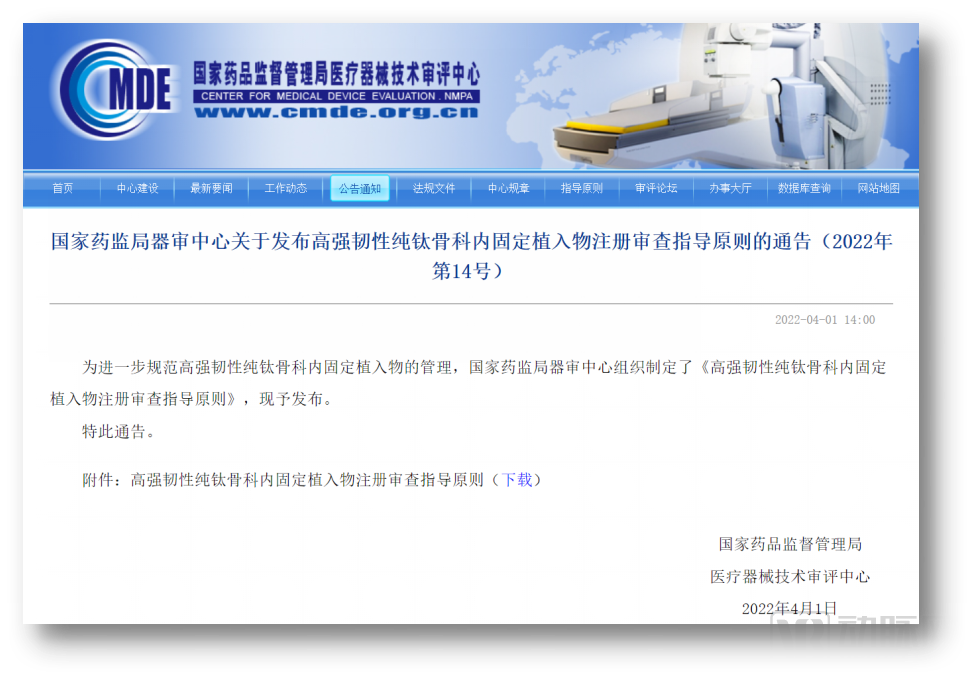
Since 2020, under the guidance of the Center for Medical Device Evaluation (CMDE) of the National Medical Products Administration, the team led by Huang Chongxiang and Nie Yu has participated in the drafting of“Guidelines for Technical Review of Registration for High-Strength and High-Toughness Pure Titanium Orthopedic Internal Fixation Implants”, following repeated deliberations and revisions by peer experts, industry enterprises, and regulatory authorities, was officially released and implemented by the Center for Medical Device Evaluation in April 2022, laying the foundation for high-strength, high-toughness pure titanium orthopedic implant products to enter the market.
The Significant Demand Behind Innovative Technologies
At the start of the interview, Huang Chongxiang presented some data to Chengguo Bureau: In 2020, China’s orthopedic implant market was valued at RMB 35 billion and has been growing year by year; in 2022, the market size for dental implants in China reached RMB 6.686 billion.
Take the dental implant market as an example. Over the past 30-plus years of modern dental implant development, commercially pure titanium has remained the material of choice for fabricating implants. As of the end of 2021, there were 117 registered implant and implant system products marketed in China, including 99 imported products and 18 domestically produced ones, with imported products accounting for more than 90% of the total. In terms of manufacturers, there were 52 foreign companies, three companies from Taiwan, China, and 18 companies from mainland China holding relevant approval certificates.
Various signs indicate that,China's raw materials market is not only highly homogeneous but also predominantly import-dependent.。
The status quo needs to be broken.
“Forgoing surface treatments and structural design, we focus on innovating the raw materials.” Since returning to Sichuan University in 2014, Huang Chongxiang has been dedicated to innovative research on raw materials, striving to improve the mechanical properties of medical-grade pure titanium.
Current biomedical materials include ceramics, stainless steel, pure titanium and titanium alloys, medical-grade polymers, and more. How can one identify a material with market potential among the myriad of options?
In fact, the decision to select pure titanium as the breakthrough point was driven by the team’s dual considerations of academic and market demands.
Around 2003, Huang Chongxiang came into contact with nano-titanium for the first time. “When I was pursuing my doctoral degree, I had seen samples of nano-titanium. Although the samples were small at that time, their mechanical properties were surprisingly excellent.” Since then, an idea has lingered in Huang Chongxiang’s mind—to develop a new type of pure titanium.
“From an academic perspective, the microstructure of pure titanium can be modified through existing industrial processing methods”'Biomimetic' Regulation, thereby achieving a significant improvement in overall performance. From a market perspective, titanium and titanium alloys serve as foundational materials for the fabrication of medical devices in orthopedics, dentistry, and other fields.Large volume and wide coverage, most widely applied.” said Huang Chongxiang.
“Bionics was the greatest inspiration I drew during my Humboldt Postdoctoral Fellowship from 2008 to 2010 in the laboratory of Professor Ernst Wagner, a member of the Academia Europaea,” said Nie Yu. “Through hundreds of millions of years of evolution, every part of biological organisms has acquired exceptionally excellent structures and properties; therefore, the design of biomaterials should learn from nature.”
In 2016, after achieving a breakthrough in key technologies, Huang Chongxiang joined forces with Nie Yu to consult Academician Zhang Xingdong, who had first proposed the concept of “tissue-inductive” biomaterials on the international stage. Academician Zhang highly recognized their research that overcame critical challenges in raw materials and provided guidance on deepening the theoretical foundation and advancing technological applications. As the domestic high-end medical metal materials market was monopolized by foreign companies, hindering the development of China’s high-end medical device industry, addressing the nation’s “chokehold” problems effectively required starting from the source of raw materials.
In 2017, the Ministry of Science and Technology’s “13th Five-Year Plan” Guide for “Research on Novel Medical Metallic Materials and Their Industrialization” included high-strength pure titanium. In 2019, “Regulatory Science Research on New Materials for Medical Devices,” one of the first nine key projects under China’s Action Plan for Regulatory Science of Drugs, also listed high-strength and high-toughness pure titanium as a priority. From innovations in new materials, new technologies, and new principles to practical industrial translation, novel high-strength pure titanium has officially been incorporated into the national plan for scientific and technological innovation.
A Material More Suitable for Humans
In orthopedic implant surgery, commercially pure titanium is widely used in clinical implants due to its excellent biocompatibility; however, it has limitations, including a lack of bioactivity and low mechanical strength, resulting in suboptimal load-bearing capacity. To enhance the mechanical properties of pure titanium, researchers have added alloying elements to create harder titanium alloys. Currently, the titanium alloy Ti-6Al-4V remains the primary material for orthopedic surgical applications.
However, from a safety perspective, vanadium and aluminum released through the wear and degradation of alloy implants are cytotoxic; long-term patient exposure can lead to adverse side effects such as osteolysis and neurological disorders.
In Huang Chongxiang’s view, the new high-strength, high-toughness pure titanium is bound to bring about some changes. “It is as hard as alloys, but safer than alloys,”It can completely replace titanium alloys in the manufacture of medical devices such as bone implants and dental implants.。”
 Uniaxial Tensile Properties of Novel Pure Titanium Materials
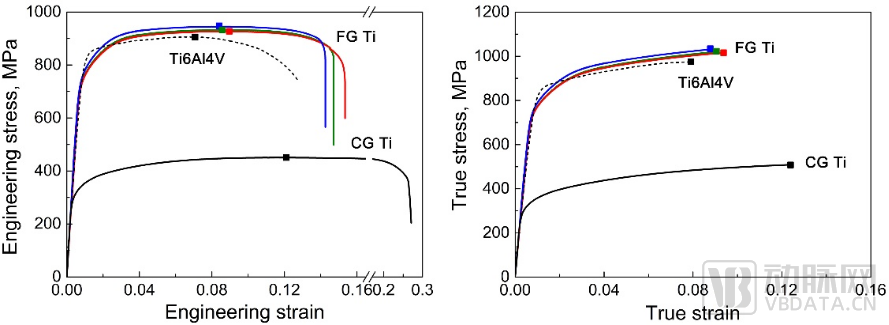
First,Excellent Mechanical PropertiesIt is reported that the new type of pure titanium boasts a tensile strength of up to 950 MPa, an elongation rate of up to 14.6%, and a fatigue strength of up to 480 MPa, with comprehensive mechanical properties comparable to those of the Ti-6Al-4V titanium alloy. “Pure titanium is non-toxic and non-magnetic. We have enhanced its strength to meet the standards of titanium alloys, enabling long-term implantation in patients,” said Huang Chongxiang.
Evaluation of the In Vivo Osseointegration Effect of Novel Pure Titanium Implants
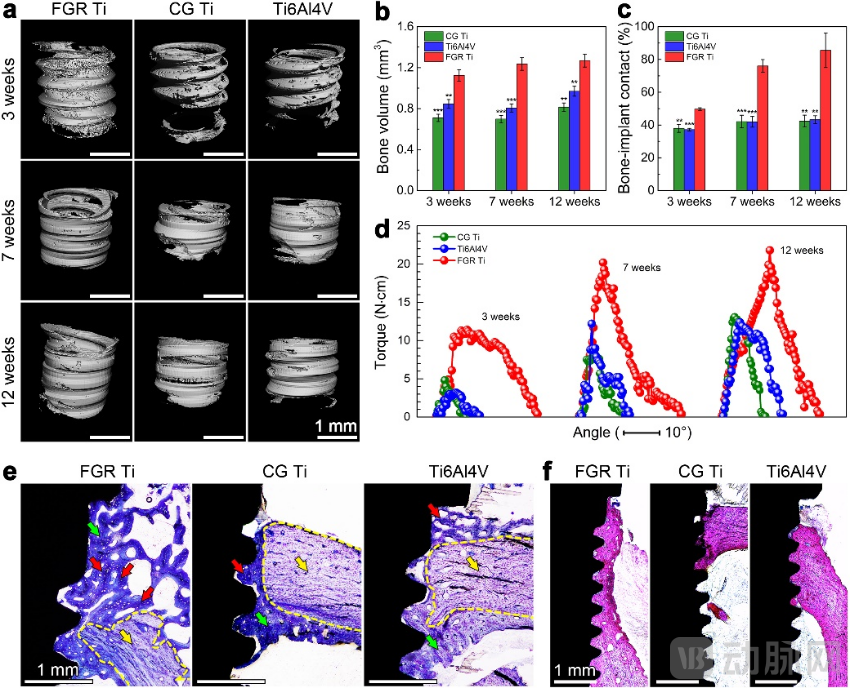
“In addition to its mechanical properties, our material also exhibits rapid osseointegration capability,” added Nie Yu. In vivo animal studies demonstrated that the bone healing period for the novel pure titanium was shortened to three weeks, approximately one-third of that for conventional pure titanium and standard Ti6Al4V titanium alloy implants. “Through micro-CT imaging and hard tissue histological sectioning, we observed that the novel pure titanium implants generated more new bone tissue at various postoperative time points compared with conventional pure titanium and titanium alloys. At 12 weeks post-surgery, the bone-to-implant contact (BIC) ratio reached twice that of the control group, and the intrinsic osseointegration performance of the material surpassed that of some titanium implants coated with bioactive molecules. Based on a comprehensive evaluation of various osseointegration parameters, the three-week osseointegration outcome of the novel pure titanium implants was comparable to the 12-week outcome of commercial titanium-based controls, significantly shortening the osseointegration time and enhancing osseointegration efficacy.”
These two advantages are attributed to the novel pure titanium’s unique multi-scale microstructure and surface topography, which mimic the oriented arrangement of collagen-hydroxyapatite found in natural bone.
The multi-level microstructure consists of equiaxed nanocrystals and fibrous crystals, with highly oriented grains where the (0002) crystal plane, exhibiting optimal bioactivity, is parallel to the sample surface, thereby achieving excellent synergy between strength and ductility; the surface topography features hydrophilic anatase titanium dioxide,Extremely LargeEnhanced surface hydrophilicity of the material, promoting contact guidance in osteocytes and facilitating biomineralization., thereby achieving rapid bone healing.
“This is an effect that is difficult to achieve with all current metallic materials.“This is how Huang Chongxiang evaluated it. In fact, this marks the first time that self-topological surface design has been achieved on metal implants, innovatively proposing the concept of crystallographic regulation of implant surfaces.”
After nearly a decade of research into fundamental principles and the development of innovative technologies, 13 domestic and international invention patents have been granted for novel pure titanium materials, and five high-quality academic papers have been published. This has established a comprehensive R&D pathway and a series of achievements encompassing “principles–technologies–materials.”
Planned Conversion
As a scientific researcher, Huang Chongxiang’s work begins with foundational theory. He stated that exploration in the realm of basic academia does not fully take market factors into account.
Leveraging their independently developed high-strength, high-toughness pure titanium, the team led by Huang Chongxiang and Nie Yu has successfully produced trial batches of various implantable devices, including bone screws, bone pins, intramedullary nails, and dental implants.
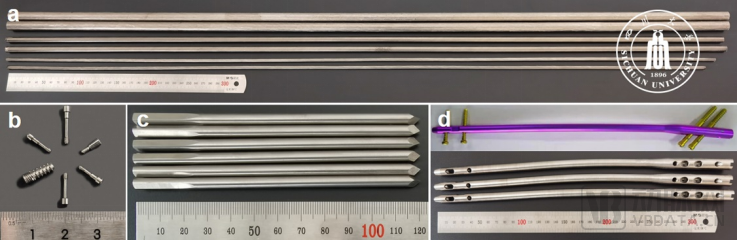 Trial Production of High-Strength and High-Toughness Pure Titanium Raw Materials and Their Implantable Devices
“It would certainly be a positive development if the outcomes could be integrated with industry,” stated Huang Chongxiang.
Conversely,New technologies and new materials also require time to gain acceptance from the market and consumers.. Huang Chongxiang made a rough estimate that the cost of new high-strength, high-toughness pure titanium accounts for approximately 10% of the product's external sales price. Coupled with the high technical barriers, corporate acceptance still needs to be improved.
“Sometimes the technology is sound, but it may not be immediately accepted by the market.” Huang Chongxiang discussed the challenges of translating basic scientific research into practical applications. At this point, he reassured himself that, in the worst-case scenario, it could serve as a reserve technology for the future.
Currently, a wave of innovation is sweeping across China, with enterprises often proactively collaborating with researchers to seek out original innovative technologies. Huang Chongxiang told VCBeat,Numerous enterprises and teams have already approached us, seeking to commercialize the technology.。
Yet Huang Chongxiang does not seem to be in a hurry to discuss technology transfer with the company. At present, they are engaged in something far more important—Standard Setting。
“Without standards, products are effectively produced without a clear basis, and the market does not recognize them,” said Huang Chongxiang, discussing the importance of establishing industry standards.
Formulating industry standards is invariably a multi-stakeholder collaborative process. Huang Chongxiang told Chengguo Bureau that technical standards must ultimately gain corporate acceptance; therefore, the team proactively engaged enterprises and supervisory testing centers to foster collaboration.
“From upstream R&D institutions to intermediate supervision and testing centers, and finally to downstream application enterprises, our technical parameters must undergo repeated testing and validation, and can only be finalized upon recognition by all three parties,” stated Huang Chongxiang. It is understood that over the next one to two years, the team led by Huang Chongxiang and Nie Yu will work to implement industry standards with the support of universities, professional societies, enterprises, and technical supervision authorities.
Huang Chongxiang concluded by stating, “Technological innovation should be carried out in accordance with the purpose and requirements of the ‘Four Orientations.’ In the coming period, guided by national policies, we will gradually achieve the industrialization of original achievements in line with industrial production standards, thereby enabling new materials to benefit the public.”