

BioNTech Strikes Seventh Deal in China This Year with Over $1 Billion PM8002 Agreement
Biotheus
Innovative Biopharmaceutical Developer

BioNTech
Developer of Novel Biologics
On November 6, 2023, Biotheus Inc. announced a collaboration agreement with BioNTech. Under the terms of the agreement, BioNTech will obtain the rights to develop, manufacture, and commercialize the anti-PD-L1/VEGF bispecific antibody (PM8002) worldwide, excluding Greater China. In return, Biotheus will receive an upfront payment of $55 million, as well as over $1 billion in development, regulatory, and commercial milestone payments, along with tiered sales royalties.
PM8002 is a bispecific antibody candidate drug, composed of a humanized anti-PD-L1 single-domain antibody (VHH) fused to an anti-VEGF-A IgG1 antibody containing Fc-silencing mutations. By enriching the PM8002 molecule in the tumor microenvironment via PD-L1 binding, it reduces systemic side effects caused by global VEGF blockade.
Currently, PM8002 is undergoing Phase II clinical trials in China to evaluate the efficacy and safety of the drug as a monotherapy or in combination with chemotherapy for patients with solid tumors. Existing clinical results have demonstrated that PM8002 exhibits a favorable safety profile and antitumor efficacy.
This is not the first time BioNTech and Biotheus have entered into a partnership this year.
Just four months ago, BioNTech and Biotheus Inc. entered into a strategic research collaboration, project optioning, and global licensing agreement.
Under the terms of the agreement, BioNTech will obtain exclusive global options to a preclinical bispecific antibody and a clinical-stage monoclonal antibody developed by Biotheus Inc. for the treatment of malignant tumors. In addition, Biotheus Inc. will exclusively license to BioNTech multiple preclinical nanobody projects under development and provide designated target-specific nanobody development services as required.
Accordingly, Biotheus Inc. will receive an upfront payment from BioNTech and, upon BioNTech’s selection of a bispecific antibody for preclinical development, will be eligible to receive clinical development, regulatory, and commercial milestone payments as well as tiered sales royalties based on unit volume. However, the specific financial terms of this collaboration were not disclosed in detail.
BioNTech not only maintains a close partnership with Biotheus Inc., but has also entered into collaborations with multiple innovative pharmaceutical companies in China. Including this latest deal, it marks the seventh time this year that BioNTech has engaged with Chinese innovators. According to disclosed information, three of these collaborations have a cumulative total value exceeding $1 billion.
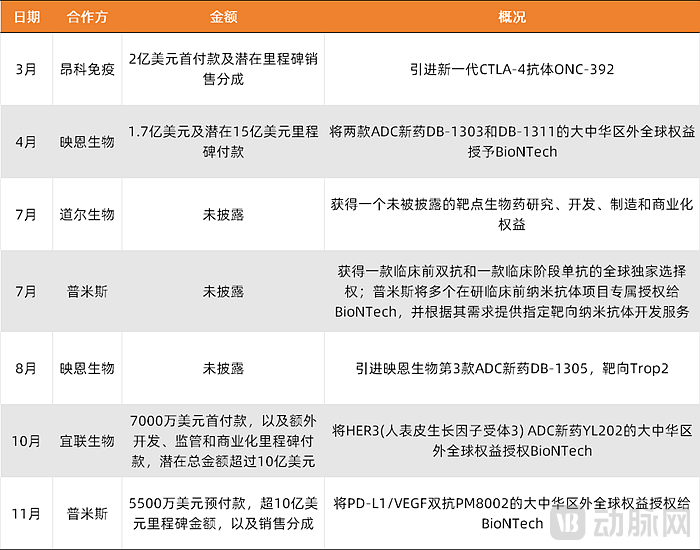
(Chart by VBInsight, compiled from public data)
BioNTech has been frequently licensing projects in the Chinese innovation market, earning it the title of “Super Acquisition King.”
In fact, BioNTech’s enthusiasm for “sourcing” from the Chinese market and its high frequency of collaborations are partly due to the strong capabilities of domestic innovative pharmaceutical companies and partly because BioNTech can bring numerous advantages to its partners.
Most people became acquainted with BioNTech during the pandemic outbreak over the past three years, as it rose to prominence as a star company thanks to its mRNA vaccines for infectious diseases. However, BioNTech’s accumulation of industrial resources, technological innovations, and product portfolio in the European and American markets extends far beyond this.
Since its establishment in 2008, BioNTech has conducted extensive research in the field of cancer. Its personalized mRNA cancer vaccine entered clinical trials in 2014, and a paper published in Nature in 2017 highlighted the potential of its mRNA vaccines to reduce recurrence in melanoma patients.
BioNTech has adopted a multi-platform innovation strategy, with its platform technologies encompassing mRNA vaccines, cell and gene therapies, targeted antibodies, small-molecule immunomodulators, ribologicals, and next-generation immunomodulatory therapies. Among these, cancer treatment is a key strategic focus for the future. Furthermore, there is potential to enhance therapeutic efficacy through combination regimens across different modalities.
Over the past three years, BioNTech has seized opportunities and accumulated substantial wealth through its COVID-19 vaccine. According to its financial report for the first half of 2023, BioNTech held €14.117 billion in cash and cash equivalents.
With substantial financial resources at its disposal, BioNTech’s desire to return to its core competency in oncology is hardly surprising. This move was also foreshadowed by the multiple innovative drug collaborations it disclosed in China this year. It is reported that BioNTech’s CEO visited China last year to evaluate several projects and expressed strong appreciation for the innovation capabilities and efficiency of Chinese enterprises.
However, the development of innovative drugs has always been fraught with peril. We look to BioNTech, a well-capitalized player, to leverage its accumulated resources in oncology and its biological expertise in novel targets, while combining these strengths with the robust development potential of Chinese enterprises in the innovative drug sector, to yield more successful outcomes.
BioNTech, a European company headquartered in Mainz, Germany, listed on the Nasdaq in October 2019 under the ticker symbol BNTX, and is currently Europe’s largest biotechnology unicorn.
Prior to its initial public offering, BioNTech completed three rounds of financing, raising $270 million, €80 million, and $325 million, respectively. Investors included Redile Group, Invus, Fidelity Management and Research Company, Sonofi, Redmile Group, and several other institutions.
Given BioNTech’s geographic location and accumulated resources, it would theoretically be more convenient for the company to seek partners in the European and American pharmaceutical markets. Why, then, has BioNTech traveled thousands of miles to China? There are three primary reasons.
First, in recent years, the domestic biotech sector has developed rapidly, with its innovation quality continuously improving.Nearly 90% of China’s innovative pharmaceutical companies are founded by individuals with extensive research and industrialization experience in the medical field, many of whom are serial entrepreneurs. In terms of team composition, Chinese innovative drug companies already hold a strong hand. Leveraging their founders’ years, or even decades, of accumulated expertise in the pharmaceutical sector, along with their experienced judgment on emerging technologies, it is only a matter of time before these companies deliver robust drug pipelines.
Second,The current pharmaceutical environment is generally sluggish, yet the research and development of innovative drugs remains a continuous cash-burning process.When domestic biotech companies face difficulties in securing internal financing or have not yet reached the IPO stage, partnering with large enterprises is an effective way to quickly restore financial health.On the other hand, these established corporate partners not only bring immediate cash flow but also provide ongoing resource support and expertise in industrial-scale manufacturing in subsequent collaborations, thereby helping biotech companies lacking commercialization experience to successfully transition to commercial operations.
Third, and most importantly, China’s pharmaceutical market has demonstrated a higher growth rate compared to other regions worldwide.According to Frost & Sullivan data, the global pharmaceutical market size reached USD 1.4012 trillion in 2021 and is projected to increase to USD 2.1148 trillion by 2030; China’s pharmaceutical market size was RMB 1.5912 trillion in 2021 and is expected to reach RMB 2.7390 trillion by 2030, with a compound annual growth rate (CAGR) of approximately 6.2% during this period.
In the realm of innovative drugs, China has accelerated its momentum in recent years. The market size of China’s biopharmaceutical industry is projected to reach RMB 710.2 billion in 2025 and RMB 1.1991 trillion in 2030, representing a compound annual growth rate (CAGR) of approximately 12.7% from 2021 to 2030. Notably, the market size of innovative drugs in China stood at RMB 947 billion in 2021 and is expected to reach RMB 2.0584 trillion by 2030.
Whether evaluated in terms of patient population, team talent, innovation quality, R&D efficiency, or other dimensions, China has long become a fertile ground for innovative pharmaceuticals. It is therefore only natural that BioNTech has chosen to seek out promising seeds in this land to blossom and bear fruit.