

Fudan University Achieves Six Technology-to-Equity Conversions Within Two Years, Showcasing Innovation Commercialization Success
In December 2021, Academician of the Chinese Academy of Sciences and Professor at Fudan UniversityZhao DongyuanThe team, through the use of patentsCapital Contribution in Kindby licensing the patent “Preparation Method for a Mesoporous-Microporous Core–Shell Structured Composite Zeolite Molecular Sieve Catalyst” (a technological achievement that won the First Prize of the National Natural Science Award), and jointly established Shandong Fuyuan New Materials Technology Co., Ltd. with Xiba Technology.
This isThe First Successful Case Following Fudan University’s Empowerment ReformFrom the initial disclosure of results through negotiations, and from agreement drafting to post-agreement management, the Technology Transfer Center of Fudan University’s Office of Scientific Research was involved throughout the entire process and provided continuous follow-up. According to statistics, within a two-year period (March 2021–January 2023), Fudan University completed six projects that commercialized scientific and technological achievements through equity investment based on their appraised value.
To explore the reasons behind the success of its empowerment reforms, we need to delve deeper and discuss Fudan University’s scientific research innovation, technology transfer system, and capital support. It is because of these factors that the story of Fudan University has become so compelling.
Scientific Research: The Pursuit of Free Exploration
Fudan University boasts a faculty of 3,602 teaching and research personnel, including 59 academicians from the Chinese Academy of Sciences and the Chinese Academy of Engineering. The university is also affiliated with 17 high-quality clinical medical institutions, such as Zhongshan Hospital, Huashan Hospital, and Children’s Hospital, and hosts numerous leading disciplines and laboratories in fields related to life sciences, molecular biology, new materials, and chemistry.
Therefore, Fudan University is not merely an educator that supplies talent to the innovation sector; it is also a cradle of innovation, with its scientific research achievements influencing the entire industry. However, the reason these research outcomes can be produced in large quantities and possess market potential is actuallyRelated to Innovation in University Laboratories Themselves。
Academician Zhao Dongyuan has stated that his achievements are closely tied to the environment at Fudan University, which nurtured him through its supportive research atmosphere and spirit of free exploration.
In scientific research and exploration, Fudan University has successively established people-oriented, cross-disciplinary research principles to enhance the efficiency of task-oriented scientific research.
1People-Oriented
In 2020, Fudan University innovatively established research personnel positions—Dedicated Position, with the aim of building and stabilizing a well-structured, appropriately sized workforce capable of tackling tough challenges, thereby fostering excellent innovation teams and team clusters.
Fudan University attracts talent from diverse professional backgrounds by optimizing job-role alignment for researchers and offering competitive compensation packages. In tackling large-scale, engineering-oriented research initiatives, this “army-group” approach facilitates unified leadership, synchronized efforts, and effective coordination among technical experts across various disciplines.
As of 2022, Fudan University had approved the inclusion of 22 major innovation initiatives in the pilot program for dedicated faculty positions.
2Breaking Down Disciplinary Boundaries
Interdisciplinary Integration and Fusion Innovation Have Now Become a Consensus Among Fudan Researchers.
As early as 2005, Fudan University had already throughConstruction of Physical Research Institutions, guided by scientific questions and research domains, to pool high-caliber research expertise from within and outside the university,Break the disciplinary development pattern originally formed along departmental boundaries.
“For instance, the issue of depression cannot be resolved by any single discipline alone; it requires not only mathematicians like myself but also researchers in fundamental biology.” Professor Feng Jianfeng, Dean of the Institute of Science and Technology for Brain-inspired Intelligence, likened scientific research to “building with blocks,” stating that “only by pooling all efforts to address a problem can we achieve a synergistic effect where 1+1>2.”
It is reported that Fudan University has established 24 new university-level, physically operational research institutes in the fields of science, engineering, and medicine. These institutes primarily focus on quantum technology, artificial intelligence, big data, integrated circuits, optoelectronic materials, fintech, brain science, biomedicine, and reproductive development.
Among these, the five National Natural Science Foundation of China (NSFC) Basic Science Center projects—“Functional Mesoporous Materials,” “Next-Generation Computational Methods and Software for Functional Material Applications,” “Phenomic Analysis and Systematic Deconstruction of Human Complex Traits in Low-Pressure and Hypoxic Environments,” “Ocean-Land-Atmosphere Systems and Extreme Weather and Climate in the Mid-to-High Latitudes of the Northern Hemisphere,” and “Pan-Vascular Interventional Complex Systems”—are all undertaken by interdisciplinary teams formed by physical research institutions or departments in collaboration with other physical research institutions.
In addition to the above two points, Fudan University has introduced a series of specific measures in recent years,Creating a More Liberated Research Environment。
Establish “Special Zones for Basic Research” by innovating review and support mechanisms for original, frontier scientific research, providing stable support in various forms, and fostering a relaxed environment conducive to scientists’ dedicated research; build operational institutional platforms oriented toward major international frontiers and critical national needs, gathering superior research strengths from within and outside the university to achieve breakthroughs at scientific peaks or in tackling key domain challenges; strengthen the cultivation of talent in basic research, implement researchers’ autonomy in project selection, fund utilization, and resource allocation, and unleash the innovative vitality of talent...
“The primary focus lies in a people-oriented approach that respects the autonomy of researchers. Secondly, it involves combining resource investment with institutional and mechanistic reforms, strengthening guidance while streamlining performance evaluations, fostering a conducive research environment, and stimulating innovative vitality,” stated a relevant official publicly.
Transformation: Exerting Effort in the Subtle Details
A solid research foundation is one of the prerequisites for Fudan University to develop its capabilities in translating scientific and technological achievements, enabling the university to subsequently identify commercialization opportunities.
In 2020, under the leadership of Fudan University’s Leading Group for Intellectual Property Management and Operations, various functional departments—including Scientific Research, Intellectual Property, State-owned Assets, Human Resources, the Technology Transfer Center, and the Library—jointly promoted the commercialization of scientific and technological achievements.
The foremost priority, naturally, is theImprovement of the Institutional Framework for the Translation of Scientific and Technological AchievementsIn recent years, Fudan University has successively issued documents such as the "Administrative Measures for the Transformation of Scientific and Technological Achievements," the "Implementation Plan for the Pilot Program Granting Researchers Ownership or Long-Term Usage Rights to Job-Related Inventions," the "Interim Provisions on Off-Campus Part-Time Employment and Leave-of-Absence Entrepreneurship for Faculty and Staff," and the "Administrative Measures for Investment with Valued Scientific and Technological Achievements," thereby providing strong support and safeguards for researchers.
If policy promulgation resembles grand narratives, then Fudan University has focused its granular implementation efforts on high-value patents, ownership reform, and innovation platforms.
1Cultivation and Management of High-Value Patents
In summary, drawing on past successful experiences, the management and cultivation of intellectual property represent the aspect to which universities attach the greatest importance. These legally protected, high-value achievements form the cornerstone of Fudan University’s efforts in commercializing scientific and technological outcomes.
In 2018, Fudan University’s Technology Transfer Center established an intellectual property management system; in 2022, Fudan University further developed a system for the disclosure and translation of scientific and technological achievements.
Add on-campus innovation achievements to the disclosure system. Prior to filing patent applications, the Technology Transfer Center of Fudan University engages professional firms to conduct evaluations from multiple perspectives, including project content, marketability, transaction potential, legal compliance, technical feasibility, and investment viability.Conduct In-Depth Analysis。
According to statistics, in 2022, Fudan University filed 1,354 patent applications in China and was granted 1,072 Chinese patents, achieving a patent approval rate of 79%.
Among these, the Technology Transfer Center selects achievements with higher comprehensive rankings and promotes their transfer and commercialization to target enterprises and investors through methods such as holding achievement release conferences. For achievements with lower comprehensive rankings, the Technology Transfer Center will continue to follow up and intensify promotion efforts at appropriate times.
To strengthen the creation, management, and utilization of high-value patents within the university, Fudan University officially began operating a special fund for intellectual property management and commercialization in 2022.Fund patent navigation and the cultivation of high-value patents.
The emergence of high-value patents has also drawn significant market attention to Fudan University.
For example, the vertebrate piggyBac transposon genetic manipulation system successfully developed by Professor Xu Tian and Professor Wu Xiaohui’s team at the Institute of Developmental Biology, Fudan University, along with their patent titled “piggyBac as a Genetic Manipulation and Analysis Tool in Vertebrates,” attracted enterprises from Shanghai, Nanjing, Hangzhou, and other cities between 2019 and 2021, generating a total of RMB 4.8 million in patent licensing fees.
2Empowerment Reform: Encouraging Researchers to Launch Startups
In March 2021, Fudan University promulgated the “Implementation Plan for the Pilot Program on Granting Ownership or Long-Term Usage Rights of Job-Related Scientific and Technological Achievements to Scientific and Technical Personnel.” The policy stipulates that the inventor team shall apply for the authorization of patent technologies, and the university shall organize experts to determine whether such patent technologies constitute major scientific and technological achievements.
At the specific implementation level, Fudan UniversityFirst, it will determine whether the achievement constitutes a major scientific and technological breakthrough.For non-major scientific and technological achievements, the university grants the inventor team long-term usage rights to the patent technology. The inventor team shall conduct external valuation-based investment, hold 100% of the equity, return 30% of the proceeds to the university, while the university does not participate in the company’s decision-making or operations. For major scientific and technological achievements, the university confers ownership rights of the technological achievement, with the inventor team holding 70% of the ownership and the university’s asset management company holding 30%. Both parties shall jointly conduct valuation-based investment in the technological invention and receive proceeds in proportion to their respective equity shares.
“We encourage researchers to commercialize their own scientific achievements, as they have the deepest understanding of these outcomes,” stated Zhong Shi, Director of the Technology Transfer Center at Fudan University’s Academy for Engineering & Technology. To support researchers in pursuing innovation and entrepreneurship, Fudan University has also clarified multiple pathways. “Even if the technology is transferred to a company founded by the researchers themselves, it is permissible as long as the process complies with laws and regulations. The university’s policies reflect the principles of openness, fairness, and impartiality.”
3Leveraging Innovative Platforms
The incubation and implementation of achievements are inseparable from the support of innovation carriers. As the "first stop" for the successful transformation of university scientific research,Sci-Tech Innovation Center and Science ParkIncubate innovative projects through resource integration.
In November 2021, the Baoshan Fudan Science and Technology Innovation Center officially commenced operations. Eight major innovation projects from Fudan University successfully settled in, including the functional mesoporous materials R&D project led by Academician Zhao Dongyuan of the Chinese Academy of Sciences, the industrialization project for high-performance coating materials led by Professors Zhou Shuxue and Wu Limin, and the industrialization project for intelligent building communication systems led by Professor Zheng Lirong.
Leveraging Fudan University’s leading disciplines and major scientific and technological innovations, we focus on emerging sectors such as chemical materials, information electronics, and equipment manufacturing. By bridging scientific research outputs with market demands, we provide end-to-end innovation services across the entire lifecycle to “catalyze” the commercialization of research achievements.
Here, innovative projects will receive a comprehensive suite of services—including financial support, business operations, technology, digital empowerment, spatial ecosystem development, and new-type R&D—to fully facilitate the translation and industrialization of scientific and technological achievements.
Capital: Exclusively for the Fudan Project
Fudan University is one of China’s richest talent pools for financial professionals.
From the perspective of academic discipline development, Fudan University’s economics program was rated as an A+ discipline in the fourth round of national discipline assessments. In terms of talent reserves, over the past century, the School has boasted renowned senior economists such as Xu Dixin, Qi Qisheng, Jiang Xuemo, Wu Bolin, and Hong Yuanpeng, who have enjoyed prestigious reputations both domestically and internationally, as well as a cohort of influential young and middle-aged academic leaders—including Zhang Jun, Hua Min, Yuan Zhigang, Jiang Boke, and Chen Shiyi—who hold significant sway in theoretical circles at home and abroad.
A set of survey data from Rongzhong Finance shows that among the 49 well-known figures in the venture capital and private equity industry surveyed, six graduated with undergraduate degrees from Fudan University, accounting for 12% and ranking first in this survey. These individuals include Yu Feng of Yunfeng Capital, Liang Xinjun of Fosun Capital, Li Ruigang of CMC Capital, Mi Qun of Lightspeed Venture Partners, Shao Jun of DT Capital Partners, and Bao Fan of China Renaissance.
Leveraging its unique disciplinary strengths, Fudan University is exploring"Universities + Venture Capital" / "Finance + Technology"A Model for Translating Research Achievements into Practice—Venture capital firms established by Fudan University or its alumni build a bridge between “academia” and “industry” from an investment perspective, helping Fudan’s sci-tech projects grow from “0” to 1, and then to positive infinity.
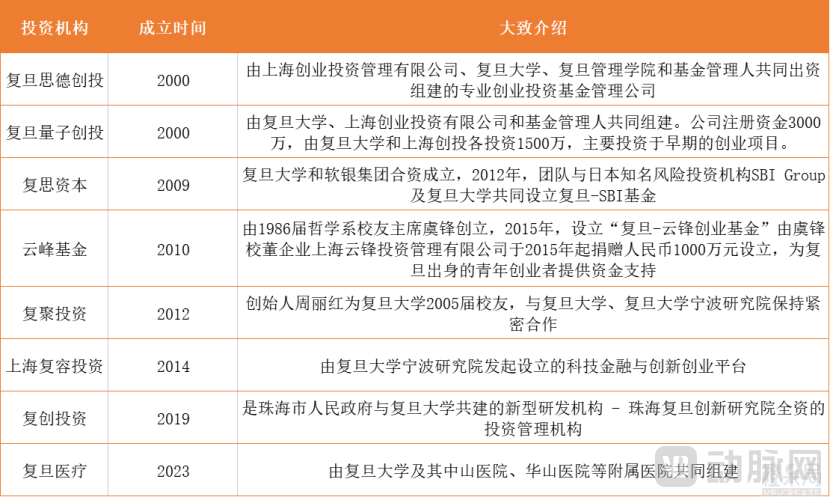
Fudan-affiliated venture capital firms; data sources: Juzi IT, Qichacha, and VBInsight
According to incomplete statistics from Orange Bureau, since 2000,“Fudan-affiliated venture capital firms” leverage their inherent ties with professors and alumni to identify and screen original innovation projects that align with clinical needs and possess high potential for growth.. Taking Fuchuang Investment as an example, this venture capital firm, wholly established by the Zhuhai Fudan Innovation Research Institute, includes Mr. Tang Yukuan and Mr. Gu Guangxin among its members, both of whom are also alumni of Fudan University.
On one hand, Fuchuang Investment has constructed the “Fudan University Scientific and Technological Innovation Achievements Database” through systematic research into Fudan University’s directions in technological innovation and industrialization. It catalogs the scientific research achievements of Fudan University academicians, Changjiang Scholars, and professors, making direct investments in major scientific research outcomes. On the other hand, Fuchuang Investment has established project collaborations with Fudan University’s School of Innovation and Entrepreneurship, Institute of Intelligent Science and Technology, and Academy for Engineering and Applied Technology, thereby facilitating the commercialization of these achievements.
Established four years ago, Fuchuang Investment has successively invested in five companies: Kangjing Biology, Hualan Micro, Banggusi Electronic Technology, Yingbisen, and Xinhua Weishi. Among these, three are projects affiliated with Fudan University, including Kangjing Biology, founded by Professor Hu Weiguo of Fudan University; Banggusi Electronic Technology, established by Fudan University alumnus Chen Yuefan; and Yingbisen, co-founded by Zou Liang, a 2006 master’s graduate from the School of Microelectronics at Fudan University.
The “Fudan-Yunfeng Entrepreneurship Fund,” established by Yunfeng Capital, aims to encourage current Fudan University students to engage in independent technological innovation and entrepreneurship, foster talent in technological innovation, and broaden employment channels for graduates. Additionally, the fund provides financial support, entrepreneurial training, and mentoring to Fudan University alumni who graduated within the past eight years and demonstrate entrepreneurial intent, potential, and concrete business plans.
As of 2021,The “Fudan-Yunfeng Venture Fund” has supported 151 innovation and entrepreneurship projects at Fudan University, among which 15 projects have secured follow-on venture capital funding totaling over RMB 90 million.
Epilogue
As a source of innovation, Fudan University has strengthened key elements such as innovative talent, innovation platforms, and capital. Moreover, the local government’s strong support for the commercialization of scientific achievements is evident—as early as 1998, the Shanghai Municipal Government issued the Several Provisions of Shanghai Municipality on Promoting the Commercialization of High-Tech Achievements to facilitate this process. Consequently, Fudan University has basically established a comprehensive ecosystem for innovation and technology transfer, successfully commercializing a large number of high-value patents through equity investment based on patent valuation, as well as patent assignment and licensing.
These successful experiences ultimately complete the ecosystem’s closed loop, substantiating Fudan University’s innovative DNA and attracting greater attention from capital and enterprises, thereby continuing to write Fudan’s innovation story.