

Lilly's Zepbound™ (Tirzepatide), First Dual GIP/GLP-1 Receptor Agonist for Chronic Weight Management, Receives FDA Approval with Top Dose Achieving Average 43.5-Pound Weight Loss
On November 8, Eli Lilly announced that the U.S. Food and Drug Administration (FDA) had approved the marketing of its GLP-1/GIP dual receptor agonist Zepbound™ (tirzepatide) injection for the treatment of adults with a body mass index (BMI) of 30 or higher, as well as adults with a BMI of 27 or higher who have weight-related conditions such as hypertension, type 2 diabetes, obstructive sleep apnea, or cardiovascular disease.
Zepbound has become the first and currently only approved therapeutic agent that activates the receptors for two incretin hormones, GIP and GLP-1.
The First GLP-1/GIP Dual Receptor Agonist Weight-Loss Drug
Zepbound shares the same formulation as Mounjaro, Eli Lilly’s blockbuster drug for type 2 diabetes. Both are dual GLP-1/GIP receptor agonists that simultaneously activate signaling pathways mediated by the GLP-1 and GIP receptors, thereby promoting weight loss through multiple mechanisms, including appetite suppression, increased energy expenditure, and improved function of insulin-secreting beta cells.
Since receiving FDA approval in May 2022, Mounjaro has been widely used for the treatment of obesity.
The approval of Zepbound is based on the results from the Phase III SURMOUNT-1 and SURMOUNT-2 trials. SURMOUNT-1 studied 2,539 adults with obesity or overweight and weight-related health conditions (excluding diabetes). Compared with placebo, patients taking Zepbound as an adjunct to diet and exercise achieved significantly greater weight loss at 72 weeks. At the highest dose of 15 mg, participants taking Zepbound lost an average of 48 pounds (21.8 kg), while at the lowest dose of 5 mg, they lost an average of 34 pounds (15.4 kg); in contrast, those receiving placebo lost 7 pounds (3.2 kg).
Furthermore, based on data without control for Type I error, one-third of patients receiving the highest dose of Zepbound achieved weight loss exceeding 58 pounds (25% of body weight), compared with a 1.5% weight reduction in those receiving placebo. The mean baseline body weight was 231 pounds.
Meanwhile, a clinical trial demonstrated that patients with obesity, overweight, and weight-related conditions treated through dieting, exercise, and Zepbound also exhibited changes in cholesterol and blood pressure, as well as a reduction in waist circumference.
“A Head-on Confrontation” Is About to Unfold
Eli Lilly anticipates that Zepbound will be launched by the end of 2023, available in six dosages: 2.5 mg, 5 mg, 7.5 mg, 10 mg, 12.5 mg, and 15 mg, with a price set at $1,059.87 per month. David Ricks, CEO of Eli Lilly, stated,Zepbound’s list price will be approximately 20% lower than that of Novo Nordisk’s Wegovy.
Meanwhile, Eli Lilly’s two initiatives will help patients reduce their out-of-pocket costs for Zepbound. Patients with commercial insurance may pay as little as $25 per month, while those without commercial insurance can pay approximately $550, representing a discount of up to 50%.
With the approval of Zepbound, Eli Lilly will engage in direct competition with Novo Nordisk. Novo Nordisk holds GLP-1 agonists Ozempic for type 2 diabetes and Wegovy for obesity, while Eli Lilly possesses Mounjaro for type 2 diabetes and the weight-loss drug Zepbound, both of which are GLP-1/GIP dual receptor agonists.
Regarding obesity, although Zepbound and Wegovy have not been directly compared head-to-head, data from Eli Lilly suggest that Zepbound may deliver more pronounced weight loss effects. Data from Eli Lilly’s SURMOUNT-1 and SURMOUNT-2 trials show that patients receiving the highest dose of Zepbound experienced approximately 12% to 18% reduction in body weight. Clinical trial results from Novo Nordisk indicate that participants treated with Wegovy achieved a 10% to 16% reduction in body weight.
It is also worth noting that, upon approving Zepbound, the FDA added a safety warning regarding serious gastrointestinal disorders to the drug’s label, whereas Wegovy did not receive such a warning. However, based on preclinical rat studies, the FDA has assigned a boxed warning about the risk of thyroid tumors to both drugs.
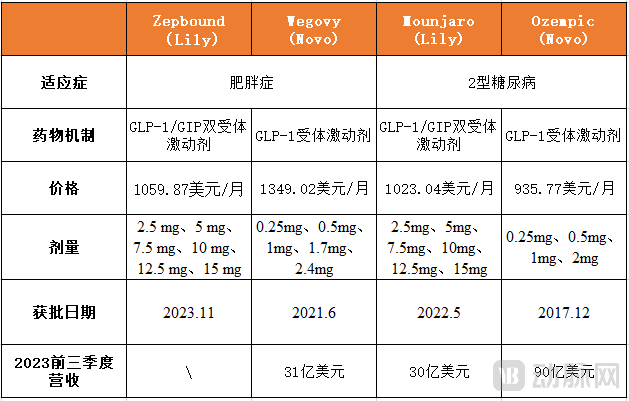
In terms of revenue, Novo Nordisk’s two drugs demonstrated strong growth. In the first nine months of 2023, Wegovy’s sales increased fivefold to DKK 21.7 billion (approximately USD 3.1 billion). Although Ozempic has been approved for the treatment of type 2 diabetes, it is also used off-label for weight loss, driving a 58% increase in its sales to over USD 9 billion.
Meanwhile, although Eli Lilly’s Mounjaro received approval later, its revenue is closely trailing that of Novo Nordisk. Sales in the first nine months of 2023 amounted to $3 billion. The drug’s financial success to date, coupled with prospects for future revenue growth, has helped elevate Eli Lilly to become the most valuable pharmaceutical company, boosting its market capitalization to nearly $600 billion.
And the approval of Zepbound will unleash enormous sales potential in a market projected to reach $100 billion by 2030. Citigroup analyst Andrew Baum wrote in late October,Mounjaro’s peak sales are projected to reach $22 billion, while Zepbound’s peak sales are expected to hit $37 billion.
However, despite the extremely high product requirements and fierce market competition,The issue of tight production capacity supply appears more urgent., to the extent that both companies are struggling to meet this demand. Last week, Eli Lilly stated that sales of Mounjaro would have been higher if not for “intermittent delays” in order fulfillment.
In 2023, Eli Lilly invested over $2 billion to strengthen its production facilities and plant construction in North Carolina and Indiana, doubling the company’s capacity compared to a year earlier.
As for Novo Nordisk, earlier this year the company restricted Wegovy supplies to the United States and imposed limits on starting doses to ensure it could continue serving existing patients. Last week, Novo Nordisk CEO Lars Fruergaard Jørgensen stated that although the company continues to expand its manufacturing capacity, he expects demand to continue outstripping supply.