

Soochow University Raises $1B Talent Initiative, Builds Innovation 'Circle of Friends' in Eastern China
Suzhou is the flower-adorned bridge and waterside pavilion from Bai Juyi’s dreams, the clear melody of water-chestnut songs that lingered in Li Bai’s ears, and the classical gardens of Ye Shengtao’s childhood—a city that has captivated countless literati and poets over the millennia.
Nestled within the Jiangnan water town, renowned for its timeless charm, lies Soochow University (hereinafter referred to as “Soochow University”), China’s earliest university established under a modern disciplinary framework. Tracing its origins back to 1900, the institution awarded China’s first Bachelor of Arts degree, produced its first cohort of Master of Science graduates in Chemistry, and founded Asia’s first law school dedicated to comparative law.
In fact, Soochow University is renowned not only for its scenic beauty and rich history but also for its lesser-known strength in innovation and technology transfer. Over the past five years, the university has incubated 85 enterprises based on the commercialization of scientific and technological achievements. Among these, two companies—Suzhou Fangsheng Optoelectronics and Jiangsu Huibo Robotics—have been listed on the National Equities Exchange and Quotations (NEEQ).
Attracted by Its Appeal, Loyal to Its Strength. How Did Soochow University Become an Innovation Dark Horse Step by Step?
I. Attracting Talent, and More Importantly, Cultivating Talent
Soochow University’s predecessor was Dongwu University, founded in 1900 as a missionary university established by the American Methodist Episcopal Church, South. In light of this historical background, Soochow University currently has both Chinese and English versions of its motto: “养天地正气,法古今完人” and “Unto a Full Grown Man.”
However, regardless of the language used, it is evident that Soochow University places significant emphasis on talent education, a philosophy that naturally extends to its efforts in translating research outcomes into practical applications. On one hand, the university prioritizes innovative talent; on the other, it remains committed to cultivating professionals specialized in technology transfer.
As the saying goes, "Great teachers produce outstanding students," and Soochow University’s faculty strength is not to be underestimated. As of November 2023, the university’s current faculty includes 10 academicians of the Chinese Academy of Sciences and the Chinese Academy of Engineering, 8 academicians from developed countries, and one Nobel laureate.
To attract high-level talent, Soochow University has offered generous compensation and benefits. According to the university’s official website in July 2023, in addition to covering “standard” provisions such as research funding and living allowances for distinguished professors and top-tier talents, the university provides individual subsidies of no less than RMB 4.5 million, with total packages exceeding RMB 10 million. As a result, Soochow University has been dubbed by outsiders as a “talent excavator.”
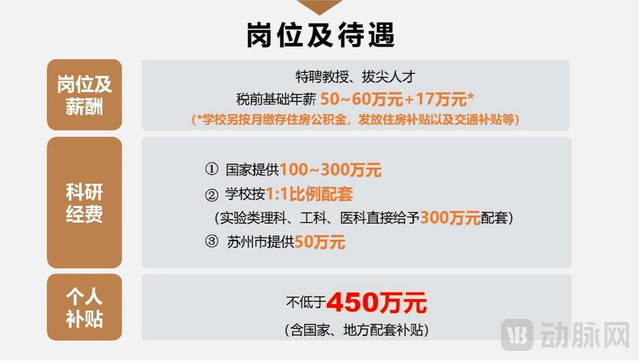
Soochow University’s Talent Introduction Policy (Image source: Soochow University)
Furthermore, Soochow University has implemented a cultivation model of “Academic Masters + Innovation Teams,” under which leading talents spearhead the formation of innovation teams and are granted greater authority over the allocation of personnel, funding, and resources, as well as decision-making power regarding technical routes.
However, attracting talent cannot rely solely on external conditions. From the very beginning, Soochow University has placed great emphasis on disciplinary development, establishing a host of leading academic platforms such as the National Engineering Laboratory for Modern Silk at Soochow University, the State Key Laboratory of Radiation Medicine and Radiation Protection at Soochow University, and the Suzhou Collaborative Innovation Center of Nanotechnology. These initiatives have significantly enriched the university’s range of disciplines. It is this order-of-magnitude growth in research strength that serves as the ultimate secret to attracting top-tier talent.
Since 2007, Soochow University has invested more than RMB 700 million in talent recruitment, bringing in 139 distinguished professors, 80% of whom were recruited directly from overseas, and establishing over 20 innovative research teams.
The recruitment of a large number of outstanding talents has built Soochow University’s strong faculty, enabling its students to access the most cutting-edge scientific achievements and research directions. Under the leadership of Professor J. Michael Kosterlitz, Nobel Laureate in Physics, graduate students at Soochow University’s Postdoctoral Research Station in Physics have published more than 100 SCI papers in Q1 and Q2 journals as first authors and with Soochow University as the first affiliated institution, including renowned journals such as Physical Review Letters, Nature Communications, and Advanced Materials, achieving remarkable scientific accomplishments.
Beyond student education, a distinguished faculty also drives the advancement of the overall teaching staff. For many high-level researchers, academic research has become an integral part of daily life. Their passion for scholarly inquiry influences the academic ethos and environment of higher education institutions, elevating the quality of the entire faculty and fostering a virtuous cycle.
Introducing high-caliber faculty is only one aspect of Soochow University’s efforts to cultivate innovative talent. The university also emphasizes the development of interdisciplinary professionals through a “platform-support-culture” trinity teaching system. First, Soochow University has abandoned the traditional major-specific credit certification system and piloted an interdisciplinary, self-defined minor study mechanism, thereby making the credit recognition system more flexible.
Furthermore, in emerging engineering disciplines such as artificial intelligence, intelligent manufacturing, and big data science and technology, Soochow University has taken the lead in launching interdisciplinary experimental classes. At Soochow University, Gaokao scores are not the sole criterion for admission. After enrollment, the university conducts a second round of internal selection to identify and recruit innovative talents into these interdisciplinary experimental classes. The training curriculum for students in these experimental classes differs from traditional undergraduate education by placing greater emphasis on practical components, such as research platforms and internship bases, thereby ensuring that learning is applied to practice.
Under Soochow University’s open and innovative talent development environment, the 123-year-old institution has produced numerous renowned scholars and public figures, including Xu Deheng, Zhou Gucheng, Fei Xiaotong, Lei Jieqiong, Sun Qimeng, Tsung-Dao Lee, and Louis Cha.
However, the translation of scientific research achievements requires not only excellent research outcomes but also talent who understand technology and are familiar with the market to lead the transformation. To this end, Soochow University’s School of Continuing Education has established a specialized Industrial Talent Training College to cultivate market-oriented professionals who are well-versed in both industry dynamics and technical expertise.
In addition, leveraging the advantages of “university–local government” collaboration, the National Technology Transfer Center of Soochow University has repeatedly invited active technology managers from the market to engage in on-campus exchanges. On one hand, this opportunity enables the university to communicate its specific initiatives in industry–academia–research collaboration to external stakeholders, including alignment points and cooperation models between universities and enterprises, thereby enhancing the industry’s understanding of Soochow University’s technology transfer efforts. On the other hand, it helps improve the market awareness of Soochow University’s internal technical professionals, further promoting industry–academia–research collaboration and strengthening enterprises’ independent innovation capabilities.
II. Policy Guidance: Cultivating a Conducive “Soil” for Implementation
If talent strength has laid a solid foundation for the commercialization of scientific and technological achievements at Soochow University, policy guidance has further empowered this process. For researchers preparing to translate their findings into practical applications, Soochow University has established a flexible evaluation system and reformed its performance assessment model, enabling them to devote themselves fully to research. For researchers currently engaged in the translation process, the university encourages experimentation through incentive policies.
For many researchers, the number of high-impact-factor papers is directly linked to their academic standing. Suzhou University is working from within to break this stereotype.
In 2020, Soochow University issued the "Opinions of Soochow University on Establishing a Correct Orientation for Scientific Research Evaluation," which explicitly stated that peer review of representative works should be strengthened, and that neither the quantity of representative works nor their impact factors should be used as quantitative assessment indicators.
At Soochow University, greater emphasis is placed on patent quality and commercialization in performance evaluations than on the quantity and value of published papers. The university has established a comprehensive evaluation system for patent quality, assessing patents across nine key dimensions, including new technologies, new methods, outcomes of technology transfer and application, and their role in addressing critical issues in economic and social development. Researchers are encouraged to conduct research driven by societal needs. This approach helps reduce the emergence of “dormant patents” at the source and enhances the overall value of researchers’ patents.
Given the varying durations of scientific research and technology transfer across different fields, Soochow University has adopted a long-term evaluation mechanism. Specifically, it customizes evaluation cycles for individual projects based on factors such as project type, technology transfer platforms, and technical complexity, while consciously streamlining the evaluation process to achieve diversified and objective assessments.
This flexible evaluation approach better facilitates researchers in achieving substantive translational research, streamlines cumbersome procedures, and creates a more conducive “soil” for the practical application of scientific achievements.
Meanwhile, Soochow University has avoided a one-size-fits-all approach to promoting the commercialization of research findings. In addition to supporting the translation of scientific achievements into practical applications, the university also encourages the development of basic research. Its personalized evaluation criteria enable researchers of different types to find career paths suited to their individual strengths.
For researchers engaged in the commercialization of their findings, Soochow University has established “attractive” incentive policies: for major basic research and original innovation achievements that have received the National Science and Technology Award, the team responsible for the achievement is entitled to 100% of the proceeds from its transfer.
High returns are more likely to foster a sense of ownership among researchers, thereby stimulating their enthusiasm for technology transfer.
In addition to direct financial incentives, Soochow University has established a dedicated promotion pathway for professionals specializing in technology transfer by creating separate “application and promotion-oriented positions.” Applications for these positions are not restricted by current job rank; instead, the evaluation focuses primarily on candidates’ practical competencies, development potential, and fit with the role, thereby opening up career advancement opportunities for technical talent.
However, the motivation of technology transfer personnel also affects transfer efficiency. To address this, Soochow University has adopted a corporate-style employment model for its technology transfer staff, reducing their dependence on the university. Meanwhile, to encourage them to proactively enhance their commercialization capabilities, outstanding performers are encouraged to apply for positions in the university’s public institution recruitment process and are given priority in hiring. It is reported that two employees from the technology transfer center’s enterprise entity have successfully been hired as research management cadres in Soochow University’s Department of Scientific and Technological Research.
Furthermore, the compensation structure for technology transfer personnel adopts a “low base salary + high performance-based pay” model that rewards greater effort with higher earnings. The performance incentives are particularly attractive: at Soochow University, upon the successful transfer and commercialization of scientific and technological achievements (as verified through technical contract registration and full payment receipt), 80% of the net proceeds are awarded to the creators of the achievements, 10% is allocated as intermediary fees, and 10% is retained by the university. This dual incentive system of “established staffing status + performance-based rewards” has alleviated the concerns of Soochow University’s technology transfer staff.
Supported by policy incentives, Soochow University has seen a rapid increase in the number of patent assignments and licensing conversions in recent years: from only 29 cases in 2015 to 176 cases in 2019, with the assignment rate accounting for more than 15% of the patents granted by the university that year.
III. Scattered, They Are Stars Across the Sky; United, They Form “Su Daqiang”
Due to historical factors, Suzhou has often been jokingly referred to as a “loosely assembled city.” However, with the deepening of coordinated urban development, Suzhou is increasingly exhibiting a trend where “its thirteen districts shine individually like stars, yet together they form a mighty Suzhou.” This spirit of collaboration has naturally extended to Soochow University.
Research and innovation capability is naturally the primary criterion for determining the success of technology transfer. To enhance this capability, in addition to implementing internal reforms, Soochow University has also actively drawn on external resources.
In 2013, Soochow University announced the joint establishment of the Laboratory for Interface Science and Applied Technology of Nanomaterials with the Suzhou Institute of Nano-Tech and Nano-Bionics, Chinese Academy of Sciences. The laboratory focuses on innovative research in nanomaterials and technology. The application and study of nanomaterials play a significant role in fields such as energy, environment, life, and health. Collaboration with the CAS Institute of Nano-Tech and Nano-Bionics helps Soochow University further enhance its scientific research capabilities in the field of materials and promote original innovation.
In 2023, Nature’s special issue “Nature Index: Nanoscience and Nanotechnology” featured an article titled “Soochow University’s Pioneering Nanoresearch Offers Solutions to Global Challenges,” highlighting the university’s landmark scientific achievements in nanotechnology. This serves as strong evidence that Soochow University’s prowess in the field of nanotechnology is steadily rising.
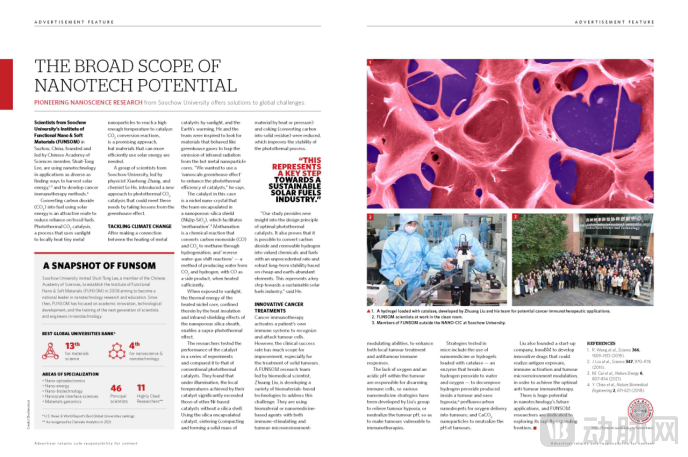
Screenshot of the report (Image source: Soochow University News Network)
Coincidentally, in 2012, Soochow University and the University of Western Ontario jointly established the Soochow University–University of Western Ontario Joint Research Center for Synchrotron Radiation. The establishment of this center not only enhances and advances China’s large-scale synchrotron radiation scientific facilities but also provides a research platform for talent development in synchrotron radiation and interdisciplinary cross-cutting research at Soochow University.
In 2020, the center collaborated with the National Synchrotron Radiation Laboratory at the University of Science and Technology of China to jointly establish the “Soft X-ray In Situ Analysis Beamline for Energy Materials”—the first synchrotron radiation beamline in China co-built with a light source facility under the leadership of a university, setting a paradigm for deep collaboration between higher education institutions and research institutes.
Furthermore, by leveraging collaborative strengths across numerous fields such as healthcare, chemistry, and industry, Soochow University has continued to scale new heights, positioning itself at the forefront of scientific research among Chinese universities.
As one of the Chinese cities with the most comprehensive industrial systems, Suzhou boasts unique advantages in industrial scale and clustering. However, its development has been hindered by the characteristic of being “large but not strong.” The innovative strength of Soochow University precisely compensates for Suzhou’s relative weakness in innovation capacity.
Therefore, in addition to collaborating with research institutes, Soochow University has also established its own “circle of friends” by leveraging the advantages of the “university-local government-enterprise” model.
At the local level, Soochow University implements the “One School, One City, One Base” model, under which each school collaborates with a city to jointly establish an industrial technology research base. Through in-depth cooperation with major cities in Jiangsu Province, Soochow University has successively co-established six industrial research institutes with local governments, including those of Zhangjiagang, Nantong, Suzhou Industrial Park, and Suzhou New District.
On the corporate front, Soochow University has implemented the “One Team, One Enterprise, One Platform” model, in which a single research team co-establishes a research platform with a leading enterprise. As of 2023, Soochow University had jointly established university–enterprise research platforms with more than 130 industry-leading companies, including Canadian Solar and Ecovacs Robotics.
Close collaboration with enterprises has enabled the research team at Soochow University to meet corporate needs in a “point-to-point” manner, achieving “order-based R&D” for scientific research projects. This approach has significantly improved the technology transfer efficiency of Soochow University while providing “customized” solutions to enterprises’ technical challenges. To date, three companies have partnered with Soochow University, with cumulative investments exceeding RMB 10 million.
In addition to the official collaboration among the university, enterprises, and local government, researchers at Soochow University can also participate in these partnerships on an individual basis. The university permits its researchers to take on part-time roles at enterprises to guide their R&D and production activities, while also enrolling in-service enterprise researchers in effective degree and continuing education programs. By treating partners as “alumni,” the ties among these three parties are further strengthened.
Whether through deep ties with research institutions and universities or via “university-local government-enterprise” collaborations, Soochow University has accelerated exchanges between its research community and external partners, while enhancing the risk resilience of its scientific achievements during the translation process, thereby achieving win-win outcomes.
A Land of Fish and Rice, and More So, a City of Innovation
Blessed with magnificent mountains and rivers, and a fine, pleasant climate, this region is the heartland of Jiangnan. Today’s Suzhou is no longer merely a land of fish and rice; it has also become a city of innovation. Soochow University stands tall within this vibrant landscape, nurtured by its surroundings while giving back to the community.
In the 2020 Nature Index report released by *Nature*, Soochow University was hailed as the “fastest-rising university globally” in recent years. It is perhaps this philosophy of embracing talent and fostering open collaboration that has enabled Soochow University to carve out a distinctive path of innovation characterized by “harmony in diversity.” Today, the university’s efforts in innovation and technology transfer are gaining strong momentum; by harnessing the power of collaboration, it is poised for remarkable ascent.