

Autifony Therapeutics Secures $770.5M Global Licensing Deal with Jazz Pharmaceuticals for Two Ion Channel Targets in Neurological Disorders
Autifony Therapeutics
Small Molecule Modulator Developer

Jazz Pharmaceuticals
Innovative Therapeutic Drug Developer
On November 14 (local time), Autifony Therapeutics announced that it had entered into an exclusive global licensing agreement with Jazz Pharmaceuticals (Nasdaq: JAZZ) worth up to $770.5 million (approximately RMB 5.578 billion based on the current USD/CNY exchange rate) for the discovery and development of candidate drugs targeting two distinct ion channel targets associated with neurological disorders.
Under the terms of the agreement, Autifony Therapeutics will receive an upfront payment from Jazz Pharmaceuticals and will be eligible to receive development, regulatory, and commercial milestone payments for two programs, as well as royalties on future net sales. According to the press release, Autifony Therapeutics will lead drug discovery and preclinical development activities for both targets. Upon successful completion of preclinical development, Jazz Pharmaceuticals will lead all clinical development, manufacturing, and regulatory activities, as well as commercialization.
Autifony was spun off from GlaxoSmithKline in 2011, with GlaxoSmithKline retaining an equity stake in the company. According to the company’s official website, GlaxoSmithKline remains its primary investor. Autifony also inherited its parent company GlaxoSmithKline’s accumulated expertise in ion channel modulators.
Leveraging its accumulated expertise in ion channel research, this biotechnology company initially focused on age-related hearing impairment before expanding into the development of high-value novel therapeutics for severe central nervous system disorders. It has secured investment from prominent venture capital firms, including SV Health Investors, IP Group, Pfizer Ventures, International Biotechnology Trust PLC, and UCL Business PLC.
Ion channels are critical to many physiological functions, including neural and muscular activity. They are membrane proteins that serve as gated pathways for ion movement across cell membranes. Research indicates that an increasing number of diseases are associated with ion channel dysfunction. Many of these conditions result from mutations in genes encoding ion channel proteins and are termed “channelopathies.”
Autifony Therapeutics leverages its pioneering scientific expertise and proprietary ion channel drug discovery platform to develop a series of small-molecule modulators that selectively target specific ion channel subtypes. Currently, the company is developing therapies for conditions including Fragile X syndrome and rare epilepsies.
Its candidate drug, AUT00201 (a potent and selective Kv3 ion channel modulator), is in Phase Ib clinical trials and is currently enrolling patients with myoclonic epilepsy and ataxia caused by potassium (K+) channel mutations or MEAK (also known as EPM7) at the Hospital of the University of Pennsylvania. AUT00201 is a novel, orally active small molecule designed to selectively modulate Kv3 potassium channels. The FDA has granted AUT00201 Rare Pediatric Disease Designation and Orphan Drug Designation for the treatment of EPM7.
According to a press release issued by Autifony Therapeutics, Jazz Pharmaceuticals was drawn to Autifony’s accumulated expertise in the development of small-molecule modulators and recognized that this capability was well-suited for treating neurological disorders, which ultimately facilitated their subsequent collaboration.
Jazz Pharmaceuticals,
Products Rely Entirely on "Buy, Buy, Buy"
Jazz Pharmaceuticals is likely a familiar name to most. Founded in 2003 and headquartered in Dublin, Ireland, Jazz Pharmaceuticals is a commercial-stage biopharmaceutical company with a portfolio of marketed medicines and novel product candidates for adult and pediatric indications. Currently, the company’s key therapeutic areas include neuroscience and oncology, with significant breakthroughs particularly in the treatment of sleep disorders and epilepsy.
In the 2023 Pharm Exec 50 ranking of the top 50 global pharmaceutical companies, published by U.S. magazine Pharmaceutical Executive (Pharm Exec), it ranked 44th. In the corresponding 2022 ranking, it was placed 48th.
For a pharmaceutical company, a 20-year history is not particularly long. Nevertheless, Jazz Pharmaceuticals has broken into the top 50 global pharmaceutical companies during this period and successfully commercialized multiple products, relying on its formidable financial muscle for strategic acquisitions.
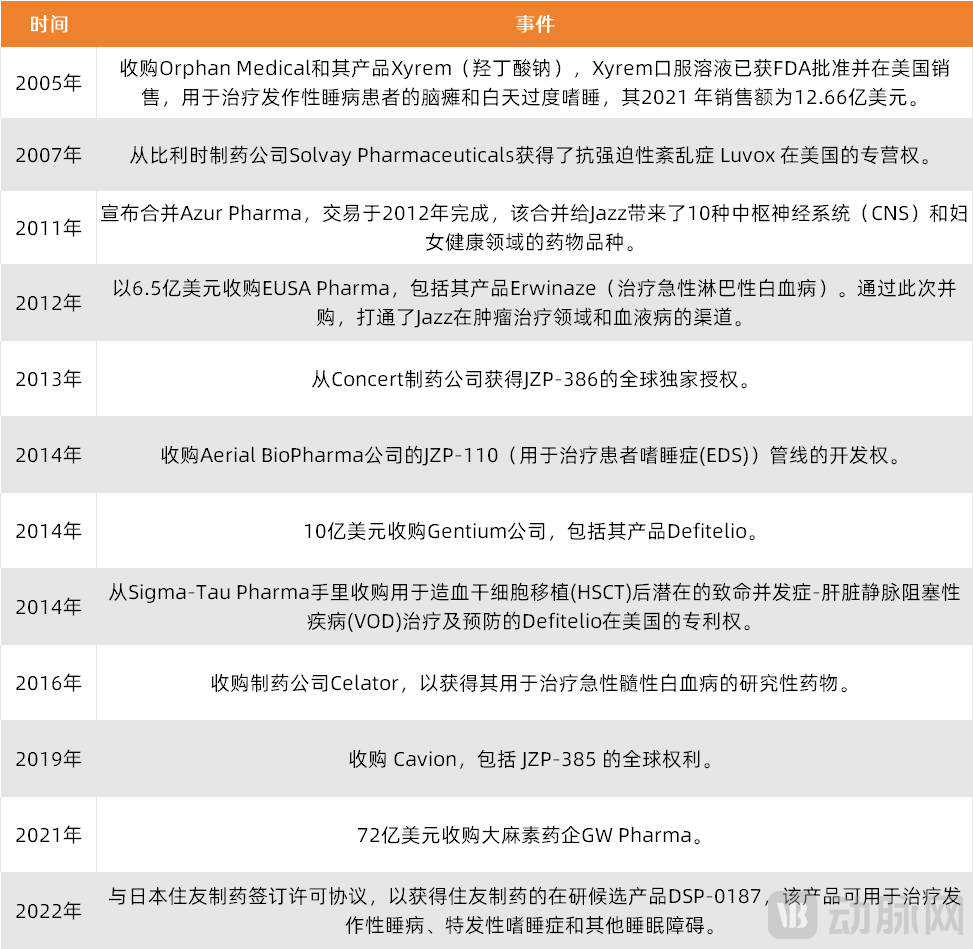 VCBeat New Medicine Chart, Data Source: Public Information
According to incomplete statistics, in addition to this collaboration, Jazz Pharmaceuticals has completed 12 acquisitions, mergers, and strategic partnerships of varying scales since its inception.Its flagship product, Xyrem (sodium oxybate) oral solution, was acquired through its 2005 purchase of Orphan Medical. In 2021, Jazz Pharmaceuticals’ $7.2 billion acquisition of GW Pharmaceuticals ranked third in the “Top 100 Pharma and Biotech Deals of 2021” published by the PharmaCompass team.
In the field of neurological therapeutics, in addition to the collaboration with Autifony Therapeutics valued at up to $770 million, Jazz Pharmaceuticals has also acquired numerous pipelines in this area in recent years.
The most recent instance occurred in May 2022, when Jazz Pharmaceuticals announced a licensing agreement with Sumitomo Pharma of Japan to obtain DSP-0187, an investigational candidate product from Sumitomo Pharma. DSP-0187 is a potent, highly selective oral orexin-2 receptor (OX2R) agonist for the treatment of narcolepsy, idiopathic hypersomnia, and other sleep disorders.
Under the terms of the agreement, Jazz Pharmaceuticals will pay Sumitomo Pharma an upfront payment of $50 million. Sumitomo is eligible to receive up to $1.09 billion in development, regulatory, and commercial milestone payments, as well as tiered royalties in the low double digits on future net sales of JZP441.
Jazz Pharmaceuticals’ continuous, substantial investments in neurological therapeutics underscore its strong confidence in this field. In fact, over the past few years, the complexity of the central nervous system indeed caused drug development progress in this area to lag behind that of other therapeutic fields. However, with the ongoing advancement and iteration of high-precision instruments, we now have the capability to study individual neurons and synapses, and basic research has reached a critical threshold for breakthroughs. Therefore, it is expected that in the near future, more neurological disorders will become amenable to effective pharmacological treatments.
Given Jazz Pharmaceuticals’ repeated success in acquisitions and mergers, as well as its aggressive expansion in the neuroscience field in recent years, it is expected that the company will launch another blockbuster product with annual sales exceeding $1 billion, beyond Xyrem, in the future.