

Domestic Medical Device Innovation Focuses on FDA Breakthrough Device Designation: Exclusive Interview with Dr. Mingdong Zhang, Former FDA CDRH Medical Officer
Driven by multiple factors, including favorable policies, improved demand quality, upgraded manufacturing capabilities, technological innovation, and capital infusion, the medical device industry has become the fastest-growing segment within the healthcare sector and one of the most favored investment hotspots in the capital market. According to data from Facts & Factors, the size of China’s medical device market reached approximately RMB 1.3 trillion in 2022, representing a year-on-year growth of 12%—roughly three times the global market growth rate. Accounting for more than one-third of the global market share, China ranks second only to the United States, firmly establishing itself as the world’s second-largest medical device market.
For investment institutions, accurately identifying the “genuine needs” of the market in the highly diversified medical device industry is a considerable challenge. This task is even more difficult for investors new to the medical device sector. Amidst numerous product categories, seizing the right opportunities is crucial. In addition to evaluating industry size, sustainable growth potential, and the caliber of founders and core teams, the most critical criteria for assessment are the innovativeness of core products, their disruptive potential in clinical applications, and the opportunity to achieve market leadership.
How to Identify “Innovative Doers”? How to Find High-Potential Innovative Medical Devices That Truly Meet Clinical Needs? VCBeat conducted an exclusive interview with Zhang Mingdong, former Medical Officer at the FDA’s Center for Devices and Radiological Health and Adjunct Professor at the School of Public Health, Fudan University. From the international perspective of regulatory approval and strategies for global expansion of innovations, he offers new insights and perspectives for the industry.

Dr. Zhang Mingdong
Dr. Zhang Mingdong is an expert in medical device regulation, corporate medical affairs, and clinical regulations. With extensive medical expertise and senior-level experience in medical device regulatory affairs, he has been deeply engaged in these fields for nearly 20 years. He recentlyChief Medical Officer for Boston Scientific Asia Pacific and Vice President of Medical Affairs and Health EconomicsRetired from his position. Prior to joining Boston Scientific, Dr. Zhang Mingdong served asGlobal Medical Director, Biosense Webster (Johnson & Johnson)andMedical Officer and Epidemiologist, Center for Devices and Radiological Health, U.S. Food and Drug Administration (FDA), with international leadership experience in medical device regulatory registration, healthcare venture capital investment, and commercial strategy. In addition, Dr. Zhang Mingdong previously served atProfessor at the Faculty of Medicine, The Chinese University of Hong Kong, and onThe U.S. National Institutes of Health (NIH) engages in academic and clinical research.Over an eight-year period, it has established academic influence, professional appeal, and business development capabilities on the international stage.
【FDA Breakthrough Device】
“Genuine Demand” Certified by Global Authoritative Regulatory Agencies
In the 1990s, innovative medical devices and drugs often reached the U.S. market later than they did in Europe. The U.S. Congress attributed this lag to the inefficient review process of the Food and Drug Administration (FDA), and the House of Representatives proposed stripping the FDA of its authority to review medical devices and establishing an independent third-party review body. To retain its regulatory authority, the FDA implemented a series of policy updates within its Center for Devices and Radiological Health (CDRH), which oversees medical device regulation, aiming to accelerate the approval and market entry of innovative medical devices.After more than three decades of development and multiple adjustments and adaptations to legislation, the CDRH issued the "Breakthrough Devices Program (BDP) Guidance" on December 18, 2018. This guidance aims to accelerate the development and review process, enabling patients with life-threatening and irreversible degenerative diseases to gain earlier access to innovative, safer new therapies and diagnostic methods.
Professor Zhang Mingdong pointed out that products granted “Breakthrough Device” designation must feature original, globally novel technologies and are expected to deliver significant clinical benefits to patients suffering from life-threatening or irreversible degenerative diseases. Furthermore, there must be no approved alternative products currently available on the market, or the device must demonstrate a potential for significant clinical advantages over existing technological solutions.
Not only can U.S. companies apply to leverage this pathway for accelerated market approval, but in recent years, approximately 20 leading domestic enterprises have also successfully obtained “Breakthrough Device” designation for their core products.”Certification.Among these, Professor Zhang Mingdong participated in guiding nine innovative products to obtain Breakthrough Device Designation, which he believes is a strong testament to China’s innovation capabilities in the medical device industry.

The FDA allows companies to submit an application for Breakthrough Device designation at any time prior to submitting a marketing application. This policy aims to accelerate the market entry of high-potential products; therefore, to some extent,Companies whose core products have received Breakthrough Device Designation inevitably possess significant innovation capabilities and market foresight within their respective fields. Seeking “Breakthrough Device” designation for innovative products is also a crucial strategy for commercialization, while simultaneously helping companies identify more overseas partners.
“Breakthrough Devices” Are More Than Just “Certification”
FDA Preferential Policies Safeguard Product Market Launch
The “Breakthrough Device” designation program aims to accelerate the market entry of products that address unmet clinical needs, thereby enabling patients to receive more effective and safer treatments in a timely manner. To this end, the FDA allocates upfront resources to these products, actively participates in their design and development processes, and provides early intervention and guidance on critical issues. These measures include timely interactive communication, balancing pre- and post-market clinical data, flexible and efficient clinical trial design, support from review teams, involvement of senior management, priority review, and expedited review of manufacturing quality systems within Premarket Approval (PMA) applications.
Moreover, to accelerate device market entry, the FDA balances premarket and postmarket data requirements by considering the use of interim endpoints or surrogate clinical endpoints, shifting certain premarket production inspections to postmarket inspections, and incorporating some postmarket requirements as part of conditional approvals.
Professor Zhang Mingdong explained that the FDA’s purpose in introducing these “preferential policies” is to accelerate product market entry, enabling faster clinical application and benefiting patients. However, the FDA’s criteria for “breakthrough devices””The market launch does not lower statutory standards and procedures, which is consistent with China’s requirements for innovative medical devices.For companies, receiving the FDA’s comprehensive “escort” provides strong support for accelerating product market entry, while earlier collaboration with regulatory agencies also gives companies a more certain growth path and profitability plan.
Pre-emptive Global Expansion Strategy
Exclusive Preferential Policy for Overseas Health Insurance Payments
For innovative products, obtaining regulatory approval is merely the first step, while commercialization remains the ultimate goal. “Breakthrough Devices”The exclusive medical insurance reimbursement policy can provide an “acceleration buff” for the overseas sales of domestically produced innovative products after their market launch.
The Centers for Medicare & Medicaid Services (CMS, hereinafter referred to as CMS) once addressed “breakthrough devices””Some attempts have been made to establish new Medicare payment pathways. On January 21, 2021, the “Medicare Coverage of Innovative Technology” (MCIT) rule (CMS-3372-P) was enacted, creating a new payment pathway to cover FDA-authorized and approved breakthrough devices for beneficiaries enrolled in Original Medicare (the only non-commercial insurance program in the United States). However, due to various reasons, CMS withdrew this rule in November of the same year.
On June 22, 2023, CMS once again released a draft for public comment on the “Transitional Coverage for Emerging Technologies (TCET) Pathway under Medicare,” which stated thatBreakthrough devices can undergo CMS Medicare coverage review concurrently with the FDA approval process; “Breakthrough Devices”Once approved by the FDA for market entry, the Centers for Medicare & Medicaid Services (CMS) may provide conditional reimbursement for the device. During this period, manufacturers can further gather health economics evidence; upon completion of the CMS approval process, permanent reimbursement can be secured. This policy is a preferential measure exclusively applicable to Breakthrough Devices. This unique reimbursement advantage serves as a true “accelerator” for the rapid commercial deployment of innovative medical devices following their international market launch. Professor Zhang Mingdong emphasizes that for innovative enterprises, incorporating overseas reimbursement considerations into product strategy from the outset is a prudent and necessary approach.
Case 1: A Global First, Device-Based Treatment for Pulmonary Hypertension
Even when cardiac function improves in many patients with heart failure, the risk of death remains high—a persistent challenge for countless cardiovascular specialists. A critical underlying condition that cannot be overlooked is pulmonary hypertension (PH).
A novel therapy for pulmonary hypertension, independently developed by the Chinese company Parma Medical, is a device-based product utilizing percutaneous pulmonary artery denervation (PADN). This vascular interventional ablation therapy works by using radiofrequency ablation to block the sympathetic nerves in the pulmonary vascular intima, thereby reducing pulmonary arterial pressure and slowing disease progression.
In February 2021, the PADN radiofrequency ablation catheter rapidly obtained FDA Breakthrough Device designation within 16 days, making its developer the first company in China to receive this designation in this field. As the first domestic medical device innovator to enter the Premarket Approval (PMA) review process after obtaining FDA Breakthrough Device designation, PADN technology and products will undergo the most rigorous clinical, regulatory, and product evaluations within the international medical regulatory system. This entails more in-depth and comprehensive product testing, including system testing, animal studies, and human clinical trials, to ensure that the product delivers a safer and more effective clinical treatment solution for pulmonary hypertension. This achievement will significantly enhance PADN’s global reputation and trust, helping PulmOne Medical to bring this original Chinese medical device to the world market and address more unmet clinical needs.
Case 2: Greater Benefits, Chinese Innovative Medical Devices for Treating Hypertension
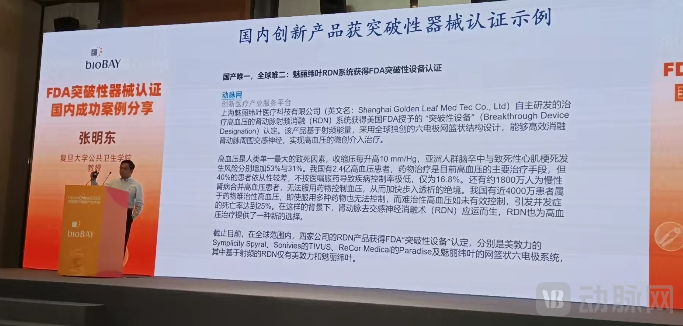
Hypertension is the most common cardiovascular disease and a major public health concern worldwide. In recent years, despite significant efforts to improve blood pressure control rates, these rates remain low. For some individuals, hypertension remains difficult to manage even with lifestyle modifications and pharmacological therapy. Furthermore, long-term medication adherence is often poor due to significant side effects. Consequently, device-based interventional therapies have been introduced for the treatment of hypertension.
Among these, the most extensively studied approach is catheter-based renal denervation (RDN), which works by interrupting afferent and efferent renal sympathetic nerve activity through the application of radiofrequency energy, ultrasound energy, or thermal injection into the perivascular space, thereby lowering blood pressure. Netrod, independently developed by Shanghai BRATTEA Medical Technology Co., Ltd.®Netrod Mesh Multi-electrode Renal Artery Radiofrequency Ablation System (hereinafter referred to as Netrod®system), featuring a three-dimensionally controllable expandable basket, independent six-electrode six-channel configuration, and four-quadrant continuous energy field, enabling multi-site, multi-point ablation, Netrod®- The results of the HTN study confirmed its efficacy and safety.
With Medtronic’s Symplicity Spyral being the first globally to receive Breakthrough Device designation,In 2021, the FDA approved BRATTEA's Netrod®System "Breakthrough Device"”Certification Approval Application. When similar products have already been approved, FDA approval tends to be more stringent; BRATTEA’s Netrod®The system received approval due to its independent innovation in RDN products.Netrod®The system’s proprietary basket-like structure enhances catheter flexibility, providing excellent wall apposition within blood vessels; the six electrodes are arranged in a 360-degree spiral pattern for comprehensive coverage, enabling more efficient ablation therapy.
Based on the advantages of product design, the FDA reasonably expects that this product can bring greater clinical benefits.This means that BRATTEA's Netrod®The system product design is innovative and leading globally. We believe that once the product is approved for market launch, its commercial value will become even more apparent.
Professor Zhang Mingdong mentioned, “Breakthrough Devices”For medical device companies, it serves as a litmus test; valuable innovative products receive “Breakthrough Device” designation.”Certification is not only an international honor but also provides reference and guidance for subsequent clinical trial design, global market layout, and sales strategies. For investment institutions, whether they possess "breakthrough device”Certification may serve as a credible label for identifying “top performers.”
*Netrod®The mesh multi-electrode renal artery radiofrequency ablation system has not yet been approved in China.