

Mindray's AI Journey in Ultrasound Imaging Bears Fruit with Breakthrough Resona A20 Launch

Mindray
Medical Device R&D Manufacturer
In recent years, medical AI has advanced rapidly, providing support in areas such as assisted diagnosis, personalized treatment, drug development, disease prediction, clinical decision support, process automation, and patient management. Particularly in the field of imaging-based assisted diagnosis, AI has become an indispensable tool for physicians interpreting static images from DR, CT, MRI, and other modalities.
Compared with the aforementioned imaging equipment, ultrasound boasts broader application scenarios and significantly higher prevalence. However, in contrast to the advancements of AI in CT, MRI, and even DR imaging, “Ultrasound + AI” clearly has substantial room for improvement and is widely recognized as an untapped “blue ocean” within the “Imaging + AI” landscape. The ultrasound industry has long been dedicated to R&D, striving to better integrate AI with ultrasound technology. These efforts have finally yielded a breakthrough: at the recently held “23rd National Ultrasound Medical Academic Conference of the Chinese Medical Association” in Haikou, Mindray, a leading domestic medical device manufacturer, unveiled its domestically produced ultra-high-end solution—the Kunlun Resona A20 ultra-high-end ultrasound system (hereinafter referred to as “Ultra-High-End A20”). Achieving multiple breakthroughs, this launch elevates “Ultrasound + AI” to an entirely new stage.
A Major Leap in Ultrasound Imaging
Wuji Acoustics Smart Platform Achieves First Productization of Adaptive Beamforming in Ultrasound Imaging
Since its inception in 1965, ultrasound equipment has undergone three technological revolutions, evolving from grayscale imaging to color Doppler, and now to contrast-enhanced ultrasound, with steadily improving image clarity and intelligence. Against the backdrop of multidisciplinary collaborative diagnosis and treatment, ultrasound imaging is becoming increasingly aligned with clinical practice and is seamlessly integrated with clinical departments such as surgery and internal medicine, earning it the reputation as the clinician’s “visual stethoscope.”
Nowadays, ultrasound equipment is achieving breakthroughs in functional imaging, integrated diagnosis and treatment, and artificial intelligence, and is on the verge of moving towardA New Round of Technological Breakthroughson the eve. As a leader in the ultrasound industry, Mindray has profound insights into the technological development of ultrasound. These insights have been refined through eight years of research and development for the ultra-high-end A20, achieving significant breakthroughs in multiple fields.
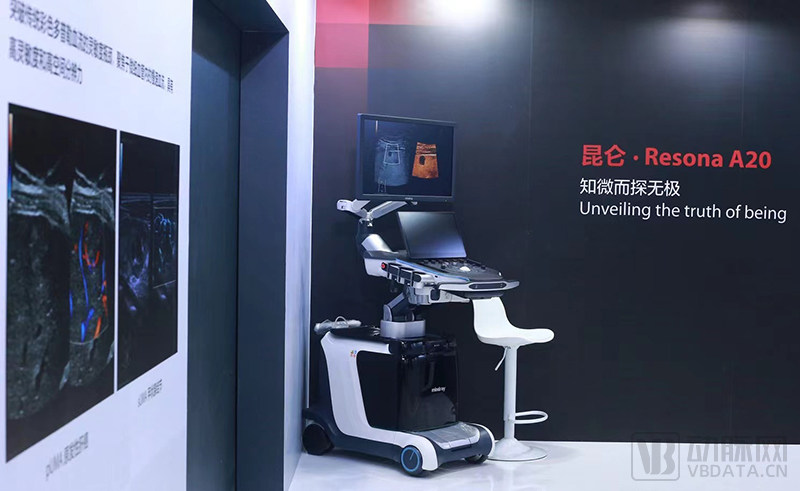
Mindray's Ultra-High-End Ultrasound System: Kunlun Resona A20
Wuji Acoustic Intelligence Platform (hereinafter referred to as: Wuji Platform) is the ultra-high-end A20'sCore Technology Platform, achieving major breakthroughs in the three foundational structures of ultrasound equipment: acoustic-electrical data, imaging algorithms, and system computing power.
In acquiring acoustic-electrical data, the Wujie platform has introduced a new AFM moment-energy probe and FreeWave transmit-receive technology. These technologies have comprehensively enhanced the signal quality of acoustic-electrical data, providing strong driving force for the Wujie platform.
The acquisition of high-quality acoustic-electrical data has always been the foundation for the evolution of ultrasound equipment, but how to effectively utilize this data and further integrate it with clinical practice requiresIntelligentBreakthroughs in Imaging Algorithms and System Computing Power. In terms of advancements in algorithms and computing power, the progress of the Wuji Platform is particularly noteworthy.
Especially in terms of algorithms, Mindray has introduced FreeBeam adaptive beamforming technology. This intelligent adaptive algorithm overcomes the traditional limitation of being unable to simultaneously optimize the main lobe and side lobes during beamforming. It enhances the main lobe to improve spatial resolution while suppressing side lobes. This not only improves image resolution but also enhances imaging across multiple modalities.
In fact, adaptive beamforming algorithms have long existed; the primary reason they were previously disfavored was their algorithmic complexity and prohibitively high computational requirements. Conventional algorithms require only about 0.2 TFLOPS (trillion floating-point operations per second), whereas the computational demand of adaptive beamforming algorithms exceeds that of conventional algorithms by40000Multiple-fold increase! Even GPUs with the most powerful computing capabilities in the industry are far from meeting its demands; using multiple cards in parallel or adopting more advanced acceleration cards may meet the requirements, but their costs and power consumption will be difficult to control. Undoubtedly, this algorithm is not commercially viable!
To address this issueTopic: The Wuji Platform adopts a dual-pronged approach combining software and hardware—by ingeniously reconstructing the intelligent adaptive beamforming algorithm at the software level and establishing a massively parallel computing architecture at the hardware level, thereby enabling the Wuji Platform to achieve adaptive beamforming for the first time.Achieving Productization of Ultrasound Imaging! Building on the ZST+ Domain Light Platform,Once again leading the industry forward by a generation in ultrasound beamforming technology.
This major breakthrough makes the newly released ultra-premium A20 not only a milestone product for Mindray, but also ensures that this technological platform evolution provides a wealth of innovative imaging tools for clinical academic research in ultrasound, thereby supporting the development of clinical disciplines and the high-quality development of public hospitals.
Mindray’s breakthrough progress in ultrasound AI was not achieved overnight, but rather stems from its years of accumulated expertise in AI imaging. From2009Since [year], Mindray has been exploring and attempting to integrate AI with its three major product lines—medical imaging, in vitro diagnostics, and patient monitoring & life support—and has achieved remarkable results in multiple application scenarios.
In the field of medical ultrasound imaging, Mindray has been deeply engaged in intelligent ultrasound technology for many years. With the recent launch of its ultra-premium A20 model, the company has already achieved industry-leading status in both the breadth of clinical applications and the performance of technical functionalities, thereby spearheading the development of intelligent ultrasound solutions.
Since the debut of the Smart OB automated obstetric measurement feature in the DC7 digital color Doppler ultrasound system in 2009, more than 40 intelligent ultrasound technologies have been successively launched across the fields of obstetrics and gynecology, radiology, and cardiovascular medicine. These include highly valued clinical features with strong market reputation, such as Smart Planes CNS and Smart Pelvic.
Furthermore, in the emerging field of point-of-care ultrasound (POCUS), AI has been integrated into the TE10/20 series ultrasound systems with the launch of Smart EchoVue for automatic cardiac structure recognition. This feature is the first ultrasound AI-based real-time standard plane recognition function in China to receive registration certification from the National Medical Products Administration (NMPA). It not only enhances the efficiency and quality control of cardiac ultrasound examinations but also helps beginners quickly master the scanning techniques for standard cardiac ultrasound planes.
In the field of AI-assisted diagnosis, Mindray is also pursuing regulatory registration for its intelligent auxiliary diagnosis technology for breast ultrasound lesions. This technology not only enables automatic localization and contouring of individual lesions but also integrates image processing and pattern recognition techniques to automatically identify BI-RADS features and assign classifications to detected lesions, thereby assisting physicians in clinical diagnosis and treatment.
Mindray's AI Applications in the Field of In Vitro DiagnosticsSimilarlyA Classic Case. As early as 2013, Mindray partnered with Tencent to explore the integration of AI with medical devices. After a decade of dedicated efforts, the collaboration between these two industry giants has finally borne fruit. In 2022, Mindray and Tencent jointly developed and launched an automated cell morphology analyzer (hereinafter referred to as the “Slide Reader”). By leveraging AI to clearly reconstruct the three-dimensional structures and details of cells, this device significantly improves the accuracy and overall efficiency of slide reading, breaking the monopoly of imported products and filling a domestic gap.
This successful collaboration has further solidified the partnership between Mindray and Tencent. On September 8, Mindray and Tencent Health entered into a strategic cooperation agreement at the 2023 Tencent Global Digital Ecosystem Conference. The two parties will engage in comprehensive collaboration on the digitalization of the medical device industry, exploring the application and implementation of large healthcare AI models in the fields of critical care and laboratory diagnostics.
As Mindray’s most mature business line in its product portfolio, Patient Monitoring & Life Support has integrated AI into the majority of its products. Leveraging this accumulated expertise, Mindray’s “Intelligent ICU Ventilator and Its Clinical Decision Support System” was successfully shortlisted in the 2022 Artificial Intelligence Medical Device Unveiling Project launched by the Ministry of Industry and Information Technology (MIIT).
AI primarily empowers this product line in two key areas: patient-ventilator synchrony and intelligent oxygen control. For instance, the SV series ventilators have incorporated AI through a feature known as Intelligent Patient-Ventilator Synchrony Technology. This function intelligently identifies the patient’s spontaneous breathing status based on multi-dimensional morphological characteristics of respiratory waveforms, automatically adjusts ventilation to match the patient’s breathing rhythm, and thereby improves patient-ventilator synchrony. In addition, the NB series neonatal ventilators are equipped with Intelligent Oxygen Control Technology, which automatically monitors the infant’s blood oxygen levels and intelligently adjusts the delivered oxygen concentration to maintain blood oxygen within a safe target range.
Building on its comprehensive portfolio of medical devices, Mindray has successively launched three smart healthcare solutions—“Ruiying Cloud++,” “Mindray Smart Lab,” and “Rui Zhilian” (collectively known as the “Sanrui” ecosystem)—which correspond to its three major product lines: medical imaging, in vitro diagnostics, and patient monitoring & life support.
Among these, “Ruiying Cloud++” focuses on imaging connectivity, supporting remote guidance, online consultations, branch hospital teaching, and multi-center research across departments, hospitals, and regions, thereby addressing urgent needs such as mutual recognition of test results and lean equipment management. “Mindray Smart Lab” is built upon its comprehensive portfolio of medical laboratory products, designed to meet the core demands of smart laboratory operations in hospitals—namely, quality improvement and efficiency enhancement, lean cost control, and homogeneous development—thereby providing end-to-end services for all key stages of the clinical laboratory workflow. “RuiZhiLian” integrates medical device data with clinical execution, covering intelligent hardware, Internet of Medical Things (IoMT), and data interoperability, while linking to intelligent applications such as clinical automation, intelligent decision support, and medical device management.
By strongly introducing AI empowerment into the three major production lines and the “Sanrui” ecosystem, Mindray is accelerating the R&D iteration of intelligent and informatized medical devices, establishing a benchmark for the digital upgrade of domestically produced medical equipment, thereby expanding into the global market.
When it comes to the future trends of medical devices, AI integration is inevitably one of the most significant trends. Centered on the core pain points and needs of the healthcare industry, AI-enabled medical devices have already spawned numerous innovative applications and scenarios, empowering the healthcare sector by enhancing the supply capacity of medical devices, optimizing diagnostic and treatment processes, and pioneering new medical approaches.
For China’s domestically produced medical device industry, artificial intelligence (AI) represents a brand-new opportunity. The sector currently faces challenges such as dependence on foreign entities for certain key manufacturing processes and relatively low levels of complete-unit manufacturing capability. There is an urgent need to leverage next-generation information and communication technologies, including AI, to drive intelligent and digital transformation, accelerate product upgrades and performance enhancements, and thereby create leapfrog development opportunities for the medical device industry.
As a representative of domestically produced medical devices, Mindray has long adhered to a clinical-need-oriented approach, driving technological advancements and product iterations through integrated innovation involving industry, academia, research, and clinical practice. In response to the new industry opportunities presented by AI technology, Mindray is actively collaborating with enterprises and hospitals to explore the application of new technologies, thereby leading industry development. From launching digital slide scanners last year to fill a domestic gap, to now initiating the fourth ultrasound technology revolution with the ultra-high-end A20 system, Mindray’s path in AI is becoming increasingly broad.
References:
Wen Kun, Shenzhen Special Zone Daily: “Mindray and Tencent Join Forces Across Industries for the First Time to Set a Benchmark for ‘Healthcare + AI’ Integrated Innovation—Intelligent ‘Slide Reader’ Fills a Domestic Gap”
Jin Zhe, National Business Daily: “Li Xinsheng, VP of R&D at Mindray: Healthcare Is the Most Viable Field for AI Implementation; We Hope Large Language Models Can Free Up Doctors to Focus More on Clinical Care”