

Who Can Solve the Medical Poverty Alleviation Challenge in Mountainous Townships? Zhongmai's Innovative Digital Solution Bridges the Rural Healthcare Gap

Tencent
Internet Comprehensive Service Provider
Xima Town in northern Qiannan, although less than 60 kilometers from the provincial capital Guiyang, has seen the majority of its young population drawn away by the siphon effect of major cities. Left-behind elderly residents and some pre-school-aged children now constitute the town’s primary population.
Under the overarching strategy of rural revitalization, residents in the town are not affluent but enjoy basic security in food and clothing. The most pressing challenge lies in healthcare. With an aging population, there is a rising prevalence of complex and refractory conditions that often exceed the management capabilities of physicians at the town health center. It is only during outreach clinics and training sessions conducted by specialists from major hospitals that patients can receive thorough interpretations of their prior test results and obtain more precise medical recommendations.
However, the mere handful of on-site assistance visits conducted within a year cannot address the thousands of diagnostic and treatment needs, nor can township doctors systematically improve their clinical capabilities through this approach.
It was not until a few months ago, when several pieces of specialized equipment arrived, that the medical situation in Xima Town saw a turning point.
At the end of 2015, as the “battle against poverty” was just being launched, the Qiannan Buyi and Miao Autonomous Prefecture in Guizhou Province had already devised a series of poverty alleviation plans. Among these, healthcare-related poverty alleviation has consistently been the most challenging issue for Qiannan. Due to the fact that numerous counties and towns are located in mountainous areas with inconvenient transportation, residents there have largely faced difficulties characterized by “long distances to seek medical care” and “limited access to medical services.”
Emerging telemedicine was once hailed as a beacon of hope for breaking the impasse in primary healthcare across Qiannan. Ideally, by leveraging the internet to bridge the geographical gap between tertiary and primary care institutions, it enables grassroots medical providers to bring specialist expertise “face-to-face” to patients’ bedsides.
However, building a channel to connect medical institutions at different levels is not easy. Each medical institution is like an isolated information island. Simply achieving interoperability of medical data between different institutions requires a thorough overhaul of the internal information systems of hospitals in accordance with unified national standards. To reach Level 5 of the national interoperability standard, the investment for a single county-level hospital would exceed RMB 50 million. Such costs are far beyond what ordinary county-level institutions can afford.
Witnessing this demand, Zhongmai and Tencent, both Shenzhen-based enterprises, approached the Qiannan Prefecture Health Commission with their proposed solution for tiered diagnosis and treatment in primary healthcare. During the initial negotiations, Lin Ziniu, Chairman of Shenzhen Zhongmai, summarized the proposal into two core points.
First, dedicated terminals must be developed for primary healthcare institutions; second, the cost of information services must be reduced.
According to Lin Ziniu, the significance of dedicated terminals lies in bypassing the complex interfaces of various hospitals. With the support of Tencent’s blockchain technology, hospitals only need to deploy Zhongmai’s terminals and establish a single interface between the terminal and the backend server. Thereafter, they will no longer need to pay for interface integration; instead, they can simply modify smart contracts on the respective blockchains on both ends.
In other words, a single API enables on-demand transmission of medical data and services, allowing for instant access upon delivery and immediate withdrawal after retrieval.
This model has also played a disruptive role in cost control. With the elimination of expensive system upgrades and interface fees, the primary cost component of the Zhongmai solution is reduced to just the dedicated terminal hardware. As a result, what would have been tens of millions of yuan in medical TI transformation costs has been drastically compressed to merely 100,000 yuan.
Faced with the numerous advantages offered by the “dedicated devices + blockchain” model, the Qiannan Prefecture Health Commission ultimately decided to select Longli County as a pilot site for Shenzhen Zhongmai. Over the following eight years, Zhongmai continuously refined its software and hardware applications, gradually establishing trusted, controllable, end-to-end, peer-to-peer medical data connections among healthcare institutions at all levels.
Currently, the digital tiered diagnosis and treatment system in Longli County covers 18 clinical departments across three county-level hospitals, 15 township health centers, 52 administrative villages, and 83 village clinics, benefiting over 100,000 patient visits. This system has effectively simplified healthcare access for residents at the grassroots level, reduced medical costs, and facilitated the establishment of a county-level medical institution development model known as the “Qiannan Model,” which is driven by provincial initiatives, features coordinated efforts across different administrative levels, and promotes progressive leadership.
In the first half of this year, Xima Town Central Health Center, under the jurisdiction of Longli County, also began using Zhongmai’s specialized equipment. During an on-site visit, a physician at the town health center told us, “In the past, we were hesitant to treat complex and difficult cases, often having to defer care or refer patients to higher-level hospitals. However, there were instances where patients with seemingly mild conditions required treatment at tertiary hospitals, while those presenting with apparently critical symptoms were actually within our scope of practice.”
“With specialized equipment now in place, we can seek assistance from Longli County People’s Hospital at any time. On busy days, we conduct more than ten remote consultations daily. During these consultations, physicians at the county hospital can directly access patients’ medical records, imaging reports, and laboratory test results. We learn by observing their explanations, and many of our physicians have shown significant improvement in their clinical skills over the past six months. As a result, residents in the county are increasingly trusting our diagnoses.”
Another doctor highlighted the convenience of the equipment. “In theory, each department should be equipped with a dedicated device. However, the patient volume in our township is not as high as that in county-level hospitals, and the Health Commission lacks the budget to purchase many such units. Fortunately, the dedicated devices are fitted with casters, allowing us to wheel them to whichever department has need. This has indeed helped lower our costs.”
Although the introduction of Zhongmai’s specialized equipment has effectively advanced tiered diagnosis and treatment across multiple medical institutions under Longli County, numerous clinical and non-clinical challenges remain within this complex healthcare system, requiring coordinated efforts from various stakeholders. These include how to quantify the value of services provided by tertiary hospitals to primary care facilities, thereby ensuring the enthusiasm and sustainability of vertical collaboration; and how to help primary care institutions avoid the “siphon effect” exerted by tertiary hospitals, so as to build their own independent medical capabilities.
Recently, to further promote the tiered diagnosis and treatment system and implement the guiding principle of “keeping serious diseases within the province, resolving common illnesses at the city and county levels, and managing everyday health issues at the grassroots level, thereby providing reliable safeguards for public health,” The First Affiliated Hospital of Sun Yat-sen University Guizhou Hospital has stepped in. Leveraging its leading role as a National Regional Medical Center and its specialized strengths, it has officially signed the “Strategic Cooperation Agreement on Digital Tiered Diagnosis and Treatment” with the Qiannan Prefecture Health Commission and Zhongmai Digital. With the overarching goals of “strengthening disciplines, mentoring talent, transferring technology, and assisting in management,” the partnership aims to provide sustained support for routine remote healthcare services while integrating the hospital’s high-quality specialized resources to enhance medical service capabilities across the entire prefecture through radiating influence and driven development.
Throughout this process, the collaboration will leverage the digital tiered medical education system jointly established by China Medical and Tencent. The teaching assistance provided by The First Affiliated Hospital of Sun Yat-sen University Guizhou Hospital to Qiannan Prefecture will be upgraded from traditional annual offline teaching sessions and free clinics to weekly online teaching rounds and remote case-based discussions. This transformation will institutionalize medical assistance, connecting doctors and patients in remote areas with the most advanced healthcare systems.
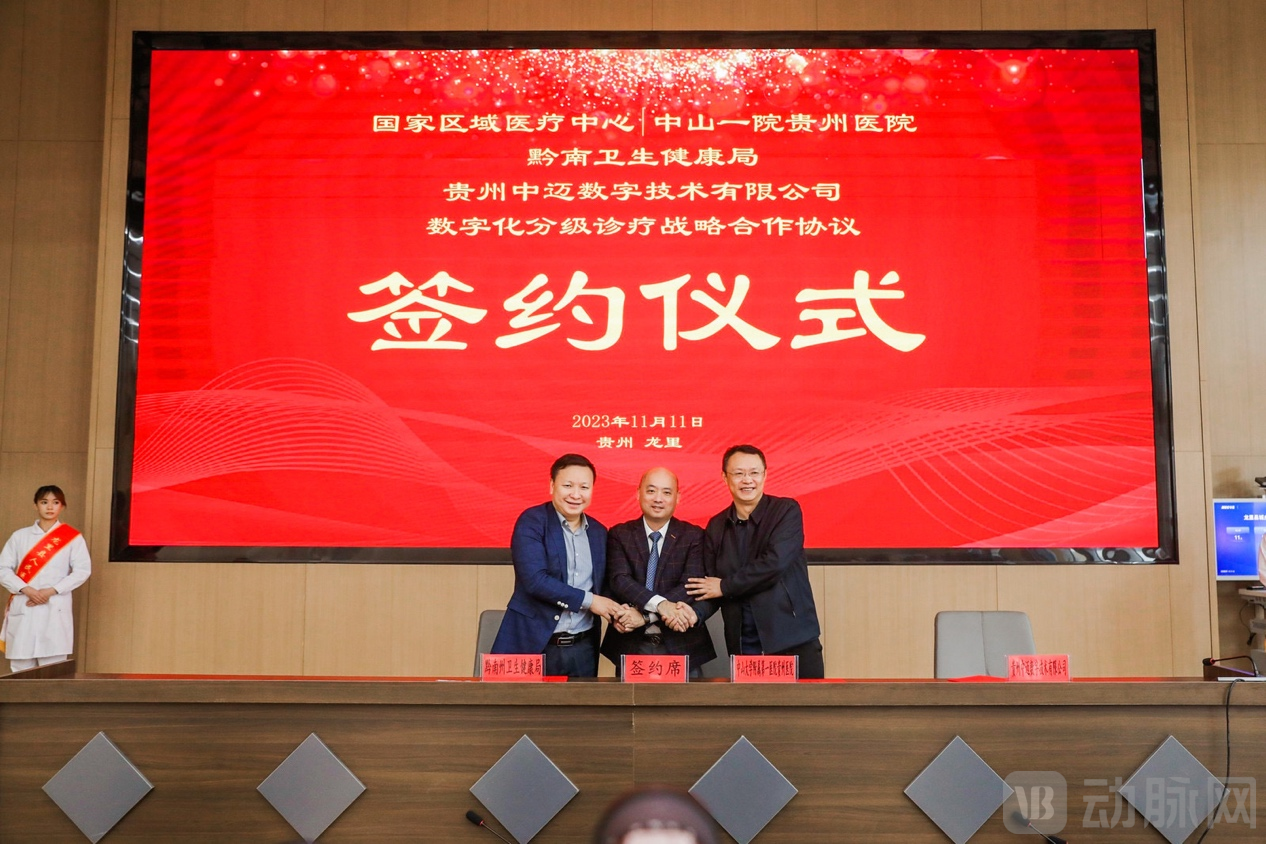
The First Affiliated Hospital of Sun Yat-sen University Guizhou Hospital, Qiannan Prefecture Health Commission, and Zhongmai Digital Officially Sign Agreement
In the third quarter of this year, the Office of the Leading Group for Deepening the Reform of the Medical and Healthcare System of Qiannan Prefecture issued the “Implementation Plan for the Construction of a Digital Tiered Diagnosis and Treatment System in Qiannan Prefecture.” The plan states that efforts will be made to fully establish, by the end of 2025, a digital tiered diagnosis and treatment service model across the prefecture, supported by digitalization, featuring vertical flow and seamless integration of high-quality medical resources between upper- and lower-level institutions. The aim is to achieve a local consultation rate of over 90% within county-level jurisdictions, thereby further meeting the demand of Qiannan Prefecture’s residents for high-quality medical and health services.
With Longli County serving as a precedent and the entry of Grade 3A hospitals, the implementation of tiered diagnosis and treatment in Qiannan Buyi and Miao Autonomous Prefecture may prove more thorough than originally planned.