

Fasikl Submits IPO Prospectus: Pioneering NeuroAI Firm with Dual FDA Breakthrough Designations and Top-Tier Human Implant Data Advances Commercialization

Fasikl
Neural AI Technology Developer
Three years ago, after Musk announced the latest progress in Neuralink’s brain-computer interface (BCI) technology, discussions about “brain-computer interfaces” flooded social media feeds, bringing BCI technology into the public eye.
Although this appears to be a pivotal turning point for brain-computer interfaces, the first human neuroprosthetic devices actually emerged as early as the mid-1990s. Driven by advances in technology and research methodologies, along with ongoing policy initiatives, a series of revolutionary innovations are also brewing worldwide.
On October 22, 2020, the team led by Zhi Yang from the Department of Biomedical Engineering at the University of Minnesota, Twin Cities, published their latest research findings in the Journal of Neural Engineering, in a paper titled “A bioelectric neural interface towards intuitive prosthetic control for amputees.”
Unlike Neuralink, which employs implanted microelectrode arrays in the brain for cortical decoding, Yang Zhi’s team has innovatively integrated implantable intrafascicular microelectrodes, neural chipsets, and artificial intelligence to develop a next-generation bioelectric neural interface technology platform. This platform connects peripheral nerves via microchip electrodes, enabling signal capture at the nerve fiber level and allowing patients to control fine motor movements of prosthetic limbs with dexterity and intuition through voluntary intent. This breakthrough successfully explores an innovative pathway for establishing new information channels between human thought and machines, making non-craniotomy, minimally invasive, and low-infection-risk “human-machine symbiosis” possible.
Currently, the team has not only established Fasikl in the United States and set up a branch in Hangzhou to commercialize ten years of laboratory research achievements, but also built two major technology platforms: wearable AI and brain-computer interface (BCI), to rapidly advance product commercialization. Based on the wearable AI technology platform, Fasikl has developed the Felix NeuroAI wristband, which can provide all-day relief for Essential Tremor (ET) and Parkinson’s Disease (PD). Leveraging its BCI platform, Fasikl has created the world’s only minimally invasive Peripheral Nervous System (PNS) implantable system that supports device control via free will, thereby promoting the integration of the human brain with computer networks.
Notably, Fasikl’s implantable system (the MindForce Nerve-Computer Interface system, NCI) has received two FDA Breakthrough Therapy designations. This October, the product was further selected for the FDA’s Total Product Life Cycle Advisory Program (TAP), accelerating its clinical trials and commercial expansion.
For Fasikl, the inclusion of its NCI implantable system in the TAP program marks a significant milestone following its receipt of the FDA Breakthrough Device Designation.
As a key initiative by the FDA this year to promote the implementation of frontier innovations in medical devices, the TAP program will bring numerous benefits to accelerate the market launch of products from medical device manufacturers. In simple terms, through this program, the FDA will provide diverse strategic assistance to medical device manufacturers, thereby ensuring that patients in the United States are among the first globally to access high-quality, safe, effective, and innovative medical devices in the coming years.
However, certain entry thresholds must be met to be included in the program.
The FDA will prioritize innovative devices that treat life-threatening conditions or those likely to cause permanent impairment of bodily functions, where adequate alternatives are lacking or significant risks exist, and which may have a substantial impact on clinical practice or public health. It also prioritizes devices that benefit patients with rare diseases or pediatric populations. Subsequently, these devices must undergo rigorous evaluation and approval processes to ensure their safety and efficacy. This imposes high demands on companies’ original innovation capabilities, product development competencies, and other aspects. As a result, as of November this year, only 15 devices in the United States have been selected for the Technology Access Program (TAP), with Fasikl’s NCI implantable system being the sole device in the brain-computer interface field to be included.
Following the inclusion of Fasikl’s NCI implantable system in the TAP program, the clinical trial and approval processes for the company’s products will be significantly accelerated. During implementation, in addition to facilitating device development and review, providing strategic decision-making support throughout the development process, and improving the efficiency of premarket review, the FDA will also enhance premarket communications and engagement. Specifically, the FDA will act as an intermediary to connect TAP-listed devices with insurance providers and facilitate hospital sales channels, while increasing product promotion efforts, thereby laying the foundation for large-scale commercialization in the future.
Last year, the field of artificial intelligence witnessed a surge of interest in returning to neuroscience. Dozens of scientists, including Bengio and LeCun, have called for increased investment in foundational research on NeuroAI, regarding neuroscience as a key driver catalyzing the next revolution in artificial intelligence.
However, the Fasikl team had already begun in-depth research in the field of neuro-AI a decade ago and has successfully achieved the translation of its scientific achievements in recent years.
With extensive experience in the neural AI chip industry, the Fasikl team boasts a composite background combining “industry and academia.” Its members include professors and scholars from renowned universities in China and the United States, specializing in biomedical science, computer science, electronics, materials science, neurology, and neurosurgery. To date, the team has published over 300 papers, including more than 50 articles in international academic journals and conferences as well as patents, with citations exceeding 10,000. After more than a decade of exploration and accumulation, Fasikl has ranked among the top three globally in terms of volume of human-implanted chip data (100 TB of neural big data). By successfully integrating implantable intrafascicular microelectrodes, neural chipsets, and AI, Fasikl has developed a new-generation bioelectric neural interface technology platform that enables intelligent neuromodulation, making significant contributions to the advancement of the global neural AI field.
The Felix NeuroAI wristband is the world’s first AI-powered neuromodulation product independently developed by Fasikl, leveraging its extensive research expertise. This device provides round-the-clock relief from essential tremor (ET) and Parkinson’s disease (PD) through electrical stimulation, addressing the global challenge of non-invasive or minimally invasive treatment for neurological disorders.
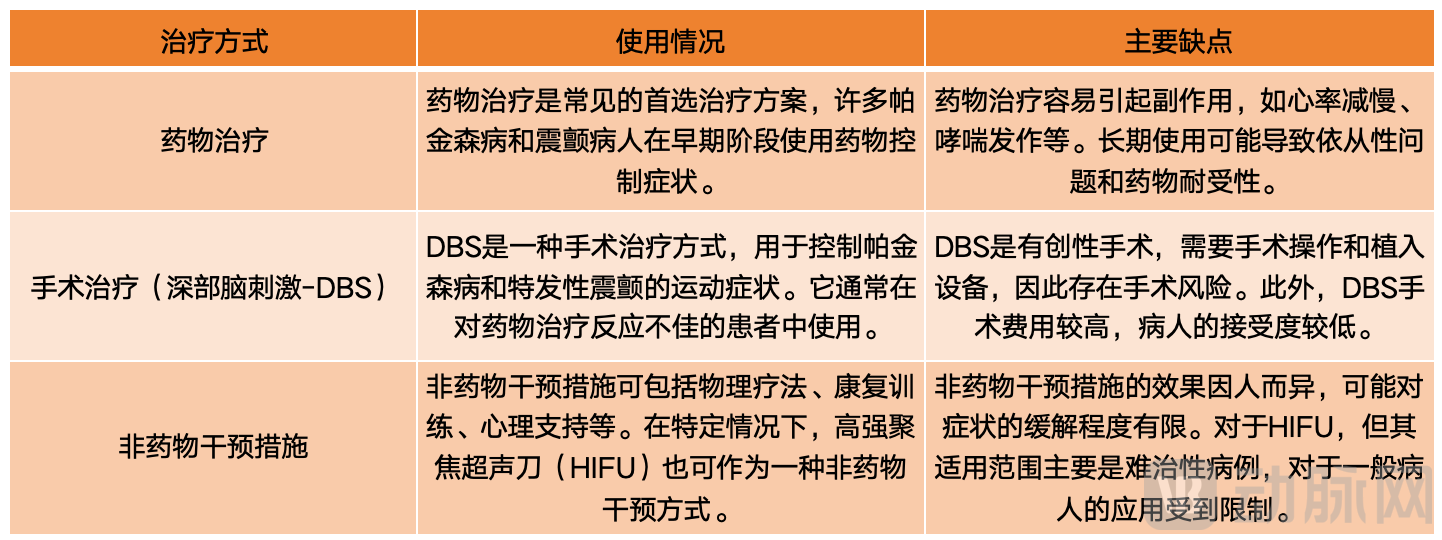
Primary Treatment Modalities and Their Limitations for Essential Tremor (ET) and Parkinson’s Disease (PD)
According to the "White Paper on Tremor Patients in China," essential tremor, as one of the most common movement disorders in clinical practice, has an incidence rate of 0.9% in the general population. In China, the number of patients with essential tremor exceeds 10 million. Meanwhile, Parkinson's disease is the second most common neurodegenerative disease globally. Academic projections indicate that by 2030, the number of Parkinson's disease patients in China alone may reach 4.9 million, accounting for 57% of the global total.
In the future, as population aging progresses, the number of patients with conditions such as essential tremor and Parkinson’s disease will continue to rise. Based on 2021 demographic data, it is estimated that China alone has more than 8.7 million patients with essential tremor and over 3 million patients with Parkinson’s disease among individuals aged 65 and older; globally, the patient population is even larger. However, current treatment modalities for Parkinson’s disease primarily consist of pharmacological therapy, surgical interventions, and non-pharmacological measures. All these approaches have certain drawbacks or limitations.
Encouragingly, the Felix NeuroAI wristband, independently developed by Fasikl, has entered Phase II clinical trials and is poised to commence confirmatory clinical trials, with complete patient enrollment scheduled by the end of July next year. The product is expected to launch first in the United States and China in 2025. According to projections by Tan Zhen Capital, if the NeuroAI wristband demonstrates superior efficacy compared to pharmacological therapy and is incorporated into treatment guidelines, its penetration rate could exceed 30%, corresponding to a market value surpassing $10 billion.
In the future, driven by the trend of population aging, the field of neuromodulation is bound to see greater growth potential. Fasikl, with its focus on the intersection of neuromodulation and AI, will leverage its core technologies to expand clinical applications for more products.
As the only company in the world with nerve-fiber-level data acquisition capabilities and the ability to embed AI technology into neuromodulation products based on real human data, Fasikl has also developed technology that enables amputees to control prosthetic limbs dexterously and intuitively.
Leveraging neural chipsets with ultra-low noise characteristics, the minimally invasive PNS implantable system can acquire large-scale, high-quality neural data along with corresponding neural intent labels (such as fist clenching and finger flexion), record them, and subsequently decode the electroneurograms using an artificial intelligence model based on recurrent neural networks (RNN).
Through use, individuals can learn to make their intentions more comprehensible to AI, while AI, by analyzing data, may gain a more accurate understanding of human intent. This trend toward generalized human-AI interaction is evident; for instance, humans and AI working together enable users to play StarCraft or virtual reality games directly via computer—without keyboards or mice—at near-expert levels.
For prosthetic limb control, Fasikl not only increases the degrees of freedom from 3–6 to 17 and enables stable decoding of patients’ motor intentions over 15,000 hours, but also achieves near real-time decoding of amputees’ neural intentions. This allows amputees to control their prostheses naturally and effortlessly through thought, addressing key pain points of commercially available prosthetics, such as insufficient degrees of freedom and limited grip patterns.
Furthermore, by employing real-time electrical stimulation artifact removal algorithms and dynamic stimulation parameter modulation techniques, the team enabled patients to perceive the robotic hand and its spatial position, as well as the shape of objects touched by the hand. Patients were able to discriminate weight differences as small as 10 grams and distinguish object stiffness, while also experiencing significant pain relief during long-term treatment.
Currently, Fasikl’s brain-computer interface technology has been successfully applied to control robotic arms or computers and to treat post-amputation pain, following its receipt of the FDA Breakthrough Device Designation. After the successful completion of pivotal Investigational Device Exemption (IDE) trials, the company will continue to expand its indications to include refractory chronic pain, neural control of prosthetic limbs, and other conditions amenable to neuromodulation therapy, such as diabetes, hypertension, depression, heart failure, epilepsy, overactive bladder, and sleep apnea.
An ideal brain-computer interface (BCI) can not only help researchers collect neuronal signals but also encode specific instructions and transmit them to other parts of the body through the BCI, assisting the brain in completing signal output. However, at least four processes are required to achieve this: signal acquisition – signal decoding – re-encoding – feedback.
These four processes appear deceptively simple, yet in reality, they are as difficult as scaling the heavens. Merely the first step—“signal acquisition”—has stymied a vast number of researchers. After all, the human brain contains nearly 100 billion neurons, and there are 19 layers separating the outermost surface of the head from the interior of the skull. Furthermore, between the skull and the brain lie tissues such as the dura mater, arachnoid mater, and arachnoid trabeculae. Overcoming these substantial barriers to achieve precise signal collection remains fraught with significant challenges.
For example, non-invasive brain-computer interfaces (BCIs), with electrodes and sensors placed on the scalp surface, offer advantages such as being non-invasive and low-cost; however, the signals acquired are weak and contain limited information, making subsequent decoding challenging. In contrast, invasive BCI products require the implantation of electrodes and chips into the human brain, which not only carries the risk of surgical trauma but also necessitates addressing long-term safety concerns associated with intracranial implants.
Fasikl pioneers neural AI technology by targeting the peripheral nervous system, ensuring patient safety during surgery through electrode implantation in the arm. Meanwhile, its self-developed high-precision brain-computer interface (BCI) chip features automatic kT/C noise cancellation, signal channel separation, and frequency shaping technologies, enabling precise and stable reading of microvolt-level signals with stable sources and high information capacity. According to Fasikl’s research data, compared to Neuralink’s chip, this chip reduces input noise by approximately 75% and expands the dynamic range by an additional 20-fold.
Furthermore, Fasikl employs redundant cross-linking and automatic residual charge correction technologies to prevent pathological changes in surrounding cellular tissues under long-term stimulation, thereby ensuring human safety. This truly realizes a non-craniotomy, minimally invasive, and low-infection-risk approach to brain-computer interface technology.
We believe that in the future, with the continuous advancement of artificial intelligence and neuroscience technologies, along with explorations by companies such as Fasikl, true “human-machine symbiosis” will become a reality. As these technologies become more widely accessible, they will provide greater assistance to patients.