

Commercial CSO Emerges as Biotech's Breakthrough Force Amid Capital Winter

Baheal Medical
Health Brand Commercialization Platform
How New Drugs with Substantial R&D Investment Reach Frontline Patients Has Become a Common Challenge for Pharmaceutical Companies.
As the capital winter sets in, market attention has shifted from whether drugs can be successfully developed to whether they can be rapidly commercialized and generate substantial returns after launch. While a large number of new drugs are queuing up for market approval, pharmaceutical companies are struggling with the commercialization process.
Over the past decade, the CXO industry—represented by technical outsourcing services such as CROs and CDMOs—was fueled by pharmaceutical companies’ fervent R&D demand. However, order volumes are now beginning to decline, and growth is slowing. In the latest Q3 financial reports, the CXO sector witnessed a collective slowdown. Against this backdrop, one company achieved a 49% year-on-year increase in its Q3 net profit.
Baheal Medical, a leading commercial CSO, achieved counter-trend growth in both performance and stock price during this downturn, presenting pharmaceutical contract sales organizations (CSOs) with an opportunity to realize their intrinsic value.
Although CSOs belong to the same CXO industry, their development momentum has been significantly weaker than that of CROs and CDMOs over the years.
The CXO sector has long been a favorite among investors, hailed within the industry as the “water sellers.” By providing services across every stage—from R&D and manufacturing to clinical trials—CXOs enjoy stable growth rates. They collect fees regardless of whether drug development ultimately succeeds, with profitability increasing at later stages.
Particularly with the launch of China’s pharmaceutical industry reforms in 2015, rising domestic demand for innovative drugs, strengthened policy support, and enhanced R&D capabilities of pharmaceutical companies, China’s investment in new drug research and development has continued to grow. Leveraging extensive international experience, advantages in human resources, and the trend of global supply chains shifting to China, the Chinese CXO (Contract Research, Development, and Manufacturing) industry has entered a golden age of development. CXO companies represented by WuXi AppTec, Pharmaron, and Tigermed have entered a phase of rapid growth.
Over the past few years, particularly during the pandemic, there has been a surge in demand for the research and development of vaccines and various pharmaceuticals. The performance growth rates of CXO companies have generally started at triple digits, suggesting that fluctuations in downstream industries seem unable to hinder the relentless momentum of the CXO sector.
It is CROs and CMO/CDMOs, represented by technology services, that have played the vanguard role in this wave of advancement, while CSOs, which primarily provide commercial services, have not ridden this wave.
No industry can grow indefinitely, and the CXO sector is no exception.
As the capital winter sets in, biotech companies facing layoffs, mergers and acquisitions, and bankruptcy have become commonplace. However, there is a certain lag in the transmission of this chill from the downstream to the upstream CXO sector, meaning that the full impact of the cold snap originating around 2022 has only become apparent this year. If the CXO industry already showed signs of decline in the first half of the year, its performance growth rate began to slow further in the third quarter.
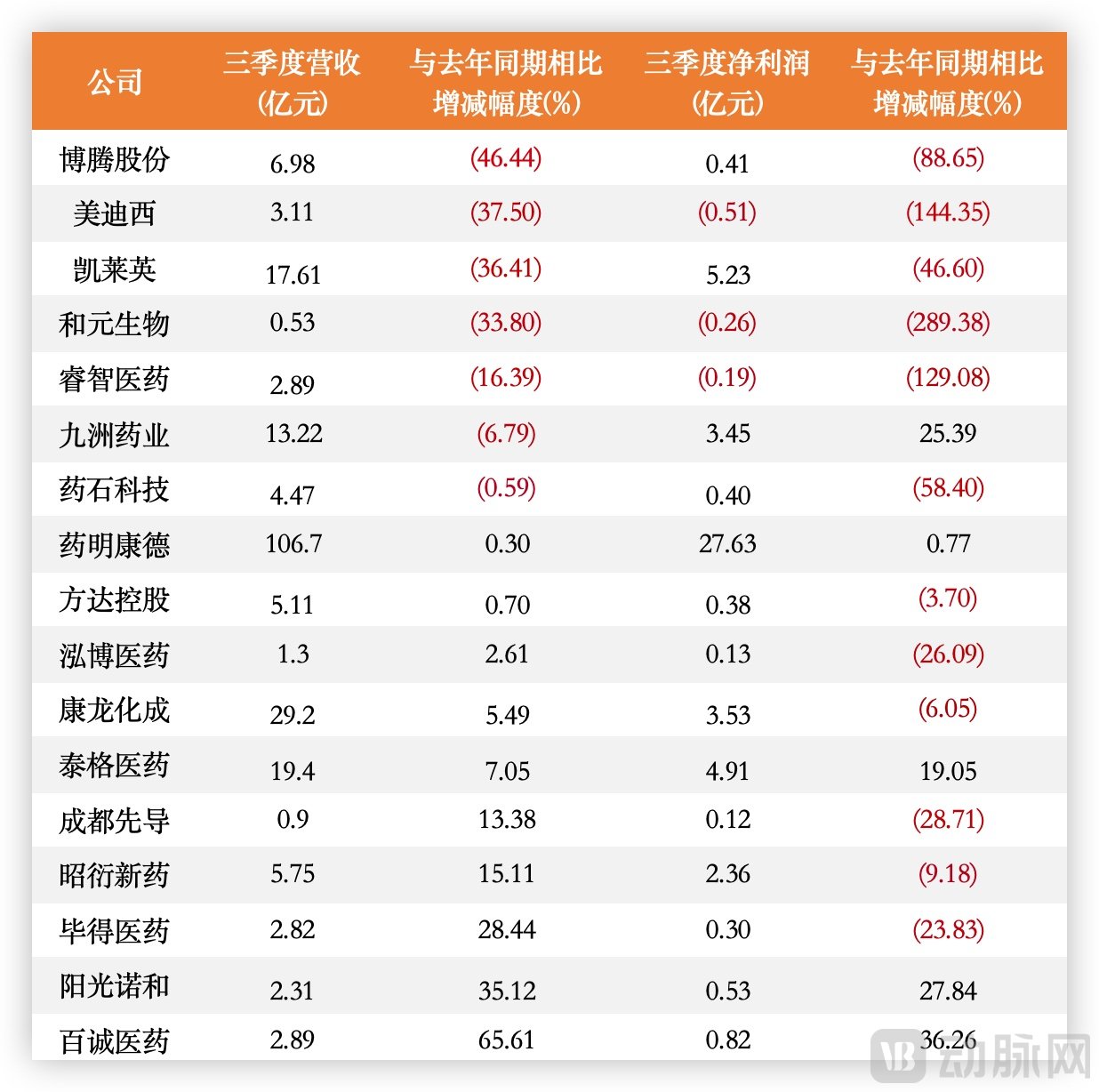
Q3 Revenue of Select CXO Companies, Sourced from Financial Reports
In the Q3 financial reports of dozens of A-share and Hong Kong-listed CXO companies, the overall average revenue growth rate was only slightly above 10%, with several companies experiencing negative revenue growth. The situation is equally concerning when examining net profit data. The average net profit growth rate for the CXO sector has begun to decline, with more than 10 companies reporting negative net profit growth, and the average profit decline among 20 companies exceeding 19%.
Specifically, leading CXO companies are still able to maintain a certain growth rate by relying on overseas orders, while small and medium-sized CXO companies, whose primary order sources are domestic innovative pharmaceutical enterprises, are experiencing a rapid decline in performance.
According to data from VCBeat, domestic healthcare financing in China fell by 57% and 23% in the first and second quarters of this year, respectively, with biopharmaceutical financing yet to recover. In this context, pharmaceutical companies’ risk appetite has naturally become more conservative. Taking CRO orders as an example, pharmaceutical companies are tilting resources toward later-stage clinical projects during this period, while higher-risk early-stage clinical projects may be temporarily put on hold.
As this wave subsides, innovative drugs that have emerged from the intense market consolidation are entering the commercialization phase, and pharmaceutical companies’ needs are beginning to shift subtly.
Like CROs and CDMOs, the rise of CSOs is also inseparable from the increasing specialization of labor.
For pharmaceutical companies, their development history is essentially a history of product pipeline iteration, which is often accompanied by significant uncertainty. Decision-making for an innovative drug project inevitably carries substantial risks, both for the project itself and for the decision-makers. Consequently, the entire pharmaceutical industry ecosystem is increasingly moving towards specialized division of labor and collaboration.
Large companies, leveraging years of accumulated experience and mature commercial operational systems, acquire projects through mergers and acquisitions or business development (BD) partnerships, and then monetize them through their commercialization capabilities. This ecosystem, characterized by centralized commercial operations and decentralized innovation, provides larger companies with greater certainty while offering smaller companies more opportunities for growth. Years of practical operation have validated the effectiveness of this industrial division of labor.
As domestic innovative pharmaceutical companies complete their R&D cycles and sequentially enter the commercialization phase, higher demands are being placed on their corporate capabilities.
On the one hand, influenced by policy, once new drugs successfully pass negotiations for inclusion in the National Reimbursement Drug List (NRDL), they gain immediate access to the nationwide market in China, entering a phase of rapid volume expansion. Historically, in international markets, it typically takes about 8 to 10 years for a drug to reach peak sales from its launch. However, the advancement of the dynamic adjustment mechanism for the NRDL has accelerated this process in the domestic market. Consequently, the sales curve of a drug’s lifecycle has become steeper, with earlier stages holding greater value.
This means that the sales of innovative drugs have entered a state characterized by low tolerance for error, an earlier peak period, and a higher rate of decline; it also implies that pharmaceutical companies have less room for their sales teams to adapt, experiment, and refine their strategies, thereby imposing higher requirements on the composition and capabilities of the sales force.
On the other hand, biotech companies that are reluctant to be acquired require a lengthy period to evolve into big pharma. While every enterprise aspires to emulate Hengrui Medicine by excelling in both R&D and commercialization, the reality is that for most biotechs, successfully navigating the R&D pathway is already a formidable challenge. Throughout this process, they face significant uncertainties regarding pipeline iteration and the quality of clinical data.
For years, the primary goal of biotech companies has been to reach the IPO stage. The products used to meet listing requirements are often those with a high degree of certainty, which typically face intense competition. When these projects advance to the late clinical stages and enter the commercialization phase, their inherently weak sales capabilities are insufficient to support the commercial rollout of the drugs.
If CROs serve as accelerators for many biotech companies during the R&D phase, then CSOs are what biotechs need in the commercialization stage.
Although traditional big pharma companies also export their sales capabilities, they cannot possibly capture all products from key therapeutic departments. Meanwhile, the sales team management structure and operational mechanisms of big pharma are primarily built around their own core product pipelines and corporate strategies. There is significant uncertainty as to whether their sales philosophy aligns with the unique characteristics of biotech novel drug commercialization. Furthermore, the disparity in scale between the two parties inevitably places biotechs in a weaker position within such collaborations.
Commercialization capability, as a competency reliant on management systems, requires prolonged accumulation and refinement for both sales teams and departmental resources. To some extent, sales capability is more stable than R&D capability. For Contract Sales Organization (CSO) companies, the marginal cost of adding new products to therapeutic areas where they already possess sales advantages is relatively low; therefore, they have a strong incentive to export their sales capabilities externally.
With the advent of the commercialization phase for new varieties in this cycle of innovative drugs, the CSO industry is poised to experience a strong upswing.
The contradiction between the high investment required for new drug commercialization and pharmaceutical companies’ demand for cost reduction and efficiency improvement has become the underlying logic driving the development of Contract Sales Organizations (CSOs).
Promoting the inclusion of new drugs in hospitals nationwide requires a mature sales team, while building commercialization capabilities often demands long-term accumulation and experience, with an established sales force potentially numbering in the thousands. Biotech companies, having been founded relatively recently, have limited accumulation in terms of teams and channels, and high commercialization costs will inevitably drag down their profitability.
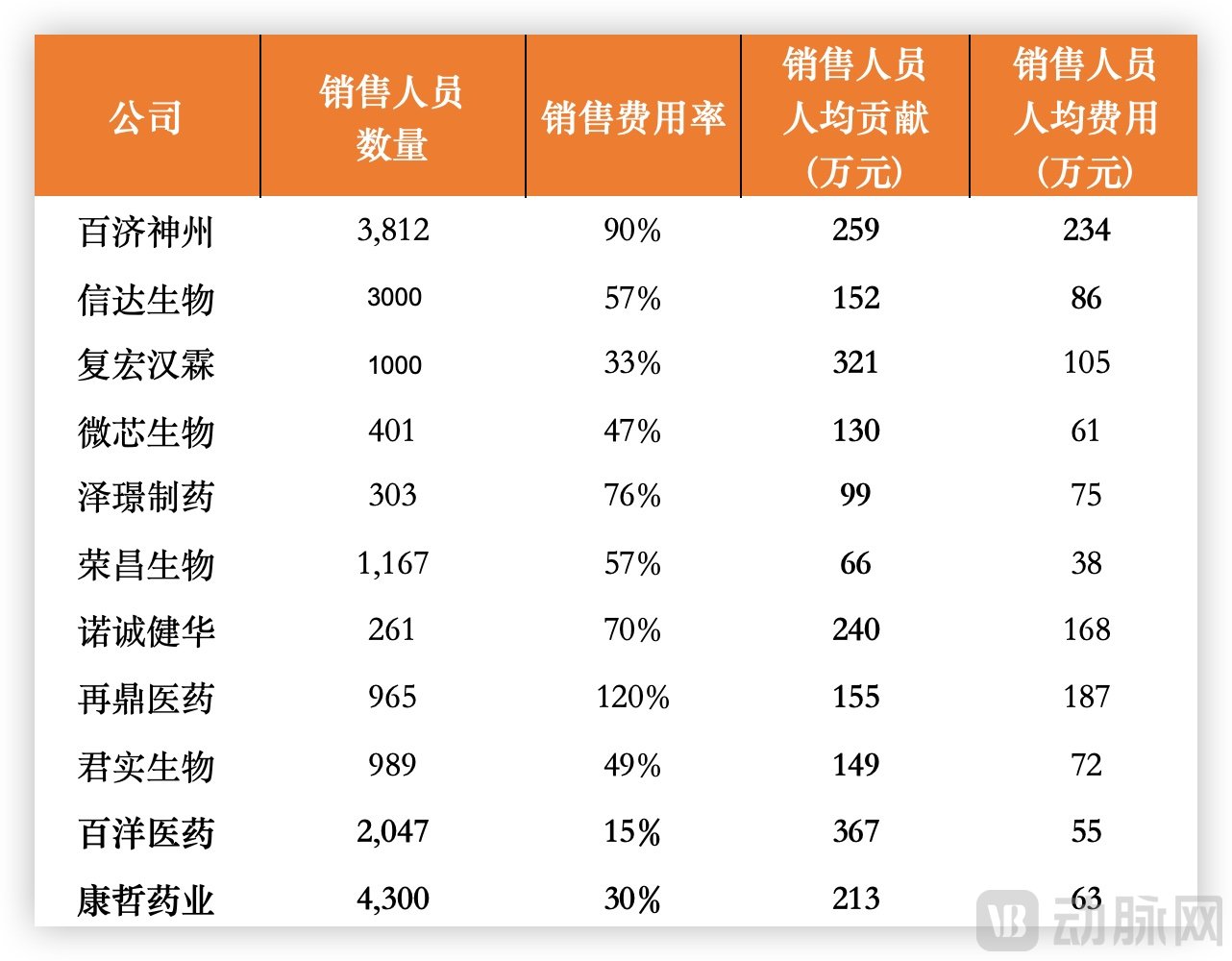
Commercialization Data of Selected Pharmaceutical Companies, Sourced from Corporate 2022 Annual Reports
According to the financial reports of some listed innovative pharmaceutical companies, the sales expense ratio is generally as high as over 50%, with the average annual cost per sales representative exceeding one million yuan in some enterprises. However, these high sales expenses have not created corresponding value for the pharmaceutical companies, and most of them have still not achieved profitability after years of independent commercialization.
In contrast, contract sales organizations (CSOs) represented by Baheal Medical and CMS Pharmaceutical exhibit higher overall sales expense ratios and greater revenue per sales representative than most biotech companies. According to Choice data, the average sales expenses of domestically listed pharmaceutical companies reached approximately RMB 870 million in 2021, a year-on-year increase of nearly 9%. From a cost-reduction perspective, pharmaceutical companies are increasingly inclined to outsource drug commercialization to CSO firms.
On the other hand, traditional pharmaceutical companies are facing increasing sales pressure in the hospital market and must also break through in commercialization.
With the introduction of policies such as centralized volume-based procurement and the two-invoice system, the traditional “pharmaceutical manufacturer–distributor–hospital” model is in urgent need of transformation. Companies have historically focused primarily on hospital channels, resulting in weak accumulation in the out-of-hospital market dominated by retail. Demand drivers such as expanding coverage into third- and fourth-tier cities, refining pharmaceutical commercialization, and transitioning toward retail-oriented models are all providing momentum for the development of the Contract Sales Organization (CSO) industry.
Furthermore, with the internationalization of the pharmaceutical market and the continuous improvement of China's economic level, the Chinese pharmaceutical market has become an important part of the global pharmaceutical market. According to data from the General Administration of Customs, the import value of medicinal materials and drugs in China reached 286.23 billion yuan in 2022, with a compound annual growth rate (CAGR) of 9.5% for drug imports from 2018 to 2022. Multinational pharmaceutical companies are continuously increasing their investment in the domestic market; however, due to insufficient understanding of domestic market demands, some multinational pharmaceutical companies are willing to entrust product promotion and sales to Contract Sales Organizations (CSOs).
CSOs are increasingly becoming the preferred choice for pharmaceutical companies in marketing and sales. Pharmaceutical firms’ evaluation of CSO partners has expanded beyond mere product sales; they now seek professional brand management services that establish strong connections between the manufacturers and downstream end-users.
Traditional pharmaceutical commercial companies are responsible for circulation and distribution, essentially handling product logistics and channel coverage; this clearly does not warrant the designation of a commercial CSO.
In the medical field, the influx of new drugs is the norm; their value can be fully realized only when they are appropriately integrated into specific treatment regimens. This requires pharmaceutical companies not only to have the capacity to supply products but also to possess profound insights into and understanding of clinical scenarios, thereby shaping brand and product perception among physicians and patients. Only in this way can they achieve genuine commercial success in an increasingly competitive pharmaceutical market.
What distinguishes a CSO from traditional pharmaceutical commercial companies is its focus on brand operations.
Baheal Medical, a company focused on CSO services, released its third-quarter financial report. Its net profit for Q3 reached RMB 494 million, representing a year-on-year increase of 43.29%. The growth in net profit was primarily driven by its CSO business, with the majority contributed by its brand operation services.
Baheal Medical initially built its business on the operation of two brands, D-Cal and Bite. After more than a decade of operational efforts, it has successfully established D-Cal and Bite as among the most competitive brands in their respective niche markets. Taking D-Cal products as an example, they have grown into one of the major products in the calcium supplementation market, with annual revenue exceeding RMB 1 billion. Meanwhile, the product’s gross profit margin increased from 53.4% in 2015 to 67.5% in 2022, achieving growth in both sales volume and pricing. It is remarkable that a brand operated for nearly 20 years can still maintain a growth rate of close to 10%, underscoring its significant success.
Tailored to distinct brand positioning, Baheal Medical implements precision marketing and promotion targeting specific customer segments. Leveraging years of accumulated expertise, the company has developed robust supply chain management capabilities and extensive channel resources. Currently, Baheal Medical has established a nationwide pharmaceutical commercial network comprising over 600 distributors, directly or indirectly covering more than 14,000 hospitals and 370,000 pharmacies. In the online sector, the company expands its digital business through a model combining self-built e-commerce platforms with deep collaborations with major platforms, thereby enabling precise consumer reach. Supported by these strengths, Baheal Medical achieves a hospital listing development efficiency of over 100 institutions per product per month, while maintaining a sales expense ratio of 15%.
With such successful cases, there is potential for business replication.
Since 2022, Baheal Medical has expanded its collaborations with mainstream pharmaceutical companies. For instance, it entered into a commercialization partnership with Shanghai Yizhong for its innovative oncology drug, “Paclitaxel Polymeric Micelles for Injection” (brand name: Zisheng), which is the first paclitaxel micelle formulation approved for marketing in China. Baheal Medical also partnered with AstraZeneca to manage the commercial operations of its antidiabetic drug Onglyza (a DPP-4 inhibitor) both within and outside hospitals. Additionally, leveraging the distribution channels of its D-Cal brand, Baheal Medical secured exclusive rights to promote Roche’s Rocaltrol (calcitriol soft capsules) through retail channels in China. Furthermore, the company has engaged in deep cooperation with Giant Biogene to drive the offline commercialization of its core product, Comfy.
From a financial perspective, the brand operation business has become the core profit growth driver for Baheal Medical. From 2018 to 2022, the compound annual growth rate (CAGR) of revenue from brand product sales and promotion was 18.6%. In the first three quarters of this year, the brand operation segment achieved revenue of RMB 3.09 billion, a year-on-year increase of 16.8%, with a gross profit margin of 43.5%.
From Q1 to Q3 of this year, Baheal Medical successively signed commercial cooperation agreements with Daiichi Sankyo, Novartis Innovative Medicines, Laborui Chen, Gilead Sciences, AstraZeneca, Radio Diagnostics Technology, and Medis Medical. These collaborations include a number of innovative products, such as RAB001 injection, a first-in-class new drug for osteonecrosis developed by Laborui Chen; a series of radiopharmaceuticals including 99mTc-3PRGD2, a Class 1 innovative diagnostic agent for nuclear medicine tumor imaging developed by Radio Diagnostics Technology; and omeprazole enteric-coated tablets, a classic gastrointestinal medication under AstraZeneca. Additionally, the implantable left ventricular assist device (LVAD) system from Tongxin Medical has also been placed under the operation of Baheal Medical.
As Baheal Medical’s brand operation capabilities gain validation and recognition, its brand operation matrix is expected to continue expanding. The company’s CSO (Contract Sales Organization) business model has also proven successful. From a financial perspective, both academic promotion and marketing planning fall under asset-light operations; the more brands it contracts, the higher the promotional efficiency and the lower the marginal costs, driving the CSO industry into a virtuous cycle of growth.
Starting from the CSO model, many enterprises are moving from the downstream to the upstream of the industrial chain.
The development trajectory of China Medical System, another leading CSO enterprise, signals greater possibilities for the CSO industry.
As part of its service offerings, CSO companies assist clients in collecting data from frontline markets, preparing market research reports, and providing feedback to manufacturers to support product development. Leveraging the extensive network of department physicians and experts accumulated through its prior CSO operations, China Medical System (CMS) extensively identifies clinical pain points from real-world frontline practice. By combining deep market insights with its established commercialization capabilities, CMS seeks to introduce high-quality innovative drug projects.
In the first half of this year alone, CMS Pharmaceutical had three innovative drugs with differentiated advantages approved for market launch. These include the diazepam nasal spray, the first of its kind approved in China in June, which meets the clinical need for convenient, on-the-go treatment during cluster seizures in epilepsy patients; tildrakizumab injection, approved in May, which offers a better treatment option for patients with moderate-to-severe psoriasis due to advantages such as less frequent injections and good long-term safety and tolerability; and methotrexate injection, approved in March, which is the first pre-filled subcutaneous MTX injection in China.
In addition, CMS Pharma is steadily advancing the development and registration of its other innovative pipelines, continuously enriching its product portfolio, while simultaneously promoting the growth of its dermatological aesthetic medicine and ophthalmology businesses.
Innovation is not only about addressing problems in major therapeutic areas, such as the use of GLP-1 for weight loss; it also involves making an impact in niche segments across various medical specialties. By developing innovative formulations and novel drug delivery methods to address existing challenges in first-line clinical practice, such innovations likewise hold significant market value.
Whether it is Baheal Medical, which relies on the CSO model to establish its presence in innovative drugs, innovative medical devices, and basic research platforms, or CMS Pharmaceuticals, which started with CSO services, keenly captured frontline clinical needs, and began introducing innovative drug products to extend its business coverage across the entire pharmaceutical industry chain—including R&D, manufacturing, and marketing—thereby becoming a specialized pharmaceutical company, both have demonstrated that starting with a CSO model can build a complete ecosystem. In the current capital winter, this low-risk, high-efficiency, innovation-driven model is poised to serve as a vanguard for Biotech companies seeking to break through existing bottlenecks.