

Boundless Bio, Pioneering ecDNA-Targeted Cancer Therapies, Files for IPO After $100M Series C Led by Leaps by Bayer

Alexandria Venture Investments
Healthcare Venture Capital Firms

RA Capital
Life Sciences Venture Capital Firms

Fidelity Investments
Financial Services Institutions

ARCH Venture Partners
Venture Capital Firms

Wellington Management
Investment Management Institution

Boundless Bio
Developer of Novel Cancer Therapeutics

Leaps by Bayer
Leaps by Bayer
In May this year, Boundless Bio, a U.S.-based clinical-stage next-generation precision oncology company, announced the completion of a $100 million Series C financing round, which was led byLeaps by BayerandRA Capital ManagementCo-led the investment round, with participation from Fidelity Management and Research Company, ARCH Venture Partners, Wellington Management, Alexandria Venture Investments, and others.
Boundless Bio, founded in 2018, leverages its scientific team’s research on the mechanisms of extrachromosomal DNA (ecDNA) to develop next-generation innovative precision oncology therapies for patients with tumors driven by oncogene amplification. According to the announcement, the Series C financing will be used to advance BBI-355, the first ecDNA-directed therapy (ecDTx), with the aim of generating meaningful clinical results from the ongoing Phase 1/2 clinical trial.
Capture the Ringleader First: Wielding the Knife Against Cancer’s “Strategist,” ecDNA
Extrachromosomal DNA (ecDNA) is a type of highly accessible DNA particle located outside the chromosomes. Prior to 2019, it was recognized that ecDNA plays a significant role in cancer development and a key part in the progression of cancer cells; however, understanding of its structure and its impact on gene regulation remained limited.
November 20, 2019,Prof. Paul S. Mischel and Vineet Bafna Serve as Co-Corresponding Authors, Publishing Major Breakthrough on ecDNA in NatureThe research team successfully elucidated the structure of extrachromosomal DNA (ecDNA) and clarified the mechanisms by which ecDNA influences oncogene function, leveraging super-resolution imaging, optical mapping, and whole-genome sequencing analysis. The study revealed that ecDNA alters the physical distances within native chromatin DNA, thereby generating novel regulatory pathways, which bridges ecDNA-related research with modern cancer genomics and epigenetics.
Further research by Professor Paul S. Mischel’s team revealed that nearly half of human cancers harbor extrachromosomal DNAs (ecDNAs), whereas ecDNAs are rarely detected in normal cells. Kim H et al. found that ecDNA amplification frequently occurs in most cancer types but is absent in blood or normal tissues. Moreover, the proportion of ecDNA-positive cases was only 40% in established cell lines after multiple passages, whereas it reached as high as 90% in cultures derived from tumor patients, suggesting that the in vivo tumor microenvironment may, to some extent, facilitate the maintenance of ecDNAs.
On November 21, 2019, an article published in the journal Cell confirmed that DNA sequences present on extrachromosomal DNA (ecDNA) include not only oncogenes but also enhancers that promote cancer gene expression. The research team employed CRISPR gene-editing technology to individually silence the enhancers or “regulatory elements” of multiple genes, ultimately finding that nearly all of these “regulatory elements” contributed to tumor growth. One of the corresponding authors, a professor, joked, “It appears as though oncogenes are grabbing ‘switches’ from various locations across the genome to maximize their own expression.”
A growing body of experimental evidence demonstrates that extrachromosomal DNA (ecDNA) is both prevalent and potent, enabling a substantial increase in oncogene copy numbers within tumor cells—a feat difficult to achieve through chromosomal amplification. Furthermore, studies have revealed that due to the absence of centromeres, ecDNAs are randomly and unevenly segregated into daughter cells during mitosis. Consequently, this mode of amplification allows tumors to rapidly acquire and maintain intratumoral genetic heterogeneity.This also means that ecDNA plays a central role in accelerating tumor evolution and may act as the “strategist” of tumors. In other words, ecDNA may offer a novel avenue for addressing the challenge of tumor gene amplification, against which targeted therapies and immunotherapies are largely ineffective.
To date, Professor Paul S. Mischel has published multiple papers on ecDNA in Nature and Science. Just two months before the publication of Professor Mischel’s groundbreaking paper on ecDNA, Boundless Bio, a biotechnology company co-founded by Professor Paul S. Mischel along with Zachary Hornby and Dr. Jonathan Lim, completed a $46.4 million Series A financing round.
At its inception, CEO Zachary Hornby stated that the three revolutions in cancer treatment were chemotherapy, which emerged in the 1940s; targeted therapy, which arose in the late 20th century; and immunotherapy, which has been developed in recent years. He further asserted that ecDNA would usher in the fourth revolution in cancer treatment.
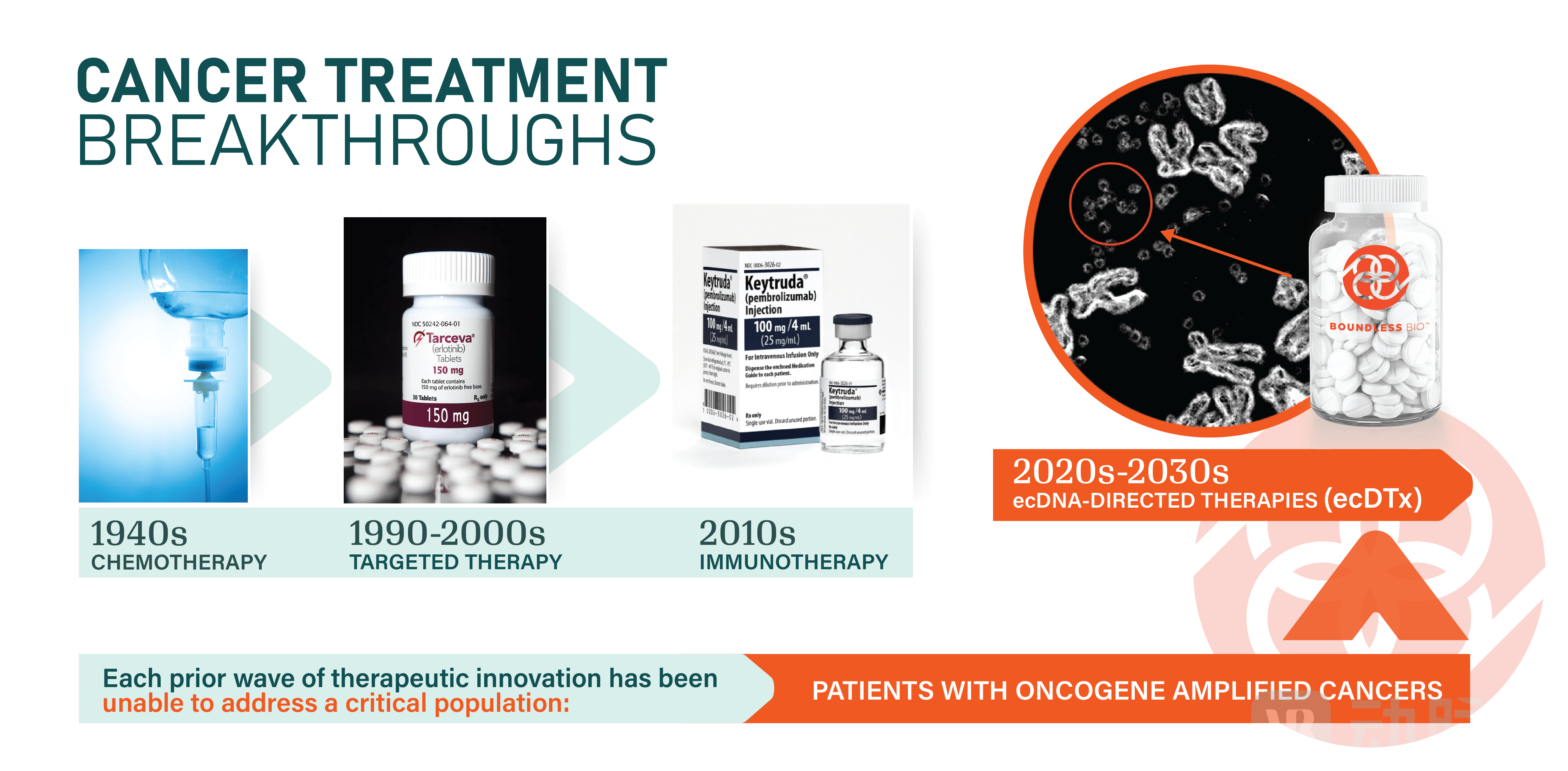 Image source:Boundless BioOfficial Website
Spyglass Technology Platform: Uncovering ecDNA Vulnerabilities, Three Targets Identified
As Zachary noted in a recent interview, “There is currently no roadmap for pharmacological intervention targeting ecDNA, no precedents to follow, and no validated targets. Therefore, we must forge our own path, develop our own models, propose our own therapeutic strategies, and define our own portfolio of targeted products.”
Many questions regarding ecDNA remain to be answered. Since its inception, Boundless Bio has focused on understanding the role of ecDNA in cancer development—including when and why it arises—as well as how to disrupt its formation and function, thereby preventing cancer cells from leveraging ecDNA to drive amplification and tumorigenesis and ultimately develop drug resistance. To this end, Boundless Bio established Spyglass, a drug discovery engine designed to identify and preclinically validate targets that are critical for cancer cell growth, treatment resistance, and survival through their dependence on ecDNA, and has already uncovered three biological vulnerabilities associated with ecDNA.
In April 2022, Boundless Bio presented at the American Association for Cancer Research (AACR) Annual Meeting regardingAssociation Between ecDNA and Replication StressNew findings reveal replication stress in ecDNA-driven cancers as a therapeutic strategy for cancers with gene amplification.
According to previous research by Boundless Bio, cancers with oncogene amplification on extrachromosomal DNA (ecDNA) are associated with poor clinical prognosis and typically do not respond to targeted therapies, indicating an urgent need to identify clinical strategies for treating ecDNA-amplified cancers. DNA replication stress is a known form of genomic instability, and excessive replication stress leads to extensive DNA damage and cancer cell death.
More specifically, the hyper-transcription and replication of ecDNA in cancer cells increase replicative stress and dependence on nucleotide biosynthesis. In this context, replicative stress inducers can serve as a synthetic lethality strategy, leading to the death of ecDNA-driven cancer cells. Based on this discovery, Boundless Bio has developed itsFirst ecDTX Candidate Pipeline BBI-355。
BBI-355 is an oral, potent, and selective small-molecule inhibitor that targets CHK1, a key regulator of replication stress in ecDNA-positive tumor cells. CHK1 is a synthetic lethal target that plays a dual role in cancer, both suppressing tumorigenesis and promoting tumor survival. According to incomplete statistics, there are more than 30 global clinical and preclinical programs related to CHK1 currently under development.
In both in vitro and in vivo models, BBI-355 has demonstrated antitumor activity against multiple ecDNA-carrying solid tumor types, including breast cancer, ovarian cancer, pancreatic cancer, colorectal cancer, lung cancer, and melanoma. As the first drug targeting ecDNA-directed therapy (ecDTX), BBI-355 is currently undergoing Phase I/II clinical trials (POTENTIATE) to evaluate its safety and efficacy in patients with advanced solid tumors harboring ecDNA and oncogene amplification.
Leveraging the biological vulnerability of ecDNA replication stress, Boundless has also developed BBI-098, a second-generation CHK1 inhibitor that is orally available, potent, and selective, targeting central nervous system cancers such as glioblastoma and brain metastases.
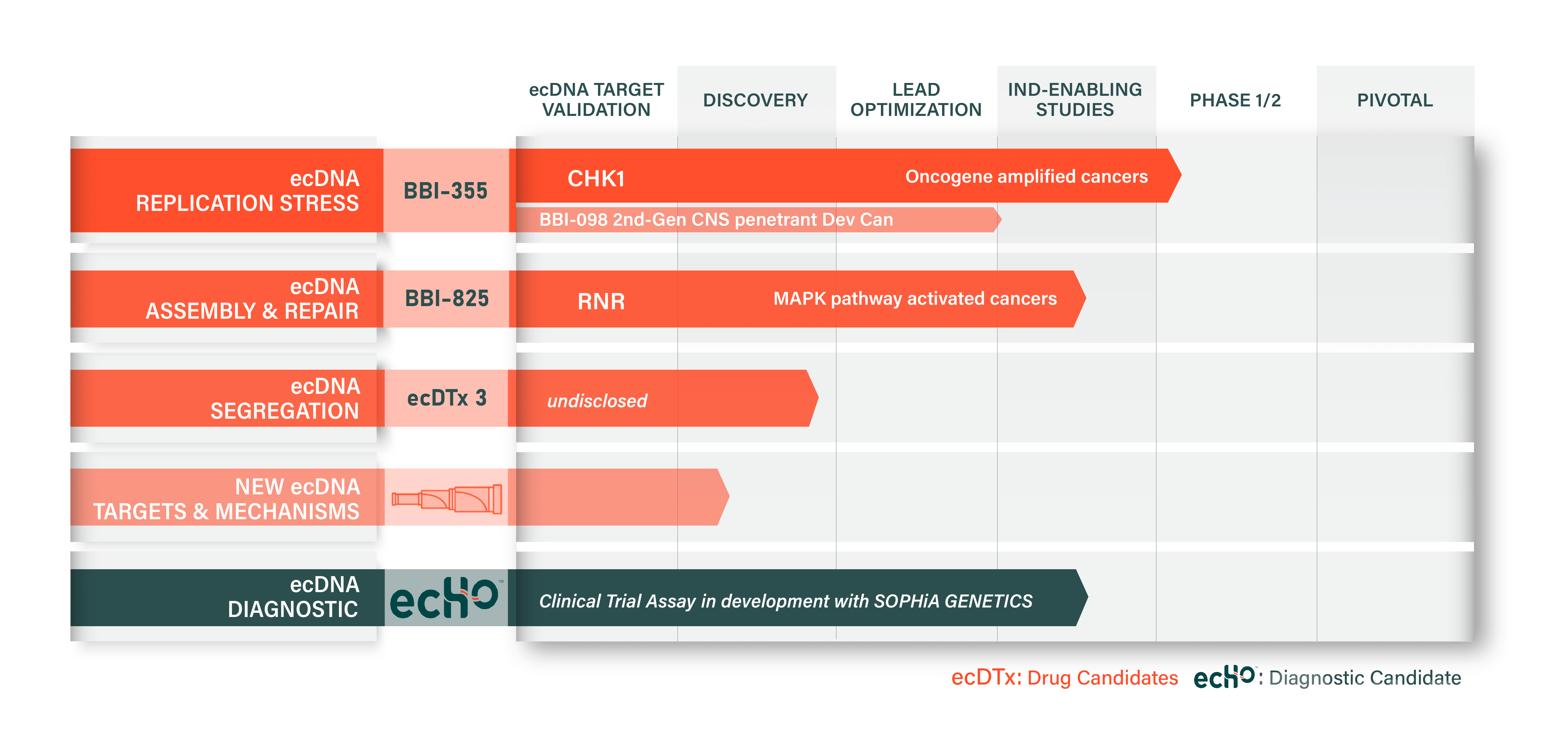 Boundless Candidate Pipeline Source: Boundless Official Website
Beyond ecDNA replication stress, Boundless has also disclosed two additional biological vulnerabilities of ecDNA discovered through its Spyglass technology platform:ecDNA assembly and repair; ecDNA segregation.The following will be introduced one by one.
To maintain the assembly and repair of ecDNA, ecDNA-driven cancer cells must rely on deoxyribonucleoside triphosphates (dNTPs), the raw materials used for DNA synthesis and replication. In Boundless Bio’s view, disruptingAssembly and Repair of ecDNAthe required raw materials, leading to cancer cell death. Based on this, Boundless has developedThe second ecDTX candidate pipeline, BBI-825.
BBI-825 is a novel, potent, and selective oral inhibitor of ribonucleotide reductase (RNR), a rate-limiting enzyme essential for producing the deoxynucleoside triphosphates (dNTPs) required for extrachromosomal DNA (ecDNA) assembly and repair. BBI-825 has completed preclinical proof-of-concept studies in multiple tumor types across diverse ecDNA-driven contexts, including those involving oncogene drivers and drug resistance, and IND-enabling studies are currently underway.
At the AACR-NCI-EORTC International Conference on Molecular Targets and Cancer Therapeutics this October, Boundless Bio presented preclinical data for BBI-825: the drug demonstrated synergistic activity when combined with specific targeted therapies in ecDNA-driven in vivo tumor models, particularly in cancer models exhibiting resistance amplifications on KRAS-bearing ecDNA and in colorectal cancer models with KRAS inhibitor-resistant mutations.
ecDNA segregation refers to the process by which ecDNA, lacking centromeres—the structural components of chromosomes required for proper separation during cell division—is distributed. Building on this, Boundless Bio has identified and validated a novel protein target critical for ecDNA segregation, whose inhibition exhibits synthetic lethality in ecDNA-driven cancer cells. Drug discovery efforts are currently underway for this undisclosed target, ecDTx 3.
In addition to the three ecDTx candidates mentioned above, Boundless Bio is also turning its attention to diagnostics, having partnered with genomics pioneer SOPHiA GENETICS to jointly advance ECHO (ecDNA Harboring Oncogenes), a proprietary clinical diagnostic assay for ecDNA.
Collaborating with multiple universities and research institutions, and partnering with MNCs such as Eli Lilly to prioritize the development of combination therapies
Boundless was founded in San Diego in 2018. Over the course of five years, it grew from a laboratory-based startup into a biotech company with total financing reaching $251 million, a trajectory inseparable from its solid foundational research. According to an interview with Zachary Hornby, some of Boundless’s research outcomes originated from the Scripps Research Institute and Stanford University, with several members of its Scientific Advisory Board—including Paul S. Mischel—also holding faculty positions at Stanford University.
In advancing clinical trials, Boundless has partnered with multiple academic clinical trial centers, including Memorial Sloan Kettering Cancer Center, MD Anderson Cancer Center, and Dana-Farber Cancer Institute.
Over the past two decades, numerous targeted therapies have demonstrated significant efficacy; however, resistance to monotherapy remains a clinical challenge. For BBI-355, a CHK1-targeted agent developed by Boundless Bio, the dual role of CHK1 in cancer—suppressing tumorigenesis while also promoting tumor survival—suggests that, if successfully developed into a drug, it would hold greater potential for combination regimens with chemotherapy, ATR inhibitors, and PD-1 inhibitors.
This September, Boundless has reached an agreement with Taiho Oncology to advance Taiho’s pan-epidermal growth factor receptor inhibitor LYTGOBI®(Futibatinib) in combination with BBI-355: A clinical trial for locally advanced or metastatic solid tumors with oncogene amplification.
Subsequently, Boundless announced a clinical trial collaboration and supply agreement with Eli Lilly to supply its CDK4/6 inhibitor Verzenio (abemaciclib) for use in combination with BBI-355 in clinical trials for locally advanced or metastatic solid tumors with oncogene amplification.
In a recent interview with CEO Zachary, we gained insight into Boundless Bio’s determination. “Our core value is ‘BOLD,’ and the science we are pursuing is quite novel. … All of this involves risk, but we believe it is meaningful and worth undertaking… —having the courage to try, striving to bring patients meaningful new advances and new treatment options.”