

Breakthrough in Early Screening for Mild Cognitive Impairment: Xiangya Hospital Study Published in Top Neurology Journal
A Major Breakthrough in Early Screening for Mild Cognitive Impairment (MCI)! Professor Shen Lu’s Team from the Department of Neurology at Xiangya Hospital, Central South University, Published in a Top-Tier Journal in NeurologyAlzheimer’s & DementiaPublished a groundbreaking research paper that, for the first time, integrated quantitative parameters of gait and eye movement behavior using domestically developed neurofunctional quantitative assessment systems—namely, the ReadyGo Motor Function Quantitative Assessment System and the EyeKnow Intelligent Eye Movement Analysis and Assessment System, both under Zhongke Ruiyi. An AI-assisted diagnostic model was constructed, and the efficacy of this approach in efficiently identifying patients with mild cognitive impairment (MCI) was validated. This innovative finding signifies that early screening for MCI will usher in a new generation of non-invasive, convenient, objective, and precise methods.
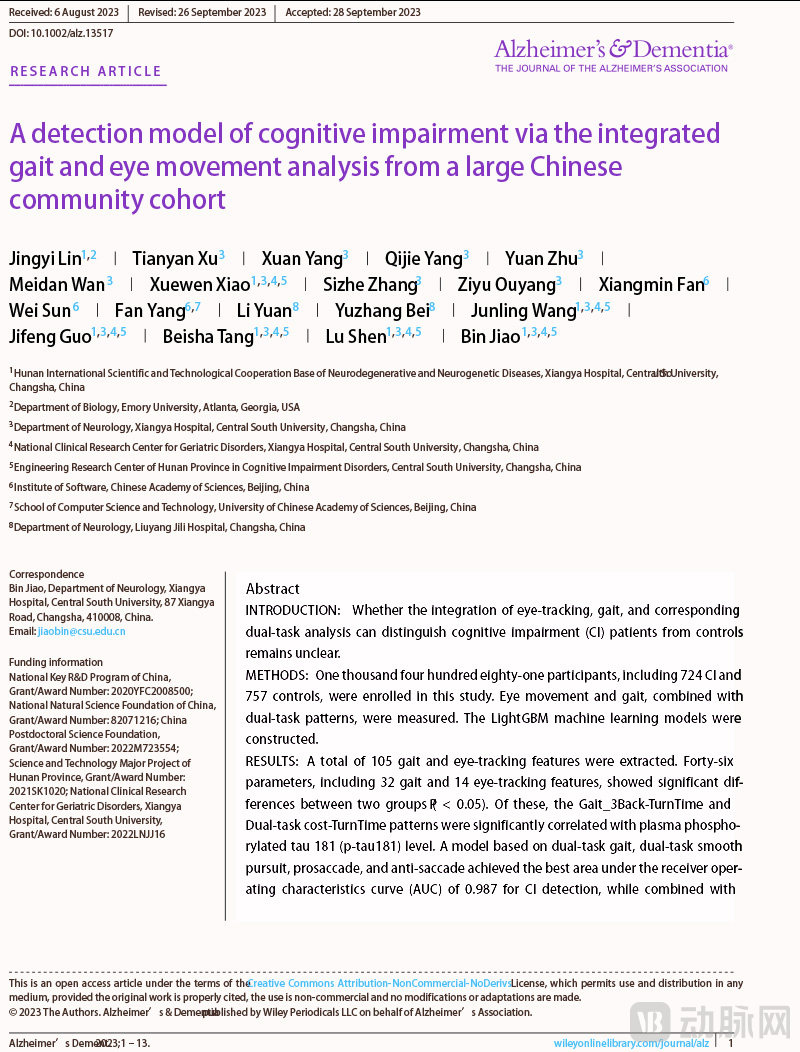
Homepage of the Research Paper Published by Professor Shen Lu’s Team from the Department of Neurology, Xiangya Hospital of Central South University
In recent years, with the accelerating pace of global population aging, the harms caused by neurodegenerative diseases closely associated with this trend have been increasingly severe. Taking China as an example, there are currently approximately 15 million individuals aged 60 and above living with Alzheimer’s disease (AD), ranking first worldwide. This has resulted in substantial social and economic costs; it is projected that by 2030, the total annual societal cost of Alzheimer’s disease in China will exceed RMB 3 trillion.
However, the prevention and treatment of neurodegenerative diseases, represented by Alzheimer’s disease (AD), have failed to achieve significant progress. This is mainly due to two reasons.
First, the clinical course of neurodegenerative diseases is typically prolonged and strongly age-dependent; early manifestations are often mistaken for normal aging phenomena and consequently overlooked. Statistics indicate that over 85% of Alzheimer’s disease patients are diagnosed with moderate-to-severe Alzheimer’s disease at their initial medical consultation, thereby bypassing the early stages of cognitive decline and rendering therapeutic intervention futile.
Secondly, because the relationship between the brain—a complex organ composed of hundreds of billions of nerve cells—and the human body has not been thoroughly studied, most neurological diseases still lack effective treatments. Over the past two decades, approximately one hundred drugs targeting Alzheimer’s disease have entered testing phases globally, but very few have been approved for use. Moreover, their indications and efficacy in symptom improvement are relatively limited; they cannot reverse cognitive impairment or significantly slow disease progression. Only by intervening during the early stage of mild cognitive impairment (MCI) is it possible to effectively delay the progression of the disease.
Therefore, early detection of MCI is of great significance for its prevention and treatment, and China has also stepped up related prevention and control efforts in recent years.
Notably, the Outline of the “Healthy China 2030” Plan, released in 2016, put forth the requirement to “strengthen effective interventions for Alzheimer’s disease and other dementias.” In 2020, the National Health Commission issued the Work Plan for Exploring Specialized Services in the Prevention and Treatment of Dementia among the Elderly. In 2022, the National Health Commission, together with 14 other departments, jointly printed and distributed the 14th Five-Year Plan for Healthy Aging. This May, the General Office of the National Health Commission released the Notice on Launching the Action to Promote the Prevention and Treatment of Dementia among the Elderly (2023–2025).
Driven by strong policy support, large-scale screening for cognitive impairment is rapidly being rolled out nationwide.
Currently, there are several primary methods for cognitive impairment screening: first, traditional neuropsychological scales and subjective observation; second, the use of imaging techniques such as magnetic resonance imaging (MRI) to identify changes in brain structure; and finally, biomarker testing using peripheral blood, cerebrospinal fluid, and other samples. However, these methods currently exhibit significant limitations in large-scale cognitive impairment screening efforts.
Neuropsychological scales are widely used in clinical practice for screening cognitive impairment, but they present several challenges. On one hand, these scales comprise hundreds of questions and typically require more than 30 minutes to complete, making most patients unwilling to fill them out during the screening phase. On the other hand, the scales impose certain requirements on the respondent’s educational level; insufficient education may hinder comprehension of the questions, thereby compromising the objectivity of the assessment.
Although imaging techniques such as magnetic resonance imaging (MRI) can accurately reflect changes in brain structure, it remains impossible to identify cognitive status in advance when no structural changes are present, and it is also difficult to assess risk based on subtle structural alterations. Furthermore, the accessibility of MRI is limited; both the equipment costs and examination fees are prohibitive for primary care screening.
Biomarker testing, such as cerebrospinal fluid and peripheral blood assays, has risen rapidly in recent years due to its ability to detect changes in brain function at an early stage. However, its clinical implementation is constrained by specific setting requirements, along with practical challenges including difficult sample collection and high costs.
Given this current landscape, epigenetic recognition methods for neurological function have long been regarded as promising screening tools due to their inherent objectivity and convenience. Among these, the most prominent focus has been on the quantitative analysis and evaluation of gait and eye movement behaviors. However, previous devices for assessing gait and eye movements have faced technical limitations, such as cumbersome wearing procedures and complex calibration processes; consequently, their effectiveness and broad applicability in large-scale screening have not been fully validated. The recent study by Professor Shen Lu’s team from the Department of Neurology at Xiangya Hospital of Central South University has demonstrated the feasibility and potential of this analytical evaluation method for early screening, marking a significant breakthrough.
This article, titledA detection model of cognitive impairment via the integrated gait and eye movement analysis from a large Chinese community cohort(《Development of an Early Recognition Model for Cognitive Impairment Using a Dual-Task Paradigm Combining Eye Tracking and Gait Analysis in Community-Based CohortsThe paper published in 》 was jointly completed by the team led by Professor Shen Lu and Associate Researcher Jiao Bin from the Department of Neurology, Xiangya Hospital of Central South University, and the team led by Professor Fan Xiangmin from the Institute of Software, Chinese Academy of Sciences.
Researchers successfully recruited 1,481 community-dwelling adults aged over 60 years. Comprehensive eye movement and gait characteristics were collected from the participants using the EyeKnow intelligent eye-tracking analysis system and the ReadyGo quantitative motor function assessment system. Through extensive data analysis, the researchers identified significant differences between the cognitive impairment group and the cognitively normal group in as many as 32 gait parameters and 14 eye-tracking parameters, providing robust data support for the early screening of cognitive impairment.
The research team also conducted extensive analyses of gait and eye movement features to reveal the objective impacts of changes in cognitive function on subjects’ gait and oculomotor behavior. For instance, in eye-tracking tests, the observed eye movement trajectories exhibited significant differences among groups with cognitively normal (CN) status, mild cognitive impairment (MCI), and dementia, intuitively demonstrating how cognitive decline affects ocular activity. Compared with the CN group, the MCI and dementia groups displayed more disordered and unstable eye movements, as well as longer saccadic latency following target displacement. During smooth pursuit tasks, these groups also showed greater pursuit deviations and more frequent compensatory saccades.
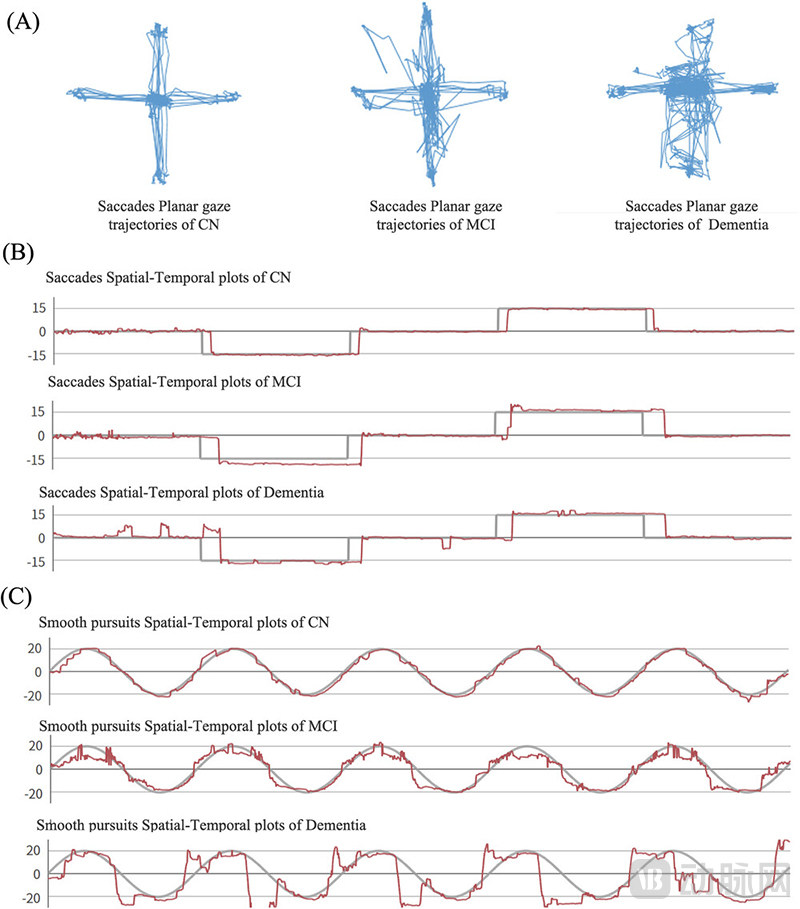
The study presents eye-tracking trajectories for the cognitively normal group and the cognitively impaired group (MCI and dementia), visually demonstrating the distinct differences among these groups in saccadic planar trajectories (A), saccadic temporal plots (B), and smooth pursuit temporal plots (C).
Furthermore, this study established a machine learning classification model for cognitive impairment based on quantitative parameters of gait and eye movement behavior. ROC analysis further confirmed that the model demonstrated robust discriminative performance, with an accuracy of 0.929, sensitivity and specificity of 0.915 and 0.941, respectively, and an area under the curve (AUC) of 0.987.
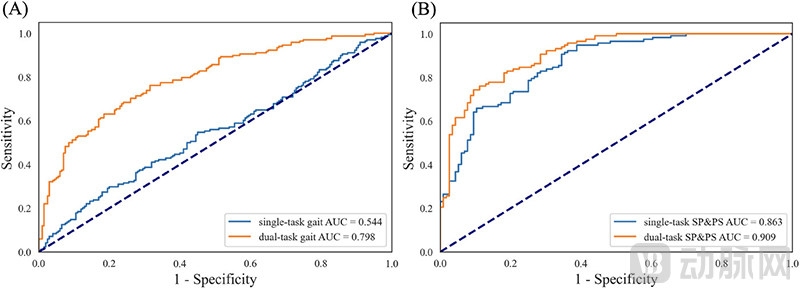
A Dual-Channel Fusion Model Based on Quantitative Parameters of Gait and Eye Movement Behaviors Achieved Optimal Recognition Performance
Compared with existing various screening methods for cognitive impairment, non-invasive and non-disruptive quantitative behavioral analysis methods—such as eye-tracking and gait analysis—can more conveniently identify the risk of cognitive impairment. These approaches are expected to be widely applied in community-based screening for cognitive impairment among residents, providing strong support for early screening and diagnosis of dementia.
It is worth noting that the quantitative evaluation systems for neurological function, which provided key technical support for this study, are all innovative medical devices independently developed by domestic enterprises. Their key performance indicators have reached a leading position globally, and they are increasingly appearing on top international stages.
It is reported that the developer of this device series, Zhongke Ruiyi, is an innovative medical technology enterprise established by the Institute of Software, Chinese Academy of Sciences (ISCAS), to commercialize its scientific research achievements. Leveraging prior research outcomes from projects undertaken by its scientific team—including the National 12th Five-Year Plan’s “863” Program and the 13th Five-Year Plan’s Key R&D Program, which received the Second Prize of the National Science and Technology Progress Award—the company has developed a comprehensive product portfolio and more than ten specialized pipelines focused on quantitative assessment of core neurological functions such as motor and cognitive capabilities, as well as interactive digital intervention methods, thereby comprehensively building a “new infrastructure” for neurology. The company participated in undertaking the Ministry of Science and Technology’s major project during the 14th Five-Year Plan period, titled “Key Technologies for Intelligent Human-Computer Interaction Oriented toward Early Warning of Nervous System Diseases,” and serves as the sole corporate entity responsible for the application, implementation, and promotion of the project’s outcomes. Its launched innovative medical devices have been deployed in clinical practice and scientific research at over 200 large Grade-A tertiary hospitals.
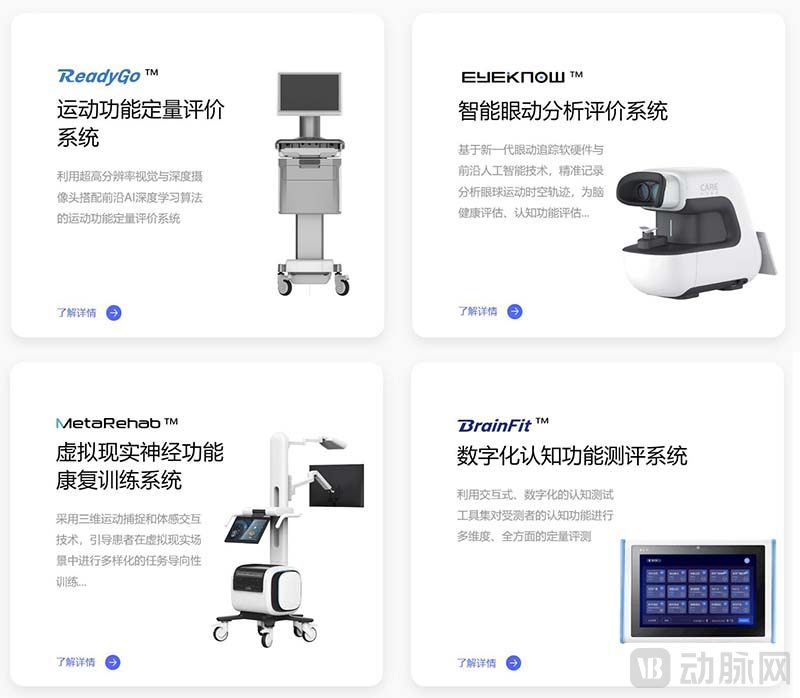
Product Portfolio of Zhongke Ruiyi (Source: Official Website of Zhongke Ruiyi)
In recent years, driven by national policies and the relentless efforts of China’s domestic medical device industry, innovative Chinese-made medical devices have made significant strides, gradually achieving international leadership in certain fields. Innovative enterprises represented by Zhongke Ruiyi are flourishing, demonstrating the robust vitality and promising prospects of China’s innovative medical device industry.