

ZhiFei Biological to Acquire 100% Equity of ChenAn Bio to Expand into GLP-1 Therapeutics
ZFSW
Vaccine R&D and Manufacturing Companies
On November 23, Chongqing Zhifei Biological Products Co., Ltd. (hereinafter referred to as “Zhifei Biological”) announced that the Company intends to acquire in cash 85% and 15%, respectively, of the equity interests in Chongqing Chen’an Biopharmaceutical Co., Ltd. (hereinafter referred to as “Chen’an Biological”) held by Chongqing ZhiRui Investment Co., Ltd. (hereinafter referred to as “ZhiRui Investment”) and Zhang Gaoxia, totaling 100% of the equity interests, and has signed an “Intent Agreement on Equity Acquisition.”
Zhifei Biological intends to extend its business footprint into the field of metabolic diseases, such as diabetes and obesity, through this transaction, while also entering the therapeutic biopharmaceutical sector.
Affected by this news, Zhifei Biological Products was trading at 66.12 yuan, up 1.36%, with a total market capitalization of 158.7 billion yuan as of press time.
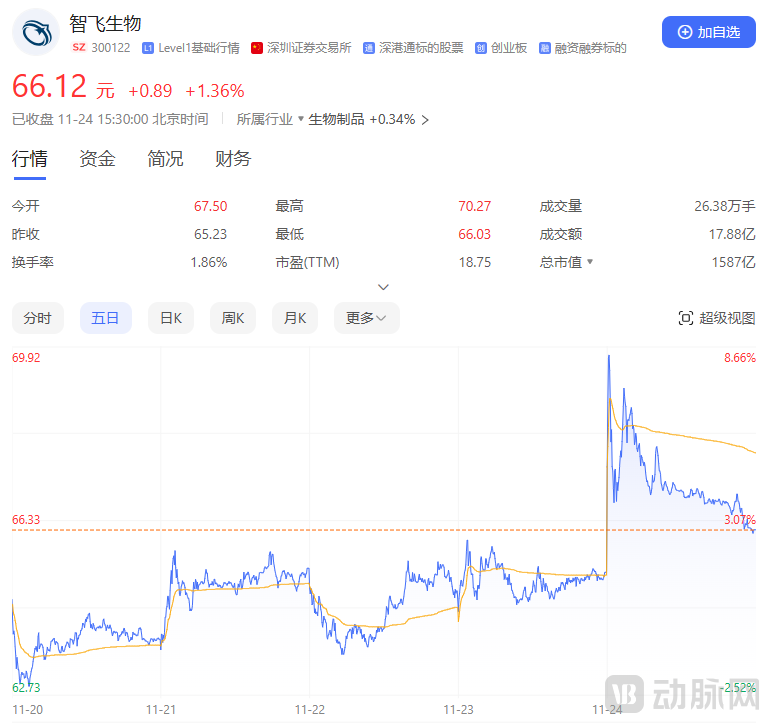
Chongqing Zhifei Biological Products Co., Ltd. was established in 2002, with its core business focused on preventive vaccines. In September 2010, it was listed on the Shenzhen Stock Exchange (stock code: 300122), becoming the first private vaccine enterprise to be listed on the ChiNext Board. It has since grown into a leading company in China’s private vaccine industry.
In 2015, Zhifei Biologicals entered the broader biologics sector. It established Chongqing ZhiRui Investment Co., Ltd. in the Chongqing International Bio-City and planned the development of the Zhirui Biopharmaceutical Industrial Park, an integrated production and R&D facility with investments exceeding RMB 10 billion, to strategically position itself in the research and development of major biologics, including monoclonal antibodies, cell therapies, and diabetes treatments.
Chongqing ZhiRui Investment Co., Ltd. specializes in biopharmaceutical investments using its own capital, with a primary focus on oncology, metabolic diseases, cardiovascular diseases, autoimmune disorders, and neurodegenerative diseases. The company is committed to the development and industrialization of high-end biopharmaceuticals and advanced biotechnologies.
ChenAn Biologics is a biopharmaceutical company incubated and invested in by the ZhiRui Investment platform in 2015. The company’s legal representative is Jiang Lingfeng, Vice Chairman and Vice President of Zhifei Biological Products. The company’s official website also indicates that Zhifei Biological Products is one of its investors.
Leveraging its recombinant protein chemical modification technology platform, Chenan Biologics focuses on metabolic disorders such as diabetes and obesity, and has established a well-tiered pipeline of glucagon-like peptide-1 (GLP-1) analogs and insulin analogs.
Currently, ChenAn Biologics has more than 10 projects under development. According to the Drug Clinical Trial Registration and Information Publicity Platform, the company has five candidate drugs in clinical development. Among them, recombinant liraglutide injection and insulin degludec injection have completed Phase III clinical trials and are in the stage of submitting for marketing approval; recombinant semaglutide injection has entered Phase III clinical trials; and the GLP-1/GIP dual-target receptor agonist as well as oral semaglutide tablets are in the preclinical stage.
Upon completion of this transaction, Zhifei Biological will acquire a pipeline and production facilities for GLP-1 analogs, including recombinant semaglutide injection, as well as insulin analog products.
In 2021, Novo Nordisk’s semaglutide product Wegovy, indicated for weight management, received regulatory approval for market launch, marking the point at which semaglutide gained widespread prominence due to its obesity indication. By 2023, semaglutide’s momentum had grown even stronger. According to Novo Nordisk’s third-quarter 2023 financial report, the company’s flagship product, semaglutide, generated total revenue of approximately $14.2 billion in the first three quarters of the year, representing a year-on-year increase of 86%.
The explosive popularity of semaglutide has made GLP-1 one of the hottest targets in the industry, attracting a surge of players into this field in a short period. According to statistics from the Insight database, there are currently 289 drugs targeting GLP-1R worldwide (ranging from preclinical stages to approved market launch). To date, 12 GLP-1 drugs have been marketed globally, with 10 of them available in China.
Among them, Novo Nordisk’s semaglutide and Eli Lilly’s dulaglutide hold the largest share of the GLP-1 market. However, in China, these two drugs are currently approved only for diabetes indications, making the weight-loss drug segment one of the key areas where domestic companies are seeking breakthroughs.
According to the Report on the Nutrition and Chronic Disease Status of Chinese Residents (2020), more than half of Chinese adults are currently overweight or obese, with prevalence rates of 34.3% for overweight and 16.4% for obesity among adult residents (aged ≥18 years). As projected by The Lancet Diabetes & Endocrinology, the number of overweight and obese individuals in China is expected to reach 790 million by 2030.
As the clinical demand for weight management among overweight and obese patients continues to grow, the weight-loss drug market is poised for rapid expansion. According to Ping An Securities, the market size of weight-loss drugs in China is projected to reach RMB 14.9 billion by 2030, with a compound annual growth rate (CAGR) of 22.9%.
Numerous companies have set their sights on this “multi-billion-dollar” market.
According to the PharmCube database, there are currently 80 GLP-1 receptor agonists in the development pipeline in China. Among these, 42 are targeting weight loss indications, accounting for 52.5% of the total domestic pipeline. Seven products have either been marketed or are in Phase III clinical trials.
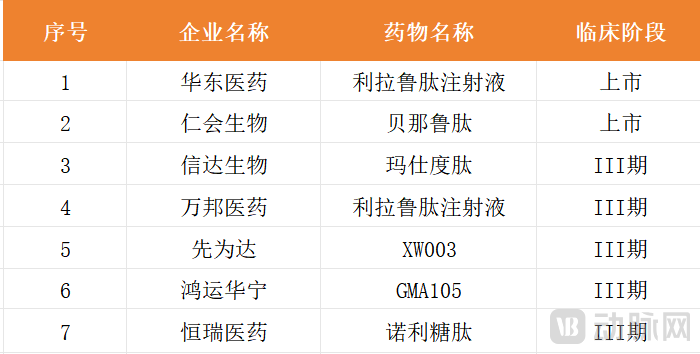 GLP-1 Weight-Loss Drugs Listed in China and in Phase III Clinical Trials
Data source: Compiled from public data; chart by VCBeat.
However, the highly sought-after “miracle drug” semaglutide is not “perfect.”
Previously, researchers at Columbia University Irving Medical Center reported in JAMA that GLP-1 drugs such as semaglutide are associated with gastrointestinal and pancreatitis-related adverse effects. The incidence of pancreatitis among individuals taking semaglutide was 4.6 times higher than that among those taking other types of weight-loss medications. Additionally, both Novo Nordisk’s Wegovy and Eli Lilly’s tirzepatide carry FDA-mandated boxed warnings regarding the risk of thyroid tumors.
Currently, in the fiercely competitive domestic GLP-1 weight-loss market, improving efficacy, reducing side effects, and lowering costs are likely to become key core competencies for companies still in the R&D phase, especially when compared with those that have already successfully “landed” their products.
However, some companies are expanding from the fiercely competitive fields of glucose-lowering and weight-loss therapies into high-prevalence areas such as cardiovascular disease, chronic kidney disease, non-alcoholic fatty liver disease (NAFLD), and Alzheimer’s disease. According to the PharmaCube database, there are currently 26 pipelines targeting indications in NAFLD, cardiovascular disease, chronic kidney disease, and Alzheimer’s disease, with the majority still in the preclinical stage.