

Plio Surgical Secures MedTech Innovator Investment with Novel Magnetic Anastomosis Device Eliminating Need for Staples
Plio Surgical
Medical Device Developer

MedTech Innovator
MedTech Innovator is a nonprofit global competition and accelerator for medical device, digital health, and diagnostic companies.
Globally, colorectal cancer is the third most common malignant tumor, ranking second among causes of death from malignancies and 16th among all causes of death from diseases and injuries, thus becoming a public health issue that seriously threatens human health.
According to the World Health Organization, in 2020, there were an estimated more than 1.9 million new cases of colorectal cancer and over 930,000 deaths from colorectal cancer worldwide.
In patients with colorectal cancer, a significant proportion require surgical resection of the tumor to restore normal bowel function. Unfortunately, this procedure carries a major complication: postoperative anastomotic leakage. In their article “Progress in Early Diagnosis and Prevention of Anastomotic Leakage After Rectal Cancer Surgery,” scholars Yao Hongwei, Xu Fengming, and others pointed out that anastomotic leakage is a common and serious complication following anterior resection for rectal cancer, with an incidence rate ranging from 2.4% to 27.0% and a mortality rate as high as 18%.
Leakage of intestinal contents into the abdominal cavity poses a serious threat to patient health, often leading to sepsis and necessitating emergency reoperation. This may delay discharge and chemotherapy, increase the incidence of complications and mortality, and elevate the risk of local recurrence. Even with timely diagnosis and treatment, anastomotic leakage can still adversely affect patients’ quality of life after discharge.
To address this challenge, Plio Surgical has entered the fray. Based in Dublin, Ireland, this medical device company is one of the leading innovators in Europe’s medtech industry, dedicated to enhancing surgical efficiency and ensuring patient safety.
Before the 20th century, nearly all suturing in surgical procedures relied on manual stitching performed by surgeons. This approach not only depended heavily on individual clinical experience and demanded a high level of technical proficiency, but was also extremely time-consuming and labor-intensive. In major surgeries, surgeons could spend several to over ten hours solely on suturing.
The advent of surgical staplers, known as "surgical stapling devices," has liberated surgeons from the burdensome task of manual suturing. Compared with manual suturing, surgical staplers facilitate surgical procedures and reduce operative time. Their use is highly prevalent in surgery, with widespread applications in cardiothoracic, gastrointestinal, hepatobiliary-pancreatic-splenic, urological, and general surgical procedures. According to Huaan Securities, there are approximately 30 types of surgical procedures that require the use of surgical staplers (without distinguishing between open and minimally invasive surgeries).
Since the successful invention of the first surgical stapler by Hümer Hültl, known as the “Father of Surgical Staplers,” in 1908, surgical staplers have undergone more than a century of development. During this period, the drawbacks of traditional staplers have gradually become apparent.
Traditional staplers require the use of staples, which may lead to complications such as tissue injury, infection, foreign body reactions, and staple leg detachment. Furthermore, the size and shape of staplers limit their applicability and flexibility, making it difficult to accommodate varying anastomotic requirements and levels of difficulty. More importantly, the use of traditional staplers demands a certain level of technical skill and experience; improper operation can result in serious consequences such as poor anastomosis, anastomotic leakage, and anastomotic stricture.
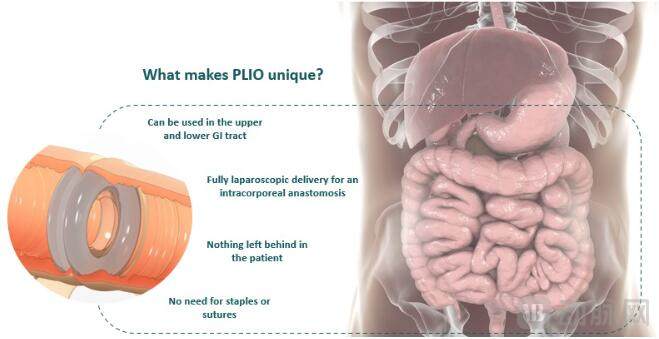
Advantages of Plio Surgical’s Magnetic Anastomosis Device, Plio | Image Source: Plio Surgical Official Website
Plio Surgical’s magnetic anastomosis device, Plio, eliminates the reliance on surgical staples and revolutionizes traditional staplers in terms of anastomotic efficacy and adjustability.
The Plio surgical implant is a medical device designed to connect two ends of the intestine. It avoids traditional suturing or stapling methods, thereby reducing operative time and complications while causing no long-term damage to the bowel. Furthermore, the Plio surgical implant leverages innovative minimally invasive technology to enhance the efficiency and safety of gastrointestinal surgeries.
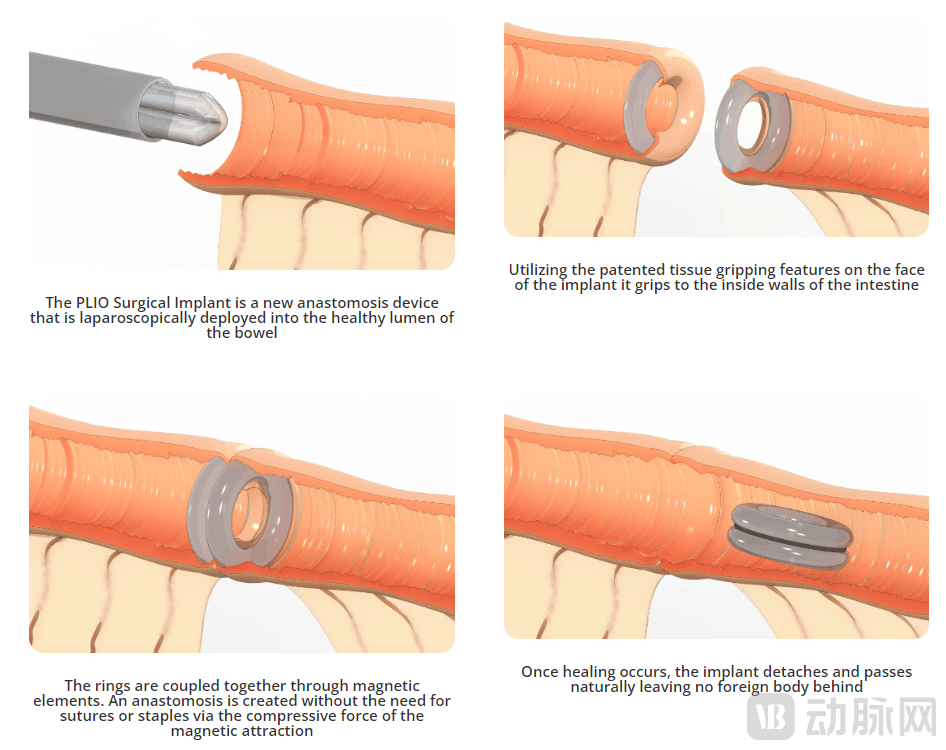
Plio Surgical’s Magnetic Anastomosis Device Plio: Workflow. Image source: Plio Surgical official website
Plio can be placed within the healthy lumen of the intestine via laparoscopy. The fully laparoscopic approach enables intracorporeal anastomosis, eliminating the need to enlarge the incision or exteriorize the bowel. The anastomotic ring of Plio features hook-like structures with grasping capabilities that securely attach to the inner layer of the intestinal wall, preventing implant migration or dislodgement. Furthermore, Plio can be used in both the upper and lower gastrointestinal tracts, without being constrained by anatomical location.
The core component of Plio consists of two magnetic rings that attract each other. Through magnetic compression, they create an anastomosis without the need for staples, drawing the two ends of the intestine together and securing them tightly to form a channel for intestinal fluid flow. This approach reduces the risk of anastomotic leakage while improving the quality and efficiency of the anastomosis. Consequently, Plio effectively reduces surgical complexity and risk, enhancing both procedural efficiency and safety. Furthermore, Plio is simple and easy to use: the two magnetic rings are attached to the respective ends of the intestine to be anastomosed, and bringing them together completes the procedure. This results in short operative times and low technical difficulty.
Notably, the size of the Plio magnetic ring can be adjusted as needed, allowing it to accommodate intestines of varying diameters. Furthermore, the Plio anastomosis ring is disposable and does not remain permanently in the body; instead, it gradually loosens as the intestine heals, eventually detaching and being excreted with feces, causing no harm to the human body.
The development of novel magnetic anastomosis devices relies on robust R&D capabilities and a comprehensive management system. Plio Surgical’s outstanding core team, with its interdisciplinary background, provides essential support for this endeavor.
Company CEO Cristina Purtill has over 15 years of experience in the healthcare industry and product management. She previously served as a Global Product Manager at GE Healthcare and held marketing positions at Dell. Cristina Purtill led the development of five Class II high-acuity patient monitors and managed their commercialization following 510(k) clearance in the United States and CE marking in Europe and Asia.
CSO Bruce Murphy possesses deep technical expertise in the development of minimally invasive surgical devices. His laboratory has achieved significant success in the development and commercialization of innovative, proprietary medical technologies, spawning companies such as CroiValve, Proverum, Selio Medical, and OneProjects, while maintaining strong relationships with the investment community.
CTO Gareth Gallagher holds a Master’s degree in Biomedical Engineering from University College London and has accumulated over seven years of experience in developing medical devices for a range of gastrointestinal surgical and diagnostic applications. His professional background spans both startups and large multinational corporations, covering all stages from conceptual design to commercial launch.
On May 12, 2023, the Plio Surgical team conducted the second round of preclinical porcine trials at the IHU in Strasbourg. With the support of Dr. Lee Swanstrom and Dr. Juan Verde, the Plio implant successfully created end-to-end small bowel anastomoses in two live pigs.
On June 7, 2023, Plio Surgical was accepted into the MedTech Innovator Accelerator Program and was selected as one of five finalists in the Vision Award competition at the MedTech Innovator Summit 2023 in Palo Alto, California.
The company is currently in the incubator/accelerator stage. In June 2023, Plio Surgical completed a non-equity financing round with MedTech Innovator as the investor; the financing amount was not disclosed.
MedTech Innovator, known as the “accelerator for the medical device industry,” is the world’s largest medical technology accelerator and the leading nonprofit startup accelerator in the medtech sector, dedicated to supporting startups that create new technologies in medical technology and digital health.
Securing investment from MedTech Innovator signifies that Plio Surgical’s products are innovative and valuable, with the potential to improve patients’ quality of life, enhance healthcare efficiency, and reduce medical costs. Furthermore, strong support from MedTech Innovator enables Plio Surgical to access a wealth of high-quality industry resources, including executive mentorship from leading companies, specialized commercialization training, and opportunities to participate in global industry conferences and exhibitions.
Domestic brands have largely replaced imports in the open surgical stapler segment, while imported brands continue to dominate the endoscopic stapler market, leaving room for further import substitution. To increase the localization rate of surgical staplers and fill market gaps, a number of Chinese companies are ramping up their efforts.
Established in August 2003, Tianchen Medical is a high-tech enterprise dedicated to the R&D, innovation, manufacturing, and sales of premium surgical staplers. Through nearly 17 years of continuous independent R&D and innovation, the company has developed five major product categories: circular staplers, endoscopic staplers, linear cutting staplers, purse-string staplers, and linear suturing staplers. These products are applied across various surgical fields, including cardiothoracic surgery, gastrointestinal surgery, hepatobiliary and pancreatic surgery, general surgery, and urology. As of the end of 2019, the company held 380 domestic and international patents, including 228 invention patents, covering China, Europe, the United States, Japan, and other countries and regions. It has effectively broken through the long-standing intellectual property barriers monopolized by US medical device giants in this field, becoming a leading Chinese exporter of premium surgical staplers.
Fenghe Medical is a leading innovative enterprise in China, dedicated to the research and development, manufacturing, and sales of minimally invasive surgical instruments and consumables, with a particular focus on the field of powered intelligent staplers. The company’s second-generation powered endoscopic stapler, Lunar, is a fully self-developed product. Both the Lunar and its predecessor, the Landian series of powered endoscopic staplers, have obtained Class III product registration certificates from the FDA, CE, and NMPA. The Lunar II® disposable powered linear cutter stapler for endoscopic use features an OLED high-definition display and a handle tilted at 78°, enhancing the surgeon’s grip and operational feel. Its “zipper” function also helps reduce the risk of stapler jamming.
Suzhou Intuitive Medical Technology Co., Ltd. is an innovative high-tech enterprise dedicated to the research, development, and manufacturing of surgical instruments. The company’s independently developed products have secured over 400 patent applications domestically and internationally, with inventions accounting for nearly 60% of these filings; more than 200 patents have been granted. Currently, the entire series of staplers based on Intuitive’s intelligent electric drive platform has obtained CE certification.
According to Huayan Securities’ forecast, the compound annual growth rate (CAGR) of China’s surgical stapler market is expected to reach 8.2% from 2022 to 2030, surpassing the global average. The market size in China is projected to reach RMB 14.058 billion by 2025 and is expected to hit RMB 20.603 billion by 2030. With enhanced independent R&D capabilities and continuous technological iterations, domestic companies are poised to make further strides in promoting the localization, electrification, and intelligentization of surgical staplers.
References:
1.GBD 2017 Causes of Death Collaborators.Global, regional, and national age-sex-specific mortality for 282 causes of death in 195 countries and territories, 1980-2017: a systematic analysis for the global burden of disease study 2017[J]. Lancet, 2018, 392(10159):1736-1788. DOI:10.1016/S0140-6736(18)32203-7.
2. Yao HW, Xu FM, An YB, et al. Research progress in early diagnosis and prevention of anastomotic leakage after rectal cancer surgery [J]. Chinese Journal of Gastrointestinal Surgery, 2021, 24(6): 480-486. DOI: 10.3760/cma.j.cn.441530-20210401-00140.
3. Huaan Securities: In-Depth Report on Pharmaceuticals and Biotechnology—Progress Amid Stability, the Minimally Invasive Era Forges a Multi-Billion Stapler Market