

China's Flagship STEM University: The BIT Model Behind a 2.6 Billion Yuan Success Story
Beijing Institute of Technology(hereinafter referred to as BIT) trended on social media—among the weapons reviewed, every ground-based system was associated with this Double First-Class university.
As China’s first specialized institution for national defense industry, Beijing Institute of Technology (BIT) traces its history back to the Academy of Natural Sciences established in 1940, followed by the North China Institute of Technology in 1948. In 1952, it relocated to Beijing and was renamed Beijing Institute of Technology, before finally adopting its current name, Beijing Institute of Technology. Throughout its journey, BIT has achieved numerous “firsts” in China’s scientific and technological history: the first television transmission and reception system, the first two-stage solid-fuel high-altitude sounding rocket, the first light tank, the first low-altitude height-finding radar, the first 20-kilometer long-range camera, and more. These remarkable scientific research achievements have enabled"Cradle of Red National Defense Engineers"The title is well-deserved.
In the 1970s, the vigorous wave of transferring national defense science and technology to civilian applications began, and Beijing Institute of Technology was no exception. Since China began systematically compiling statistics on the commercialization of scientific and technological achievements in higher education institutions, the total contract value of such transfers at Beijing Institute of Technology has consistently ranked among the top ten nationwide. In"Latest Release of the '2022 Annual Report on China's Scientific and Technological Achievements Transformation (Higher Education Institutions Edition)'"In,Beijing Institute of Technology still ranks fourth in China with a score of 2,675.152 million yuan.
I. Transformation Begins with National Defense and Starts with Professors
At the World Renowned Universities Technology Transfer Development Conference held during the 2023 Zhongguancun Forum, when asked “How can universities establish their own specialized technology transfer offices?” Chen Boqiang, Director of the Technology Transfer Center at Beijing Institute of Technology, revealed BIT’s secret: “What suits you best may well be the best option.”
As one of the “Seven Sons of National Defence,”Beijing Institute of Technology’s technology transfer efforts also began with the declassification of defense technologies.Whether it is listed companies such as Kingfa Sci. & Tech., Gaomeng New Materials, and Dongcai Technology that originated from Beijing Institute of Technology, or start-ups still in the incubation stage, virtually all of these enterprises have foundational technologies with a distinct defense technology character.
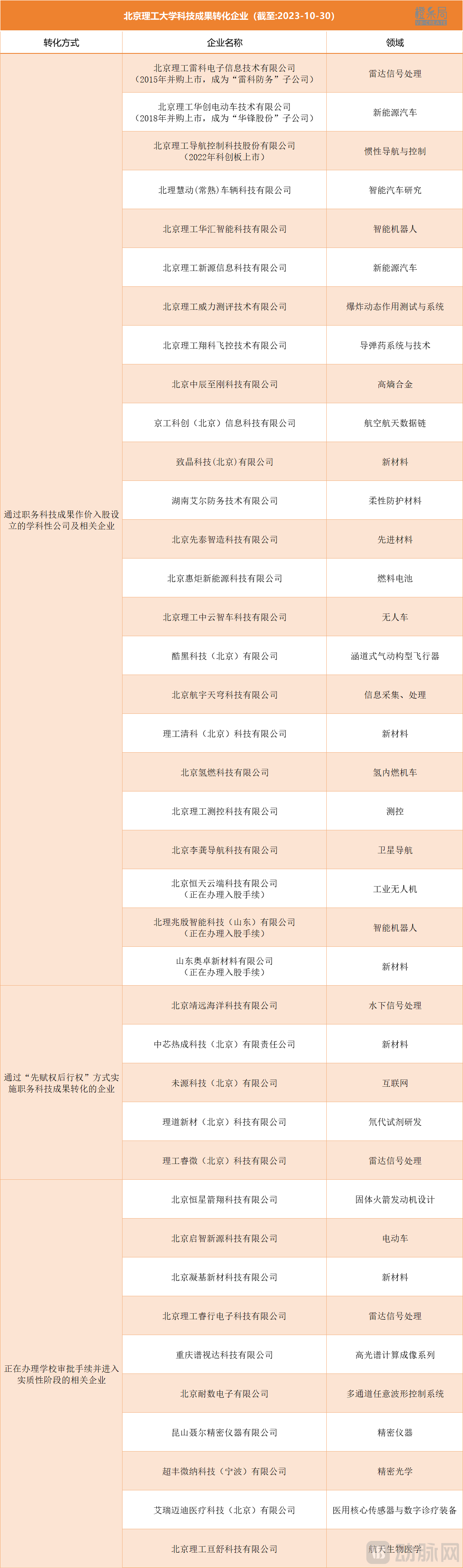 List of Enterprises for the Commercialization of Scientific and Technological Achievements Approved by Beijing Institute of Technology as of October 30, 2023 (Source: Technology Transfer Center of Beijing Institute of Technology)
The declassification and application of defense-related scientific achievements to the civilian market represent a disruptive, "dimension-reducing" advantage. Consequently, enterprises backed by Beijing Institute of Technology (BIT) technologies are largely imprinted with the hallmark of cutting-edge, high-precision, and advanced science and technology—this is perhaps one of the most distinctive features of BIT’s spin-off companies, and alsoNorthProfessors in Science and EngineeringEntrepreneurshiptypical features.
In 1964, Mao Erke, then a professor, joined several other faculty members in establishing the Radar Research Institute at Beijing Institute of Technology. Against the backdrop of the times, the institute adhered to the principle that “scientific research should address urgent national needs and serve practical applications”—a foundation that later facilitated Academician Mao’s (elected in 1995) technology transfer and entrepreneurial endeavors.
As time went by, the Radar Research Institute also cultivated a group of outstanding young scientific research talents, and the innovative scientific research achievements created were countless. In order to transfer scientific research achievements to the market, Academician Mao came up with the idea of establishing a company.
At that time, it was widely believed that researchers should devote themselves diligently to their work, while founding a company was considered an unattainable fantasy. Just as professors were grappling with this dilemma, the Zhongguancun National Independent Innovation Demonstration Zone was approved, and the professors immediately seized this policy window. At the end of 2009, Mao Erke, together with more than ten faculty members from the Radar Research Institute of Beijing Institute of Technology, embarked on an entrepreneurial venture and establishedLigong Leike——It is also the first discipline-based company established under the new policy.
Not coincidentally, in addition to Academician Mao, Beijing Institute of Technology is also home to Li Gong Hua Chuang, founded by Professor Lin Cheng, and Beijing Hydrogen Combustion, established by Professor Sun Baigang. Both in the past and present, a large number of professors continue to venture into entrepreneurship, naturally inspiring students to engage in innovation and startups.
Defense technology and professor-led startups—these two distinctive features have bolstered Beijing Institute of Technology’s (BIT) confidence in technology transfer. This is by no means accidental; a deeper look reveals that BIT’s true, closely guarded secret lies in its discipline-specific advantages aligned with innovation trends and its policy frameworks that keep pace with the times.
II. From Advantages to Trends
As a national defense industry university held in high esteem, Beijing Institute of Technology (BIT) has configured its academic programs differently from other higher education institutions, creating opportunities to develop disciplinary advantages. By cultivating talent and fostering an environment for innovation and entrepreneurship, BIT has turned these advantages into prevailing trends.
1National Defense Technology Major Lays the Foundation for Scientific Research
In early November 2023, ShanghaiRanking released the “2023 Best Chinese Subjects Ranking.” Beijing Institute of Technology firmly secured its position in the “first tier” with six subjects ranked among the best and 30 subjects listed, demonstrating outstanding strength.
The six disciplines rated as “China’s Top Disciplines” are Mechanical Engineering, Information and Communication Engineering, Control Science and Engineering, Weaponry Science and Technology, Cyberspace Security, and Management Science and Engineering. From this, it is not difficult to observe thatMost of the selected disciplines are closely aligned with the distinctive features of national defense technology.
Moreover, in the latest ESI data released this September, Beijing Institute of Technology’s four disciplines—Engineering Science, Materials Science, Chemistry, and Computer Science—ranked within the top 1‰ globally, with an additional 11 disciplines ranking within the top 1% worldwide.
The reasons why Beijing Institute of Technology has achieved such academic accomplishments are mainly threefold.
First, the establishment of Beijing Institute of Technology (BIT) was driven by clear objectives. Compared with traditional comprehensive universities, BIT’s academic programs pursue a “small but specialized” model with a distinct national defense orientation. This has enabled the university to further subdivide broad disciplines and maintain sustained in-depth development within niche fields.
Secondly, Beijing Institute of Technology boasts a robust faculty. In the early years of its establishment, many distinguished scholars served at BIT, including Professor Ma Shixiu, one of the principal founders of engineering optics in China; Academician Wang Xiaomo, known as the “Father of Chinese Early Warning Aircraft”; and Academician Xu Gengguang, an expert in explosion theory and explosive application technologies. They have cultivated a large number of talents, such as Professor Long Teng and Professor Xu Ying, who now stand at the forefront of China’s national defense research.
To this day, nearly 40 academicians of the Chinese Academy of Sciences and the Chinese Academy of Engineering, along with more than 450 recipients of national-level talent programs (data as of April 2023), continue to teach at Beijing Institute of Technology (BIT). In the list of newly elected academicians announced on November 23, 2023, five BIT affiliates were elected, further strengthening the university’s faculty prowess.
Furthermore, the advancement of academic disciplines relies heavily on the impetus provided by scientific research. In recent years, Beijing Institute of Technology has established a series of research platforms, including the Advanced Materials Experimental Center, the Microwave Anechoic Chamber, the Beijing Engineering Research Center for Mixed Reality and Novel Display Technologies, and the Laboratory for Reconfigurable Launch Vehicle Technology at Beijing Institute of Technology. These abundant key laboratory resources not only facilitate the generation of high-quality research outcomes but also promote the continuous modernization of disciplinary development.
2Cultivate Scientific Research Talents First, Then Integrate Entrepreneurial Spirit into the Classroom
Students from Beijing Institute of Technology (BIT) are virtually ever-present in major innovation and entrepreneurship competitions. Their achievements—such as winning the championship in the “Challenge Cup” and the “Chuang Qingchun” Competition, as well as securing first prizes in artificial intelligence and mathematical modeling contests—not only highlight the strengths of BIT’s academic platforms but also underscore its advantages in talent cultivation.
In 2018, Beijing Institute of Technology implemented the “SPACE+X” (Global+) plan for talent cultivation reform, establishing a tripartite talent development model integrating “value shaping, knowledge acquisition, and practical competence,” and constructing an integrated undergraduate–master’s–doctoral training system.
At Beijing Institute of Technology (BIT), the selection of a major is not determined solely by the National College Entrance Examination (Gaokao) scores. Upon enrollment, students are initially assigned to broad disciplinary categories. After completing one year of general and foundational education, and having gained a basic understanding of various majors, students can confirm their specific major within the scope of their broad category based on their interests and academic requirements, using a method that combines “preference respect with score-based ranking.” For major selection, BIT also adopts a policy of “unrestricted transfer-out, assessed transfer-in.” This approach not only helps to tap into students’ research potential in a targeted manner but also promotes interdisciplinary integration, thereby cultivating more cross-disciplinary talents for the future scientific research community.
Furthermore, Beijing Institute of Technology (BIT) provides targeted cultivation for outstanding students through its “Experimental Classes.” Depending on the academic discipline, BIT currently offers a variety of distinctive specialized experimental classes, such as the “Xu Teli Elite Class,” the “Electronic Information Experimental Class,” and the “Intelligent Manufacturing and Vehicles Experimental Class.” Students admitted to these experimental classes are mentored under a one-on-one tutorial system. The university also encourages undergraduates to undertake at least one study experience at a prestigious overseas university during their undergraduate studies and provides dedicated financial support for this purpose.
Beijing Institute of Technology’s “Experimental Class” has achieved remarkable success. Taking the “Electronic Information Experimental Class” as an example, it has cultivated more than ten academicians since its inception, and many of its students are actively engaged in tackling key technological challenges in domestic and international 5G and 6G systems.
In addition to cultivating scientific research talent, Beijing Institute of Technology has established a dedicated “Makerspace” to encourage research teams, technological innovation platforms, and alumni entrepreneurship platforms to launch university-based innovation and entrepreneurship projects. Furthermore, the “Student Innovation and Entrepreneurship Practice Center,” which focuses on providing entrepreneurial services to students, enhances their innovation and entrepreneurship capabilities through tangible support.
More importantly,Many professors have integrated concepts of innovation and entrepreneurship into their classrooms and laboratories.Taking the Optoelectronic Innovation Education and Practice Base, led by Professor Zhang Zhonglian, as an example, Professor Zhang requires students to engage in entrepreneurial endeavors during both their graduation internships and final-year projects, applying their acquired knowledge to solve real-world problems. To date, over 10,000 students have embarked on their entrepreneurial journeys through this platform. At Beijing Institute of Technology, Professor Zhang is by no means the only faculty member who integrates innovation and entrepreneurship into classroom teaching, nor will he be the last.
III. Two Institutional Innovations
Returning to the commercialization of scientific and technological achievements, Beijing Institute of Technology’s (BIT) path has not been smooth. Behind its success lie inevitable setbacks. However, BIT’s pragmatic spirit—characterized by reflective practice and leveraging strengths while addressing weaknesses—has enabled its commercialization policies to adapt dynamically to changing times and keep pace with the era.
1Phase I: University technology equity contribution + implementation of equity incentives + team cash investment
2010 marked a turning point for the commercialization of scientific and technological achievements from China’s research institutes and universities. That year, Zhongguancun’s “1+6” pilot policies provided significant incentives for such commercialization by delegating to universities and research institutes the autonomous authority to dispose of intellectual property rights valued at under RMB 8 million.
Previously, technology transfer projects at research institutions and universities valued at over RMB 8 million required approval from the competent authorities and filing with the Ministry of Finance before they could proceed. This back-and-forth bureaucratic process consumed significant time and energy for research teams. Given the rapid pace of technological innovation, missing the market window would adversely affect the outcomes of technology transfer.
Delegation not only enables research teams to accelerate the translation of their findings, but also sends a strong signal:Encourage research institutions and universities to carry out technology transfer。
Seizing this opportunity, Beijing Institute of Technology pioneered an innovative pathway for technology transfer through discipline-based companies. By adopting a model that combines “university equity contribution via technology, implementation of equity incentives, and cash investment by the team,” the university supports faculty members in undertaking on-the-job entrepreneurship to commercialize major scientific and technological achievements.
The university has, to the greatest extent possible, returned decision-making authority over technology commercialization to researchers, while strengthening their sense of responsibility for managing and commercializing research outcomes through a mechanism that aligns responsibilities, rights, and interests. Under this policy framework, Beijing Institute of Technology (BIT) successfully spun off Leike Technologies, a publicly listed company. Within less than four years of its establishment, the company achieved cumulative sales revenue exceeding RMB 350 million and commercialized seven new products, including BeiDou satellite navigation baseband chips, terminal devices, and foreign object debris (FOD) detection radar for airport runways.
2Phase II: Professionalized Management + Market-Oriented Operations
By 2016, Beijing Institute of Technology leveraged its first-mover advantage in technology transfer to further innovate its commercialization policies.
Previously, Beijing Institute of Technology (BIT) did not have dedicated staff responsible for technology transfer; instead, it adopted a decentralized approach by appointing coordinators within various schools and laboratories to consolidate information at the university level. However, with personnel scattered across the campus and no direct personal stake in translation outcomes, this structural disconnect may partly explain why BIT has not generated more significant technology transfer achievements.
To address this issue, in 2016Beijing Institute of Technology has establishedTechnology Transfer Center,At the same time, Beijing Institute of Technology Technology Transfer Co., Ltd. was registered as its market-oriented operation platform.
The Center and the Company operate under a “single team, dual branding” model: the Center primarily fulfills functions such as the review and approval of transfers, licensing, and equity investments based on valued scientific and technological achievements; whereas the Company mainly promotes the transfer and commercialization of such achievements through market-oriented mechanisms. This approach is also referred to as “public institution-style management combined with market-oriented operations.”
On one hand, institutionalized management enables universities to accurately monitor the dynamics of researchers’ technology transfer activities and safeguard these processes throughout under the university’s name; on the other hand, market-oriented operations can break the “iron rice bowl” culture of guaranteed income regardless of performance, thereby stimulating the vitality of personnel involved in technology transfer.
Furthermore, regarding its operational mechanism, Beijing Institute of Technology has proposed a scheme whereby 10% of the proceeds from achievement commercialization are allocated as departmental funding, covering all expenses including personnel salaries, with no additional separate funding provided. By linking commercialization performance directly to researchers and technology transfer professionals, the institute aims to strengthen the team’s sense of ownership and incentivize commercialization through tangible personal interests.
Driven by this policy, Beijing Institute of Technology has accelerated the cultivation and incubation of a cohort of leading high-tech enterprises, including Air Defense, Zhijing Technology, BIT Qingke, and BIT Xinyuan. These achievements demonstrate that even within public institutions, it is possible to build technology transfer teams with strong market vitality.
IV. Located in Zhongguancun, “University-Local Government” Collaborative Partnership
Looking beyond the campus, Beijing Institute of Technology is located in Zhongguancun, Beijing, known as “China’s Silicon Valley.” This area is home not only to 41 higher education institutions, including Peking University, Renmin University of China, and Tsinghua University, but also to 206 national (and municipal) scientific research institutes, represented by those affiliated with the Chinese Academy of Sciences and the Chinese Academy of Engineering, as well as 67 national key laboratories.
Beyond its formidable research prowess, its capacity for commercialization is equally impressive. Statistics show that the transaction value of technology contracts in Zhongguancun accounts for approximately one-third of the national total, with nearly 80% extending to regions outside Beijing. On this fertile ground where scientific research and commercialization advance hand in hand, Beijing Institute of Technology has also reaped significant benefits.
The concentration of research institutions and universities enables Beijing Institute of Technology (BIT) to further strengthen its scientific research collaborations both on and off campus. Furthermore, as of May 2023, more than 300 multinational corporations had established branches in Zhongguancun. This facilitates the alignment of BIT’s research achievements with international standards, garnering global attention. Moreover, Zhongguancun has become a representative hub for innovative scientific research in China, where many major policies are piloted, allowing BIT to benefit from these policy advantages.
Universities are never isolated entities; they draw greater innovative strength by developing within the technological ecosystem. Beijing Institute of Technology nurtures Zhongguancun with its technology transfer capabilities, while also benefiting from its reciprocal support.
V. The BIT Story Continues
In October 2020, Beijing Institute of Technology (BIT), by virtue of its outstanding achievements in technology transfer and commercialization, was officially approved to establish the “Beijing University Technology Transfer and Commercialization Promotion Center,” becoming a model for numerous other universities to emulate and learn from.
However, BIT’s story of technology transfer does not end here; the university continues to advance innovation in both scientific research and institutional frameworks.
At the Zhongguancun Forum, Chen Boqiang briefly revealed“BIT Model 2.0”plan. From this, we can see that Beijing Institute of Technology will continue to strengthen enterprise-led deep integration of industry, academia, and research, further upgrading the “Center + Company + Research Institute” trinity model into a new generation of technology transfer institutions, with the aim of exploring a commercialization mechanism better tailored to the actual conditions of Beijing Institute of Technology.
“Virtue Illuminates Reason, Learning Masters Precision”—innovation and translation have long been woven into the scientific research life of every member of the Beijing Institute of Technology community. In the future, they will continue to press forward, setting more benchmarks on the path of technology transfer.