

Kelun-Biotech's RET Inhibitor A400 Receives FDA Orphan Drug Designation as the 23rd Chinese Orphan Drug Approved This Year
Kelun-Biotech
Innovative Drug Developer
On November 26, Sichuan Kelun-Biotech Biopharmaceutical Co., Ltd. (hereinafter referred to as “Kelun-Biotech”) announced that its investigational small-molecule RET kinase inhibitor A400 (KL590586, EP0031) has been granted Orphan Drug Designation by the U.S. Food and Drug Administration (FDA) for the treatment of RET fusion-positive solid tumors.
This is Kelun-Biotech’s first investigational drug to receive FDA Orphan Drug Designation this year, and the 23rd orphan drug from China to gain FDA approval this year.
The RET gene is a proto-oncogene carried by every individual. Under normal circumstances, the RET gene is regulated and constrained by the body’s own mechanisms, preventing excessive proliferation of normal or tumor cells. However, once mutations occur in the RET gene, they may lead to the development of cancer cells. Data indicate that the incidence of RET gene fusions is approximately 1–2% in patients with non-small cell lung cancer (NSCLC), about 10% in papillary thyroid carcinoma (PTC), and around 60% in medullary thyroid carcinoma (MTC)1.
Currently, conventional chemotherapy and immunotherapy are commonly used treatment modalities. However, for patients who have developed resistance to multi-kinase inhibitors (MKIs) and first-generation selective RET inhibitors (SRIs), the efficacy of chemotherapy and immunotherapy is limited, resulting in a poor prognosis and few effective therapeutic options. Therefore, there remains an unmet clinical need among patients with RET-positive tumors.
A400 is a next-generation selective RET inhibitor (SRI) with broad activity against common RET gene fusions and mutations, positioning it as a promising second-generation SRI for the treatment of RET-positive solid tumors. Preclinical studies have demonstrated that, compared with first-generation SRIs, A400 exhibits potent inhibitory activity against RET kinase both in vitro and in vivo, with significantly higher selectivity for RET over VEGFR2, JAK1, and JAK2. Furthermore, A400 has shown favorable blood-brain barrier penetration in animal models.
Previously, Kelun-Biotech announced the results of its Phase I/II clinical study of A400 in patients with advanced solid tumors harboring RET gene alterations. The study consisted of two parts: dose escalation (six dose cohorts, 10–120 mg, once daily) and dose expansion (60 mg/90 mg, once daily), enrolling a total of 109 patients.
Data indicate that, in terms of safety, no dose-limiting toxicities (DLTs) were observed in the A400 10–120 mg group. Treatment-related adverse events (TRAEs) occurred in 94.5% of patients, with the majority being Grade 1–2. Regarding efficacy, as of April 20 this year, 90 patients receiving A400 at doses ranging from 40 mg to 120 mg were evaluable for response, achieving an objective response rate (ORR) of 60% and a disease control rate (DCR) of 94%. In the A400 90 mg dose cohort, 56 patients were evaluable for response, with an ORR of 63% and a DCR of 95%.
Notably, among the 6 patients with measurable brain lesions at baseline treated with A400, 5 of whom had not previously received radiotherapy, brain lesions shrank by more than 30%, and in 3 cases, the brain lesions completely disappeared.
In March 2021, Kelun-Biotech entered into a regional licensing and collaboration agreement with the UK-based biopharmaceutical company Ellipses Pharma Ltd., granting Ellipses exclusive, paid rights to develop and commercialize A400 in Europe, the United States, and other designated regions. Kelun-Biotech retained rights for Greater China and certain Asia-Pacific markets, including South Korea, Singapore, and Malaysia. Both parties will conduct development and commercialization activities within their respective territories and leverage regional data to support the global research and development of the project.
In May 2023, Kelun-Biotech completed clinical consultation with the Center for Drug Evaluation (CDE). Currently, a pivotal clinical study of A400 for second-line and later treatment of advanced RET-positive non-small cell lung cancer (NSCLC) is underway in China.
“Rare diseases” are not rare, but drugs for rare diseases are.
According to the data from the "2021 Research Report on the Definition of Rare Diseases in China," there are currently more than 1,400 known rare diseases in China, with the patient population exceeding 20 million. The "First Batch of Rare Diseases Catalog" shows that, to date, a total of 199 drugs have been marketed globally, covering 87 types of rare diseases; among them, 103 drugs have been marketed in China, covering 47 types of rare diseases.
Although the number of rare disease drugs approved for marketing in China has shown a significant upward trend in recent years, it remains low compared with that in foreign countries. Patients continue to face a shortage of therapeutic options and the dilemma of “drugs available overseas but not domestically.”
However, the limited availability of drugs for rare diseases is gradually improving. In contrast to the previous hesitation of pharmaceutical companies to enter the rare disease field, domestic pharmaceutical enterprises are now actively positioning themselves in the rare disease drug development sector and accelerating R&D efforts, driven by factors such as adjustments in national pharmaceutical policies and growing clinical demand.
According to data from Frost & Sullivan’s “2023 China Rare Disease Industry Trend Observation Report,” as of February 2023, there were 81 rare disease drugs (excluding chemical generics and biosimilars) in clinical trials or under marketing application review in China, covering 27 rare diseases. Among these, 46 drugs were independently developed or co-introduced by domestic pharmaceutical companies, involving 16 rare diseases. Chinese pharmaceutical companies are actively promoting the research and development of rare disease drugs, leading to a continuous emergence of innovative therapies for rare diseases.
According to incomplete statistics, a total of 23 investigational drugs in China have received FDA Orphan Drug Designation as of 2023.
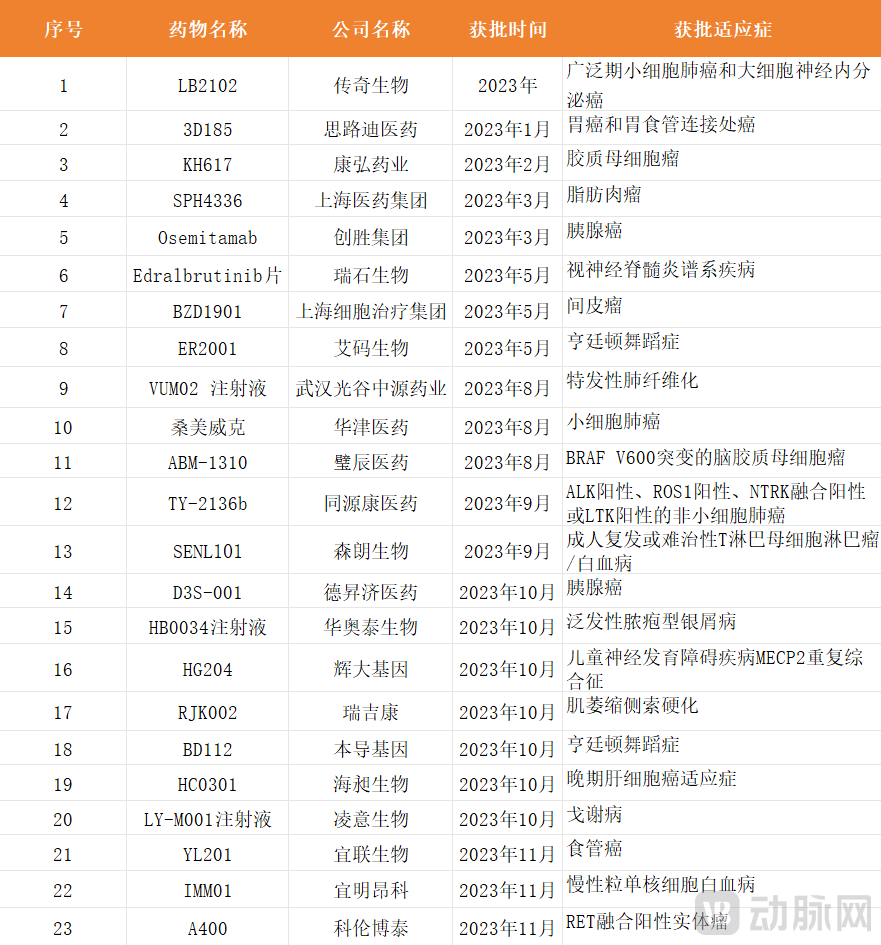 Orphan Drugs Approved by China’s NMPA in 2023
Source: Compiled from public data; graphic by VCBeat.
As the number of marketed rare disease drugs continues to increase, their market size is also expanding. According to data published by Frost & Sullivan, the market size for orphan drugs in China was approximately $1.3 billion in 2020 and is projected to reach $25.9 billion by 2030, accounting for about 7% of the global orphan drug market.
In the future, with the advancement of R&D and product approvals for market launch, Chinese pharmaceutical companies may become the dominant players in this $10 billion market, addressing the challenge of “untreatable” conditions.
References:
1.Drilon A, Hu ZI, Lai GGY, Tan DSW. Targeting RET-driven cancers: lessons from evolving preclinical and clinical landscapes. Nat Rev Clin Oncol. 2018 Mar;15(3):151-167. doi: 10.1038/nrclinonc.2017.175. Epub 2017 Nov 14. Erratum in: Nat Rev Clin Oncol. 2017 Nov 28;: PMID: 29134959; PMCID: PMC7938338.