

Yingnuo Medical Secures Strategic Collaboration with Olympus to Lead AI-Powered Digestive Endoscopy Diagnosis
Although11The weather in the month grew increasingly cold,Digestive EndoscopyAIReal-Time Assistance System VendorsXiamen Yingnuo Medical Technology Co., Ltd. (abbreviated as: Yingnuo Medical)Yet Good News Keeps Coming, Warming the Heart, ushering in its own season of harvest.
On November 6, Yingnuo Medical signed a strategic cooperation agreement with Olympus (China) Co., Ltd., a leading enterprise in the field of digestive endoscopy. It is reported that Yingnuo Medical’s self-developed “Yingnuo Eagle Eye” software, an AI-assisted detection system for electronic lower gastrointestinal endoscopic images of colorectal polyps, was developed based on hundreds of thousands of colonoscopy cases and boasts a processing speed of up to 60 frames per second. When used in conjunction with Olympus’s digestive endoscopy systems, the software can accurately identify lesions in the lower gastrointestinal tract, assisting endoscopists in improving the detection rates of early-stage cancer and precancerous lesions. Through this collaboration, both parties will jointly explore the innovative applications and development of artificial intelligence technology in the field of digestive endoscopy.
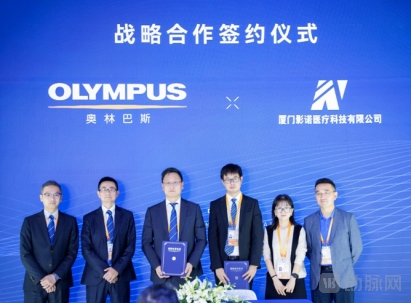
Signing Ceremony of the Strategic Cooperation Agreement between Olympus (China) and Yingnuo Medical
November 8, Yingnuo Eagle Eye®The “Electronic Lower Gastrointestinal Endoscopy Image-Assisted Detection Software for Intestinal Polyps” has obtained the NMPA Class III Medical Device Registration Certificate.
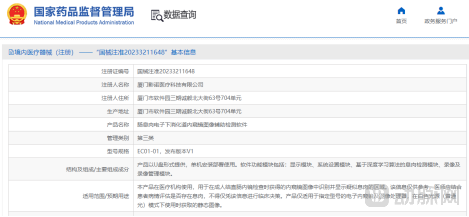
Yingnuo Eagle Eye®The Series of Products Successfully Obtained Class III Medical Device Registration Certificate
On November 9, Professor Hu Bing’s team from West China Hospital of Sichuan University published a large-scale, prospective, multicenter, double-blind, tandem randomized controlled trial in *The Lancet Gastroenterology & Hepatology* (IF=35.7), titled “Effect of an artificial intelligence-assisted system on endoscopic diagnosis of superficial oesophageal squamous cell carcinoma and precancerous lesions: a multicentre, tandem, double-blind, randomised controlled trial.” The results demonstrated that the “Yingnuo Eagle Eye” system significantly improves endoscopists’ detection rates of superficial esophageal squamous cell carcinoma (SESCC) and its precancerous lesions without prolonging examination time, thereby reducing the risk of missed diagnoses and exhibiting a favorable safety profile.
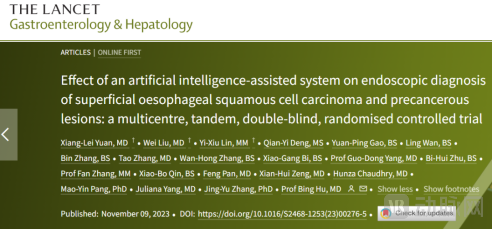
West China Hospital and Yingnuo Medical Unveil Latest Research: AI Significantly Improves Detection Rate of Superficial Esophageal Squamous Cell Carcinoma
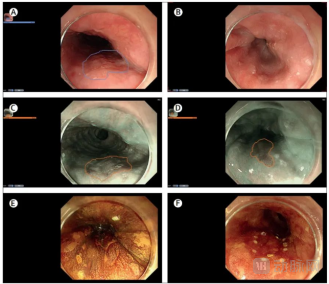
(A, C, E): Both “Yingnuo Eagle Eye” and the endoscopist identified lesions invading the lamina propria of the mucosa;
(B, D, F): Without the assistance of “Yingnuo Eagle Eye,” physicians failed to detect the lesions; upon secondary examination (AI-assisted), the lesions were identified.
(Figures and case sourced from The Lancet Gastroenterology & Hepatology)
Why Has Yinuo Medical, After Years of Stealth Operations, Stood Out Among AI-Endoscopy Manufacturers? Yinuo Eagle Eye®What advantages do the company’s product lines hold over similar offerings on the market? How is Yinuo Medical advancing the implementation and application of its comprehensive AI solutions for gastroenterology? With these questions in mind, VCBeat conducted an exclusive interview with Hu Yanxing, founder of Yinuo Medical.
China has a vast population of patients with gastrointestinal diseases, and the incidence of related tumors is high. Early diagnosis and treatment of gastrointestinal tumors are of great significance to national health. Endoscopy is the optimal method for the early detection and diagnosis of gastrointestinal tumors. However, constrained by factors such as endoscopic equipment, examination procedures, and the experience and fatigue levels of endoscopists, the quality of endoscopic examinations and diagnostic standards in China vary significantly. This has resulted in critical challenges, including low early detection rates of gastrointestinal tumors and low overall patient survival rates.
The AI-powered real-time assistant diagnostic system for digestive endoscopy, “Yingnuo Eagle Eye,” has emerged as a timely solution. This product aims to leverage artificial intelligence (AI) technology to enhance the detection rates of early-stage cancer and precancerous lesions during digestive endoscopic examinations. Its core functionalities include “lesion detection,” “lesion diagnosis,” and “surgical quality control.”It offers advantages such as real-time performance, high sensitivity, high specificity, and high convenience.
Colorectal cancer is the second most common cancer in China, with 95% of cases evolving from intestinal polyps. The recently approved Yingnuo Eagle Eye®The product series “Electronic Lower Gastrointestinal Endoscopy Image-Assisted Detection Software for Intestinal Polyps” has achievedHigh sensitivity and specificity, minimizing false-positive interference for physicians while ensuring high sensitivity.Its agile, smooth, and precise processing capabilities also provide physicians with a comfortable user experience.. In addition, for some clinically more complex intestinal polyp lesions, the algorithm can also demonstrate excellent clinical performance.
It is reported that multiple functions of the “Yingnuo Eagle Eye” series are currently undergoing clinical registration and approval, and the products are poised for imminent market launch.
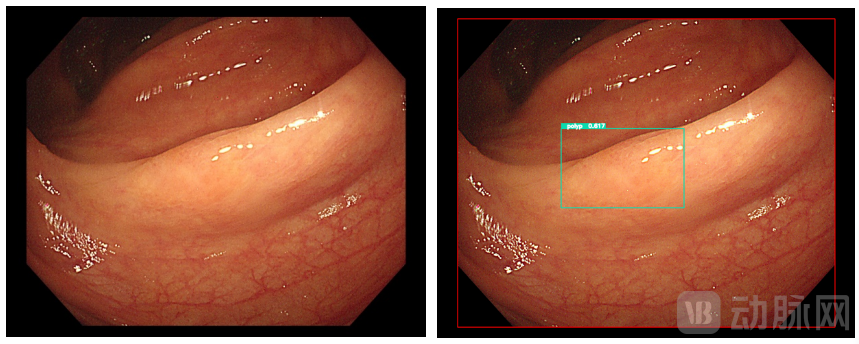
“Yingnuo Eagle Eye” for the detection of sessile serrated adenomas (precancerous lesions with high malignant potential, low incidence, and low detection rates)
Left: Original image; Right: “Yingnuo Eagle Eye” detection image
“In the field of digestive endoscopy,For AI-assisted diagnostic systems to gain clinical acceptance, they must satisfy three core elements: first, align with physicians’ usage habits and diagnostic reasoning; second, ensure that the product’s research, development, and manufacturing processes comply with regulatory requirements; and third, achieve high accuracy.“This accuracy improvement is not merely an increase in sensitivity or specificity, but rather an enhancement of the model’s overall accuracy,” Hu Yanxing told VCBeat.Yingnuo Medical has adopted a three-pronged approach—continuously expanding datasets to enhance algorithm generalizability, incorporating expert physician insights, and implementing more rigorous data screening and annotation—to steadily improve the sensitivity of “Yingnuo Eagle Eye” in detecting various types of lesions while consistently reducing the model’s false-positive rate.
“In addition to core metrics such as sensitivity and specificity, there are also some intangible characteristics that are difficult to quantify but are equally important in clinical practice,” Hu Yanxing illustrated. “For instance, both AI and physicians can detect the same lesion; however, the auxiliary value of AI is only realized when it detects the lesion earlier than physicians.”
Yingnuo Medical’s AI-powered real-time auxiliary diagnostic system for digestive endoscopy has been able to precisely address current clinical pain points, effectively improve diagnostic efficiency and quality, and genuinely meet patient needs. This success is attributable, in part, to the company’s strong R&D capabilities. Yingnuo Medical’s core team comprises professors and PhDs from prestigious institutions such as The Chinese University of Hong Kong, The Hong Kong Polytechnic University, Xiamen University, and West China Hospital of Sichuan University, bringing deep expertise and robust research and development strength to the field of AI-assisted diagnosis in digestive endoscopy.
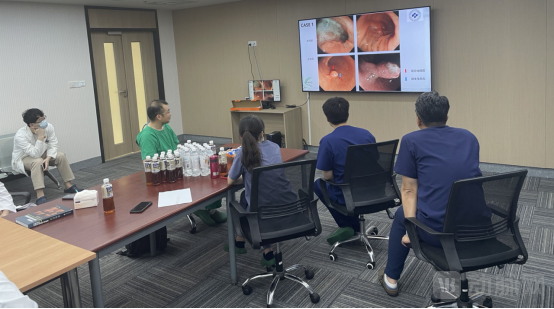
Yingnuo Medical Staff and Physicians Jointly Engage in Learning and Discussion
In product design, technological refinement, and exploration of clinical needs, Inno Medical adheres to the philosophy of “taking physicians as mentors and patients as the core,” deeply advancing research collaborations with clinicians and actively incorporating their authentic feedback.
“Physicians’ needs have subtle nuances. Only by understanding these nuances and respecting such requirements can a comprehensive AI-based digestive endoscopy solution be gradually developed. Although these differentiated needs may not be explicitly articulated, they align with the clinical scenarios and work habits of different physicians, thereby creating an authentic user experience,” summarized Hu Yanxing.
Yingnuo Eagle Eye®SystemCompletedDeployed in over 200 hospitals domestically and internationally, assisted in the examination of more than 200,000 cases, with no adverse events reported., receiving widespread acclaim from experts at all levels.
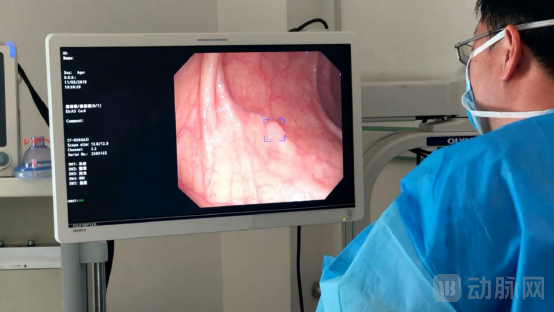
Doctors use Yingnuo Eagle Eye®
"The Roc Rises with the Wind in a Day, Soaring Ninety Thousand Li Straight Up."
According to the 2023 Blue Book of China’s Medical Device Industry, Olympus holds a market share exceeding 60% in the field of digestive endoscopy, backed by profound expertise in optical technologies. Meanwhile, Yingnuo Medical possesses specialized technology and experience in artificial intelligence and medical applications. This collaboration between Yingnuo Medical and Olympus undoubtedly represents “standing on the shoulders of giants,” ushering in Yingnuo’s own moment of soaring to “great heights.”
The two parties have joined forces to conduct in-depth research on real-time AI-assisted diagnosis and treatment in the field of digestive endoscopy, thereby promoting the application of artificial intelligence to smart diagnostic and therapeutic procedures in this domain. This collaboration marks a significant advancement for both parties in the field of digestive endoscopy. In the future, we will deepen our cooperation in innovative R&D, technological synergy, and market sales, jointly driving innovation and development in digestive endoscopy techniques. Our efforts aim to enhance the standardization of medical technical proficiency, accelerate the implementation of tiered diagnosis and treatment systems, and ultimately deliver superior diagnostic and therapeutic experiences and well-being to patients.
Leveraging Yingnuo Medical’s specialized expertise and experience in AI-driven healthcare, along with Olympus’s longstanding optical technology leadership in the endoscopy field, this collaboration focuses on research into real-time AI-assisted diagnosis and treatment in digestive endoscopy. The partnership aims to build an endoscopic ecosystem centered on a suite of AI-powered products, including AI-assisted detection, AI-assisted diagnosis, and AI-based quality control. This initiative is designed to advance the development of digestive endoscopy in China, promote standardized examinations and homogeneous technical practices, support the implementation of tiered diagnosis and treatment, substantially alleviate patients’ physical suffering and financial burden, and truly benefit the general public.