

Patient-Centric Service Chain Emerges as New Growth Driver: How Pharma Companies Can Seize Industry Opportunities
2023 was undoubtedly a year of profound significance for the healthcare industry.
On one hand, with the advent of the post-pandemic era, the healthcare industry is accelerating its restructuring. This transformation is not a mere return to previous models but rather an integration of the “online experiences” gained during the pandemic. On the other hand, the rapid advancements in digital technologies, such as large language models like GPT, have revealed new developmental directions for the entire healthcare sector.
Meanwhile, challenges persist: Against the backdrop of a frequently shifting global economic landscape, how to achieve cross-cycle development in the healthcare industry is undoubtedly a question facing industry practitioners.
Especially for pharmaceutical companies, how to better control costs and achieve cost reduction and efficiency improvement in pharmaceutical marketing under cost-containment policies such as the “Two-Invoice System” and centralized volume-based procurement; and how to iterate their products more rapidly to gain greater market recognition—these are undoubtedly challenges that the entire pharmaceutical industry seeks to address.
Baidu Health has also proposed a new pathway for end-to-end empowerment of the pharmaceutical industry against this backdrop: by building its “content + services” ecosystem, Baidu Health enables precise patient reach and efficient communication, thereby empowering the entire pharmaceutical value chain.
How Exactly Does Baidu Health Operate?
Over the past few years, pharmaceutical companies have made extensive efforts in the field of pharmaceutical marketing, focusing on key stakeholders such as physicians and patients.
In fact, traditional pharmaceutical marketing has predominantly focused on in-hospital scenarios. Pharmaceutical companies have primarily empowered physicians through academic education, aiming to enhance their academic knowledge and diagnostic and treatment capabilities, thereby ensuring that patients receive the most effective care when seeking medical consultation at hospitals. From the patient perspective, although pharmaceutical companies have made attempts, their previous extensive and untargeted popular science and patient education efforts often reached individuals merely associated with certain diseases rather than precisely identifying those with actual treatment needs. This has resulted in inefficiencies in patient education.
For pharmaceutical companies, with disease incidence rates remaining stable, the core challenge is undoubtedly how to identify patients more precisely and achieve efficient outreach to the target patient population. The outbreak of the pandemic has significantly shifted user attitudes toward health consultations and healthcare consumption, leading a large number of health-conscious individuals—both healthy and those with chronic conditions—to move their healthcare spending online. This shift has also drawn greater attention to patient education and science popularization channels, which were previously “underestimated.”
However, as patient education and outreach gain significant momentum, the challenges facing pharmaceutical companies are also becoming increasingly apparent.
First, there is the issue of how to capture precise patient traffic.The traditional model of academic education for physicians is predicated on a key assumption: that patient needs are clearly defined. Patients typically undergo triage, registration, and other steps before finally consulting with an outpatient physician. However, the vast population of internet users does not constitute a well-defined patient cohort; their healthcare-related needs are often vague and ill-defined.
Secondly, there is the issue of how to establish efficient communication with patients.Unlike discretionary consumption of consumer goods, when faced with health issues, a patient’s adoption of Treatment A necessarily entails forgoing Treatment B. This also implies an increased opportunity cost of treatment, leading patients to exercise greater caution in their decision-making.
Major internet tech giants are also attempting to address this issue by turning their attention to medical content. Platforms such as Baidu (a search engine), Tencent WeChat (a social networking tool), and Toutiao (an information platform) already boast massive user bases. Leveraging this advantage, they have all chosen to focus on popularizing medical science. This strategic shift is driven by several factors: first, there is substantial user demand for healthcare-related content; second, users searching for medical information are often potential patients; and third, the historically poor quality of medical content has left many user needs unmet.
However, even if medical content resolves the issue of patient acquisition (let alone the fact that it may not effectively address the challenge of acquiring precisely targeted patients), the underlying problem persists: merely providing medical science popularization ultimately addresses only the dissemination of knowledge. Yet, behind the demand for such educational content may lie users’ true need: access to higher-quality medical services.
Focusing solely on content provision tends to emphasize knowledge dissemination, whereas limiting oneself to service delivery requires patients to first understand their specific medical conditions. Many internet platforms have started with medical content but stalled at the service stage. In contrast, leveraging the characteristics of its search engine, Baidu has progressed from content to services, thereby building a comprehensive ecosystem. This outcome is a natural progression.
Undoubtedly, only by establishing a robust “content + services” ecosystem can patient needs be effectively met and efficient communication with patients who have genuine healthcare demands be achieved. It is precisely based on this approach that Baidu Health has built its own unique “content + services” ecosystem.
Baidu Health addresses the “pre-link” challenges faced by patients by replicating the traditional patient consultation journey for disease diagnosis, thereby enabling online platform users to ultimately connect with physicians. Furthermore, by accurately identifying the right patients from a broad user base and directing them to appropriate, authoritative medical institutions, Baidu Health resolves the “post-link” service issues, ensuring precise patient management and care delivery.
Currently, leveraging its massive search traffic entry point, Baidu Health is comprehensively addressing users’ personalized needs through initiatives such as the Baidu Health Medical Encyclopedia, Brand Zone, and Pharmaceutical Company Zone, thereby building its ownBrand Presence。
The ability to achieve results is closely tied to the continuous development and refinement of Baidu Health’s “content + services” ecosystem.
In terms of content ecosystem development, Baidu Health has achieved comprehensive coverage ranging from medical encyclopedia entries and physician Q&A to live text-and-image broadcasts. It leverages Baidu’s authoritative search engine, the Baidu Health Baijiahao platform, and Baidu Health Medical Encyclopedia to deliver high-quality popular science content.
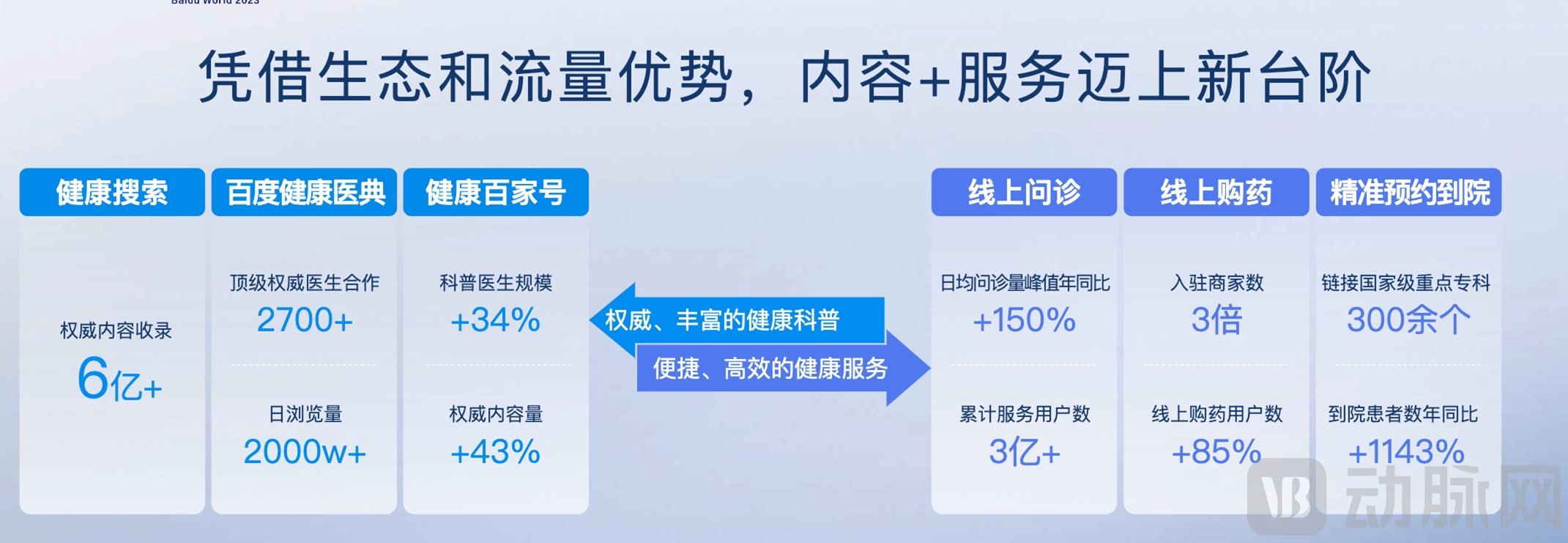
To better provide rigorous science-based health content and meet user demands, Baidu Health has also taken several measures:
For example, in terms of meeting user needs, the content provided by Baidu Health Medical Encyclopedia is guided by the search results of hundreds of millions of users. Each health term is produced under the drive of high-priority questions raised by users, fully responding to user concerns and achieving a match with content needs. Moreover, through Baidu Health’s unique advantages in popular science and patient education content, it can help users become more familiar with medications related to disease treatment and achievePositive Guidance; From the perspective of content producers, Baidu Health has currently partnered with over 3,000 top-tier experts and more than 200 leading authoritative institutions. By collaborating with academicians, hospital presidents (chief committee members), and senior department heads to co-create content, it fully ensures the authority of its popular science content, while also facilitatingOnline Physician Education and Training, to help physicians moreGain an in-depth understanding of therapeutic drugs for specific diseases.
It is reported that, leveraging professional physician-hosted content from public hospitals, Baidu Health currently conducts over 3,000 health-related live streaming sessions per month. In addition, Baidu Health has cumulatively produced 500 million pieces of popular science content. As one of the largest patient education platforms nationwide, and supported by scientific content covering the entire lifecycle of user health management, Baidu Health’s medical popular science content now sees a daily search volume as high as 200 million.
From the perspective of the medical service content ecosystem, Baidu Health currently offers diversified services, including online consultations, appointment scheduling, an e-commerce marketplace, and health check-up bookings, thereby fully meeting users’ diverse needs for health and disease-related services.
On one hand, Baidu Health has launched the “100 Cities, 100 Hospitals Initiative,” promoting the establishment of internet hospitals by public hospitals through providing one-stop services—including pre-consultation for specific diseases, appointment registration, online follow-up visits, home medication delivery, and follow-up management—to 300 hospitals across 100 cities in China. Furthermore, leveraging Baidu Health’s AI-driven precise matching capabilities, patients can be connected with specialist physicians in their respective fields of need. Additionally, when issues cannot be resolved online, Baidu Health extends its services to offline scenarios, enabling users to better access in-hospital care and thereby creating a closed-loop integration of online and offline medical services.
On the other hand, Baidu Health is committed to covering users' healthcare needs throughout their entire life cycle. Leveraging services such as online consultations, internet hospitals, chronic disease management, and an online marketplace, Baidu Health further meets patient demands. After receiving medical care, patients often require prescription medications. To address this, Baidu Health has built pharmaceutical e-commerce capabilities based on its online marketplace and other platforms, enabling omnichannel coverage across the entire network and fully satisfying patients' need for immediate access to therapeutic drugs.
Currently, Baidu Health has established direct partnerships with over 300,000 physicians, handling up to 2 million online medical consultations daily and serving a cumulative user base exceeding 210 million. The provision of thoughtful, 24/7 uninterrupted medical services has earned it more than 100 recommendations from Chinese and foreign embassies and consulates.
The refinement of Baidu Health’s “content + services” ecosystem is facilitating the construction of a patient-centric service pathway, while also empowering pharmaceutical companies to execute precision marketing.
In pharmaceutical marketing, one aspect that is often overlooked is the role played by “pharmaceutical companies.” These companies possess the capacity to enhance the industry’s ability to deliver better and faster solutions. From the physician’s perspective, they can empower doctors by helping them master new technologies and cutting-edge treatment regimens. From the patient’s perspective, they can help patients achieve a higher level of health literacy, enabling them to recognize when medical intervention is necessary.
Under compliance frameworks, pharmaceutical companies collaborate with Baidu Health to curate, organize, and disseminate high-quality content, thereby enhancing services for physicians and patients. Baidu Health’s core strength lies in its ability to deliver the most effective information to precisely targeted patients through more efficient channels. It is on this basis that numerous pharmaceutical companies have established partnerships with Baidu Health, spanning a wide range of therapeutic areas—from common to rare diseases, and from gynecology to pediatrics.
For instance, in the case of rare diseases, users can be guided toward accurate disease understanding during content searches, thereby facilitating subsequent medical services; for common diseases, high-quality professional science popularization content within search results offers improved solutions in areas where current treatment modalities exhibit suboptimal efficacy.
Not limited to disease types, Baidu Health is also continuously enhancing users' health awareness at various levels during the process of popular science and patient education:
1) More targeted delivery of science-based patient education content. Leveraging its big data analytics capabilities, along with resources such as Baidu Search and Baidu Health content, Baidu Health can gain deeper insights into the specific needs of particular regions and population groups. For example, it can push science-based patient education materials on gastric cancer prevention and treatment—co-created with authoritative clinical experts—to northern regions where gastric cancer incidence is relatively higher. This enables precise health education and helps improve local users’ dietary habits. Furthermore, by leveraging its own medical service capabilities, Baidu Health can better serve precisely identified patients.
2) Further promote the enhancement of health awareness among susceptible users. For example, in the case of HPV vaccination, public awareness of HPV vaccines is gradually increasing, yet gaps in knowledge persist. Traditional pharmaceutical e-commerce platforms primarily offer HPV vaccine appointment services to users who already have an established demand. In contrast, Baidu Health targets individuals with insufficient knowledge by disseminating medical content, thereby fostering improvements and shifts in user awareness. This approach ultimately encourages a broader segment of the market to schedule HPV vaccine appointments through its pharmaceutical e-commerce platform.
While continuously refining its “content + services” ecosystem to empower pharmaceutical companies with precision marketing, Baidu Health has not rested on its laurels.
First, Baidu Health continues to delve deeply into patient needs.Leveraging cloud computing, big data, and AI capabilities, Baidu Health continues to identify patient needs at a lower cost, while better matching them with accurate and effective medical science popularization content and corresponding healthcare services.
Secondly, Baidu Health is continuously integrating its products to meet patient needs.If Baidu Health initially moved toward better connecting “people and information,” it is now advancing further along the path of linking “people–information–services.” In addition to matching relevant information, Baidu Health will, in the future, serve patients more comprehensively through integrated products and new digital technologies, providing them with more intelligent recommendations, among other services.
Evidently, the successful implementation of the aforementioned strategy is attributable to Baidu Health’s robust AI capabilities and algorithms. In an era where large language models are increasingly integrated into application layers and AI capabilities are becoming ever more critical, Baidu Health is leveraging its own business operations to further empower stakeholders across the ecosystem—including healthcare providers, patients, and pharmaceutical companies—through a suite of capabilities and AI-native applications such as the Lingyi Large Language Model, the AI Health Assistant, and AI-powered medication instructions. This approach not only facilitates the practical deployment of technology but also establishes distinctive competitive barriers for Baidu throughout the upstream and downstream segments of the broader health industry chain.
For Baidu Health, collaboration with pharmaceutical companies is a natural outcome following the establishment of its “content + services” ecosystem. While continuously integrating products and services to better serve patients, Baidu Health will further empower pharmaceutical companies across their entire marketing value chain. Enhanced cooperation between the two parties will also drive progress in the overall healthcare industry and facilitate transcendence of traditional business cycles.
Amidst this, the original aspiration may remain unchanged. Medicine is inherently serious. Baidu Health has also stated that it will uphold evidence-based medicine. “Whether in terms of content or services, they must first align with medical science and meet patient needs,” emphasized Baidu Health. “Only in this way can we promote the healthy development of the industry.”