

Johns Hopkins Hospital Innovation Translation Revelation: Prospectus for Transforming Medical Breakthroughs into Global Impact
In 1873, in an apartment building on West Saratoga Street in downtown Baltimore, 78-year-old American banker Johns Hopkins passed away peacefully on his sickbed. He seemed to have no regrets about his departure, as he bequeathed his $7 million estate to establish two institutions to perpetuate his name: Johns Hopkins University and Johns Hopkins Hospital.
Sixteen years later, Johns Hopkins Hospital (JHH) was formally established as the medical teaching hospital and biomedical research institution of the Johns Hopkins School of Medicine in Baltimore, Maryland.
As a widely recognized founding institution of modern American medicine, Johns Hopkins Hospital and its School of Medicine are also the birthplace of many renowned medical traditions, such as ward rounds, residency programs, and house staff.
Over the past 25 years, two groundbreaking advances with profound implications in medicine have also been achieved at Johns Hopkins Hospital:
First, the discovery of restriction endonucleases, recognized by the Nobel Committee, laid the foundational groundwork for the emergence of the genetic engineering industry. Second, the discovery of endogenous opioid substances in the brain has also spurred extensive research into neurotransmitter pathways and functions.
Seemingly influenced by the founder’s original aspiration to give back to society, Johns Hopkins Hospital has steadfastly advanced over the past century in translating research achievements into clinical practice to benefit patients.
1A single entity overseeing industry, academia, and research.
Johns Hopkins Hospital represents a series of research, teaching, and clinical institutions in the Baltimore and Washington areas. How to coordinate the production, learning, and research work of all institutions? A higher-level entity seems to be the optimal solution.
Headquartered in Baltimore, Johns Hopkins Medicine integrates the physicians and scientists of the Johns Hopkins University School of Medicine with the institutions, healthcare professionals, and facilities of the Johns Hopkins Hospital and Health System, providing unified coordination for industry-academia-research collaboration and resource allocation.
The group operates eight academic and community hospitals, six suburban healthcare and surgical centers, and dozens of patient care sites to provide a wide range of medical services to patients in the Baltimore and Washington areas.
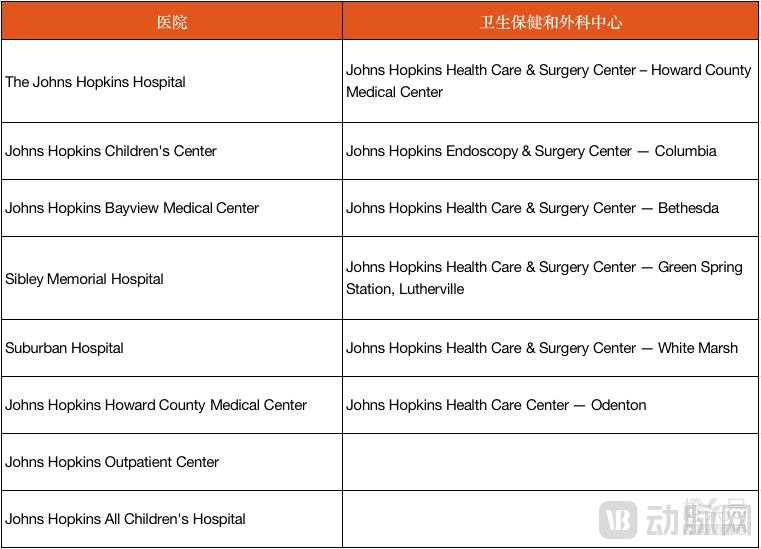
Supported by such an extensive medical network, the Group serves more than 2.8 million patients annually, enabling effective research and academic work within its medical schools and providing a fertile ground for tackling clinical challenges and expanding solutions globally.
2A department that delivers innovation commercialization to the market
Within this group-coordinated medical ecosystem, physicians engage in clinical practice at Johns Hopkins Hospital and its affiliated institutions while concurrently conducting research and teaching at the university’s school of medicine. Research findings generated through this process can be licensed to commercial enterprises via Johns Hopkins Technology Ventures (hereinafter referred to as JHTV), or translated into innovative ventures by establishing startups with the support of the group’s diverse resources.
The original purpose of establishing JHTV was to achieve long-term, beneficial social impact through commercialization.
As frontline participants in technology transfer, JHTV’s technology transfer team collaborates with inventors across the university to translate academic discoveries into products and services that benefit society.
The process of commercializing JHTV’s research achievements is not fundamentally different from the well-established practices at mature universities:
Upon receiving invention disclosures submitted by researchers from hospitals or universities, they assess the potential for future technological development and protect the technology through patent, trademark, or copyright applications.
Subsequently, we will promote the technology to the industry to identify one or more investors or companies interested in developing products based on this technology, and negotiate licensing agreements with interested parties.
Finally, maintain relationships with companies that develop licensed technologies and support and advise researchers in identifying the optimal commercialization pathway.
This similarity stems from the highly unified and well-established maturation and transformation mechanisms.
JHTV also provides corresponding programs and service guidance to inventors within the system to help them bring their ideas from the office or laboratory to the market. Whether by securing funding and establishing startups with partners, or licensing technologies to established industry partners, JHTV’s goal is to maximize the global impact of discoveries made within the Johns Hopkins system.
The FastForward program helps researchers establish startups and drive technologies from academia to the market by coordinating a unified portfolio of resources within the group. This resource portfolio includes:
Pair and connect with one or more mentors who have successfully founded, sold, or invested in startups;
Participate in the Network of Entrepreneurs in Science and Technology (NEST) and attend specialized, high-value lectures or expert knowledge sessions regularly provided by mentors;
A support department that liaises with dedicated staff to assist researchers in applying for financial incentives and serves as a technology transfer consultant to guide researchers through the application process;
Support departments for FastForward members, ranging from basic accounting and legal assistance to business analysis and IT infrastructure support.
With such robust back-end support, FastForward supported 14 startups in fiscal year 2022. The entire portfolio of 150 companies to date has raised $264 million in venture capital, generated $800,000 in conversion revenue, and seen 200 teams participate in I-Corps applications. The organization even launched a version tailored for college students—FastForwardU—building on the foundation of FastForward.
When it comes to universities, one must mention the unique Commercial College Transition Program exclusive to the Johns Hopkins system. This program seamlessly bridges the transitional phase for college students moving from academia to the marketplace.
As a highly competitive program, the JHTV Commercialization Academy offers Johns Hopkins full-time students a two-year paid internship to gain experience in commercialization and entrepreneurship. Participants work approximately 8–10 hours per week, with the option to work full-time during the summer.
Students at the JHTV Commercialization Academy gain unique experience related to technology development through daily interactions and training. All students have the opportunity to collaborate with JHTV staff and distinguished entrepreneurs to translate Johns Hopkins University’s groundbreaking research into products that transform and save lives, and even reshape entire industries.
Johns Hopkins’ resolve to create a profound impact is reflected not only in its commitment to researchers and students within the institution, but also extends to the general public.
The Social Innovation Lab originated from a student organization at Johns Hopkins University. Students, staff, and faculty from the School of Public Health, the School of Engineering, and the Business School joined forces to collaboratively tackle some of the world’s most pressing challenges in environment, energy, and medicine.
Companies dedicated to building innovative, sustainable, and scalable solutions for a healthy and prosperous world are eligible to access the program’s extensive network resources and incubator office spaces. Upon successful review of their applications, they may qualify for seed funding ranging from $5,000 to $25,000.
3Academic Institutions Ignite the Engine, Industry Keeps Fueling
Funding is the key to driving substantial progress in any scientific discovery. Under the model where the Johns Hopkins Group provides the framework and JHTV serves as the transmission structure, the final critical step is sustained operational support from the industry sector.
To enable researchers to focus on their scientific work and minimize the energy expended in securing funding, Johns Hopkins University has specifically designed a liaison process to assist researchers in tracking funding opportunities, thereby facilitating the commercialization of academic technologies.
These funds can be used to cover the costs of early-stage research, technology development, proof-of-concept studies, prototyping, clinical trials, and startup formation. Meanwhile, the Johns Hopkins Corporate Partnerships team assists in establishing, executing, and managing industry-institution partnerships. These collaborations typically center on sponsored research projects, bridging the gap between early scientific discoveries and their translation into new products.
These funds offer multiple advantages. On one hand, they can mitigate technical risks and enhance the company’s value in the eyes of business partners. On the other hand, such funding is typically not structured as equity investment, thereby avoiding dilution of ownership stakes.

4Multi-party Collaboration Drives the Emergence of Industrialization
Leveraging the Group’s framework, JHTV’s driving force, and the support of resources and funding from various parties, the Johns Hopkins system has been launching one project after another to address clinical challenges in the market:
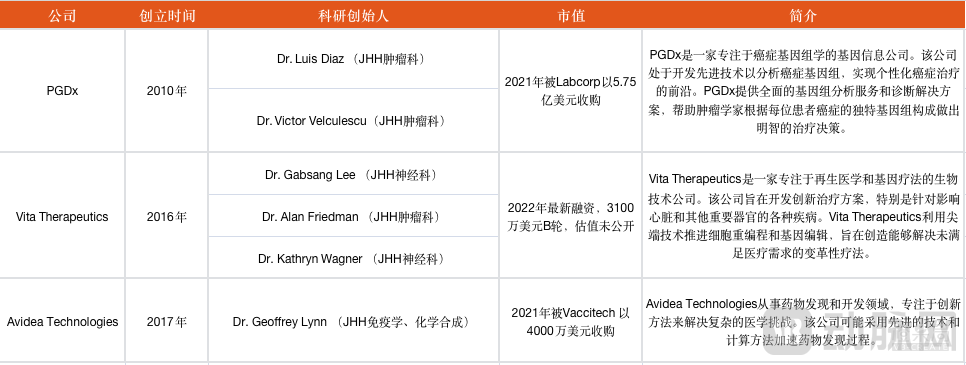
At the milestone of nearly 10 years since its establishment, JHTV has incubated and held equity stakes in more than 270 companies, with nearly 140 achieving exits. Among them, Maryland Technology Development Corporation, Gaingels, Plum Alley Investments, and Sand Hill Angels served as key co-investment partners, continuing to bolster subsequent industrialization efforts.
5Summary
It is evident that the Johns Hopkins model bears a striking resemblance to the innovation and translation models of Massachusetts General Hospital and Brigham and Women’s Hospital, as discussed in our previous article, “Harvard in One Hand, Clinical Practice in the Other: Insights into Research Translation at Mass General and Brigham.”
First, both rely on an overarching entity above medical schools, hospitals, and clinical centers to centrally coordinate and schedule innovation translation efforts;
Secondly, both have comprehensive systems for innovation and translation tailored to clinical researchers and students.
Finally, their abundant clinical resources provide both with the capital to attract substantial industry resources, partnerships, and funding.
However, unlike Mass General Brigham, Baltimore—home to Johns Hopkins—has a relatively less developed industrial cluster and venture capital ecosystem, making it more suitable for shifting its focus upstream toward scientific research and education. This undoubtedly offers valuable insights for the translation models of key research-oriented institutions in non-tier-one cities in China.