

CAR-T Therapy Faces New Safety Controversy Amid FDA Investigation and IPO Filing
The FDA has been striving to strike a balance between efficacy and safety.
Not long ago, when the FDA convened an Advisory Committee (AC) meeting to discuss the gene-editing therapy exa-cel, the discussion did not center on efficacy but rather focused on safety.
The outcome of the FDA’s approval decision on exa-cel remains uncertain. Yesterday (November 28), the FDA issued a public announcement,Announcement of an investigation into whether autologous CAR-T therapies targeting BCMA or CD19 pose a serious risk of T-cell malignancies in patients in rare cases.
The FDA has determined thatThe risk of T-cell malignancies applies to all currently approved autologous CAR-T therapies targeting BCMA or CD19.Adverse event reports received to date indicate that T-cell malignancies have occurred in patients treated with several products of this class. Currently, there are six such CAR-T therapies approved by the FDA for marketing, as detailed below:
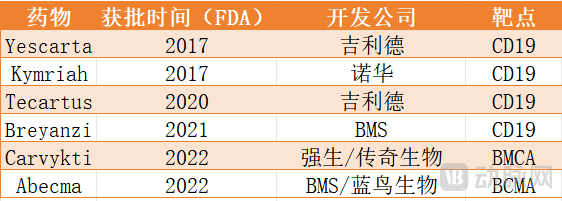 CAR-T Therapy Targeting BCMA and CD19 | Graphic by VCBeat
The entire issue originated from reports received by the FDA from clinical trials and post-marketing adverse event (AE) data sources, indicating cases of T-cell malignancies in patients treated with BCMA- or CD19-targeted autologous CAR-T therapies, some of which were severe enough to result in hospitalization or death. According to current disclosures from the FDA’s FAERS database, a total of 12 cases of T-cell lymphoma have been reported across six products.
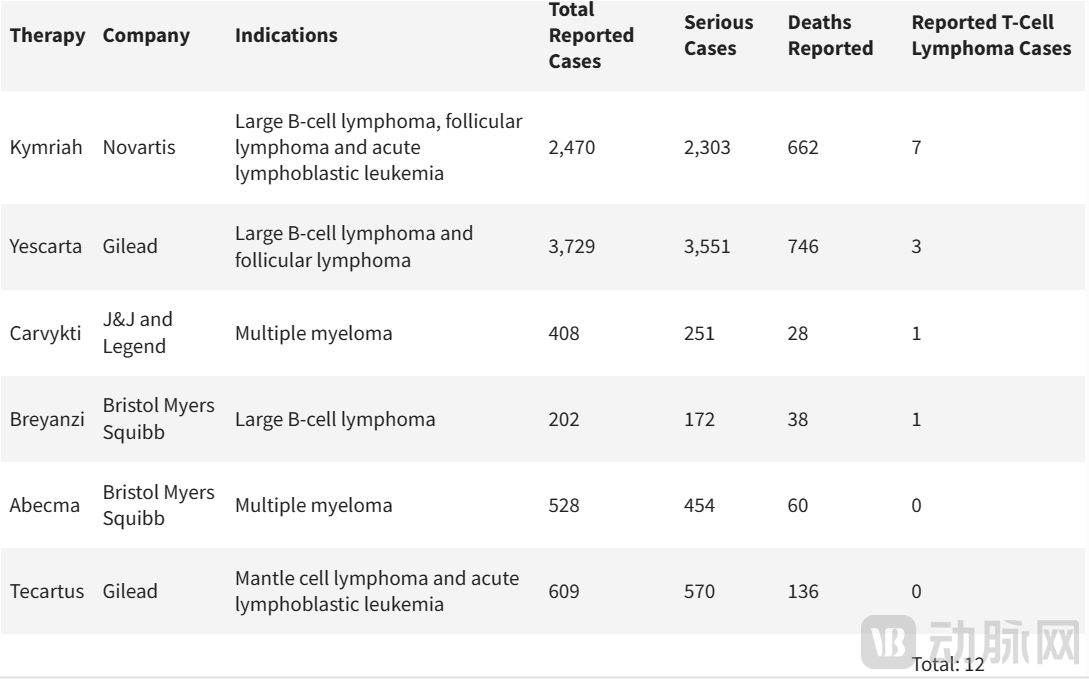 Image source: William Blair, FDA FAERS database, Fierce Biotech
The FDA stated,Although the overall benefits of these products continue to outweigh the potential risks associated with their approved uses, the FDA is investigating the identified risk of T-cell malignancies, including hospitalization and death, and is evaluating the need for regulatory action.Notably, all gene therapy products containing integrating vectors (lentiviral or retroviral vectors), including CAR-T therapies, are labeled in their U.S. Prescribing Information (USPIs) as having a potential risk of developing secondary malignancies.
According to previous scientific research, the risk of cancer is largely attributed to differences in the viral vectors used for delivering cells and gene therapies in CAR-T therapy. In CAR-T treatment, a patient’s own T cells are extracted and genetically modified to recognize cancer cells based on specific targets (such as CD19 or BCMA), thereby achieving therapeutic goals. However, the issue lies in the fact that although viral vectors can deliver genetic payloads, the insertion of genetic material into the human genome may potentially lead to cancer, particularly when it occurs near cancer-associated DNA sequences or consensus motifs. Caleb Lareau, a computational immunologist at Memorial Sloan Kettering Cancer Center, suggests that the problem may stem from scientists’ inability to precisely control the integration sites of retroviruses within the genome.
Therefore, in accordance with the FDA’s postmarketing requirements (PMRs), all cell therapy manufacturers are required to conduct 15-year long-term follow-up safety studies for their marketed products to assess long-term safety and the risk of secondary malignancies following treatment. However, while the FDA has not ruled out taking more direct regulatory action regarding secondary T-cell malignancies, it also emphasized in its announcement that the overall benefits of approved CAR-T therapies continue to outweigh the risks. In other words,At least for now, the FDA does not intend to withdraw any approvals.
Affected by this news, the stock prices of several CAR-T therapy-related companies fluctuated. Autolus Therapeutics, which is developing autologous CAR-T therapies, opened at $4.78, dropped to $3.05, and rebounded to close at $4.55. Nkarta, a developer of CAR-NK therapies, experienced intraday volatility but ended the day with only a approximately 1% decline. Arcellx, a subsidiary of Gilead, opened at $52.95, fell to $48.37, and then recovered to close at $51.10.
Companies involved in autologous CAR-T therapies targeting BCMA or CD19 also saw their shares decline. Legend Biotech, which co-developed Carvykti with Johnson & Johnson, opened at $61.69 before dropping to a low of $57.38. Bristol Myers Squibb (BMS) fell from $49.99 to $48.92, while Gilead Sciences edged down slightly from $74.92 to $74.51.
Following the FDA’s announcement, a host of companies including Novartis, Gilead, and BMS have issued their latest positive responses to the review.
Novartis stated in a press release that Kymriah has been used to treat more than 10,000 patients to date, with no causal link to secondary malignancies identified, and the company remains confident in its benefit-risk profile. A spokesperson for Bristol Myers Squibb (BMS) said the company is responding to FDA information requests and remains confident in the safety and clinical value of its cell therapies. Johnson & Johnson also indicated that it has shared post-treatment monitoring data for Carvykti with the FDA and is collaborating with the agency to evaluate this safety signal.
Gilead stated that it will fully cooperate with the FDA’s request for additional analysis of data on CAR-T therapies, expressing “full confidence” in the overall safety profiles of Tecartus and Yescarta. The company cited its rigorous monitoring processes for safety issues and noted that 17,700 patients have been treated with these products in both clinical trials and commercial settings. It further added that, to date, there is no evidence suggesting a causal link between treatment with Yescarta or Tecartus and the occurrence of new secondary malignancies.
Stephan Grupp, head of the Cell Therapy and Transplant Program at Children’s Hospital of Philadelphia, stated that among the 500 patients who received CAR-T therapy at the University of Pennsylvania, not a single case of T-cell malignancy was observed. Grupp further suggested that the true purpose of the FDA announcement is to increase the likelihood of voluntary reporting of such events. “Theoretically, other cancer therapies also carry the risk of inducing secondary malignancies; radiation, chemotherapy, and certain targeted therapies may all increase the risk of developing another type of cancer.”
Dane Leone, an analyst at Raymond James, noted in a report that the FDA’s announcement on CAR-T therapies may indicate that “the drug itself is transforming into T-cell lymphoma, but the FDA has not imposed a clinical hold on any of the listed approved CAR-T therapies.”
Notably, the FDA recently deferred its decision on the supplemental indication application for the CAR-T therapy Abecma, submitted by BMS and 2seventy bio, and may refer it to an advisory committee for review. Following the news, 2seventy bio’s stock price plummeted by 18%, while BMS’ shares dipped slightly by 3.8%. It remains unclear whether this is related to the T-cell lymphoma risk highlighted in the recent FDA announcement.
Currently, China has approved three CAR-T therapies: Fosun Kite’s axicabtagene ciloleucel injection, a joint venture product of Fosun Pharma, and JW Therapeutics’ relma-cel injection, both targeting CD19. This year, the third CAR-T cell therapy approved in China, equecabtagene autoleucel injection, jointly developed and commercialized by Innovent Biologics and Gracell Biotechnologies, also became the first BCMA-targeted CAR-T cell therapy approved in the country.