

Chuxin Elder Care Files IPO Prospectus, Aiming to Become China's APFM by Tackling Information Asymmetry in the Aging Services Market
The elderly care market undoubtedly holds immense development potential.
According to data from the Seventh National Population Census, China’s total population stood at 1.41178 billion (1,411.78 million). Among them, the population aged 60 and above was 264.02 million, accounting for 18.70%. The substantial elderly population undoubtedly signifies a vast market demand in the elder care sector.
Constrained by the capacity of family-based elder care, the market for institutional elderly care services has further developed.
However, the market is simultaneously confronted with another paradox: the elderly population often struggles to find suitable senior care programs, while such programs fail to effectively reach their target elderly clientele.
Are there any solutions to bridge the problems caused by information asymmetry?
In overseas markets, companies such as APFM (A Place for Mom), which secured $175 million in financing in 2022, are offering new solutions to the market. Meanwhile, in the domestic market, elderly care information aggregation platforms are gradually emerging, with companies like Chuxin Elderly Care leading the way in presenting their own industry-specific solutions.
Lou Yi, founder of Chuxin Elderly Care, chose to enter the field of elderly care information and consulting services, a decision closely related to his long-term engagement in the internet industry.
After graduating from East China Normal University, Lou Yi immediately entered the internet industry. Since 2007, he has embarked on his entrepreneurial journey. He achieved notable success in ventures ranging from initial local catering services to a subsequent wedding banquet reservation platform. The latter, “Dao Xi La,” emerged as a representative online wedding banquet booking platform adopting the O2O (Online-to-Offline) model. It once grew to a workforce of 1,000 employees and was ultimately acquired by another platform.
The DNA of the Internet is undoubtedly deeply ingrained in the very bones of Lou Yi and his team.
Perhaps this also echoes the saying, “Every industry deserves to be reinvented with internet thinking and methods.” Lou Yi has also been attempting to identify new opportunities in the gradually developing elderly care market. Underlying this pursuit of opportunity is a continuation of Lou Yi’s consistent approach: focusing on the distinct needs at different stages of life. Since 2014, Lou Yi has been closely monitoring the development of the elderly care market.
However, the market’s immaturity at that time led Lou Yi to press the “pause button” on entering the industry.
On the one hand, from a supply perspective, the elderly care service market at that time focused more on meeting basic rigid demands, with relatively weak provision of high-quality services; on the other hand, public acceptance of paying for such services remained low, and demand for premium, high-quality services still required further cultivation.
In 2019, five years later, Lou Yi, recognizing that the market was gradually maturing, chose to enter the fray personally.
On one hand, the demand side has undergone new changes. In terms of the total elderly population, those born from the 1960s to the 1980s constitute the largest demographic base, signaling sustained market expansion. In terms of mindset, compared to those born before the 1960s, current retirees demonstrate greater acceptance of new developments and even higher familiarity with the internet. Regarding purchasing power, older adults possess more substantial financial reserves and stronger spending capacity. On the other hand, the supply side is also experiencing new shifts, gradually transitioning from primarily meeting basic rigid needs to fulfilling demands for quality-of-life services, with a further increase in the number of mid-to-high-end elderly care institutions.
How to better match the two ends is the problem that Chuxin Elderly Care wants to solve.
The solution offered by Chuxin Elderly Care is to build a platform that connects seniors in need with institutions providing elderly care services. To achieve truly effective connectivity, the platform must genuinely understand and meet the needs of both C-end users and B-end institutions.
First, from the demand sideLou Yi pointed out that this demographic is typically aged 55 to 95, with needs spanning from early-stage travel and sojourn living to later-stage home-based and institutional elderly care. Behind these personalized preferences lies a universal need: finding suitable elderly care institutions. Breaking down this need reveals two major challenges: first, identifying and selecting appropriate elderly care projects; and second, ensuring effective protection of their rights in the event of service-related issues.
In traditional offline services, seniors and their families often struggle to make effective comparisons and judgments due to limited access to information. Furthermore, these services are not senior-friendly, particularly when considering mobility constraints. Information opacity also frequently results in inadequate assurance of service quality.Chuxin Elderly Care provides a one-stop, free elderly care advisory service to the aging population through its online consulting platform, reducing the cost for customers to screen elderly care projects. By offering service support before and after move-in, it effectively addresses the challenge of ensuring service reliability.
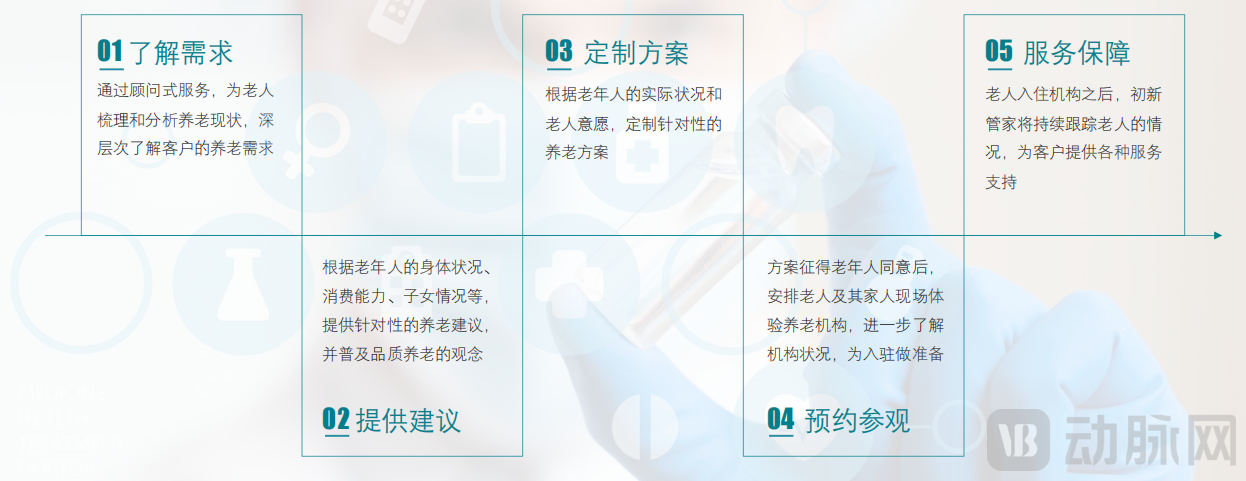
From a broader perspective, in the early stage of project decision-making, Chuxin Elderly Care provides recommendations based on seniors’ physical conditions, financial capacity, and family circumstances. It offers customized solutions tailored to their actual needs, arranges offline visits to elderly care facilities to help them gain a deeper understanding, and prepares them for future residency. Regarding follow-up service support, seniors are often concerned about the quality of services provided by elderly care institutions, as changing facilities later on can be highly disruptive. This necessitates that elderly care information consulting agencies establish robust long-term service guarantees. Leveraging its butlers who serve as frontline liaisons between elderly care institutions and seniors, Chuxin Elderly Care gains in-depth insights into service quality. During the selection process, its elderly care consultants help seniors mitigate risks. Furthermore, by providing ongoing service assurances, Chuxin Elderly Care ensures that seniors fully benefit from high-quality care.
Second, from the supply side, B-side service providers such as elderly care institutions often face challenges in customer acquisition and reputation building. Due to their localized development, traditional elderly care institutions typically rely on offline customer acquisition methods, such as word-of-mouth referrals or physical flyers, resulting in highly limited customer sources.
Lou Yi also pointed out that, as companies in the elderly care industry tend to belong to the traditional service sector, they have historically had limited opportunities for collaboration with platforms. Chuxin Elderly Care, however, has significantly helped elderly care institutions achieve effective reach, conversion, and retention of their target customer base by establishing a comprehensive set of innovative industry mechanisms. After B-side clients join the platform, they can access resources matched to them by Chuxin Elderly Care.
Currently,Chuxin Elderly Care has 200,000 registered users and a reachable audience of 800,000 across online platforms. To some extent, it ensures that partner elderly care institutions gain a stable source of clients. Leveraging the insights into seniors’ needs provided by Chuxin’s elderly care consultants, the referred clients tend to be more precisely matched. Furthermore, by utilizing Chuxin Elderly Care’s capabilities, institutions can further reduce their operational and maintenance costs. Insights derived from big data on the elderly user population also enable Chuxin Elderly Care to provide institutional decision-makers with enhanced data analytics and reference support for strategic decision-making.
Currently, according to Lou Yi, more than 5,000 B-side institutional partners have collaborated with Chuxin Elderly Care, driven by their recognition of the company.
Although Chuxin Elderly Care is a company with a team of only 20+ people, this has not hindered its rapid expansion in the elderly care consulting sector.
On the one hand, the Chuxin Elderly Care team originates from the internet sector, bringing extensive experience in consumer-facing (C-end) operations and business-side (B-end) expansion. For Lou Yi, “it is difficult to find another team in the industry that possesses expertise in both elderly care and the internet.” Furthermore, Chuxin Elderly Care is leveraging digital tools to further enhance personnel efficiency, thereby meeting the demands of a massive user base.
On the other hand, Chuxin Elderly Care has built an innovative business model from the ground up. For Chuxin Elderly Care, facing both C-end users and B-end users, how to better achieve process standardization is a problem that must be addressed. By continuously refining its own process system, Chuxin Elderly Care has not only improved its external service delivery but also further established its reputation within the industry.
It has also helped build a strong reputation, enabling Chuxin Elderly Care to further expand its market presence.
In 2023, Chuxin Elderly Care entered into a partnership with China Life Insurance. On one hand, Chuxin’s clients can access value-added services provided by China Life; on the other, both parties are further advancing user operations and value creation based on their consumer-facing (C-end) user base. Among its partners are diverse clients such as Greenland Group and Taikang Group, which to some extent reflect Chuxin Elderly Care’s anticipated strategic objectives—
In the interview, Lou Yi pointed out that Chuxin Elderly Care aims to build a trustworthy information and consulting platform for elderly care, echoing its slogan: “Unlocking a Beautiful Retirement Life.” To achieve this goal, Chuxin Elderly Care has steadily advanced its development. In the first phase, it established a platform connecting B-side elderly care service providers with C-side users, thereby completing a closed-loop business model. During the second phase, which coincided with the pandemic, the company continuously invested in backend services and support systems to further refine its platform. Looking ahead, Chuxin Elderly Care will leverage its platform capabilities, along with big data and artificial intelligence, to empower elderly care institutions and help seniors access higher-quality care services. These initiatives include collaborating with insurance companies to offer retirement planning and financial insurance products, as well as providing diverse offerings such as travel-based elderly care packages.
Currently, Chuxin Elderly Care is also launching a new round of financing, with plans to expand its team and further accelerate the development of its own ecosystem.
For Lou Yi, insights into the elderly care market have also instilled confidence in future development.
Currently, market development and the increased supply of services have, to some extent, led to a mixed landscape with varying quality. The broader economic environment has also made seniors more cautious when selecting elderly care projects. Nevertheless, Lou Yi firmly believes that the growth of the elderly care market over the coming decades is evident, driven by national policy support, the rapid increase in the elderly population, improved financial capacity among seniors, higher mobile internet adoption rates, and the integrated regional development of the Yangtze River Delta (including the advancement of cross-regional elderly care policies). To promote healthier industry development, beyond establishing industry standards, it is essential for companies within the sector to accumulate long-term experience and build a solid foundation.
“Establishing a long-term development mindset is crucial,” Lou Yi pointed out, “and Chuxin Elderly Care is already prepared.”