

2023 Digital Therapeutics White Paper Released: Industry Advances Rapidly with Strong Long-Term Potential

VCBeat
Internet Medical Health Media
Undeniably, against the backdrop of a global economic downturn, digital therapeutics have encountered some setbacks over the past year. However, when viewed from a longer-term perspective, it becomes evident that digital healthcare, marked by the large-scale penetration of digital technologies, is emerging as a technological revolution with a significant impact on human longevity, comparable to pharmaceuticals and medical devices.
As VCBeat and VBInsight, which pioneered the reporting and research on digital therapeutics in China as early as 2016 and have published five reports and over 300 articles on the subject, we have gained sufficient confidence after reviewing the progress of digital therapeutics over the past year.
Notably, in early 2022, Hainan became the first province in China to incorporate the promotion of digital therapeutics into its provincial-level planning, swiftly issuing and implementing detailed regulations. After more than a year of rapid advancement, what progress has Hainan made in the concrete implementation of digital therapeutics? This remains a topic of significant interest within the industry.

VCBeat and VBInsight have consistently adhered to a long-termist approach, growing alongside the industry. The "2023 White Paper on Digital Therapeutics" not only provides a comprehensive record of industry developments over the past year but also summarizes development trends in digital therapeutics through field visits to clinical and application frontlines, thereby offering strategic insights and support to facilitate industry breakthroughs.
The following are excerpts from the main content of the report:
Numbers do not lie; comprehensive and accurate data are essential to understanding the development trends of an industry. In this chapter, we conducted a statistical analysis of data on digital therapeutics across various sectors over the past year. The results clearly demonstrate a significant acceleration in the development of digital therapeutics during this period.
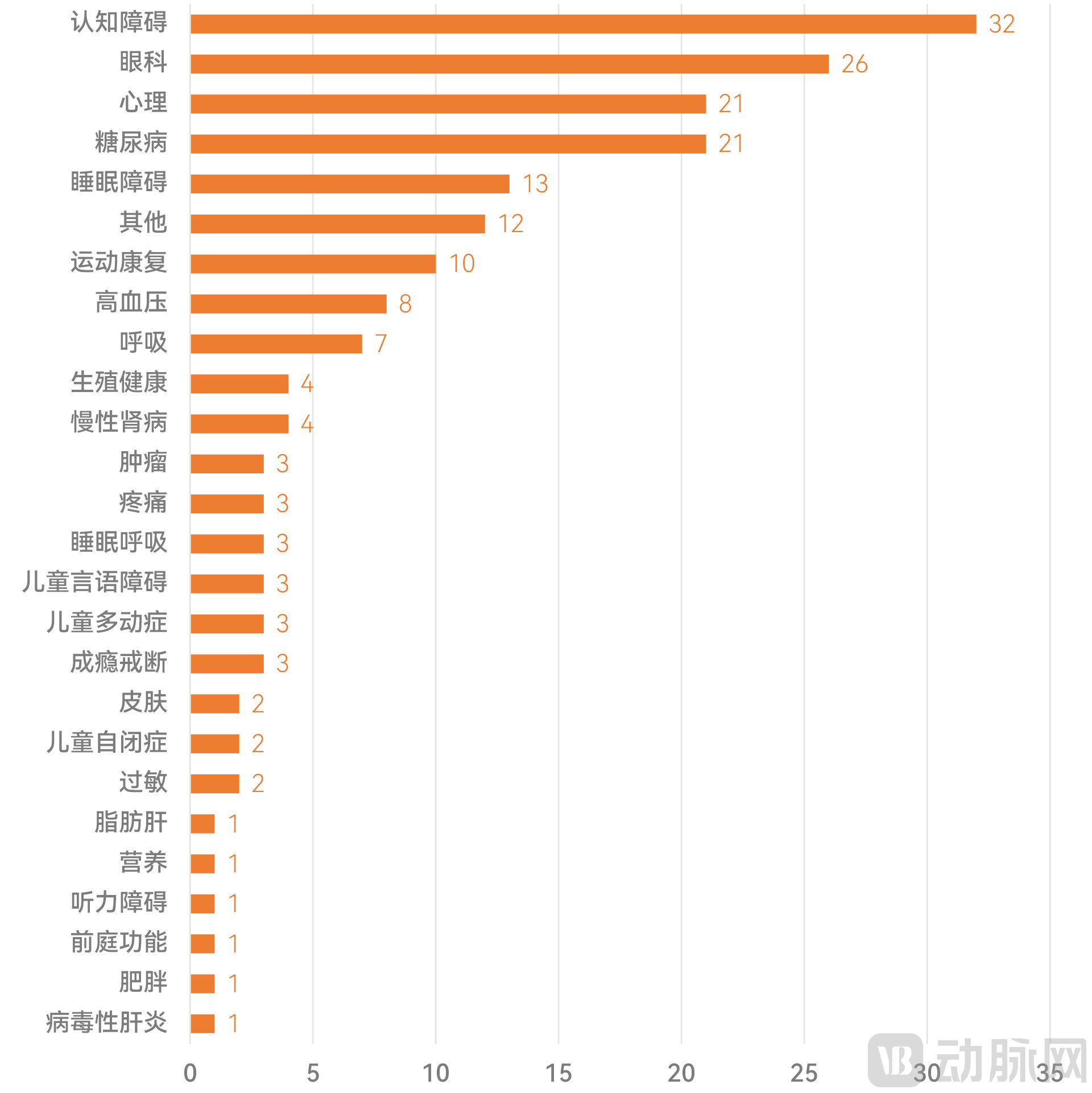
First, the indications for digital therapeutics are expanding. Based on publicly available information, VCBeat has compiled an overview of the business focuses of currently active domestic companies in the digital therapeutics sector. Public data indicates that the most prominent disease areas in the digital therapeutics field are cognitive disorders, ophthalmology, diabetes, and mental health. Companies operating in these four areas collectively account for more than half of the market. Following these, sleep disorders and sports rehabilitation are also highly popular.
Furthermore, more than one company has entered fields such as hypertension, respiratory diseases, oncology, chronic kidney disease, reproductive health, addiction withdrawal, attention-deficit/hyperactivity disorder (ADHD) in children, speech disorders in children, sleep-disordered breathing, pain management, allergies, and autism spectrum disorder in children. Notably, compared with the past, some previously niche areas are gradually attracting corporate interest. Among these, some companies have already completed product development, while others are still in the conceptualization or development stages.
In terms of regulatory approval, digital therapeutics (DTx) have also advanced rapidly. Since the U.S. Food and Drug Administration (FDA) granted the first De Novo clearance for a digital therapeutic in 2017, a total of 10 DTx products have received FDA approval via the De Novo pathway to date. The indications for these innovative products span a wide range of conditions, including diabetes, pain, amblyopia, irritable bowel syndrome (IBS), post-traumatic stress disorder (PTSD), pediatric autism spectrum disorder, and substance use disorder, underscoring the burgeoning diversity and vitality of the digital therapeutics landscape.
Germany is the first country globally to open a dedicated fast-track approval pathway. Compared with the end of 2021, Germany has made rapid progress in the approval of digital therapeutics (DTx), with significant increases in both the overall number of approvals and the number and proportion of formal approvals supported by evidence demonstrating the benefits of DTx.
Software-based medical devices in China that meet the definition of digital therapeutics have also advanced rapidly. Particularly since 2022, the number of approvals has reached a new level, with clear signs of accelerated review. The sector is on the verge of an explosion, closely aligning with the domestic digital therapeutics development trajectory of “emergence–attention–explosion.”
Nevertheless, influenced by the broader economic climate, the overall financing environment for healthcare remains pessimistic. Statistics indicate that global healthcare investment and financing in 2023 are estimated to be on par with 2019 levels. Investment and financing in digital therapeutics have also experienced volatility over the past year; however, this is not attributable solely to factors within the digital therapeutics sector itself.
Overall, digital therapeutics (DTx) are accelerating their development, with continuous progress in disease indications and regulatory approval, indicating significant long-term potential. Although investment and financing figures have declined compared to previous years, this downturn is consistent with a broader contraction in industry-wide investment driven by macroeconomic factors; thus, the current state of the DTx sector represents a normal phase within its cyclical fluctuations.
The reliance on evidence-based medicine is the core feature that distinguishes digital therapeutics from digital health. Whether the efficacy of digital therapeutics can be substantiated by robust evidence-based medical proof will be the key driver for their further development. However, in existing exploratory practices, not all digital therapeutics demonstrate the expected outcomes, even after undergoing rigorous clinical trials. We believe that overlooking the “delivery vehicle” may be the critical factor contributing to this phenomenon.
Whether pharmaceuticals or digital therapeutics, their mechanisms essentially involve delivering active ingredients to targeted therapeutic subjects and thereby achieving treatment according to their principles of action. However, some drugs do not take effect immediately after oral administration; instead, they need to reach the intestines to exert their effects and achieve optimal efficacy. To address this challenge, the pharmaceutical industry has developed the concept of delivery carriers after years of advancement, ushering drug therapy into a new era.
The efficacy challenges currently facing digital therapeutics are quite similar to those encountered by pharmaceuticals prior to the advent of drug delivery systems. The active ingredients of digital therapeutics often fail to penetrate the patient’s conscious barrier, preventing information from being effectively conveyed and genuinely altering patients’ beliefs and psychological states. This, in turn, hinders the modification of downstream behaviors, significantly diminishing the therapeutic efficacy of digital interventions.
Mobile apps are one of the fundamental forms of digital therapeutics (DTx) and currently serve as the most widely used delivery vehicle. However, there remains significant room for improvement in this delivery modality. Developers are exploring a variety of alternative “delivery vehicles” to ensure the efficacy of digital therapeutics, including gamified design, extended reality (XR), and integrated services.
We believe that, just as sustained-release capsules have revolutionized drug delivery, further advancements in digital therapeutic delivery platforms will significantly enhance the efficacy of digital therapeutics in the future, thereby driving industry development.
In addition to advances in delivery vectors, evidence-based medical data supporting digital therapeutics has also grown rapidly in recent years. Leading global digital therapeutics companies have undertaken substantial pioneering work to demonstrate the clinical efficacy of these interventions. These early explorations yielded significant results and laid the foundation for the subsequent recognition of digital therapeutics.
As time progresses, an increasing number of domestic digital therapeutics (DTx) companies have gradually recognized the necessity of clinical trials for DTx and are allocating more resources to this area. On one hand, there has been a significant upward trend in the number of DTx clinical trials in recent years, with a growing variety of DTx products undergoing clinical evaluation. On the other hand, leading Chinese DTx enterprises have continuously increased their investment in clinical trials, resulting in numerous research findings published in academic journals and even incorporated into expert consensus statements, thereby providing robust evidence to demonstrate the efficacy of digital therapeutics.
Nevertheless, digital therapeutics still face significant challenges in clinical trials, with ample room for improvement. Digital therapeutics companies preparing to embark on clinical trials must be well-prepared for this challenging landscape. They need to demonstrate the determination and resilience to establish a long-term presence in the healthcare sector and adopt innovative approaches tailored to the unique characteristics of medical practice.
Like many healthcare sectors in their early stages, the digital therapeutics industry lacks established models for commercial implementation, and even leading global players have not fully realized their commercial value. Nevertheless, the industry continues to experiment and iterate, seeking to identify the most suitable business models for each participant.
In particular, the digital transformation of large pharmaceutical companies is in full swing. How to leverage digital tools to precisely target patients and enhance patient management capabilities has become a key focus of recent digital innovation initiatives for these companies, which may also present an opportunity for breakthroughs in the commercialization of digital therapeutics.
Pear’s failure is merely an isolated case. From the perspective of Gartner’s Hype Cycle for Emerging Technologies, every industry undergoes value chain restructuring and consolidation, which is an inevitable stage in the development of new technologies. We believe that by drawing lessons from past experiences and reintegrating core technologies and innovative resources, the digital therapeutics industry will enter a period of steady recovery, ultimately delivering tangible value to both physicians and patients.
Although China’s digital therapeutics (DTx) sector started later than its global counterparts, it has advanced rapidly. A key driver behind this rapid progress is the booming digital economy, which has become a critical factor reshaping the global competitive landscape. The digital economy has emerged as a vital engine for stabilizing growth and facilitating economic transformation. As an integral component of the digital economy, the surging popularity of digital therapeutics has naturally attracted the attention of local governments.
In early 2022, Hainan became the first provincial-level administrative region in China to incorporate digital therapeutics into its provincial development plan, subsequently implementing this initiative through multiple rounds of detailed policy measures. We also conducted field visits to Hainan to gain a comprehensive understanding of the province’s progress in digital therapeutics over the past year.
Taking clinical practice as an example, Hainan has designated 20 clinical trial centers with the goal of establishing a nationally leading demonstration base for clinical research in digital therapeutics. The Hainan provincial government has provided substantial supporting measures for these clinical trial centers. Our on-site investigations reveal that these centers have already made significant progress in research and development as well as in promotion and application. These clinical projects have addressed numerous pain points in clinical diagnosis and treatment, bringing considerable convenience to both healthcare providers and patients, thereby demonstrating the practical value and immense potential of digital therapeutics in clinical settings.
Hainan is also actively cultivating innovative application scenarios for digital therapeutics, integrating them with current health initiatives and the mandated responsibilities of medical institutions at all levels. This approach not only facilitates the broader adoption of valuable digital therapeutics but also leverages them to accelerate, enhance, and improve the efficiency of various health-related tasks.
For instance, in 2023, Hainan Province introduced digital therapeutics to enhance cognitive impairment screening among the elderly and became the first in China to explicitly propose using digital therapeutics for interventional treatment. High expectations are also placed on digital therapeutics in the management of chronic diseases. Currently, Hainan has decided to pilot digital therapeutics for diabetes management in four cities and counties. In the future, Hainan aims to integrate digital therapeutic products into its healthcare service system to achieve a synergistic effect where the combined impact is far greater than the sum of its parts.
Hainan Has Also Achieved Significant Progress in Accelerating the Approval of Digital Therapeutics. According to relevant officials from the Hainan Medical Products Administration, the administration has actively responded to promote the development of the digital therapeutics industry by accelerating local approvals through measures such as publishing policy and regulatory documents for digital therapeutic products, strengthening registration guidance and training, and streamlining priority review channels for these products.
Hainan boasts exceptional natural resource endowments, making it highly suitable for the development of digital therapeutics. As Hainan announced its commitment to promoting the digital therapeutics industry by rolling out and implementing a series of supportive policies, digital therapeutics companies have flocked to the region in search of opportunities. Drawing on the Hainan Free Trade Port’s innovative dual-drive model that advances both public health initiatives and industrial growth, the Hainan Provincial Health Commission has established a dedicated Bureau for Health Industry Development and International Cooperation. This strategic move has attracted numerous enterprises to set up operations in Hainan, initially forming a clustered ecosystem for the digital therapeutics industry.
In addition to Hainan, the white paper also highlights the explorations undertaken by China’s digital therapeutics companies over the past year. These valuable experiences will provide significant reference value for the development of the digital therapeutics industry.
Undoubtedly, China has become a fertile ground for digital therapeutics (DTx). In particular, Hainan Province has provided support across the entire industry development lifecycle, effectively implementing policies in clinical practice, regulation, and application, while offering substantial support to DTx enterprises. We believe and anticipate that, by virtue of the unique value they create in clinical settings, digital therapeutics will take root and flourish in more regions.
Scan the QR code to download the report

Table of Contents
1. Digital Interpretation: A Panoramic View of the Digital Therapeutics Industry
1.1. Digital Therapeutics Indications Are Blossoming
1.2 Rapid Increase in the Number of Approved and Registered Digital Therapeutics
1.3. The Decline in Financing and Investment Data for Digital Therapeutics Is Closely Linked to the Cooling of the Broader Healthcare Environment
2. Evidence-Based Practice Is the Core of Digital Therapeutics
2.1 What is the therapeutic mechanism of digital therapeutics?
2.2 The Mechanism of Action of Digital Therapeutics Needs to Be Demonstrated Through Clinical Trials
2.3 The commercial value of digital therapeutics remains to be proven, and business models are still being explored
3. "Chinese Practice" of Digital Therapeutics
3.1 Hainan’s Policy Advancement in Digital Therapeutics Reflects “Hainan Speed”
3.2 Hainan’s Progress in Clinical Trials of Digital Therapeutics Shows Promising Prospects
3.3. Hainan Promotes Innovative Application Scenarios for Digital Therapeutics to Benefit the Public
3.4 The Hainan Drug Administration’s explorations in the regulatory approval of digital therapeutics are noteworthy
3.5 Hainan Has Initially Emerged as a Hub for Digital Therapeutics Companies
4. Practical Explorations by Digital Therapeutics Companies in China
4.1 Vispring — Dedicated to Providing Digital Medical Services for Myopia Prevention and Control
4.2 Shuyao Intelligence—Gamified Digital Therapeutics for Treating Neurological Disorders
4.3. Shukang—The Leader in Low-Cost Lifestyle Intervention Digital Therapeutics
4.4. QiangLian ZhiChuang: A High-Tech Platform Leading Intelligent Diagnosis and Treatment of Cerebrovascular Diseases
4.5. Zheng'an Health: Leveraging AI to Deliver Personalized Digital Therapeutics for Mental Health
4.6. Yingshan Health: Visual AI Builds a Digital Therapeutics R&D Platform for Musculoskeletal Rehabilitation
4.7 Zhilan Health — Digital Therapeutics CDMO and Full-Process Service Platform
4.8 JD Health – Connecting Stakeholders in Digital Healthcare to Jointly Build a Digital Therapeutics Ecosystem